
Tristan Keillor
Contributor
Articles by Tristan Keillor
3 articles found. Displaying page 1 of 1.
-
News
 Issue 22 08/09/2013
Interview: Steve Drain of The Westboro Baptist Church
Westboro Baptist Church has become infamous over the past twenty years for its stridently anti-gay messages and picketing of soldiers’ funerals. Steve Drain is a former documentarian who joined the Church in 2001. Drain featured heavily in Louis Theroux’s documentaries The Most Hated Family in America (2007) and America’s Most Hated Family in Crisis (2011), and runs the media side of WBC. I wanted to ask why you’re seen as a hate group, and why your core message doesn’t seem to come across. What is your core message? Well first of all, the idea of being a hate group is a category mistake – it’s equivocating on what the term “hate” is. We’re not talking about a base human passion like you or I might feel, we’re talking about an attribute of God. It’s a perfect attribute just as his love and his mercy is. The hatred of God is outlined in the scripture three to four more times than his love: it’s his fixed determination to punish the wicked in Hell for their sins. When you say that they don’t connect with that message, our job is not to make that connection, our job is to preach the word of God, and how it lands on the hearts of men is God’s prerogative. So our core message is simply this: “the Bible’s right and the moral standards of man are wrong.” The fact people want to say we’re a one-trick pony and all we’re focused on is the issue of homosexuality is a misunderstanding. We didn’t make homosexuality a front-burner issue, society did. Your motivation is that you’re doing God’s will? It’s out of obedience to our god. It’s out of love for our fellow man. Here’s the irony for you – when the Lord says “love your neighbor as you love yourself” he’s quoting from Leviticus 19:17 and 19:18, where the definition for how you love your neighbor as yourself is … when you warn him that his sins are taking him to Hell. If you were about to walk off a cliff, is the loving thing for me to say “keep going,” or is it to warn you and tell you to stop? That’s what our job is. Whether or not you stop is God’s business. So you’re saying it as loud as possible? Is that the motivation behind going to funerals and other high-profile events, as well as having a lot of provocative signs? We live in the soundbite generation, so every one of those signs we hold is only provocative to you because you don’t understand the Bible sentiment or the Bible standard that’s contained therein. As far as going to funerals, dying time is truth time. There [are] only a couple of times in a man’s life where he’s going to truly contemplate where the eternal state of his soul will reside. So I don’t think there’s anything kinder we can do than show up at a funeral and say “look, he didn’t die fighting for our freedoms, he died fighting for a nation that’s awash in sin, and no God-fearing man would lift a finger fighting for a nation awash in sin.” As for high-profile events, when someone’s in the media they have a considerable platform. When you acquire the attention of the media and you’re not helping your fellow man by warning them about the condition of this earth, then when you quit this earth God will cast you to Hell. Cool. So when everyone simply dismisses you as a hate group they’re unable to see all of the reasoning you’ve been talking about, and instead put your behaviour down to ulterior motives? You gotta ask the question, “what would be the point there?” Look, we’re all educated people, hard-working people, what would be the point in just wanting to shout at people? It’s an old tactic – if you can’t poke a hole in the message poke a hole in the messenger. People want to call us loons, [so] here’s what I say to them: “there’s a great advantage to know the wrong and right side of an issue. We’ve all read the scripture, we’re all intelligent creatures like the rest of you.” I think what would help convince a lot of people that you guys are actually rational is an example of an intellectual struggle that faces the WBC and how the WBC overcame that. That would show people that your position stands up to criticism. The only time a God-fearing man is going to struggle is when he’s leaning on his own understanding. The Bible is an instruction manual for the rest of your life – when a man turns away from that standard and reasons with morality himself, that’s when [he is] going to have difficulties. People at WBC, we don’t intellectually struggle with anything. What we do is put our foolish, vain ideas away and focus on what the scripture has to say about it. So you don’t need to use reason because the Bible tells you exactly what to do? But obviously rationality had to be used to get to the belief that the Bible tells you everything. Rationality even comes into the reading and interpreting of the Bible, so what’s been the most difficult challenge to your outlook that you’ve faced? You’re putting the cart before the horse there – we don’t have an opinion and go to the scripture to see if it’s supported. We go to the scripture and that tells us our position is. You’re asking a question with no answer. Okay. [Editor – abridged]
-
Features
 Issue 22 08/09/2013
Monopoly: The Poor Man's Arsenic
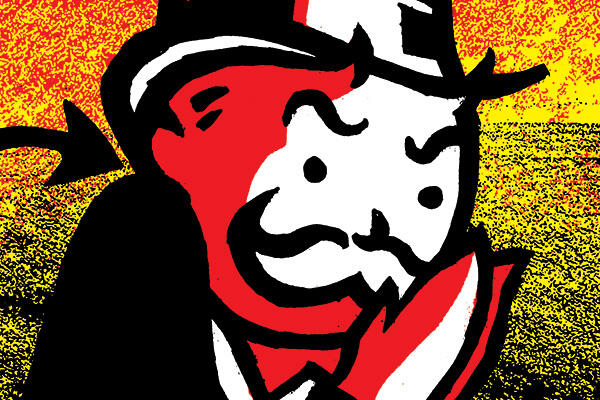
Nerds like video games, everybody likes drinking games, and nobody likes board games. I wish that sentence had come naturally, but it’s taken a week of Facebook rejections, face-to-face rejections and people “losing their phone” to teach me that no matter how much beer is on offer, it’s not worth playing board games for. Oddly, whenever someone did reply to an invitation, they’d say “it’s called a ‘board game’ because it makes us bored.” I’ll never understand how someone can find that dribble of a pun entertaining and yet not be entertained by games that are specifically designed to entertain. Monopoly’s moored in the mainstream, so I figured it must be been doing something right in order to avoid sinking. As is turns out, this is a game that only exists because of its creators’ penchant for crime, conspiracy and general cuntiness. To start my research I managed to rope my girlfriend, cousin and colleague into a Monopoly match. They were all my close friends and the only people to RSVP, but it seemed that after picking pieces they each developed new personalities. The first few moments of the game were fantastic: people were handing out colourful money, whatever I landed on I got to buy, and the whole time I could pretend I was a shoe. Eventually, this turned out to be the sole positive aspect of the game; everything else came down to chance and cheating. Players have a variety of possible actions per turn – you can buy a property, pay rent or do as a community chest card dictates. All of these actions, however, are totally dictated by the dice. The only option you can choose at any point is whether to upgrade properties. Speedy upgrades make your property the biggest earner on the board – others often don’t have the income to pay rent, and are thus forced into bitter bankruptcy. Upgrading can potentially be strategic – you have to balance building costs against what promises to yield the greatest income – but the advantages to upgrading are so obvious that players tend to do so as soon as they have enough money. Sadly, instead of blaming misfortune for their lack of funds, the players doing poorly blamed me. A terrible time ensued. With no real options regarding play, the game quickly deteriorated from a tactical battle to scams and shouting. Money was sucked into paying the bank for land and houses, but not enough came out of the bank in return. People started to go bankrupt, with only the organiser to blame and the winner to bargain with. My girlfriend was the first to go, and she left with a sigh of relief. Oddly, she never suggested quitting; in a classic Prisoners’ Dilemma, nobody said they were bored for fear of ruining the others’ fun. The game seemed a lot like Lotto: the one player above the poverty line was a shining example of wealth, and we all desperately waited for a chance card that would make us richer and them poorer. Just like with Lotto, though, our money disappeared far more often than it multiplied. The regular awarding of $200 for passing GO also made the chance cards more and more meaningless. Turning the game around seemed less and less likely. In the end, it came down to just me and my cousin, and there was only a $300 difference in capital between us. The other players had given me their properties as they died, but this turned out to be a curse. We each upgraded all our properties to hotels in an attempt to bankrupt each other, but our assets were so evenly matched that the money simply circulated, with the constant $200 for passing GO making rent seem like pennies. I suggested a tie but my cousin refused; he’d taken it upon himself to punish me for ever suggesting Monopoly. Eventually, I decided to cheat. Unlike in any other game, I couldn’t just give up by being bad – there was nothing to be bad at. Luckily for me, my opponent had flaunted his wealth by stacking every bill into a pyramid, and by a stroke of luck this small pile was positioned by the fireplace. I wasn’t particularly upset about never being able to use the Monopoly set again. As it turns out, however, cheating is just as much a part of Monopoly as playing. It turns out that the game isn’t popular just because it goes on forever and is exceptionally boring, but rather because the so-called “creator” of Monopoly himself cheated. *** The least scandalous facet of Monopoly’s history is the fact that it is based on (read: a total rip-off of) a board game called Landlords, created by Lizzie McGee. Basing games on other games is nothing new: Landlords is itself based on two millennia worth of roll-and-move games like Candy Land and Snakes & Ladders. What made Landlords different was that it was the first game based on the idea of buying properties with money while completing laps of a track. Such additions are common in board games today, but when Landlords was invented in 1905 it was the first development of roll-and-move games since Egyptian times. The game had far more stylistic elements than Monopoly, too: the train stations acted like teleporters from place to place, free parking was actually a tax haven, and you only went around the board five times before your money was counted and a winner announced. In terms of innovation, teaching someone Landlords was like showing up in 1980 with a PS3. Its greatest feature, however, was the fact that it was not patented. Landlords was passed from house to house on handmade boards with hastily remembered rules spread by word of mouth, and eventually ended up in the hands of angst-ridden Arts majors. We’ve all heard that Monopoly was designed to promote Marxism as the medicine for capitalism’s cancer, but that’s only a half truth. As copies of the Landlords game were passed around, it evolved rapidly: half-forgotten rules mutated into new ones, unimportant rules were omitted and crappy rules were changed. Through a process similar to natural selection, the game gained a satirical Stalinesque spin and became the Grand Theft Auto of its time. It was eventually patented, but by this stage the passage of twenty years had seen the game progress dramatically into a simple stylistic variant of what was slowly becoming known as Monopoly. Parker Brothers promote a different story about Monopoly’s origins – the story of Charles Darrow. Darrow was a typical “rags to riches” case: a victim of the Great Depression, he supposedly invented the game to feed his pregnant wife and child in 1932. Parker Brothers originally refused to buy the game, pinpointing 52 fatal flaws, but Darrow stuck by “his creation” until 1935, by which time he’d managed to sell over 5,000 copies of the game. Parker Brothers then changed their minds and bought him out, and just like a character in the game he was propelled into sudden prosperity. Darrow was now the creator of history’s highest-earning board game, but just like one of its characters, he’d stolen to get there. A month after they brought the patent, Parker Brothers sent a letter to Darrow explaining that they had just been informed of the true history of the game. Though they could have pulled the plug, Monopoly was their biggest earner and, being near bankruptcy, not a game they wanted to lose. Instead, they sent another letter to Darrow asking him to stick to his original story. They then drew a line through the past, refusing to allow other companies to print the game without a Parker Brothers patent. Parker Brothers also embarked on a mission to buy out any smaller companies’ games that were in any way similar. First up was Lizzie McGee’s copy of Landlords. As every subsequent finance-related game had sprung from Landlords, only McGee could claim a real patent. McGee, by this stage, was an elderly woman devoted to the idea that only land should be taxed. Parker Brothers offered to buy McGee out, but when they told her their plans to produce Monopoly instead of Landlords, she refused – she’d designed Landlords to educate people about taxation, and changing the rules would compromise that message. This, however, proved to be no deterrent: McGee was an old lady, and it was not hard for Parker Brothers to trick her into believing that they would mass-produce Landlords alongside Monopoly. Buying the rights for only $500, the Landlords game was given a tiny run and never mentioned again. From here, Parker Brothers tracked down any remaining copies, buying leftover boards for $50 each. *** These seem like wild allegations, and like all wild allegations, they have a fantastic backstory. In this case, it is the story of Anti-Monopoly. Anti-Monopoly was the brainchild of Ralph Anspach, an economics professor and ex-Israeli militant whose greatest claim to fame is having authored The Billion Dollar Monopoly Swindle, a book detailing a six-year court case against Parker Brothers and the detective work that went into it. Anti-Monopoly is an asymmetrical game in which one player attempts to lose all of their money while the other tries to gain it. The game is shit, but Parker Brothers still went after it. Anspach was told to stop producing his game, and 40,000 copies were destroyed. Unfortunately for Parker Brothers, Anspach wasn’t prepared to back down. Researching everyone who had played the game before the patent was introduced in 1932, he eventually found a number of intact copies owned by McGee’s contemporaries, as well as a number of people who could testify to having been bribed by the company. The case ended up in the Supreme Court, with more scandals being uncovered in the process. For instance, Milton Bradley, the producers of Candy Land and Twister, knew all about Monopoly’s secret and had been producing a similar game – Easy Money – for years. The evidence against Parker Brothers was startling, with much of it immortalised on the board itself. In standard American versions of the game, for instance, the streets are based on Atlantic City, the original home of the Quaker people from whom Darrow stole the idea. Unfortunately for Darrow, the Quakers had misspelled Atlantic City’s Marvin Gardens as Marven Gardens – a mistake he copied exactly. What’s more, it soon came out that every game Parker Brothers had attributed to Darrow actually had nothing to do with him, but were simply desperate attempts to capitalise on Monopoly’s success. However, none of this can be seen as the worst thing that Parker Brothers did to Monopoly. That award must go to their destruction of the original, short game that was plagued by none of the faults that started this feature. One of the many board games that Parker Brothers bought and crushed was Finance – an auction-style game that was actually good! The auction rule is another artifact of Monopoly’s history that has gotten rather lost along the way. Official Monopoly actually includes a seldom-remembered rule detailing that if a player lands on a property but elects not to buy it, then it is put up for auction. In practice, this never happens – people rarely pass on the opportunity to buy anything. The Quakers that Darrow stumbled across had added the rule allowing players to buy property because their kids were crap at bidding and didn’t like loud noises. Darrow, in other words, patented the children’s version of the game. Finance was popular because whose turn it was didn’t matter. Turns only determined what property would go up for auction and who would pay rent next. Instead of only playing the game when it was your roll, you were playing all the time. What’s more, you weren’t just doing what a die told you; you were choosing when and what to bid. As such, the game was actually enjoyable. On top of all of this, Finance never lasted long – people inevitably over-bid for properties and quickly went bankrupt. By patenting the children’s version of Monopoly, Parker Brothers essentially ensured that the game would be a never-ending torture session for anyone over the age of 12. *** Once I knew why Monopoly was crap, it was easy to get the gang back together for another game. Parker Brothers could monopolise the Monopoly industry, but they were powerless in our homes. We were going to play the outlawed and suppressed versions. We started with Landlords, but because it was designed to educated players about land taxation we quickly agreed that it sucked. Players still had minimal control over their actions, and with only five trips around the board it was clear that nobody would earn much from properties. Consequently, we tweaked the game slightly by halving our money, meaning that these tiny profits became comparatively huge. On top of this we added 20- and 10-sided dice, allowing players to choose whether to opt for the D20’s higher numbers or the D10’s greater certainty. Suddenly the game got highly strategic: what die to use became the central question, with everyone weighing up the benefits of getting to Mayfair ASAP against the risk of wasting their five trips around the board. The second game we played was Finance, the auction game that Monopoly suppressed. Here we started with only $1,000 and the ability to bid on any property. The bidding was amazing: forcing someone who wanted a property to pay top dollar in an attempt to bankrupt them always entailed the risk of being stuck with the property yourself. As much as I wanted this game to be exciting, the fact that it was designed during the Great Depression (when people had a lot more time and got a thrill just from looking at money) was obvious. People were going bankrupt on the fourth or fifth rounds, but the bidding was so time-consuming that first two rounds dragged out into hour-long ordeals. While the game was shorter than regular Monopoly, it was still far longer than anything I was prepared to play. We managed to fix this by introducing silent bidding, which made the game both faster and more strategic. By the end there was once again a clear winner, but instead of throwing their money in the fire I simply bid all of my money on Old Kent Road. It soon became clear that these games were far more fun than standard Monopoly. Before Parker Brothers patented the game, the rules were fluid and open to adjustment; today, we are stuck with the kiddies’ version. Regular Monopoly has made us all hate board games, but perhaps our ability to alter it affords it some potential. Breaking the rules not only adds to the excitement of the game, but also allows us to adapt it to fit any number of situations. We can adjust Monopoly to be whatever we want it to be, whether that’s a roll-and-move game, an auction game, or even a drinking game. This makes it far more malleable than a video game. What board games lack in faces to shoot they gain in flexibility – you can create a game without having to code and test it out instantly. Sure, Monopoly may suck, but there’s much more to the game than just the rules.
-
News
 Issue 1 24/02/2013
Student Culture Is Fucked
Castle Street has officially become lame following the completed transformation of the former Gardens Tavern (“Gardies”) into a $3.3 million University-owned and operated student study centre. The building, located at the north end of Castle Street, was a much- loved and notorious student night spot which the University bought and closed in June 2010. When Critic explored Castle Street on the nights of Friday 15 February and Saturday 16 February, historically infamous nights for misbehaviour as the University’s second-year Marketing cohort arrives for the year, we found it to be completely dead except for one big flat party on Friday and a few more on Saturday. Despite their close proximity to Friday night’s only party, one Castle Street flat Critic visited had instead opted for a night of dubstep-induced sleep deprivation, the previous night having left the residents “too fucked to venture out of the house.” When asked to comment on the antics of the previous night, the flat of four described it as “so fun,” “loose as,” and “I’m about to spew.” Despite the boring scene, Tuesday 19 February did see four non-students arrested for burning couches on Castle Street. This comes as no surprise to Critic, having spoken to a group of non-students cruising up and down the quiet street three nights earlier because they “have a car and thought [they] could come and find some trouble.” In a further sign of this year’s student complacency, residents at Knox College have been recorded in the Otago Daily Times as being “happy” with the recent changes to their home, perhaps the only time in history residents at the hall have ever been content. Critic also points out the irony of the new Knox Master’s first name being “Selwyn”.


