
Harriet Hughes
Contributor
Articles by Harriet Hughes
3 articles found. Displaying page 1 of 1.
-
Culture
 Issue 23 15/09/2013
The Great Gatsby by F. Scott Fitzgerald
There is something about the glamour of 1920s New York that makes The Great Gatsby a timeless favourite. Fitzgerald’s characters collide from one party to the next in a bubble of “purposeless splendour” where nothing has consequences, and no one loses out. Our narrator, Nick, arrives at West Egg in the hopes of cashing in on the East Coast’s easy money. His new neighbour hosts extravagant parties, and Nick watches as glittering figures dance through the blue gardens until one night he is invited to join them. His host, Gatsby, makes no dramatic entrance; it is as though he wishes to be a guest at his own party. He floats like a ghost through his own house, and has a timeless smile and handsome, all-seeing eyes. Gatsby has always loved Nick’s cousin Daisy, a beautiful, delicate creature with a voice that sounds like a song. Years later, he buys his house knowing she lives just across the water. Yet Daisy has a husband, Tom, and a daughter. Daisy cries when her girl is born, and says “I hope she’ll be a fool – that’s the best thing a girl can be in this world, a beautiful little fool.” Her husband Tom is a white supremacist, and is having an affair with Myrtle, who is also married. Everyone cheats on each other, and makes little attempt to hide it. Women fall into men’s arms at Gatsby’s parties, and are referred to as attention seeking “girls.” No one seems to know what they’re doing, so they draw attention to themselves with material things. Gatsby’s car is the centrepiece of his affluence, and yet it is the power of this car that sparks the tumultuous events at the end of the novel. What’s striking is how young everyone is; it is as though they have been prematurely thrown into adulthood. They foolishly throw their fortunes at elaborate cars, clothes and parties, in a desperate attempt to stave off boredom. By her early twenties, Daisy believes she has “been everywhere and seen everything and done everything.” Perhaps what readers still relate to is the sense of escape that such frivolity brings; throwing parties and getting drunk shows that you’re living life, when really you’re unhappy. The real tragedy, however, goes beyond the facade of having a good time, and beyond the harrowing loneliness that sets in as the last guest leaves. The saddest thing of all is that Gatsby’s show fails. He only wishes to impress Daisy, yet he fails even to bring a smile to her face. She doesn’t see what he wants her to see, and it’s tragic, frustrating and embarrassing. The moment Daisy so much as hints that she is not fully impressed by Gatsby’s mansion, it’s as though the walls are made of paper. The fact that it is all for show becomes clear as daylight, and there is no justification, no covering it up. His life is a lie, but we already knew that. What’s tragic is that the lie is pointless. Despite being the most talked-about man in West Egg, no one really knows who Jay Gatsby is. He is built on rumours and the opinions of others, and his personality is extrapolated from his material possessions. As Daisy says: if you hear enough people say something, it must be true. Gatsby is only what other people think of him, and perhaps the message is that, really, we all are.
-
Culture
 Issue 9 28/04/2013
A Tree Grows in Brooklyn
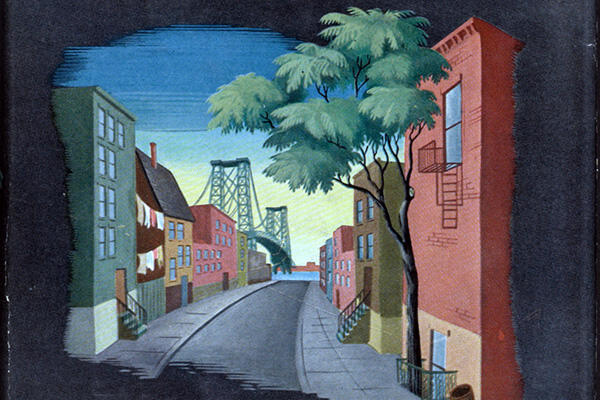
Francie Nolan is growing in Brooklyn, like a tree, constantly in search of light… The tree in her backyard struggles to plant its roots, yet it continues to grow… Shit, that is a cheesy metaphor. But this book is far from cheesy. It is the turn of the twentieth century, and Francie Nolan seems to understand more about the world than the adults around her. She offers a child’s delightful perception of life. The symbol of the tree seems to represent someone growing until they can look down over where they have been, rather than a person being kept in one place by their roots. At the age of 11, Francie’s life mostly consists of scrounging the streets for scraps. Her mother Katie is almost a child herself, and constantly has to worry about their next payment, and whether they will have enough to eat. Francie’s creative and handsome father, Johnny, suffers from alcoholism, yet Francie hopelessly idolises him. Johnny represents the bleak decline of the American dream. He still believes in the New Country that has tragically failed him. Katie sees her children encounter the same troubles she did, as generations overlap one another in an endless cycle that traps children in a predictable life. At 13, Francie decides that she doesn’t like women. When local girl Joanna falls pregnant before marriage, something they refer to as “getting into trouble,” the women throw stones at her. Katie tells her daughter that she must learn from this, and Francie is confused. She decides that because she is told this so often, her adulthood will consist primarily of tracking down grown-ups and thanking them. Francie’s creativity is squandered. Her underprivileged life leaves little room for self-development. Despite this, she keeps up her writing. Yet Mama never has time to read her work, and Francie burns her stories when her teacher tells her not write about such sordid things as poverty. Despite their poverty, Katie ensures there are always small pleasures, such as hot coffee, in the house. Francie doesn’t drink her cup, yet it is not wasted. Katie allows her to pour it down the sink to experience, even just momentarily, the carefree joys of the wealthy. It is the biggest shame to feel sorry for oneself. Starving children will turn up their noses at free food, and young Francie gets her first taste of shame over the doll she accepts as a charitable gift to a “poor girl.” Gradually, Francie’s world begins to widen. She has grown up in a small community, hearing whispers of exciting places such as New York City, but when she gets a job in the city she is miserably disappointed. Even the dull experience of the famous train ride shatters her dreams – “like Alexander the Great, Francie grieved, being convinced that there were no new worlds to conquer.” She is only 14 years old. The children of Brooklyn, it seems, are worn down into a premature adulthood. In this book, there is much emphasis on education as the key to breaking the cycle of poverty. However, particularly with the late arrival of her third child, Katie gives up on the idea of her children having a better life. The Catholics in Brooklyn have more children than they can support, and to her utter despair, Francie must work rather than attend high school. Growing older, Francie loses faith in God. She tells her brother she doesn’t believe anymore, because she never sees proof of his work. Finally, war provides the final blow. Prices soar and jobs are scarce. Francie finds herself at a crossroads, close to repeating the cycle of her own family, and making the same decisions her mother made when she was 16. The book highlights the failure of adults to provide for their children. Francie’s parents have the best of intentions, yet are unable to give Francie the life she wants. In Brooklyn, children are a nuisance, and are treated by adults as “loveable but necessary evils.” Yet Francie Nolan is an exception. She seems to grow. And maybe in time, her children will have a better chance at life than she did.
-
Culture
 Issue 22 02/09/2012
Fifty Shades of Grey
At first, reviewing Fifty Shades of Grey was a bit exciting. I’ve never read an erotic novel before, so immediately thought OMG where are the dirty bits. However it wasn’t long before an unpleasant relationship started to develop between this book and I. Meet Anastasia Steele. She is 21 and has never had sex, never had an orgasm, never ever been drunk, and only has one friend. I don’t really know what she actually does… She reads classic novels? I think that’s it. What I do know is that Fifty Shades is anything but a classic. It’s like Twilight: Cougar Edition, with raunchier passages, equally poor writing, and regrettably without the supernatural component. Ana and her only friend Kate have been living together for four years, yet their relationship seems forced and unnatural. Ana hesitates to tell her roommate anything for fear she will interrogate her or embarrass her later. James is unsuccessful in her portrayal of “young folk”, and seems to imply that female relationships consist primarily of wariness of the other’s big mouth. How does James aim to capture the female imagination? Christian Grey, a wealthy young entrepreneur, proposes a relationship in the form of a contract — it’s certain, states clear terms, and provides reassurance that Ana will be his only woman. It also means that any sexual conduct is heavily pre-meditated. The entire narrative builds around Christian’s promise to introduce Ana to his “Red Room of Pain” (to be read in the voice of B.A. from The A-Team). Basically he blindfolds her and they have sex to choral music (cougars start creaming now). So why does James have to ejaculate her fantasies all over literature? Why don’t these readers just watch porn with a bit of a story line? It would certainly be more time-efficient than reading 500 pages at a cost of $29.99. Supposedly underlying this book’s promotion is the taboo of women watching porn, but for me this isn’t the real issue. The real issue is that this uninspired shit is a bestseller! I don’t know what’s more depressing: the fact that women are being made to feel they shouldn’t watch porn, or the fact that they are reading shit literature. Maybe Ana will perk up with a self-empowering comeback, but so far I’m pretty sure this series is bent on casually undermining equality in male-female relationships. Anything feminist literature ever achieved is being bulldozed by Christian’s erection “springing from his boxer briefs”. Ana has zero independence; Christian proposes to buy her everything and even controls what she eats. The book treats female masturbation as more outrageous than a man pulling out a woman’s tampon and fucking her (this happens). Ana falls in love with Christian because of his money and good looks. I quote: “In hindsight, the beatings weren’t that bad.” She comes to the conclusion that he cares because he gives her tea, buys her a MacBook Pro, and literally stalks her across the country. On weekends he ties her up and tickles her with stuff. Christian barely speaks, except to say things like “I’m fifty shades of fucked up”, which doesn’t even make sense, and that’s what the title is based on. James refers endlessly to Ana’s “subconscious”, which I assume means her conscience? There is also reference to Ana’s “inner goddess” and “inner slut”. These are described as two little people living inside Ana’s head. It starts off as a kind of cute angel/devil thing, or perhaps an example of a bad writer struggling to express her characters’ feelings. Later, however, Ana starts to seem a bit mental. She refers to her subconscious hiding behind a couch, dancing, and wearing a hula skirt and glasses: “Kate gazes at me with pursed lips and narrowed eyes, rather like my subconscious — all she needs are the half-moon specs.” Oh E. L. James, your imagination knows no limits! So there’s going to be a movie. The big question is casting: who do we want to see dominated and fucked in the mouth? Emma Watson is a favourite. Still, I just thought humanity was deeper than this. Yet so far this book has sold enough copies for everyone in New Zealand to own at least eight. Well, congratulations E. L. James — you’re a millionaire.


