
Vimal Patel
Intern
Articles by Vimal Patel
3 articles found. Displaying page 1 of 1.
-
Culture
 Issue 27 07/10/2012
Civilization V: Gods and Kings
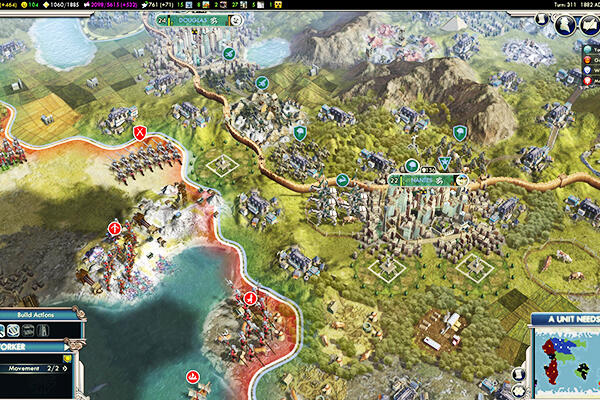
2005’s Civilization IV was a wholesome game to give to your offspring. Combat, though it was very possible, was rarely an optimal method to achieve a successful, wide reaching collection of cities. IV was a game that promoted agriculture, enlightenment and diplomacy, a game that, after its patch cycle and all of its expansions were released, was an immaculate spider’s web of game mechanics that always felt like it was smarter than you. In 2010 Civilization V was released. It was recently updated through the Gods and Kings expansion, and although it’s still smart, it lacks that same feeling of utter perfection. Combat has received a serious revamping, and becomes extremely appealing. If you want to play as Ghandi and engage in a post-modern version of the Cold War with Montezuma of the Aztecs, then Civ V is for you. The basic idea remains the same. Start off with a single city, and build more. Civilization V reins in your dreams of a sprawling empire somewhat, discouraging the building of too many cities by pumping up the “unhappiness” of your populace more quickly – and unhappy people, as the French revolution has taught us, are a bitch to rule. Cities can be fortified with buildings which provide passive bonuses, units that contribute your ever-massing forces, and wonders, providing better, more interesting bonuses but that can only be built once in the entire game-world. It’s a tangible change from Civ IV. It used to be that Joan of Arc’s vast network of interlinked settlements was as powerful as it was impressive looking. In Civ V, Ghandi’s singular juggernaut Mumbai can be just as effective. It might be less viscerally satisfying, and it’s hard to think of a terribly good justification for it. However, Civ V’s upgrades to combat and hexagonal tiles (seriously, continents actually resemble landmasses rather than weird square blocks) make it impossible to return to Civ IV. The exercise of stacking as many units as you could onto a single tile in some sort of bizarre human pyramid has been replaced with the tactical placement of units on a tile each. This change, in addition to adding ranged units, takes what was the worst element of Civ IV and transforms it into the strength of Civ V – engaging in the wanton destruction of other civilisations’ cities is now possibly the most entertaining way of playing. Archers finally function like actual archers; they have range, and need not be placed immediately adjacent to a pack of vicious elephant warriors. The Gods and Kings expansion adds two discrete elements into the game: one is richly integrated into the mechanics of core Civilization, while the other is merely an exercise in ticking a couple of boxes. Espionage, while fun in theory, boils down to gaining a new spy in every age, secretly shipping them off to a city, and “stealing” a technology dozens of turns later. Religion adds a whole heap of new elements to play. Not only could you found a brand new religion, “Criticism” perhaps, and win the game through sheer piety, it’s also possible for a religion to enhance other methods of victory. A blood-soaked bible that is the foundation of your civilization’s culture adds, as you would expect, military bonuses to your forces. Gods and Kings adds to what was already a great game, and although the total package is not quite as mechanically perfect as Civ IV, it’s still engrossing and addictive as ever. The improvements along with the stunning graphics and UI make it a pleasure to play, and you’ll find yourself up at three in the morning in a radioactively fueled diplomatic standoff between Ghandi and Catherine the Great. Just one more turn…
-
Culture
 Issue 14 03/06/2012
Max Payne 3
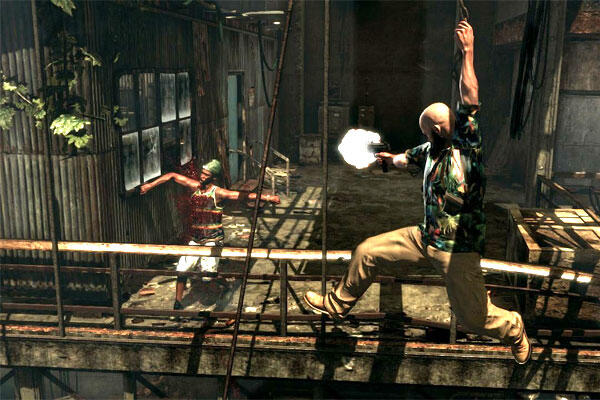
I stumble into my room, which is more of a mess than a coke addict’s savings plan. Falling into the chair in front of my desk, I stare into the screen. It stares back at me with a look of pure contempt, taunting me with the question: why didn’t you like Max Payne 3? Just like the game itself, this review has begun with a noir, in media res opening (the game’s one is much better). Now, I’ll provide a bit of background. Max Payne 3 is the follow-up to Remedy’s Max Payne series, which blended a film noir-style New York detective story with Hong-Kong-action-crossed-with-The-Matrix gameplay. However, this time round, it is not Remedy at the helm, but Rockstar, creators of the famed Grand Theft Auto, Red Dead Redemption and Bully. Max Payne 3 is a linear combat-centric game. It picks up the story of the titular character Max Payne several years after the events of the previous games. Max has fallen even further into despair. The third game centres on his addiction to alcohol and painkillers, but offers him a final chance at redemption. Rockstar chose to change the setting from wintery New York to sunny São Paulo, Brazil, while attempting to keep the noir feel. Overall, they succeed. Max is still as cynical and melodramatically poetic as ever, the story is a dark criminal conspiracy plot, and the cut scenes are very stylishly told. Indeed, the story telling is some of Rockstar’s best, which is saying a lot. The gameplay further evolves Bullet Time from the previous games. The player can slow down time when shooting, allowing bullet dodging and fine aiming. This results in some incredibly cool gunfights – imagine diving out from cover with dual Uzis, and shooting all three bad guys in the head before you hit the floor. This is complemented by the animation physics, which give Max more natural movements. Slowing time down allows you to appreciate this. Bullet Time feels less powerful than in the previous games because of improved AI, more difficult aiming (slowing time also reduces the reticule movement speed), and its shorter duration. Despite this, pulling off a perfect Bullet Time is much more rewarding. The varied weapons are back and dual wielding combinations are as fun as ever. Max has lost his trench coat that can hold every single gun. Now, the player has to decide what single two-handed weapon he carries, resulting in tactical weapon choices. Overall, Rockstar has nailed the combat. While it is more difficult, it is a real pleasure to play. Unfortunately, the game’s noir atmosphere isn’t as thick or as consistent as in previous entries. This is partly because of the change in setting – no amount of Max Payne monologue can fix the change from noir-perfect New York nights to daytime-bright São Paulo. Shooting up the favela in a Hawaiian shirt and killing Portuguese-speaking gangs doesn’t feel the same as exploring the twisted depths of a demonic New York nightclub. Secondly, the replacement of the comic book sequences with incredibly slick motion cut scenes doesn’t carry the amount of style or feeling that the incredible artwork did. The problem for old Max Payne fans is that Max Payne 3 is not a Remedy Max Payne game, with an over the top dark tone, colourful characters, and a twisted, surreal New York story. Instead, this is a realist Rockstar story about drugs, crime, and corruption in Brazil, all told through the noir perspective of Max. Staring into the pale glow of the screen, I realise why I don’t like the game: it isn’t the Max Payne I expected. I wanted the old one back, but I wanted a new one at the same time. I killed several of my hours along with the strangers I killed online in the multiplayer, and I still wasn’t satisfied. Maybe some young punk who’d never played Max Payne in his sad life would be real happy with this – but I wanted a real Max Payne 3, and all I got was some shiny Rockstar version. All I can say is, bring on GTA V. 3 / 5 stars – Vimal Patel
-
Culture
 Issue 4 18/03/2012
Call of Duty: Modern Warfare 3
I realise that reviewing the single player portion of a Call of Duty game is like reviewing McDonalds’ salads: It’s there on the menu, but no one expects you to pay good money for it. However, I did enjoy the campaigns from the first two Modern Warfare games, and subsequently thought I might kill a few hours with the third installment. The third game revolves around a stereotypically evil Russia invading the US and Europe in “World War Three”, blowing shit up and killing some innocent people. You play some special ops delta force American guy, Derek (his mates call him Frost, a much cooler name); and Yuri – a (you guessed it) Russian renegade soldier dude fighting with some British renegade soldier dudes from the previous games. Between these two soldiers, you get to kill a whole bunch of Russians (and some Africans) with some high-powered weaponry, in order to stop the war and bring the terrorist who is actually responsible to justice. Although the story makes more sense than Modern Warfare 2, it still comes across as a pro-war, anti-communist, Cold War wet dream – far removed from the almost-believable plot of the first Modern Warfare. In terms of the gameplay itself, it’s exactly what you expect: Aiming down the sights of a rifle with a lot of knobs, mowing down hordes of enemy troops and taking cover behind some crates for a few seconds to heal your bullet wounds. As per usual this is punctuated with some special missions where you control WALL-E with machine guns, and the obligatory AC-130 raining-explosions-from-the-sky. It should all be as fun as the previous games, but it’s not. It feels subtle at first, but the game won’t let you do anything: doors need to be kicked down by your AI mates, battles are already started by the time you arrive, you get told when and how to engage the enemy and there is never any reason to change your weapon – the gun you get at the start of the mission is already the best. It subtracts further from the already limited interactivity a linear FPS has to offer. – Vimal Patel


