-
Columns

Editorial | Issue 27
The title says it all: due to the complete exhaustion that follows the constant sprint that is producing Critic every week, I genuinely wish this final editorial were a fluff piece. But thanks to a seemingly indestructible rape culture in our country, it seems unjust to waste an opportunity to condemn, in no uncertain terms, the people responsible for perpetuating it through Facebook groups such as the “Rack Appreciation Society” in Dunedin, New Zealand, and worldwide. There is simply no balance here, and I implore readers to remember this when discussing the issue. I am aware that people have been critical of the group set up to counter the original, but there’s just no need to. It’s not a debate. It’s not a “battle of the sexes.” These are smoke-and-mirror reactions that seek (often too successfully) to distract from the real point. As Jennifer Lawrence said recently, in light of her personal photographs being stolen, the issues being discussed are not scandals – they are sex crimes. This fact seems rather clear to me and the key word is “consent.” I am, of course, writing this in full acknowledgement of my own position as a straight, white, middle-class cis-male. But on that note, I applaud David Cunliffe for apologising to New Zealand on this very basis earlier in the year. The unconstructive reaction to this by other politicians (our mate the PM found it “insulting”) and the New Zealand media is indicative of the deep-set ignorance at play here. This Facebook group emphasises why Cunliffe is right – it is people who fit the same description as him and I who are largely responsible for all the bullshit that women and non-cis-hetero individuals have to put up with. And it’s people like him and I who have some level of influence over our “mates;” we are empowered to help change this culture but as of yet we simply haven’t. All the while, a majority of people somehow found Cunliffe’s apology more insulting than the culture he was talking about. In this particular example, I’m guilty of feeling more angry than constructive. To those involved: fuck you all. Seriously. And if you were added to a group, my guess is that the friend who added you may have done so for a reason. Think about how you carry yourself that suggested you might have wanted to be part of such a group. Finally, if you’re one of the men who have lost partners just because you were part of a group, despite pleading innocence: clearly you’re rather untrustworthy. I can’t help but conclude with a small bit of fluff. What a year! I’m exceptionally proud of the direction that Critic pursued this year, and it had little to do with me. As such, and contrary to every other year that I’ve been involved with Critic, I believe it wouldn’t be fair in such a small amount of space to single anyone out. I’ve never worked with such a well-oiled and passionate team – each member quite frankly deserves their own page. Every individual has worked tirelessly all year to bring you an incredibly diverse range of breaking news, investigative journalism, exceptional political coverage, a huge number of fascinating and constructive features, and on-going cultural coverage. We’ve also focused a lot of attention on promoting women’s issues at a time when social constructs make this more important than ever. Critic is proud to call itself feminist and other self-respecting media should be, too. If you’re getting out of Dunedin this year, good luck with your journey. If you’re staying, remember that student media is a passionate voice for students and a reflection of your culture. Always stay in touch – if we stuff up, we admit it and work constructively through it. And if we do something well, it’s nice to receive some positive reinforcement from time to time. Zane Pocock Critic Editor
-
News

Sickness at Student Health an extra $10
As of 1 October 2014, Student Health have begun their trial period for the updated Health Declaration process during the exam period. Students will now be charged a non-refundable $10 on top of their consultation fee if they would like to be considered for the declaration. This means those with a Community Services card will pay $16.50, those without will pay $31.50, and international students will pay $45.00. For international students this will have to be paid at the time of consultation and cannot be billed to an insurer. Previously the consulting doctor at Student Health would sign a degree of impairment on a Health Declaration form as part of the general consultation. Under the new system, cases will be judged entirely by the third party and there will be no difference in levels of impairment – such as the previous system, which considered whether impairments were mild, moderate or severe. In a letter informing students of the change, Student Health said the doctor will “document the case as s/he understands it on the [Health Declaration] form and forward this to an adjudicating panel.” Director of Student Services Dr Kim Maiai told Critic this panel would be composed of “a small group of experienced Student Health professionals.” Note that this panel will not examine the patient, and their decision will be based solely on the doctor’s notes of the patient. This indicates that the individual doctors are not being trusted to judge the patients themselves. Student Health said the change was so that “health professionals can, quite correctly, focus on your health rather than the issue of academic impairment. We believe that these changes will allow for greater consistency and fairness of process and outcome.” Dr Maiai said the $10 surcharge, which comes as part of the changes, “reflects clinicians’ time in adjudicating on health declarations.” OUSA Director of Student Support Matt Tucker said, “It is absolutely unfair to require students who are already sick or possibly stressed to pay an extra fee just to apply for special consideration.” Student Support was never consulted. Tucker added the change is “unfairly disadvantaging students who are in genuine need of special consideration.” The OUSA Welfare Officer and Student Support intend to meet with Student Health to “look to work towards creating a fairer system for students.” This is the first time Student Health has implemented such a system and they intend to review the system at the end of the 2014 exam period.
-
News

Craft Beer Festival Is a Hit For Dunedin
This year’s Craft Beer and Food festival took place on Saturday 4 October. The event has been hailed as a success by organisers and attendees alike. The Critic team thoroughly enjoyed themselves, finding some new favourite brews, including Garage Project’s Tournesol and Green Man Brewery’s Tequila Beer. The culinary selection was also fantastic with over 20 different food stalls. The music from local bands kept the atmosphere buzzing. Che-Fu and the Kratez did not come on until after 5pm which, as it was advertised that this would be their start time, may have delayed the attendance of a few beer enthusiasts. OUSA used wristbands as a form of payment “to keep queues short and minimise staff time needed to process individual transactions.” The queues were exceptionally minimal. There was also a policy in place of no refunds after the festival if under $5 was left on peoples’ bands. Attendees were offered to spend their money, organise a refund on the day or give their residual to the charity. Through residual wristband income, Rape Crisis collected $2,088 on the day. Despite the event being excellent, it is questionable as to whether students, who only made up a third of ticket sales, should be funding such an event that uses so much of the OUSA Events team’s time throughout the year. OUSA would not reveal the exact number of tickets sold, due to commercial sensitivity, but the budgeted loss of $16,000 was based on all 5,000 tickets selling out, which they did not. OUSA President Ruby Sycamore-Smith explains that even though there were fewer students than general admissions, “[the number of students] is much greater than in previous end-of-year events – like we could only cater for 250 students at the Wingatui Races.” Sycamore-Smith says, “It’s year two, the template for the event is superb, the price is right, so we think we can get even more students along next year.” A number of students told Critic they could not attend the event due to the high entry price. Entry for students is $25, with beer tastings of 150ml costing between $2.50 and $5 per tasting. She adds, “It’s the best value craft beer and food festival in the country for what it offers.” Despite the excellent organisation of the event, Critic also questioned whether OUSA’s Events team should be the ones running it considering it has been the focus of the team this year to the detriment of having many more student-focused events. Sycamore-Smith responded, “OUSA will always look at various aspects to increase the student experience in Dunedin, further into the wider Dunedin community, which has become their new home. “[The Beer Festival] contributes to our strategic imperatives for high quality events, events that attract all students, not just undergrads, and is part of our town and gown push to get students seen as an integral part of the city.” Sycamore-Smith said that in 2015 there would not be as much time spent on the event because, “like all our events, once we get them established and running well, they take much less work.”
-
News

Final figures for OUSA’s General Election drive
As final figures come in, Dunedin North booth votes show an overall boost in votes by 11 per cent for the 2014 General Election versus the 2011 General Election. This follows a $28,000 budgeted spend by OUSA towards an enrolment and voting campaign this year. OUSA spent $20,127 more on promoting the 2014 campaign than in 2011 but they do not believe the increase only comes down to what OUSA spent. “Overall we believe the promotion of not just OUSA but also the work of other organisations to attract a larger voter turnout, especially advanced voting, was successful and we thank all those who helped,” said OUSA President Ruby Sycamore-Smith. “It’s so important that students are voting in the New Zealand General Election because we are the future leaders, students need to be involved in their future, and casting their vote is a way that they can do that,” she said. Promotions began on 12 August 2014 with Radio One events. Entry was granted with an enrolment form and the events were budgeted to cost $4,500. There were also other promotions through Radio 1, Sound Bites Promotions, Critic advertisements and visits to the halls of residence. The election campaign budget has several costs which have yet to be finalised, including expenditure on the elections website which held information relating to the elections. Few students were aware of the site though, due to the lack of promotions. Equally unused were the two video promotions which were budgeted to cost $2,500. They were supposed to be presented in lecturers but instead received fewer than 120 views between the two of them. Critic calculates this to work out as particularly useless spending at $21 per viewing. Following the elections, Sycamore-Smith was unable to confirm the total cost of the campaign, stating, “From a quick look it seems we will be under budget, but of course I cannot confirm this until the final invoicing has been completed.” OUSA were unable to get the figures of actual expenditure to us before Critic went to print. Sycamore-Smith believes their efforts have encouraged more informed voters and a stronger turn out for advance voting; nationwide, the overall voter turn out increased from 74.2 per cent in 2011 to 77.9 per cent in 2014. Special votes increased by 22 per cent in Dunedin North. “Increased engagement with the youth and active student associations and youth parties has been pivotal to this increase,” says Sycamore-Smith.
-
News
Top Lecturer Of The Year wants “no part of UCSA”
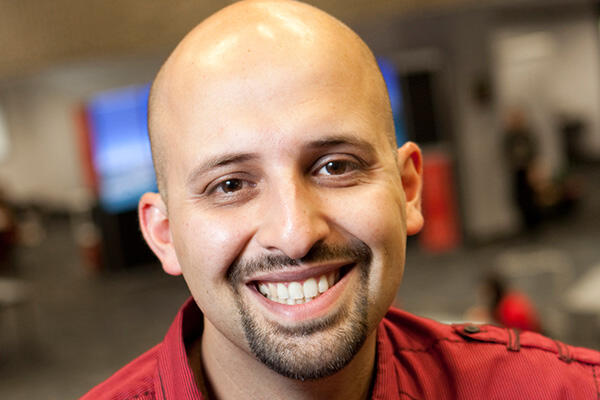
The University of Canterbury Student’s Association (UCSA) has come under scrutiny recently by staff member Dr Ekant Veer. The popular lecturer of the marketing department wrote a blog post on 7 October declaring that he would hand back his Lecturer of the Year award, as well as the $50 prize. Veer, who also won the award in 2011 and 2013, said this was due to UCSA’s response to the Engineering Society (ENSOC’s) actions in their annual RoUndie 500 event. According to Veer, “Participants of the event were encouraged to decorate their cars and come in costumes and that the more inappropriate these were, the better. This led to a series of costumes that were undeniably racist and sexist.” The student society has so far taken no formal action on this. Veer said he is “not confident that the UCSA’s response will ensure that the behaviour is not repeated.” As a result, he said, “I have no proof that the UCSA has taken the matter seriously. With no apology and no guarantee of ensuring similar behaviour does not occur again, I believe that racist and sexist behaviour will continue.” Veer told Critic, “Personally, I find any behaviour that purposefully goes out to hurt others to be disgusting and not one that promotes inclusiveness or respect. That's what ENSOC asked for – to cause offense. This isn't appropriate and when the UCSA fails to take a strong stance against this, then I want no part of the UCSA.” When asked how he believed UCSA should have responded to the actions, Veer said, “That's for the UCSA to decide. I am not them and, despite having my own opinions, I only want to know that this sort of behaviour won't ever be repeated. How this is elicited is up to the UCSA; however, their ongoing 'we will educate' hasn't worked in the past and I have no faith it will work again.” UCSA President Sarah Platt believes the decision was made “pre-emptively.” She said, “It was upsetting that Ekant felt that the only action he could take was to return [his award].” In regards to formal action against ENSOC, Platt said UCSA “are working very closely with the University of Canterbury” on a decision to “make really tangible change.”
-
News

AUSA Dismisses General Manager
The Employment Authority and Employment Court have deemed the 2012 dismissal of former Auckland University Student Association General Manager Tom O'Connor justified. O'Connor brought the case to court after he was dismissed by AUSA due to the mismanagement of AUSA finances. However, O'Connor maintained he only had AUSA's best interest in mind and that his dismissal was predetermined. In November 2011 O'Connor was made executive director of AUSA's business, Bacchid. He was appointed to the position after the company was revealed to be $1.4 million debt. The building that AUSA occupied was dependent on Bacchid’s financial stability; this was due to it being owned by Auckland University on the condition that the business was solvent. Current AUSA President and 2012 Media Officer Cate Bell explained, “Certain areas of AUSA buildings are occupied by Bacchid, and by them being insolvent it could just remove those buildings from AUSA and revert back to the University.” O'Connor took immediate steps to attempt to reduce Bacchid's debt, which included advising the AUSA Executive to transfer $220,000 from AUSA’s property trust to Bacchid. This payment was authorised by the Executive. However, according to Bell, this was authorised by O’Connor prior to the motion being passed by the AUSA Executive and O’Connor had not followed through on the conditions AUSA had attached to the motion. “Tom was General Manager of AUSA, he then took on General Manager of Bacchid, he then stayed as the Chairperson of Bacchid and a trustee of the services trust; he was also a trustee on the property trust … He was so heavily conflicted that he should not have ever been involved,” said Bell. 2012 AUSA President Arena Williams said, "When I took over my role as President, I came to realise the students and Executive didn't have a good understanding of where AUSA was at financially." In May 2012, the Executive commissioned an independent review, which found that the payment had risked AUSA's property trust's long-term financial viability. The report alleged that O'Connor had given reckless or negligent advice to the Executive, and that Bacchid was identified as having poor financial controls. Under employment advice, Williams began O'Connor's disciplinary process. At the disciplinary meeting O'Connor opposed the allegations that Bacchid was insolvent. He later acknowledged that there was an inherent conflict of interest in both of his roles, but contested that Bacchid and AUSA had the same interests. He then took AUSA to the Employment Authority, which found that there were no major procedural errors and that O'Connor's dismissal was justified. O’Connor appealed this decision through the Employment Court but the finding was upheld. O'Connor's lawyer, Garry Pollak, told the NZ Herald, "All he had was AUSA's best interests at heart – that's all he was trying to do.” “AUSA is pleased with the recent decision of the Authority and the Court … AUSA has updated all financial policies, ensured they are implemented and followed by everyone internally. AUSA is predicting a surplus from the operating budget for the first time in a long time in 2014” said Bell. Critic was unable to contact O’Connor but it is understood that there has been a monetary settlement for legal fees awarded to AUSA, which according to Pollak was considerably less than AUSA were seeking. Pollak also said the budget changes of AUSA were due to their facilities now being run by Auckland University. “[AUSA] is a mere shell of what it used to be,” Pollak said. Due to being unable to find work in New Zealand, O’Connor has now moved overseas.
-
News

No bones about it, there are some top supervisors
The Supervisors’ Awards, instituted by the OUSA and the Graduate Research School, aim to recognise and celebrate excellence in PhD, thesis or dissertation supervision. This year, Associate Professor Ruth Fitzgerald of the Anthropology & Archaeology Department was awarded the grand prize of 2014’s Supervisor of the Year, alongside other divisional winners. “The quality of a postgraduate student's academic experience is hugely affected by their supervisor,” says OUSA Postgraduate Officer Kurt Purdon, “so it's great OUSA is supporting that and promoting high calibre supervision as something that ought to be recognised.” Students currently or previously supervised by an academic may nominate them for an award. Nominations are submitted to the judging panel, which includes a representative from each division, the OUSA Postgraduate Officer, and the Dean of the Graduate Research School. The winners are chosen based on the written nominations from students. Three finalists are then chosen for each of the four divisions, where one of the three will be deemed divisional winner. The 2014 Supervisor of the Year is selected from these divisional winners. Alongside these awards, there is a Best New Supervisor of the Year Award. This year it was awarded to Dr Prasad Nishtala of the Pharmacy School. In addition, a Special Posthumous Award was also given for the late Professor Jules Kieser of the Dentistry School. This was due to a number of high quality nominations submitted by students for him and the fact he had been a finalist in the Awards several times over the past few years. The divisional winners were as follows: for Commerce, Associate Professor Holger Regenbrecht (Information Science); for Humanities, Associate Professor Ruth Fitzgerald (Anthropology & Archaeology); for Science, Dr. James Scott (Geology); and for Health Sciences, Professor Stephen Robertson (Pathology/Women's and Children's Health). The prize-giving event, held at the Staff Club, was very popular with staff and students alike, says Purdon. “It's a hugely popular event, we get a very large number of nominations, and a lot of students attend.” Purdon believes the awards are “definitely” of benefit to students, and that the calibre of winners was “exceptionally high” this year. “It was clear the supervisors had made a huge impact on their student's learning at Otago,” comments Purdon. “We had students telling us their supervisor was the reason they continued further study at Otago.”
-
News

Execrable | Issue 27
This week’s meeting went on for nearly three hours, but the presence of the 2015 Executive made for a little more excitement than usual. 2015 OUSA President-elect Paul Hunt held the chair for this meeting to give him some experience as the incoming top dog. The Executive also welcomed the new International Officer, Eric Lim. Welfare Officer Payal Ramritu says that Women’s Week went “awesome” and is working on trying to communicate with Student Health regarding the recent addition of a $10 fee to students. Colleges Officer Jess McLean said she has received emails from students complaining that they are being kicked out of the halls 24 hours after their last exam even though they are paying for the full year. After meeting with the Accommodation Services Manager, Jess said the fees are actually for the “academic period,” which is until a student’s last exam and “they don’t wanna change it.” Finance Officer Paul Hunt has been promoting the DCC submissions and the online petition, as the “online [petition] was a lot more successful than the physical copy and the door knocking.” He believes he has over 2,000 signatures now. The Executive, after some fascinating discussion in committee of the whole, passed a motion to install a new accounting system to a value “not greater than $38,000.” Admin VP Ryan Edgar declared the breach of internal policy recently made by OUSA, “we gave 3.5 days of notice before the budget instead of five. It doesn’t cause any issues but this needs to be noted.” He also said there would be another round of referendum questions coming up because OUSA did not ask students what they wanted to include in the questions for the referendum at the start of this year. He said people tend to respond to referendums better over exam period anyway, “that’s why all these Facebook pages appear over exam time, because people are finding ways to procrastinate.” Critic notes the double meaning following his “media shitstorm that has not been included in my 20 hours of work,” referring to the recent discussions over the “Rack Appreciation Society” page. Paul also addressed the issue of how future Executive nominations are run: “we need some serious consideration as to how people are nominated.” He says, “With the exception of last year, there is an exceptionally low voter turnout and no competition for positions.” He asked the Executive to start thinking how future campaigns could be improved, with some excellent suggestions of his own including providing live updates on who has been nominated online, as “then you can see where there’s a lack of competition.” OUSA General Manager Darel Hall presented the latest Health and Safety report. 2015 Education Officer Greer Mahoney showed particular interest in attending next year’s Health and Safety meetings, indicating a once-in-a-generation interest by any Executive member in H&S. The medical student said, “I’m always interested in the health of people.” The Executive discussed Victoria University’s Student Association withdrawing from NZUSA. Paul said he wants to have “serious discussions about whether we leave or really commit” to a future with NZUSA, considering “it has been a discussion lingering for the last ten years.” He says they need to have discussions over “what it offers and what it doesn’t.” He also wants to investigate what other areas are missing out due to NZUSA spending. Greer asked what the positives of NZUSA were. Ruby replied, “They were really helpful with labels, stickers and badges. Sending us pamphlets. That was really positive. Also they helped ensure various MPs came along for debate and have lobbied for the student issues.” She added, “I’m aware this is a public place so let’s just point out the positive relationship we have with NZUSA.” Postgraduate Officer Kurt Purdon said, “I’m of differing opinion to Ruby [and] I’d like to provide an equal amount of contrary opinion.” Greer also asked again for a quick rundown of the positives, but Paul and Ruby ended the discussion and assured it would be continued later. Critic suspects that the issue of throwing $45,000 a year to a questionably useful organisation is a contentious issue. After going into strict committee of the whole, as Payal wanted to discuss Student Health issues, OUSA stated that they wish to “publically oppose the changes occurring in the Student Health trial period regarding exams.” They also said that they will be requesting any future changes like this be told to OUSA and students in advance. Kurt also presented his report, which provided a summary of some of the consultations provided to OUSA over the last few years. These were the Deloitte 2011 Organisation Review, Former President Francisco Hernandez’s 2013 Governance and Representation Review and the Deloitte’s 2014 Governance Structure Review. The recommendations included that the OUSA General Manager should continue to attend Executive meetings. The number of members of the Executive should also remain at 11. The other recommendation was that there should be an advisory board established, made up of the President, the Admin VP, former OUSA members and the Finance and Expenditure Committee, to help assist OUSA with governance decision-making. This board would replace any shortfall in commercial experience as a result of the final recommendation, which was to dissolve the Planet Media Dunedin Limited Board (PMDL). All functions would then directly report to the General Manager of OUSA. Critic, Radio One and Planet Media Sales currently report to the General Manager of Planet Media Dunedin Limited, who then reports to the board (which includes external parties with experience of Critic and a lawyer), who then report to the Executive. Currently the General Manager of OUSA and the General Manager of PMDL is the same person. Kurt said, “This last point is the most contentious. I have no opinion on this right now as I don’t know enough about it; I’m just informing you.” They then went into committee of the whole to discuss Radio One, although Kurt doubted the necessity, as “it’s not commercially sensitive.”
-
News

Dunedin students’ private photos exploited online
On Tuesday 7 October 2014, a group called “Rack Appreciation Society Awareness” was created on Facebook. 24 hours later, over 2,000 women were members of the page. The group was formed out of disgust at the “Rack Appreciation Society” – a Facebook group formed two weeks ago, with over 4,000 members, most of whom are local Dunedin males. After a week of being online, members of the group began posting private nude photos of young Dunedin women and commenting with derogatory statements. Many of the 100-plus photos were Snapchats that had been screenshot. Critic notes some of the photos even have captions, proving they were intended for private viewing, including “show anyone and I’ll kill you.” The page follows on from the recent media storm surrounding the "Skank Central Chch Name and Shame" Facebook page, and the invasion of celebrities’ private photos. Critic spoke to several students who had been either victimised by the page, actively used the page, and/or those who had been “unknowingly” added to the page. Eva Ovens, one of the founders of the Awareness page, said she started it to draw attention to the “large population of the male community in Dunedin [who] are participating in this degrading and horrific act. The disgusting language, comments, photos and videos uploaded by these Dunedin men are absolutely horrifying.” A student whose pictures were used on the page said, “It makes your heart sink that everyone and anyone can see these photos and choose to do whatever they like with them.” She adds that the individual who shared her photo “should be a father role-model so it’s really disappointing.” He has a young daughter. According to the founder of the Rack Appreciation Society group, Sean McDonald, the page was formed “for the soul [sic] purpose of sharing photos already available on the Internet with each other.” The description of the Facebook group was that it was “a place of tranquillity where people alike are able to share and discuss the wonders of the rack … This is not a disrespectful page nor is it a place of contempt – we are better than that. Consider us more of a cigar and whiskey kind of page [where one can] ponder on the finer things in life.” McDonald said he attempted to shut the page down “immediately” once he saw how out of control it had gotten, with the adding of local students’ photos. “After one person posted a degrading picture it triggered a domino effect and then everyone was just posting what they wanted instead of being respectful.” The University of Otago Proctor Simon Thompson is unsure how a “rack appreciation” page was ever going to be a respectful place. “What did he think would happen?” McDonald continued, “95 per cent of members had no idea who the photos belonged to. For all we know they could [have] just been pictures off the Internet, which is what I assumed the majority of them to be.” However, another student said that amongst her group of friends, many of whom were some of the first 200 members, they were “well aware of the intention of the page – to show off photos of girlfriends and ex-girlfriends.” The Awareness page contained stories of girls who had been talked about on the Society’s group. By the time it had attracted outrage from the 2,000 students on the Rack Appreciation Awareness page, female students began private messaging members of the original page, accusing them of demeaning behaviour, even if there was no evidence of their input on the page. “Just being a member is encouraging the ones who are posting to keep going,” Emma Thompson argues. “Neutrality helps the oppressor." Despite being a group exclusively of women, Ashlyn Monk on the Awareness page said, “This is not to become something the boys responsible can turn around and use on us. We want no heated arguments with the guilty counterparts, no abusing them and calling them names, and no signalling out individuals from their group and making fun of them on our secret group.” Individuals were named, however, particularly when influential people were noticed to be members of the group – including members of the Otago Rugby Football Union and OUSA’s Administrative Vice President, Ryan Edgar. Edgar, who received backlash as soon as women on the Awareness page discovered he was a member, responded on the page, saying, “your naming and shaming approach is about as shameful as the [Appreciation] page itself. I agree with almost every point made by those condemning the page, but anyone could be added to the page without their consent and as such the approach that has been taken is like issuing a guilty verdict without a trial.” Many shared his defence that the Facebook group allows members to add other users without them having to give permission to join the group; instead they are automatically made a member. This removes the chance for people to choose whether to be a part of a group or not. He says that a lot of men have approached him expressing how unfair the allegations are. He continued in his personal capacity, saying, “When I saw that I’d been added to the page I assumed it was nothing more than a page about racks. I'm happy to put my hand up and state that I've got no problem with the appreciation of images that have been shared with consent. Once I became aware of the nature of the page, I left it.” Critic attempted to get responses from students who were also members of the page. Very few of the responses were constructive. One man said, “a few girls ranting about the boys objectifying them have been seen in wet t-shirt comps in the past.” Another added, “If they don’t like the idea of being objectified then they shouldn't first objectify themselves, and put themselves out there flaunting in front of crowds of men.” The general consensus from ex-members of the page was that “this has been blown way out of proportion.” Student Matt Miller, said, “I’m just a young idiot getting too involved in something like this; the rest of the fellas would say the same.” Michael Hastie added, “the lads have done all they can; it's up to the girls to get over it now.” An OUSA spokesperson responded, “the Executive have been approached with concerns from members of both pages. No victims who have had their images shared have approached OUSA … Any University of Otago students that have posted to the page may face repercussions from the Proctor or the NZ Police.” The Proctor said, “It’s dumb all round.” He said that once he has a list of names, “I will have them in here and get an explanation.” Thompson advises that starting pages like this is not wise, “when applying for jobs, this sort of history will show up in future.” Inspector Mel Aitken, Acting-Area Commander for Dunedin, Clutha and Waitaki, said, "While not necessarily unlawful, such social media pages can open up young people to unwanted, upsetting and inappropriate attention online. Police will act on matters which are unlawful … In general terms, anyone using social media should be very cautious about the personal information and images they share." Critic notes that we clarified to Police that the images shared were not consensual and were not posted on social media by the women. "It depends on the content of the photograph and circumstances as to whether the imagery is objectionable or not … Images or information sent to a seemingly trustworthy associate or posted on a social media site can easily, simply and quickly be republished to a wider audience," Aitken added. Kate Buchanan, a student, posted on the Awareness page, “The worst part is that this isn't about sex, or about getting off over these photos. They have porn ... All with beautiful women who are giving their consent for these images to be looked at and shared. But they don't want consent, they get off on the violation of privacy … I hope all the girls who have been victimised by that page know that it isn't your fault – you are entitled to take as many goddamn nudes as you want, and not have them distributed to anyone other than who you consented to see them. Fuck that page, everyone in it, and the society that created them.” Hester Philip, another student, addresses the fact the page has now been portrayed as an issue between the genders, with several comments being made against local guys on the Awareness page. She said, “There should be less talk about individuals and more about why it happened. How some people in society think that it is okay to share stuff like that with everyone, when it is something that was an intimate thing between two people. It's not a feminism thing, it's [about] having respect for other human beings, and knowing right from wrong … It would be just as bad if it was boys that had been posted on a page.” OUSA added, “We have had a number of people approach us who have been added to these groups without their consent ... This has resulted in some people’s reputations being unfairly tarnished and has alsoaffected several relationships." “The underlying issue of female objectification is a serious issue and cannot be ignored, but we also reject the notion that all males involved in this are sexual predators.” The Dunedin Feminist Group, lecturers and individuals are preparing letters of complaint to the University. 24 hours later Otago Uni's Vice Chancellor speaks out against the pageThe University of Otago has issued a statement condemning the Rack Appreciation Society’s page and the men involved with the creation of the page. They have said that when the University can identify breaches of the University’s ethical behaviour policy, its students will face firm disciplinary action. One complaint had been received from one female student about the Rack Appreciation Society Facebook group. One male student involved with the site now faces disciplinary action by the University after an initial investigation. On Thursday 9th October, a new page was formed on Facebook, “NZ Equality and Internet Privacy Awareness” in response to the other pages which have formed an unnecessary battle of the sexes and some “serious conflict online.” The page reads, “As a result, this page is here to provide a place for everyone to express opinions on the subject at hand. Please note that any derogatory comments towards anyone, from any of you will result in you being blocked from this page. This is a hate free environment and is simply here to raise awareness, share opinions and debate topics that fall under the Internet privacy, human rights, and gender equality umbrella.” “While it appears that a small number of this Facebook group were actively engaged in posting private photos of women without the woman’s knowledge or permission, all of those who supported this group in any way should reflect on the hurt and humiliation that they have been party to through this site,” the University’s Vice Chancellor Professor Harlene Hayne said. “We are taking these allegations very seriously and where we can identify breaches of the University’s ethical behaviour policy, we will take action to set an example to the University and wider community that this sort of behaviour is totally unacceptable on every front.” “We are extremely disappointed that the behaviour of a few has sullied the reputation of the University and cast aspersions on the remainder of our student body who continue to excel in their studies and who, both inside and outside the classroom, behave in moral, ethical and a community.” “This incident highlights a serious social issue around the objectification and degradation of women in New Zealand society and via social media in particular. Forums in which people are exploited or degraded are all too common across the social media that young people use, and this is a sad indictment on society today.” Professor Hayne says the University does not endorse any form of “sexist culture” – and considerable pastoral care is provided by a range of services on campus to ensure the Dunedin residential student environment is safe. “That is not to say that sexual offending does not exist within the community as a whole, because it does. But as a society, we must all grapple with this issue. Incidents of this nature are certainly not confined to Dunedin, nor are they confined to Universities.” In a press release, Inspector Aitken made further comment, “the content of the photograph and circumstances in which it was taken may determine whether the imagery is objectionable or not, and as such could be classified as an offence under the Indecent Publications Act. In addition, if a photograph was taken without a person's consent in circumstances that make it objectionable, then it may also be unlawful.”
-
Columns

ODT Watch | Issue 27
Very perceptive, ODT. Examination period has truly begun. Yes, we suppose students could get their applications in earlier. Or the government could pull its head in and give Studylink the resourcing it needs. Not that we don’t like listening to an entire Brooke Fraser album while on-hold. Talk about crying over spilt milk – or, in this case, paint. “A small amount of green paint” spilled onto a highway calling to the scene not only the police but also fire fighters and the Department of Conservation. ODT reports the paint was dry by the time everyone showed up. Looks like the extreme fear mongering spearheaded by the US media has taken its toll: a man has been rescued after attempting to run from Florida to Bermuda in an inflatable bubble. That’s one way to escape the “large scale outbreak” in the US. Good use of quotes, ODT, always adds credibility to any article. Unfortunately, you (and many other news sources) neglected to include the ENTIRE quote. “Mr McDonald” also said in the same post, “I hope you all learnt a very valuable lesson, that being ... with great tits, comes great responsibilities. ... Long live the RACK. Peace & love. We will now have a period of 10 minutes where everyone can say their goodbyes. :’(“
-
News
Critic tackles election year one more time
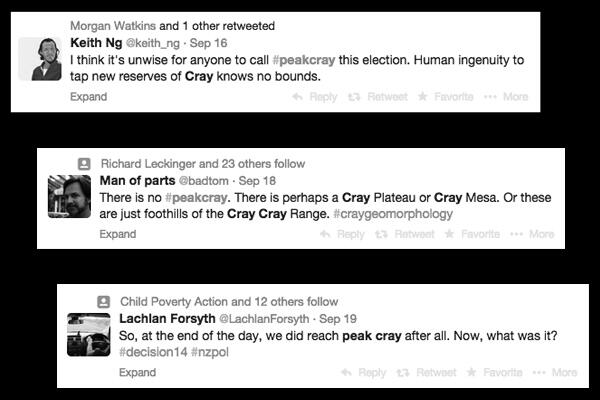
This is it. The final Critic of the year. A year of the most tumultuous election activity we could have asked for; a year of the weirdest gaffs; and a year of the most frustratingly normal results. It got so strange that Twitter began to wonder when we’d hit “peak cray,” and a simple search of the term shows that the hunt for peak cray tapped into the philosophical side of punditry. So, when did we hit peak cray? Watching the election evolve as it did means it’s difficult to make a judgement – the three months of hardcore campaigning were full of ridiculous news articles and even more ridiculous politicians. To give the peak cray award would be to assume a single event is more cray than another, when the true crayness, I think, is the sum of the cray parts. Let’s borrow a metaphor from the right wing, and consider peak cray a three-headed hydra. The body would be Dirty Politics. Whether you vehemently deny it or consider it an example of the abhorrent behaviour we’re expected to tolerate, it formed the basis for much of the cray to come. The raid on Nicky Hager’s house last week, a disgusting affront to his journalistic rights, shows the National Party is still trying to slay the Peak Cray Beast forever. The arms would be Kim Dotcom and the Moment of Truth. Each were designed to call attention to the corruption within our government, but each squeezed the New Zealand populace just that little bit too hard; and despite the arms digging their nails into Te Tai Tokerau, Kelvin Davis broke their grip. The first head would be Judith Collins. It is not in every country that a Justice Minister resigns right before an election for gross misconduct, but we were lucky enough to watch that event transpire. Slightly rabid and wildly childish, Collins was decapitated early enough that she didn’t cost her party poll points. She was the scapegoat for all of National’s dirty dealings. The second head would be the Labour Party. Despite a positive campaign and a collection of policies that would benefit many who ignored them, Labour just couldn’t seem to dissociate itself from the notion that it was in disarray. An ear on Labour’s head would be TarnBabe67, the fake Twitter account Cunliffe’s wife used to insult those who didn’t support him. The third head would be Eminem, whose appearance on the National Party opening broadcast spurred a bizarre legal case against the government. On Eminem’s head, the nose would be John Oliver, who made fun of Steven Joyce for considering the breach of copyright “pretty legal.” The legs have to go to the bloggers. On the right is, without a doubt, Whale Oil. An off-putting combination of self-righteousness and total cuntery, Whale Oil bears the brunt of the Dirty Politics body. He’s still going, however, and I think there are a few people out there who consider him important. I’m not one of them. The left leg, I’m sorry to say, is Martyn “Bomber” Bradbury. It would be easy to give it to David Farrar, but Bradbury has consistently undermined many people on the left who he was thought to represent. His volatility, in combination with his twitchy “block-them-from-the-website-for-disagreeing-with-me” toe, means he is in danger of ruining the Daily Blog. Finally, there is the tail. This has to be the result of the election – a new country called the Autonomous Republic of North Otepoti, “a collective of households and flats which have declared independence from New Zealand.” Okay. I’m sure I’ve missed a few spots and scars here and there (and I’m sure Colin Craig is a spike along Peak Cray’s back at the very least), but there it is. The Peak Cray Beast, who ravaged our newsfeeds for months, only to keel over and die at the foot of Winston Peters’ election night party. The Peak Cray Beast, whose misunderstood beasty-ness, in the end, undermined all he set out to do. The Peak Cray Beast, who only wanted to be the Princess, but ended up being the Frog. Rest in peace, Peak Cray Beast. Please get your shit together for next time should you choose to regenerate Doctor Who-style.
-
News
Critic Sport takes a stroll down memory lane
For this sad occasion, the last issue of Critic for this year, we go the tear-soaked nostalgia desk and revisit some of the most memorable sporting moments of 2014, pointing out when we got things right with our predictions and conveniently not mentioning when we got things wrong. Thanks for reading this overtly subjective and partisan column and we’ll be back next year unless our new editor, Josie, pulls the sports page in favour of increased coverage of car repair hacks. Silver Ferns take their name a little too literally Due to my strong republican feelings (not the crazy Fox News-kind) about New Zealand’s continued status as a relic of the fallen British Empire, I chose not to devote any of the valuable pages of Critic to coverage of the “poor man’s Olympics,” the Commonwealth Games. There were some good, gold-winning individual performances but we were let down in the team sports. The Sevens team lost the gold medal match to South Africa, making them undeserving of the name "All Blacks Sevens." Equally as disappointing were the two-time reigning netball champions, the Silver Ferns, who suffered a miserable 18-point defeat to those insufferable Australians. A recent rematch in Invercargill ended in a similar margin of defeat, proving the Commonwealth Games result wasn’t a fluke. While I support New Zealand becoming an independent republic, I don’t support us adopting the logo of a second-rate netball team as our national flag. Spurs sale of Bale delivers for real (look, it’s pronounced ray-el not reel, ok?) After Gareth Bale left the North-East London no-hopers, Tottenham Hotspur, for a world record-breaking transfer fee, he said he had one ambition – to return Real Madrid to the winner’s podium of club football’s biggest prize, the Champions League, as they had not won the coveted trophy since 2002. The final would see them face their city rivals Atlético Madrid and the Atléti went ahead early in the final, played in Portugal’s capital Lisbon, but Bale’s goal in extra time effectively sealed their tenth European Cup, justifying his astronomical $175 million fee. Bale had already helped deliver the domestic Copa del Ray trophy for Real, scoring a late winner against their other bitter rivals, Barcelona. Highlanders provide the best All Blacks and return to Super Rugby finals Once they had gotten rid of Ma’a Nonu, 2014 was always going to be a good year for the Highlanders, as predicted by Critic and no doubt inspired by their sponsorship deal with the University of Otago. Jamie Joseph’s team made it back into the Super Rugby final playoffs for the first time since 2002 but it was a short lived experience, though, as they narrowly lost to the Sharks in Durban in the first round. We were robbed but next year will be our year. However, the unrelated brothers Ben and Aaron Smith continued to show why they are first-choice picks for the All Blacks and we also saw the rise of Malakai Fekitoa, who has stepped up and taken his chances in the black jersey. Number 10 Lima Sopoaga also had a good year after being unconvincing over the previous few seasons. He broke Tony Brown’s long-standing point scoring record for the Highlanders and recorded one of the best accuracy rates in the competition. In Soviet Russia, olympic fails you! The Winter Olympics hosted by Russia were not a particularly memorable event for sporting reasons, especially for New Zealand, who failed to win any medals where Australia won three. Even the glorious nation of Kazakhstan managed a cheeky bronze in the men’s figure skating. The games became better known for the amusingly poor conditions of the athletes’ village accommodation. There were a wide range of hilarious problems, from multiple cases of athletes getting locked in their rooms because of door knobs falling off, and there were the bizarre double toilet stalls, yellow, caustic tap water and menacing packs of stray dogs roaming the oddly-named Sochi streets. Well, they only had seven years to prepare. Surprisingly, Tinder was one of the big winners, as they got a lot of publicity from good-looking athletes who had nothing better to do than hook up with each other, making use of the 100,000 condoms provided. One of the biggest fails came in the opening ceremony when one of the five sparkly flower things failed to light up and expand to form the Olympic rings. It turned out that President Vladimir Putin was so outraged that shortly after the Olympics ended he decided to invade Ukraine where the faulty piece of equipment was built. Oh Richie you’re so fine, you’re so fine you blow my mind, hey Richie! Not exactly surprising, but the All Blacks mopped the floor with England over their three tests and then went on to win yet another Rugby Championship in typically dominant style. They put a record-breaking score past the woeful Wallabies, with Richie McCaw grabbing a double and breaking some personal records as well. He was in fine form over the tournament, even popping up out on the wing for a memorable try against South Africa. It wasn’t all plain sailing for the boys in black as there has been some injury dramas to deal with. Dan Carter has been nursed back to fitness but we have coped very well without him, with Barrett and, when he is clean and sober, Aaron Cruden doing the business. Despite Fekitoa proving his worth in midfield, Sonny Bill has decided he is up for another code switch to complicate selection matters. Could this finally spell the end of Ma’a Nonu, who is allegedly looking to sell his soul to French rugby? Deutschland gewinnt die weltmeisterschaft!! After the recent domination of European club football by Bayern Munich, it was no big surprise that Germany would go on to lift the World Cup in Brazil. “Die Mannschaft” were a stereotypically calculating, efficient and well-drilled unit and, while not being completely dominant through the early stages, they turned it on when it really mattered, stunning the football world by absolutely thrashing hosts Brazil in their semi-final by a record breaking score of 7 – 1. They went on to face Argentina in the final, in what turned out to be a tight and tense game, which they won 1 – 0 in extra time to claim their fourth title.
-
Features

Freedom to offend
"Don't read it. I don't think you should read it,” said my friend while reading American Psycho. “It will upset you. There’s eye-gouging and ... stuff.” He meant it as a well-intentioned warning. But immediately my mind went to “‘Stuff,’ huh? What could this ‘stuff’ be?” As someone who is a totally opinionated arsehole on most topics I’m interested in, it annoys me when there is something I’m not sure about. Freedom of speech is one of those things. Freedom of speech has been trapped under the wrath of censorship for as long as anyone can remember. Socrates was sentenced to death after being found guilty of both corrupting the minds of the youth of Athens and of impiety. Mary Shelley’s Frankenstein was banned in South Africa under apartheid for containing “obscene” or “indecent” material. Dr Seuss’s Green Eggs and Ham was banned in 1965 in The People’s Republic of China for its portrayal of early Marxism. But ridiculous examples are part of the same problem as serious ones. The murderer at the Aramoana massacre reportedly owned a copy of the banned book The Poor Man’s James Bond, which had information on how to make weapons and even suggested using them on homeless people. Serial killer Paul Bernardo called American Psycho his “Bible.” Should Destiny Church be able to go ahead with their homophobic protests? Should Holocaust deniers be able to speak in public? You only have to look at countries where freedom of speech is limited to know how valuable individual expression is. In China, government funded censors detect and delete online posts containing words like “Tibet independence” or “dictatorship.” And North Korea is basically George Orwell’s 1984 put into practise. Freedom of speech is mostly taken for granted in New Zealand, but it is important to remember just how much is at stake if we pass laws to stifle the voices of even the most obtuse, offensive, tasteless, or mean people in our society, no matter how warranted it seems. Censorship is sometimes confused with responsible editing, where an editor decides what is fit for publication. I asked Critic editor Zane Pocock what he feels is necessary to screen out in the editing process: “The main things that I’m very conscious of are issues around mental health, issues around heteronormativity, issues around gender-based discrimination, and certainly rape issues. They are all things that have been trivialised by alternative media in the past. I feel like the mainstream trivialises them enough and we actually hold a really important place in trying to change that norm.” Zane believes that education is more important than censorship. “This is not as cliché as it sounds: media training both here and overseas is severely lacking. When we were chatting to Nikki Hager last week he mentioned that he could have brought into disrepute significantly more people (in the 10s, if not 100s) but he didn’t because he couldn’t justify the public interest in it, even if they seemed to be relatively evil people. He exercises a level of self-editorship and concern for taste and public interest that most of our media outlets would do well to learn from. Media aren’t taught that, though. They just want a set level of readership, and this can mean they overstep boundaries.” Good taste serves us well for the majority of our lives, but tact cannot be enforced. John Stuart Mill said, “If all in society were agreed on the truth and beauty and value of one proposition, all except one person, it would be most important. In fact it would become even more important, that that one heretic be heard, because we would still benefit from his perhaps outrageous or appalling view.” The late Christopher Hitchens – journalist, author, and debater – impeaches, “Where are your priorities, ladies and gentlemen? You’re giving away what’s most precious in your own society, and you’re giving it away without a fight, and you’re even praising the people who want to deny you the right to resist it. Shame on you while you do this. Make the best use of the time you’ve got left. This is really serious.” I asked Associate Professor Selene Mize, who specialises in media law, for an example of free speech that should not be allowed. She replied, “I would be really uneasy about a book, and I would support banning it, if it said, ‘It’s really great to have sex with children. It’s against the law, so you don’t want to get caught. Here’s how to make it less likely that you’re going to get caught. Here’s the kind of child that you can pick up that no one is going to notice the child is missing for longer than this other kind of child. Here’s the kind of things you can tell a child that mean that if that child ever complains to the police and testifies at trial that you’ll be able to impeach the child easily.’” Speech holds the potential for danger, but I don’t think it should be condemned by the potential harm it could do. British historian David Irving is a prominent Holocaust denier who, in 2006, was sentenced to three years in prison in Austria for nothing more than the potential of uttering an unwelcome thought. He didn’t actually say anything, and wasn’t even accused of saying anything. He is a historian who has committed no crime except for thought and writing. I hate Holocaust denial, but I did feel I got something from reading about the arguments. I don’t agree with it, but I do understand where they are coming from. How do we know the gas chambers were used to murder Jews, and not for de-lousing clothes? Can we really trust that the Nazi records of methodical slaughter were accurate and not exaggerated? Why is there no lock on the door of the gas chamber at Auschwitz? These questions have answers based on very good evidence that, yes, the Holocaust was just as bad as we’ve been taught all along. But they are good questions that deserve investigation, not the silencing and imprisonment of the questioners. Hitchens, who defended David Irving during his trial in Austria, said this on Irving’s right to be heard: “What he has to say must have taken him some effort to come up with, might contain a grain of historical truth, might, in any case, give people to think about why do they know what they already think they know. How do I know that I know this except that I’ve always been taught this and never heard anything else? What would you do if you met a flat-earth society member? Come to think of it, how can I prove that the earth is round? Am I sure about the theory of evolution? I know it’s supposed to be true; here’s someone who says there’s no such thing and it’s all intelligent design. How sure am I of my own views?” And without hearing his opinion, how can we argue against it? Most importantly, imagine if the position were reversed: that Holocaust denial was the mainstream thought, and Irving was trying to convince people that it had happened. Imagine the tragedy of his voice being silenced. Holocaust denial is against the law in some countries, and writing positively about homosexuality is illegal in others. Both laws are in place for the supposed good of the citizens of the country. When the men’s rights groups online irk me, I think about how much worse it would be if there were laws against expressing those opinions. And even the most self-pitying, ill-informed, perverted, overblown, squalling mess of sexist ranting may have a kernel of truth buried amid it. Why are these young men so frustrated? What has our society done to create them? How can we argue in a way that will make them see sense? Selene Mize elaborated on this point: “I think there is good evidence that Irving is wrong – but at times we have believed that there has been great evidence for something, and been wrong. If you think about Galileo who challenged the view that the sun did not rotate around the earth, that the earth rotated round the sun, people were sure he was wrong. To get to a more recent example, the bloody food pyramid! That was kind of stuffed down our throats for the past 30 or 40 years. I definitely took it on board when I tried to lose weight. Now they’re finally doing good research on it. They’re saying it’s all wrong. And I could see well-meaning people 20 or 30 years ago saying “we can’t have people telling people to have high-protein diets. That would be unhealthy. Look at our food pyramid! It’s supposed to be a high carb diet.” So because we don’t want young girls to do these unhealthy high-protein diets, we should just ban that kind of speech. And they would mean well in doing that. Just like countries that ban denying of the holocaust. They mean well. But, I think, it’s too dangerous.” Avoiding “falling intelligence” fallacies can be difficult. Doctors used to think disease was caused by an imbalance of the humours, and then they thought it was spread by bad smells, and now they have germ theory. This doesn’t mean that germ theory is wrong. And then there is the problem of secrecy: as soon as something is banned, it becomes more interesting. Selene describes how banned texts can “get an air of the forbidden fruit. People get titillated by it – what are these things we’re not allowed to talk about? Whereas if somebody is allowed to talk and present their evidence, and you say I wasn’t convinced, or that pulls into debate another person who has their evidence, then I think that’s all good and I think that’s the way free speech should work. The remedy for harmful speech is usually more speech pointing out how the other person is wrong or the food pyramid is wrong.” Zane argued how dangerous it is to let some ideas have free reign in the media: “In terms of giving holocaust deniers speaking space, it comes back to this idea of false balance. Media will often give holocaust deniers or climate change deniers a voice, because they think it’s balance. It’s not balance. The Holocaust happened. To use the climate change example, there is a statistical chance that humans have not caused climate change, but it’s something like a 0.001 per cent chance. I’m pretty happy to accept that as a truth. I don’t think deniers should be given the space to voice their opinion in this false-balance sense. They don’t have an equal voice [on the topic]. But then the problem is that flips around because you start to get into minority bashing.” Selene uses the example of LGBT rights as a minority group who fight to have their opinions heard. “Unfortunately minorities pretty much have to persuade the majority. And sometimes you can kind of despair and think it’s never going to happen. But look at gay marriage. 25 years ago, I was a big supporter of gay marriage and it just didn’t seem to be going anywhere. A lot of people thought it was just never going to change. And it just magically reached a tipping point or something, where in so many places around the world it’s changing. It takes time. It doesn’t happen overnight. Some people say censorship is necessary because free speech isn’t working. Free speech in the marketplace of ideas never promised to work overnight, or quickly.” A case in point on the titillation of banned texts – I want to read the banned copy of Critic, even though from what I’ve heard I would be disgusted if I did. I asked Selene if she would have banned it, and she repied: “I did read the issue. I don’t have a copy. But, yeah, I would not have said that no one could keep a copy of that except Te Papa and the censor’s office. Among other things I think when you have examples of something that has been declared objectionable that people can look at, it gives them guidance about what will be found to be objectionable in the future.” And Zane mentioned the futility of banning something that has already been distributed: “The weird thing about it being banned was that it had done its damage. It had been printed and circulated around campus. I’m not sure how long it took for it to be banned, but it’s not an instant process. I assume it took a couple of weeks.” Both agreed that it was a poor decision to publish in the first place, but once it’s out, banning only makes the issue more interesting. And what gives the people at the censor’s office the moral authority to say what other adults can and can’t read? In the words of Christopher Hitchens: “To whom do you award the right to decide which speech is harmful, or who is the harmful speaker, or to determine in advance what are the harmful consequences going to be that we know enough in advance to prevent? Isn’t it a famous old story that the man who has to read all the pornography in order to decide what is fit to be passed and what is fit not to be, is the man most likely to become debauched? Who do you get to decide for you what you could read? Do you know anyone to whom you would give this job? There’s a law that says there must be such a person, or a subsection of some piddling law that says it. To hell with that law. It’s inviting you to be liars and hypocrites and to deny what you evidently know.” Selene chastised me on trying to draw a line between freedom of speech and harassment or bullying. David Irving wasn’t picking on particular people with his Holocaust denial, he was writing books and presenting lectures. But Selene pointed out that freedom of speech could also be this: “There’s a neo-Nazi who is following a little old Jewish lady around every time she is doing her grocery shopping, following her and saying stuff about what happened to the Jews in WWII, and going into very elaborate and great detail about some of the worst things that happened, Mengele’s experiments and stuff, with the intent just to totally upset this woman. So he does have a right to freedom of speech, but I think it’s outweighed in that particular case. You’re obviously distinguishing between freedom of speech and bullying. But if freedom of speech is just conveying words, or writing words, it can still be bullying. Let’s assume he’s not blocking her way, he’s just following behind her in public spaces where they both have a right to be. I don’t think you could draw a distinction and say this isn’t speaking or it’s not expression or anything.” Perhaps he should have the right to say this stuff until the lady puts a restraining order against him? It’s complicated. For the record, I read American Psycho, and it gave me nightmares. But I still want to read the banned copy of Critic, The Poor Man’s James Bond, and the Holocaust deniers’ theories. I don’t want to have somebody else decide for me what is suitable for my own eyes and ears. I have read some fairly tedious books for the sole reason that they have been banned at some point in history. Despite its nasty edges, I am on the side of freedom of speech, even to the extreme ends, because I want to have the right to hear or read the things which may infuriate, disgust or offend me, and in turn have the right to speak back.
-
Features
Residential halls, paper thin walls and jerking your balls
When I was shown down the floor of my residential hall, the first thing I noticed was how tightly packed the rooms were to each other, with the slightest movement giving away our activity. At first, the only concerns I had about this was how much sleep I would be able to get and if my music would bother my neighbours, but soon there was another, far more awkward dilemma that presented itself later in the night. It was 11pm and all was (mostly) silent on our floor. Then, as I lay on my bed staring at the ceiling, half-way through my nightly routine of reflecting on everything (which includes my whole life so far and my plan for the next ten years) a sudden whining noise begun: ... Uhhh ... HHHMMmmmm ...... Uhhhhh HHmmmmm .... AHHHhhhhhh .... It was low at first, kind of like the noises someone makes when they are having a nightmare. But quickly it got louder and louder and stranger and stranger. There were moments of one-second pauses: “... Huahhhk,” like someone was holding their breath for a moment, followed by a release of “Auhhhhh ...” and then the standard noise would continue. At this point it became clear the person next to me was, for lack of a better euphemism, “punching the clown.” Is it possible to express the action of someone masturbating without a twitch breaking on your face each time you say it? Even now, as you read these words, do you glance around you, bringing your face in closer to the page just in case someone gets a glance at the topic you are reading about? Have you already got a fake answer at the ready in case someone asks you what are you reading about, like, “Oh, I was just skimming through,” followed by a continuous flicking of all the pages until you reach the end and put the magazine down so it’s like, “see, look how fast I was skimming through, couldn’t of had the time to be reading about anything awkward as fuck.” If you answered “yes” to any of these questions, you should be at ease. Your level of discomfort at this moment is not nearly as close to the levels of discomfort I had during some of those following nights. 20 minutes later, the noise had built up to a grand finale, with the last piece sounding like the dry wretch a cat makes after spewing up a hairball. Okay, I’ll try writing it out for you: AAAOOOUUUHHH. It never occurred to me that some people have more dramatic or vocal experiences when masturbating. Afterward, for a personal laugh I let out a loud yawn just at the same volume he’d been playing his orchestra at, just to indirectly let him know that he had breached the sound limit in which all things can be heard through the wall. For some reason, my reaction had made me want to laugh my guts out, so I tried to unsuccessfully hold my breathe to keep my laughter from releasing, only to have it burst out of me at a volume the person would have definitely heard. To save serious embarrassment on his behalf, I tried to tune the laughter into a coughing fit to provide my neighbour with a benefit of the doubt-type feeling, like, “Oh, he was just coughing and didn’t actually hear my jamming the man session.” If I’d ever been caught in that situation, my safety line would be that the noises your sick mind had mistaken for fapping was actually me practicing writing my essays, which just happened to cause a slight vibration given how hard and fast I was “writing.” (Yeah, you can use that one). After my coughing fit, or because of it, I also gave up on the efforts of holding back the 20–30 farts I drop daily. I know you can drop them silently, by slowly releasing your ass-valve one part of an inch at a time every few seconds, but that just required some intense dedication I couldn’t continuously produce. I also felt I had the liberty to let out my farts any way I wanted in my own damn room. And I’m not walking all the way to the bathroom just to let out a few farts – a ritual that makes up 95 per cent of my journeys to the bathrooms at the university. This ritual is made doubly worse by the fact that I don’t feel comfortable farting until I’m sure either a) there is a cover-noise over-tuning my farts, like someone drying their hands, or b) the bathroom is completely empty, because there’s no fucking way I’m walking out of the cubical after making noises that sounded as if I was busy blocking the toilet with an electric chainsaw. That night, if you were wondering, my farts were bountiful, like the fart-journey was a slide and they were all lining up waiting for a turn to scream as they went down. After several nights of adjusting to living in a hostel again, I began to think about what privacy meant. I suppose the things that are the most private to us become the hardest things to talk about. These days, everyone just puts the most awkward questions through Google. When I thought about how I’d do my own sessions in my residential room, I started panicking, wondering, “how the fuck does everyone else actually get away with this?” I’ve read (Googled) that many other guys just do it in the shower. But this can’t be everyone’s method because I found my experiments doing it in there a chore. First of all, you’re standing up, with hot water relaxingly pouring over you, making your body so hot and limp that it’s really hard to ever finish it off. Secondly, when other people walk in to the bathroom, I have the idea that what you’re doing becomes obvious because the shower noise of the water hitting the drain while your tugging your arm back and fourth makes a particular splashy splashy beat that gives you away; this always makes one stop until the person has left. And, thirdly, by the time your 20-minute shower is over and you walk out, how can people not think, “Yeah, so it was you who was in there for a good 20 minutes? Oh, what’s that you say: you decided to have an extra round of washing your hair out with shampoo? And you dropped the soap a few times, that’s what added another 15 minutes? Oh, it all totally makes sense now.” A few nights later, I couldn’t deprive myself of having my own session any longer. At first I tried being real quiet, all slow-jam like. But my God, if you try doing it slow it just takes fucking forever. I begun speeding it up. I was 80 per cent of the way there when suddenly I heard a noise of movement in my neighbour’s room, causing me to instantly stop. For fuck’s sake. I tried to start up again, because once I get into the rhythm there is no stopping the flow, but then another noise of movement came forth through the wall. Was this my neighbour’s version of my cough? I then dropped all the fucks I gave and begun speeding it up just to finish it, in the same impulse you get when you’ve been binge watching your favourite TV series (for me, Breaking Bad) and even though it’s 1am, there are only three more episodes until the end of the season so you just drop your fucks and go full steam ahead. But this time, there was a knock on my door. “Hey, Eugene, we’re going down for dinner, want to come?” Awh. Fuck. For most guys, there is a certain sequel of responses that will happen if you’ve just knocked on his door while a guy has been getting amongst it. Let’s call these the “red alert four responses.” The first is always a five-second pause followed by a “movement noise.” What is happening here is that the guy is in a state of shock, being caught “white-handed.” He doesn’t know what to fucking do. This is because no guys will begin a session if they think they will be interrupted, so it is always a surprise when they are. But he doesn’t know if you know he’s in his room, so he can’t do fucking anything, because then it’s like, “why aren’t you answering the door; what are you hiding, motherfucker?” Once realising this, the five-second pause will end, then you will hear a mix of these noises: 1) him tucking his thing back into his pants; 2) a sudden vigorous sequel of clicking noises (it’s him closing all his porn tabs); and then a give-away, 3) he’ll respond with a shaky voice saying some variation of the words “Who’s that?” Now it’s not like he actually cares who it is, he just needs to buy time while he pushes his boner down and switch to his casual face. But this is the fourth give-away. When he does answer the door, he’ll try acting extra fucking casual like, “no, wasn’t up to anything, just chilling.” He will even be extra responsive, following your inquires with a response question, just to come across as extra, “nah, you weren’t bothering from anything, especially not the wankathon that’s been occupying my last three hours.” Or, if he’s really sly and it’s a person he hasn’t met before, he’ll even shake their hand just to push out any doubt as far away as possible. These four sequels are what make up the “red alert four reactions.” However, I am not most guys, and when that person knocked on my door, my giveaways were much worse. “I can’t open the door, it’s jammed,” I yelled out even though it wasn’t jammed at all. I even pretended to wiggle the locked door at my own miserable attempt to buy time while I did my pants up. “What do you mean it’s jammed?” The person replied. Think, Eugene, think. “I was eating jam sandwiches before, and now the jam is on my knob – the door knob that is, and the jam has gotten stuck in such a way that has made the door knob ... well, jammed.” I kid you not; this has been my fucking idea of an answer. I was just about ready, when I realised if I opened the door but there was no actual jam on the door knob, that would be suspicious. “ Wait, I’ll try something,” I yelled through the door. I then grabbed some jam from beside my bed and smeared some of it on my door knob. “What are you doing?” "I’m just using some stuff to get rid of the jam.” “... Were you just wanking?” “Haha, NO, I’ll be a second.” I then hid the jam away, opened the door and pointed to the jam-smeared door knob, the same way a kid points to the family dog after breaking his mum’s furniture as a way to shift the blame for the mess. “See, I told you.” However, after we had finished dinner down in the hall, I admitted to my friends about the episode before. It is amazing how much more comfortable you can feel after admitting the uncomfortable. One person told me that in her flat the previous year, one of her flatmates went at it like they were performing an exorcism, and just as they were finishing they’d cry out the same way people cry out after completing the ice bucket challenge. It made her so uncomfortable she bought earmuffs just for those occurrences. Another person at the table said that after becoming good mates with his floor neighbour, they had gotten all open about it and they’d even have “wankititions,” where they’d compete to see who could finish first, and even, sometimes, watch porn together. I wonder how many people had never even talked about the subject with other people, even though, for many people, it’s a ritual performed multiple times a day. It’s bizarre to think how something so dominant in people’s lives has received so much silence. What makes it so embarrassing to talk about? Maybe it’s that it’s associated with the shame of being lonely, because if you have a girlfriend/boyfriend or a line of fuck buddies swiping your way on Tinder, you’d supposedly never need to. Maybe it’s also one of the few ways we can really embrace our own fantasies, which can be a really private experience and a publicly shameful thing if they were ever to be known. That is, while sex is a social thing with someone else, masturbating is something you’ve got to delve into your imagination to experience. But then again, that is not totally true, given that many people use porn. It’s also interesting to wonder what the norm is when having the experience. What I mean is, what do you have in your mind when you do it? Are you even having sex with the person, or is it just the image of them, like a poster view, or even just someone you briefly passed on the street? Do you even think of an existing person? Or do you let your mind go between many different people, not focusing on a single one? But for now, most of us will be keeping our fingers curled on the pages after this article, ready to flick them across as soon as anyone looks like they are having a peak at what we’re reading, ready to avoid any brief moments of being “caught” in the act of exploring the deeply personal.
-
Features

A trip on the wild side
It all started with a little square of paper. It was about the size of a 20-cent coin with a little corner cut out for “beginner reasons.” I held it up to the light with equal parts fear and excitement. I was going to join the hallowed ranks of those who had dared to plumb the hidden levels of human consciousness; those psychonauts who had taken a glimpse at just how deep the rabbit hole went. I was, to put it simply, about to go on a “trip.” Psychedelic drugs have always had a rather strange and often misrepresented past. This is mostly a result of the government’s stance on non-state-approved drugs. In schools we are taught from a very young age that “drugs are bad mmmkay” and this notion sticks in many of us without a second thought. It becomes so natural to chant along this mantra that we often fail to realise that many of these drugs are far less harmful than the six pack of Diesels we smash back before going to town. Dropping a tab isn’t going to coat your lungs in tar or take 20 minutes out of your life. Part of the reason why there is this divide is a result of experiments conducted by the CIA in the 1950s. You’ve all heard the saying that you are your own worst enemy. As far as the CIA is concerned, it might as well be their motto. When they weren’t overthrowing democratic governments or training Al Qaeda, the CIA spent a lot of their time during the Cold War drugging each other. Project MKUltra started in the 1950s as a way to experiment with mind control to create sleeper agents or to interrogate Communists. Think Manchurian Candidate meets Charlie in the Chocolate Factory. One of their stranger ideas was to routinely drug people with LSD, or Lysergic Acid Diethylamide 25, to see what would happen. Naturally this was done without knowledge or consent. Candidates for random drugging included: mental patients; prisoners; prostitutes; and, just for shits and gigs, other members of the CIA. You’d go to the water cooler for a quick drink of water before your board meeting and wind up face to face with Cthulhu on the way back. In one case a drugged CIA operative had a psychotic breakdown while driving, believing that every passerby was a monster out to get him. The thought of seeing people turn into monsters before my eyes was not an encouraging one. I’d already been through middle school. But any doubts I might have had were already half an hour too late. The tab had dissolved underneath my tongue and it was only a matter of time before my tie-dye shirt would come to life before me. Still, things could be a lot worse. I had an experienced friend with me to guide me through, I was wearing a pair of rose-tinted glasses and, most importantly, I knew where my towel was. I remained vigilant about anything being a little stranger than usual throughout a brief walk over to the North East Valley. While I didn’t expect rainbows to burst out of the ground or faces to melt into colours, I was expecting at least something to be a little bit off. The streets remained empty, the roads clear, and every now and then someone would come running past us. Supposedly you started to feel the effects after an hour. One of the primary reasons why the CIA was so interested in LSD is because of its ability to distort how you view yourself and how you view the world. At a certain point you start to feel like you’re melting away into the rest of the world. As if you can see the subatomic particles that comprise the universe and understand the interlinked nature of our existence. You start to realise that you are constructed entirely out of the choices you have made and will continue to make. You lose the attachment to your ego and to your own sense of identity, and it lets you confront yourself in a way you never have before. Suddenly you start to feel extremely anxious. You can see the world drip and blur and start to wonder if you are losing your mind. The ground starts to breathe, walls start to close in around you, and the idea that you are going insane is all you can think about. Piercing bright lights are shoved into your face and a CIA officer tells you that if you do not defect the trip will continue, indefinitely. I found myself in a cluttered room staring at a record. I wasn’t sure why but the record was breathing. I felt sorry for the record, it spent all day crammed into a little jacket on a shelf. A voice called out from the record. “Are you still with us?” I thought about replying but I didn’t know what the point was; the record was French. A hand touched my shoulder and I looked up to find that my friend’s curly hair had suddenly become an afro. Next to afroman were two other friends who had started their trip an hour before us. Trip Dad sat on a chair looking at the pill bottle of tabs in deep concentration, as if trying to remember something. Next to me on the bed, a book cover transfixed Tree Goblin. Deciding to join in, I grabbed a book at random from on top of the bed and looked at the title. It simply stated LSD-25 with bright alluring colours. I had taken enough English papers to know what my brain was trying to tell me. Everyone experiences psychedelics in a different fashion and their unpredictability is what ultimately stopped the CIA’s experiments. That and one of their scientists jumped out of a window while tripping – take your pick. Some experience synaesthesia (random flashes of colour when exposed to music), one of the reasons why LSD became such a prominent drug in the counter culture of the 1960s. The sense of connection with the rest of the world coupled with the sensory overload of seeing bright colours when listening to music is one of the things Jimi Hendrix credits to his extraordinary talent. In his mind he was playing colours instead of notes and this heightened awareness helped him compose his songs. Every step forward, every gust of wind blowing by on a lazy Saturday afternoon, suddenly seemed that much more enjoyable. Walking through the Botanic Gardens I could feel the enormity of every step, and each rustling of leaves came with its own colour. We all walked in silence, all locked in a sense of wonderment atthe living, breathing world of the playground. The swings hung in the air, as if waiting for our buttocks, and in our haste to reach them we realised that the ground would sink and harden seemingly at random. This notion of an ambiguous rigidity of the ground upset Trip Dad and we soon found ourselves asking the ground why it wouldn’t make up its mind. Choice, I yelled at the ground, was what separated us from mindless animals and inanimate objects. You couldn’t just teeter disappointingly between hard and soft like it was 3AM after St Paddy’s. The swing, long forgotten in our passionate debate, sulked and dilated in the corner. Besides seeing colours, another important aspect of LSD is the shift in thinking patterns. As a child we tend to use what is known as lateral thinking – coming up with indirect and often creative ways to do things. An adult asked what the uses of a CD are would remark on its ability to store and transfer data. This is known as vertical thinking, or using a step-by-step problem solving process where we use what information is available at hand and from our past experiences. A child would remark that you can use it as a Frisbee, a mirror, and run out of the room swinging the CD as a sword. Because the child isn’t using any prior information or knowledge to form an opinion, they can often come up with novel and creative ways to do things. The former CEO of Apple, Steve Jobs claimed that taking LSD was the most important experience of his life, because it opened his mind up to consider possibilities and ideas that his more rational way of thinking would’ve ignored. Considering how prevalent Apple products are, it raises the question of how many products were results of people tripping balls. With the sun beginning its gradual descent we said our goodbyes to the ambiguous ground and continued uphill. Tree Goblin, true to his name, ran up to a tree and began hugging it. I considered joining him but there was only room for one. Selfish bastard. As the rest of us laid on the grass a pair of guys dressed in fluorescent bunny suits walked past carrying a box of Cindys. Feeling like a slightly less disturbed Donnie Darko I heard Trip Dad ask if they were real. One of the bunny men had the audacity to look shocked and the two continued to walk further down the rabbit hole. Afroman asked me if I wanted to go meet Tim and walked off toward where Tree Goblin was. Eager to talk to someone who would talk back, I followed Afroman, only to realise that Tim was a tree and was being hugged. I began to wonder if maybe Tim was a person and I was merely perceiving him as a tree. Just to be safe I said hello but I don’t think he heard me. Because of the association between LSD and the counter-culture of the 1960s there was a knee jerk reaction by governments to classify LSD as an illegal drug, and following the conclusion of Project MKUltra research into LSD ground to a halt. Despite the potential uses of LSD as a psychotherapy tool, and its non-toxic and non-addictive nature, it was outlawed by the DEA in 1970 under the Controlled Substances Act. Night soon fell as we walked through the Gardens and in an effort to channel our inner Frost, we chose the path less travelled by, winding up in a cemetery. Stumbling around in the dark there was a curious lack of feeling. None of us were hungry, or tired, or thirsty. None of us had any desire to go to the bathroom. We weren’t overwhelmed or underwhelmed, to put it in the words of Tree Goblin, “We were just whelmed,” just existing without any purpose or any thought. Emerging from the cemetery, the eerie silence was gradually replaced by the raucous chorus of drunken voices. Opposite the road a group of guys strolled along in bunny suits carrying boxes of goon, as if it was the most ordinary thing for someone to do. Cars honked and swerved past drunken hordes of students, and already the tell-tale shatter of breaking glass could be heard in the distance. Just another Saturday night. Colours no longer flashed in front of my eyes, the vibrant energy of the afternoon had long faded. I no longer felt connected to the infinite number of subatomic particles in the universe. I no longer questioned the rigidity of the ground. I took off my pair of rose-tinted glasses and squinted at the dimly lit streets. Coming back to Trip Dad’s room where my trip had started was a subdued affair. It felt like several lifetimes since I had last been in this room. I had travelled ten thousand miles across a million years, only to have at last come full circle. So much of what had happened seemedso fantastical I couldn't separate what was real from what was imagined. I picked up the book titled LSD-25 to confirm if it was real - to confirm that I hadn’t simply hallucinated the book. I had done it. I had jumped into the rabbit hole and found myself on the other side. I had experienced one of the most vibrant parts of the 1960s counter culture in the span of a day. I had taken a journey into the dividing line of the real and the surreal, what I could see and what I thought I saw. Trip Dad picked up the pill bottle again and unscrewed the lid. A wan smile crept along his face and Afroman asked him what was wrong. “I don’t know about you guys but I don’t think that was LSD.” While Trip Dad and Afroman argued over what psychedelic we took, I looked at the book cover and thought to myself that maybe, just maybe, it really was just all in my head.
-
Culture
Custard and raspberry cream doughnuts
I thought I would go out with a bang for the last food column of the year, or at least a sizzle ... the sizzle of fried doughnuts! Doughnuts filled with custard and raspberries, no less. Boom. I regret to say I simultaneously wooed one boy and broke the heart of another with these very doughnuts. I hoped that receiving such a doughnut would soften the blow of receiving the honest truth. I got bought Velvet Burger once when someone broke up with me (Hi Chris, if you are reading this). Anyway, it is safe to say that these doughnuts are good for smothering any emotion with, whether it be heart break or just feeling damn awesome (holla). These will require patience, persistence and your Mum’s kitchen mixer. So probably best to leave these until AFTER your exams (even though I am partial to procrastibaking). Plus, then you can raid Mum’s pantry for the extensive ingredient list! Make the components in this order: raspberries, custard, brioche. It took me about four doughnuts to get the temperature of the oil right. It should be 180 degrees, apparently, but I didn’t have a thermometer. I found a quarter turn of the dial worked a treat. If it is too hot the surface will burn before the inside has time to cook. IngredientsMakes 10 (plus four burnt attempts) Adapted from Treats from Little and Friday by Kim Evans For the brioche dough: 275ml milk 2 teaspoons instant yeast 1 teaspoon salt 1⁄4 cup sugar 2 small eggs 70g butter, softened slightly, chopped into cubes 1L canola oil for frying For the custard: 500ml milk 1⁄2 cup sugar 3 egg yolks 1⁄3 cup plain flour 1 teaspoon vanilla bean paste (or just plain old vanilla) For the raspberry: 1 1⁄2 cups frozen raspberries 1⁄4 cup sugar Icing sugar for dusting MethodHeat the raspberries and sugar in a small saucepan over a medium heat. Stir until the fruit has defrosted, the sugar dissolved and a syrupy delight has formed (about five minutes). Remove from the heat and leave to cool. Then refrigerate until really cool. To make the custard, warm the milk and half the sugar over a medium heat in a large saucepan. Warm until hot to the finger but not boiling! Whisk together the rest of the sugar and egg yolks until pale (I use an electric beater or my stand mixer for this). Add in the flour and beat until smooth. While still beating, slowly pour in the milk. Once all the milk has been added and the egg mixture dispersed, return the custard back to the saucepan. Continuously stir the custard with a spatula over a lowish heat. Heat until the custard is nice and thick. Remove from the stove and refrigerate. To make the brioche, mix together the flour, yeast, sugar and salt. Whisk together the milk and eggs then slowly stir into the dry ingredients. You can do this by hand or with a mixer. Knead the dough for about ten minutes, until it is smooth. Then knead in small amounts of butter, a cube at a time until it has all been blended in. This will be tedious so I really recommend using a dough hook. Let the dough rise in a warm place until it has doubled in size. Pour the oil into a small saucepan until it is 5cm deep. Turn on the heat to a quarter of the maximum (around 180 degrees) and leave for ten minutes. Roll the dough out until it is about 1cm thick. Take a 10cm circular cookie cutter and cut out circles. Experiment with the first disc of dough. Place it in the oil and set the timer for two minutes. The dough should puff up and the side submerged in oil should be no darker than a golden brown. If it is really dark, turn down the temperature to low. Flip the doughnut and cook for a further two minutes on the other side. Once cooked, remove and leave to drain on a cooling rack. Repeat this process for the rest of your doughnuts. Once all your dough babies have been cooked and fully cooled, it is time to fill them! Stab one end with a knife and use the end of a spoon to wiggle out a cavity in each one. Fill a piping bag with a small nozzle with raspberry and pipe each doughnuts with about a tablespoon’s worth. With a large tipped clean piping bag, fill the doughnuts with a good squeeze of custard. Then liberally coat each doughnut in icing sugar. Enjoy and prepare to look like a cocaine fiend with each bite you take.
-
Culture
Review: Frances Hodgkins in 1913
The Dunedin Public Art Gallery Dunedin-born artist Frances Hodgkins (28 April 1869 – 13 May 1947) was a painter primarily of landscapes and still-lives. She is considered one of New Zealand's most prestigious and influential painters, although it is the work from her life in Europe that is most reputable. Between 1901, when Hodgkins first went to Europe, and 1912, when she returned to New Zealand on 25 December, she travelled widely, making visits, sometimes very brief, sometimes extending over several months, to Scotland, Belgium, the Netherlands, Italy, Morocco, and England and she lived in France for almost five and a half years. She had her first solo exhibition in London, won two art competitions, and her paintings were accepted by prestigious institutions in Paris such as The Salon and the Societe Internationale d'Aquarellistes. Frances Hodgkins visited New Zealand for the last time in 1913, and the current exhibition at the DPAG is comprised of pieces that were purchased for public collections during that time. Referred to as a “photo essay” by curator Dr Roger Collins, the nostalgic collection allows us to enter into some of the moments, and the places she had them, during this time. Frances Hodgkins left New Zealand in October 1913 and this trip was the last time she would return to her home country before she would resume her journey towards international recognition. The works in this collection seem to display the unfamiliar places and cultures from her experiences, from the “dramatic colours of Morocco, [to] the fishing boats and market scenes of Caudebec and Concarneau.” They also demonstrate the place of people in her work, advancing from an exploitative fascination with the externals of dress and place to interaction with the inner personalities of those around her; such themes are repeatedly reflected on in the works acquired for Dunedin’s art gallery in 1913. The impressionistic painting of Hodgkins’ “Summer,” c.1912, captures the spirit of Europe in the summer season where people are playful, colours are fresh and the feeling is warm. In it, a man and woman mind a child under a tree, dressed in bourgeois (fashionable) clothing. The brushstrokes are gentle and the luminous colours dissolve into each other. Indeed, it is so picturesque it could almost pass as a scene in one of Beatrix Potter’s garden tales. The painting embodies the essence of its subject as it does not necessarily reflect nature but gives a sense of the natural forms appearing within the abstraction, suggesting Hodgkin’s interest in suspending the interactions of the different cultures she experienced in different countries throughout her life. This aesthetic extends to the other pieces in the collection, which share a similarly post -impressionistic style, with a specific attention to light and focus. “Dordrecht,” c.1908, is a watercolour piece on paper, which shows a scene from Dordrecht in the Netherlands, where she lived during that year, and also took a summer sketching class in 1907. The scene is typically picturesque and captures the landscape of the Netherlands at dusk through Hodgkins’ sensuous use of colour and free handling of the brush. Hodgkins keeps the colours within a purposefully minimal range, but the complementary contrast between the colours blue, red and orange is very carefully handled and gives the warmth and chill that comes with dusk. A reflective and nostalgic, but still fresh and joyful, exhibition, this private collection is not to be missed. Additionally, it should be noted that, as a tribute to Frances Hodgkins, the University of Otago Council established the Frances Hodgkins Fellowship in 1962 to aid and encourage painters, sculptors and multi-media artists, while at the same time associating them with the life of the University and fostering an interest in the arts within the University. The annual, 12-month fellowship provides a studio/office space and not less than the minimum salary of a full-time university lecturer. It is open to artists who are normally resident in New Zealand and who, in the opinion of the Selection Committee, have executed work that demonstrates their talent and would benefit from holding the Fellowship. In 2015 the Fellowship has been awarded to John Ward Knox.
-
Culture
The Maze Runner
Rating: A I can honestly say The Maze Runner surprised me. Having seen the shorts of the movie only last week, I was pretty much expecting an incarnation of The Hunger Games. And I did not like The Hunger Games. At all. So while the two franchises have commonalities, I found the plot of Maze Runner to be infinitely more interesting. Whether that is because of the actors that carried the film, the plotline itself, or just the frankly awesome way the movie was shot is unclear, but hear this: you should see this film. As near as I can tell, the film takes place in the course of less than a week, but you don’t get the feeling of a rushed plot. A lot of time is spent on getting the audience to understand the characters, understand the Maze, understand the life that the Gladers have built in the three or so years since the first of them arrived, remembering nothing but their names. The cast contains mostly little-known or unknown actors, which I find delightful. There’s nothing worse than watching a film and coming out of the theatre completely unable to remember a character’s name (this happened when I saw The Perks of Being a Wallflower) because Hermione Granger was in it, and isn’t it strange to see her as a Muggle? Dylan O’Brien, of Teen Wolf fame, has made an excellent transition to film, and I shall be keeping an eye on his work. And does anyone remember the adorable drum playing kid from Love Actually, the one who learned to play because of a wicked crush? Yeah, he’s in there, too. And Christ, do I feel old; wasn’t he ten or something when that came out?! On the whole, the casting of this film was really well done. The characters fit well together, and the formation of relationships is quite interesting to watch. There isn’t a dull moment in The Maze Runner. I went in expecting to be either bored witless or scared senseless (there were moments, with these hideous biomechanical beasts ... urgh), but I came out thinking it was time well spent.
-
Culture
The Lunchbox
Rating: A- The Lunchbox is set in india and tells the story of Ila, an Indian woman who is struggling to connect with her distant husband. When the lunch she sends to her husband gets delivered to Saajan, a cynical widow, the two begin delivering messages to one another through the lunch delivery service. As with any romance movie, the plot alone sounds super cheesy. However, director and writer Ritesh Batra’s script avoids romantic stereotypes and instead tells a very real and human story of two damaged people finding refuge and support in the most unlikely of ways. The things they talk about are never sappy, or indeed romantic for that matter, but rather act as a way for these characters to say the things they need to say and have been unable to. It is through this mutual support that romance blossoms, instead of through declarations in the rain. On the romance genre scale, The Lunchbox is on the sophisticated side. It doesn’t pander to your tender heartstrings as most films in this genre do, but rather uses the notion of companionship as a platform to investigate concepts of human intimacy as well as cultural concepts of romance. That is not to say that you won’t get warm fuzzies, which no doubt you will, but those fuzzies are far more organic than I am used to. The setting of India offers, too, a rare take, not only posing a welcome change of character and social archetypes from Western movies in the genre, but also offering a unique perspective on the function of love itself within another culture. Nimrat Kaur, who played Ila, and Irrfan Khan, who played Saajan, gave superbly varied and engaging performances. Kaur’s performance had a strength that was amazing to watch, particularly as she battled the internal battle between her desire to be treated with respect and her supposed cultural duty as a wife and mother. Khan’s performance as Saajan was equally powerful, but showed instead an outwardly strong man trying not to show the world how damaged he is. The Lunchbox is an amazing romance film that is much food for thought as food for the soul.
-
Culture
Dazed and Confused
Classic Film Despite those hours in Central, i still haven’t finished my assignments. I haven’t prepared for my exams and, now that I’m home, my Internet isn’t working. Naturally, I’m devastated. To distract myself from my first world problems, I’m currently reflecting on a more peaceful time – as in, four hours ago. The sun was setting and I was sitting on one of those comfy red chairs watching the cult classic Dazed and Confused. Take me back. Set in 1976, Dazed and Confused is an incredibly nostalgic film, even for me and I wasn’t even born then. It’s the last day of high school, which means that next year’s group of seniors or, in our case, year 13 students, are on the prowl to initiate the incoming freshmen. Girls are forced to lie on the floor while who-knows-what is thrown on them, and the senior boys even indulge in a few car chases just so they can hit the butts of 14-year-old boys. Hazing at its finest. However, amongst all of the initiating, weed smoking, and beer drinking, some interesting topics are addressed. Neo-McCarthyism is brought up when Randall “Pink” Floyd (Jason London) is forced to sign a sheet for football that states he will not drink or do drugs, and Feminism is discussed in the girl’s toilets during an in-depth analysis of Gilligan’s Island. Whenever I listen to Bob Dylan’s “Hurricane,” my mind drifts off to a seedy David Wooderson (Matthew McConaughey) leading the pack through a very cool-looking recreation centre. Though I can’t help but listen to the alarm bells going off in my head. Firstly, whose parents would ever let their 14-year-old daughter go to a party full of intoxicated 17-year-olds? Secondly, why isn’t anyone suspicious of Wooderson? Isn’t he, like, 30 and hanging out with teenagers? And thirdly, how does a 14-year-old kid not get ID’d when buying beer? Aside from all of those concerns, Dazed and Confused deserves praise for not fulfilling the teen movie trope of love triangles and cliques. Its originality is endearing. I would definitely recommend watching it.
-
Culture

Aladdin
Classic Film Aladdin, as far as i am concerned, is a timeless classic that represents the pinnacle of Disney. It came out the year I was born and I think I watched it for the first time when I was around a year old. I recently bought the DVD to replace the utterly destroyed VHS of my childhood, and it is as captivating now as it was back then. There isn’t anything quite like the classic Disney films, I don’t think. The ones that are released these days just don’t have quite the same magic to them, and it really is a shame. I also believe that Robin Williams, who voices the “long-contained, often imitated, but never duplicated” Genie of the Lamp, contributes so much to making this movie great. His humour, his tone, and the presence that he gifts to Genie quite nearly outshine Aladdin as the star of the show. Sure, sure, everyone knows Aladdin as the Disney Prince and his lovely, exotic Princess Jasmine, but none of it would be possible without the Genie of the Lamp. I also think Jasmine’s pet tiger, Raj, is criminally underrated as a character. Not even I can look that disparaging and I have the single-raised-eyebrow down to a science. What’s more, I don’t even think you can call the plot of Aladdin clichéd like you could so many modern films, because, really, classic Disney is pretty much the source of those clichés. It’s also the source of unreasonable expectations of one’s hair and probably the reason most of my generation have a very clear idea of exactly what characteristics the perfect significant other should have. Aladdin is an incredible work of imagination and a stunning example of what could be done with graphics in the early 90s. IMHO classic Disney graphics are better than some of the CGI crap I have seen this year. It boggles the mind, honestly. I can’t recommend it enough; there are few films I can honestly say that everyone should see, and classic Disney take up most of those spots (and Marvel, these days). Aladdin is, most assuredly, one of those films.
-
Culture
Faeries
Faeries is my all-time favourite book. it’s not your normal novel in any sense of the word – it’s definitely fiction, but it’s also kind of an art book. Froud is probably most known throughout the world for this book in particular. But many of you may recognise his work from The Labyrinth (yeah, that one movie mainly featuring David Bowie’s crotch in the 1980s). Froud designed all the costuming and creatures and goblins for it. He’s a creative genius and an amazingly talented artist with a greatly imaginative mind. First, the most appealing and attractive thing about Froud’s work is his fantastical art. His paintings and illustrations, which make up about 50 per cent of the book, are absolutely stunning. He manages to combine creepy, goofy, realistic and cartoony all in the same book without it seeming tacky – he takes it all in his stride. He illustrates all of his writing himself and the art is amazing. Froud uses acrylic, watercolour, pencil sketches, ink – anything you can think of, really – and it’s all used with great skill. The art is clever and interesting. I mean, it’s not particularly high art and I wouldn’t argue that he says anything deep or meaningful with his works, but it’s certainly great to look at and get lost in. It’s kind of aimed at children, but also kind of not. There are a few naked faeries featured. Actually, I remember a strictly religious family member came over once, saw this book on my parents’ coffee table, and proceeded to scold them over giving me pornography. But, really, it’s very innocent and it’s not like anything is spread eagle and staring you down. Just the occasional tit, bum or a squiggly-looking penis. The part that I am mostly obsessed with is the writing. As a fairy-tale and folklore addict, his collection of traditional folklore around faeries is my idea of heaven. The book covers everything from describing the faerie realm and courts to creatures such as pixies, hags and goblins. In a sense the book acts like a fictional encyclopaedia of faeries – but all the information is pulled together from a history of faerie tales and folklore and not just made up. Froud references a plethora of other writers and artists, including the likes of Shakespeare and Walter Scott. Part of his writing is expressed through big, scrawling, messy handwriting that really helps aid in the image of Froud as a friendly grandparent informing his grandchildren of the magical world that really does, honest-to-god, exist hidden from us. (What I would give for Faeries to be real ... ) Furthermore, it kind of adds to the idea of this actually being some comprehensive collection of field notes that Froud has gathered to educate us with. He tells you in the introduction that faeries will either “accept you as part of their world, or they won’t” – he explains that “sometimes no amount of mooning around in misty forest glades or communing with nature at the bottom of the garden ... will bring about anything other than a general sense of damp.” Froud’s tone is delightful and entertaining – he’s begging you to believe in this world, but not so much so that you think he actually believes in it himself. It’s wonderful. Overall, this book is light and easily read (although it’s physically massive – A4 and about an inch thick). This is the kind of book that you pick up if a) you’re a big nerd like me and like reading about fantasy and folklore, or b) you really want to see some gorgeous drawings. Let’s just be honest here: I’m a Froud fan-girl and I’m trying to convert you.
-
Culture
Wasteland 2
Rating: A The successful Kickstarter campaign of Wasteland 2 was a momentous occasion for the gaming industry. Though the first Wasteland game may not be familiar to many of you, no doubt its spiritual predecessor, the Fallout franchise, is. With Wasteland 2, developers Inxile got the opportunity to show how their vision of post-apocalyptic RPGs differs from modern incarnations. And, God damn, what a vision it is! Wasteland 2 is the 21st-century embodiment of the dream 1980s and 90s RPG – a bird’s eye RPG with turn-based combat that takes full advantage of the developments of the past 20 years. Wasteland 2 begins at a funeral. The four characters you begin the game by creating are attempting to become Desert Rangers, a group of lawmakers in the post-apocalyptic Arizona Desert. The funeral is for Ace, one of the best the Rangers had. Your final task for induction into the Rangers is to complete Ace’s final mission. This core mission will send you out across the arid Arizona Desert, meeting a huge cast of unique and interesting characters and completing some of the most conceptually superb quests. A large part of what makes Wasteland 2 so successful is the interplay between its systems. Dialogue, Combat, Quest structure, Loot, AI – all of these aspects feel like they were given equal love and attention, making them combine into a flawless experience. Too often of late, games have been released which will accomplish one of these components superbly, only to the detriment of every other aspect. In the case of Wasteland 2 there is never an aspect that feels like a chore you must complete to get back to what you really want to be playing. Dialogue, for example, can often be a component of RPGs where poor quality writing can make you lose interest or engagement with not only the narrative but also the characters and world itself. The writing in Wasteland 2 is an absolute treat, presenting characters, situations and concepts that are a joy to engage with. Every time I entered a new town I clicked with glee, looking for the next NPC that my rag tag group of adventurers could converse with. The excellence of the writing comes from not only its competence in presenting fascinating characters and scenarios, but also in capturing tone. The game understands that it treads a fine line between serious and farcical and embraces this dichotomy to stunning effect. Combat is another area in which Wasteland 2 excels, presenting turn-based combat that is not only brutal fun but also keenly strategic and intellectual in nature. This comes partly from the progression system. You have to divide your party carefully into skillsets that will give you the greatest chance in battle. For example, I was careful to create a team with diverse combat range – shotgunners for short range, pistols and rifles for medium and a sniper for long range. This allowed me to arrange the battlefield in a way that meant maximum damage with minimum losses. The strategy of the game also comes from the diverse set of enemies. The enemies are varied in their AI, how they react and act in battle, but also in their combat style and form. This makes every battle uniquely different as you balance the different strengths and weaknesses of enemy types. The combat is constantly enhanced and augmented, not only as you progress the skill of your characters, but also as you find and equip increasingly better weapons and gear. The loot system is quite impressive, so much so that every battle feels like it could merit another upgrade for your party. The one real weakness of Wasteland 2 is in its visuals. Though the game presents a variety of very well designed locations, the graphics themselves are quite lacklustre, especially the closer you zoom. However, despite this flaw, the world building through every other aspect is more than strong enough to outweigh every low-resolution texture you may see. Wasteland 2 is an absolute feat, combining countless meticulously designed and executed components into an absurdly fun 60+ hours adventure. I never thought that post-apocalyptic Arizona would be somewhere I’d want to spend my time but, as it turns out, I never want to leave.
-
Columns
Queer Eye | Issue 27
Looking back over my last five years as a queer rights activist, I have noticed that I face the same ignorant bullshit from people. Here are my top five: So like now you have marriage equality, what is left to fight for? There is this idea out there that achieving marriage equality was the magical last step in achieving queer rights and equality. This is despite the fact that our queer young people are bullied three times more than straight kids, the fact that queer young people are five times more likely to attempt suicide than straight kids and despite the fact that healthcare for trans people is chronically underfunded and inaccessible. If there were one thing I hope to have conveyed through this column, it would be that society can still be hostile towards the queer community and is still overwhelmingly hetero and cisnormative. Pride is a little bit outdated, isn’t it? I think I hear this about as much from gay guys as I hear it from straight people. I used to also think this when I first came out, mainly because I didn’t want to be associated with something so publically queer. But that is the whole point. We still need public events that celebrate the diversity of our identities. This is one of the major ways in which hetero and cisnormativity is challenged. Keep your eyes out for advertisements for the next Dunedin Pride festival, which is happening between 10 and 15 November this year. The phrase “that’s so gay” is just an evolution in language. Look, you straight/ cis douchebags who use this phrase and think it is okay, just stop using it now and stop your friends from using it. The fact is that whether or not you intend to use it in a homophobic manner isn’t relevant as it is nearly always received in a homophobic way by the people who will be most affected by it: the queer community. The fact is that a majority group should not feel the right to co-opt a label that our minority group identifies with, use it as a slur, and then defend their actions because “language evolves.” Yes, language evolves, but that doesn’t mean you should intentionally make it evolve if it is going to hurt or disenfranchise a minority group. This whole gender-neutral bathroom thing is going too far. Lots of people I have talked to about freeing bathrooms from the gender binary have responded that it is a nice idea but are worried that it could inconvenience a lot of people and cost a lot of money. While the latter statement is true, it could cost a lot of money if the University decided to turn multi-stall toilets into single-stall toilets, if we just re-label some bathrooms instead it shouldn’t cost much money and should inconvenience no one. This needs to happen so that no one feels anxiety about using a bathroom, so that no one feels like they don’t belong in a space when they just want to pee, and so that no one is verbally harassed when they go to use the toilet. I am not a homophobe but ... I have a gay friend so it is okay for me to... I really hope I don’t need to state how dangerous these phrases are. My suggestion is just to check your privilege and stop using these phrases so that you don’t look ignorant! Xoxoxox Sir Lloyd
-
Columns

Defending the kingdom | Issue 27
What did you do in the last 15 minutes? Walk to Uni, waste time on facebook, take a long shower that annoyed your flatties? 15 minutes feels eternal from a Monday morning lecture theatre, but in the grand scheme it’s a fraction of a microsecond. Yet every 15 minutes something happens that is very significant in the grand scheme. On average, a species on planet earth becomes extinct every 15 minutes. That’s four an hour, and nearly a hundred per day. That’s 35,040 a year. Just forget who favourited your latest Tweet for a second and let that sink in – 350,400 over the next ten years if this keeps up (this is a moderate estimate – conservative estimates consist of 50 a day, extreme ones of up to 150). And if you believe World Wildlife Fund, who published an article in The Guardian last week, then you’ll be shocked to know that in the past 40 years earth has lost half of its wildlife. But why has this happened? What on this rapidly depleting earth could have possibly gone so frighteningly, horrifically wrong? WWF attributes it to a number of sources. Climate change accounts for seven per cent of the species that have become extinct, and habitat degradation or change for another 31 per cent. Total loss of habitat counts for another 13 per cent of the species lost, and “other” for another 11 per cent. However, the overwhelming reason attributable to this huge reduction in animal species is exploitation, the cause that accounts for a whopping 37 per cent of the species that are now gone forever. “Exploitation” here doesn’t imply paying children six cents a day to slave away in a sweatshop somewhere in Asia. But it is synonymous with “capitalisation” – it has to do with the act of making use and benefiting from resources. In short, consumerism is killing. And we can’t forget the astounding amounts of rubbish we are producing, which is also contributing to all of this. According to National Geographic, Americans produced 251 million tons of trash in 2006 (this is the most recent Environmental Protection Agency record available). Over half of this ended up in landfill. Particularly in the Western world, we are poisoning our planet and the other beautiful living creatures we are so lucky to share it with. The human global population has boomed in the last 40 years. According to Geohive, in 1964 the global population was around 3.25 billion. As you read this, it’s well over 7.25 billion and growing all the time. You’ve read my angry rants about how supply and demand is ruining our morality – cheap eggs from fucking miserable tortured hens, anyone?? Coupled with this population growth, we are running our planet into the ground. Maybe if we all worked on being a little less demanding, and a little more responsible and thoughtful with our actions, we won’t see dolphins, deer and dugong dying like the dinosaurs and the dodo. Is it really worth your new iPhone 6? I guess it does have a slightly bigger screen. What the fuck does ruining the earth matter if you have that.
-
Columns
Science, Bitches | Issue 27
Well, we’re finally here. The final column for 2014. We hope you’ve had an excellent year, because we’ve had an awesome run and a great couple of years bringing science to Critic. We thought we’d take our final column as time to reflect on the science we’ve brought to the column, and all the fun we’ve had along the way. Elsie Jacobson has brought sex-changing fish and cloned woolly mammoths to the table. Bryony Leeke has discussed the penises of the animal kingdom, and weird traits from evolution. Laura Illston has spent a lot of time talking about invisibility and the science of gaming, and I’ve talked a lot about food – chocolate, beer, bread, and caffeine. We’ve heard of weird and fascinating creatures like the naked mole rat, and mind-controlling parasites. We’ve even talked about levitating frogs and spider-silk fashion (or hagfish slime, if you’re particularly game). The IgNobels have always been a great place to look for weird and wonderful science, and Elsie brought to our attention just a few recipients. We’ve looked at some of the coolest cutting edge technologies. Maybe next time you’ll be reading our columns from information saved in DNA? We’ve shown you that science is more than just sterile labs and lots of machines. Remember the science art from nikonsmallworld.com? I hope you checked out Dance Your Thesis! And even our own photography competitions (look up the OSMS photo competitions). We’ve gotten a little Scarfie, and brought you science hangover cures, hallucinations, and swearing as a form of pain relief. We’ve gone into power-naps and procrastination. Even the animal kingdom reflects some of the habits of hitting the town, and dancing the night away. And physics has more to do with heavy metal mosh pits than you’d think! Not to mention the cold winters, and the reality of seasonal affective disorder, or even just keeping some of the damp out of those Scarfie flats. We’ve tried sleeping to help our memory, though if only it were so simple as sleeping with your textbook. We’ve made it through chopping onions and bodies, without crying, all with the help of science. We’ve also been a little more serious: highlighting the importance of vaccination and antibiotic resistance, as well as the idea of fact checking and looking at sources to avoid pseudoscience. We’ve discussed genetic engineering and about the bacteria in your gut. We’ve analysed the ever-popular gluten free diet and talked about keeping both your body and your mind in good health. We love science, and we love to talk about science. It’s been a great ride, and we hope you’ve got as much out of reading the column as we have in writing it. It’s been a lot of fun. Though, if you know any science-loving types who are keen to communicate science to the world (or student body), send them our way and we could pass “Science, Bitches!” on to a new generation. If you ever feel bereft of science, there are a ridiculous number of excellent science blogs online, like I Fucking Love Science, or some of the many New Zealand-based blogs on sciblogs. co.nz. There’s so much cool science out there, and always more to come. Until next time, that’s all the science for now, bitches!
-
Columns

Too much screens | Issue 27
Free your mind for a moment of whatever you know of Hannibal Lecter from the cinema. Let go of Anthony Hopkins and fava beans. Don't let go of them completely, because they'll be relevant soon enough, but for now, set them aside. In their place, I want you to picture Mads Mikkelsen in an exquisuitely-tailored and timelessly-stylish suit, as a Hannibal Lecter who, years prior to the events of Silence of the Lambs, has thus far managed to balance his dual lives as both one of the finest forensic psychiatrists in the field, and one of the most successful — and successfully-unsuspected — serial killers around. This feat is made all the more impressive thanks to his new work consulting with the FBI, in particular with highly-strung criminal profiler Will Graham (Hugh Dancy), whose extreme empathy is both the secret to his success and a personal liability. Where other versions of Hannibal Lecter stories are primarily thrillers or procedural horrors, Hannibal the show is first and foremost an account of the intense relationship shared by these two men. The psychological nooks and crannies of Will and Hannibal's relationship — which is in turn intimate, co-dependent, and adversarial — are explored against a backdrop of elaborate, nightmarish murder scenes, rich with metaphor and ripe for psychological interpretation by the FBI's team. The story happens in a hazy, dream-like world where serial killers are common, justice is poetic, and where psychological truth takes precedence over causal realism. While Hannibal might resemble countless case-of-the-week murder dramas, this is no procedural; the clues here are to do with meaning and interpretation, not database searches and guest-star red herrings. Yes, this is a show where people largely stand around and talk about their feelings, but make no mistake, this may very well be the most visually rich and inventive show to ever grace the small screen. Shot in rich blues and deep reds, everything in Hannibal is luxurious and exquisite to behold, even when it's making you squeamish. The food and the murder scenes are both at once beautiful and repulsive. Expertly prepared and tantalisingly presented meals are rendered horrifying in virtue of their ingredients' origins, while the most horrible and twisted crime scenes are made perversely entrancing thanks to the creativity expressed within. In Hannibal, criminals are artists, trying desperately to express themselves through the most profane and extreme medium available. Similarly, the show, through its rich visual style and Brian Reitzell's entrancing and unsettling score, uses the indecipherability and inevitability of death to blow basic human emotions up to the cosmically-important scale that they so often feel. Honestly, I have no idea whether this description is making anyone want to seek this show out, so I should probably emphasise that more than just being psychologically rewarding and intense, Hannibal's operatic nature makes it a heck of a lot of fun. Staying true to the pulpy origins of the books, Hannibal is full of twists and reversals, and anyone familiar with the source material and films will be able to enjoy the way the show plays on the previous versions, re-contextualising lines of dialogue, re-interpreting familiar images, and retelling plot developments from the show's unique perspective. From its beautiful writing to its perfect plotting, sumptuous style and uniformly wonderful cast, Hannibal is an all-around treat. I have never been this excited about every aspect of a show, and assuming you have the stomach for it, it's a show that I unequivocally recommend. That's it from me talking bunk about TV for Critic this year, but thanks for reading, good luck with exams, and keep reading at toomuchscreens. com and on Facebook at Too Much Screens!
-
Columns

Love is Blind | Issue 27
Critic’s infamous blind date column brings you weekly shutdowns, hilariously mismatched pairs, and the occasional hookup. Each week, we lure two singletons to Di Lusso, ply them with food and alcohol, then wait for their reports to arrive in our inbox. If this sounds like you, email critic@critic.co.nz. But be warned – if you dine on the free food and dash without sending us a writeup, a Critic writer will write one under your name. And that won’t end well for you. AkonAfter my flat mates gave me a much-needed two-hour run down of what and what not to say to the mystery date, I was left rather confused. I had to take their word as they were all more experienced in the art of wooing the opposite sex than I was, but they had pretty much just told me to say nothing about myself, what I’m like, my past exploits and told me nothing that I should say. I dwelled on the advice all the way to the bar, where I was greeted by a very sensually lit little establishment but no date. So I took a seat and an eager beer. I was not nearly as drunk as I would have liked to be coming in, as my flat mates had kept me under strict drinking surveillance leading up to the date; they knew how I usually deal with the prospect of courtship. Nervous conversation with the bar staff got me through the first 15 minutes of waiting, but over the next 15 I was with myself, imagining what could be taking this mystery woman so long. 40 minutes past my own time of arrival, I began coming to terms with the fact that she was not coming. This realisation was a mixture of both relief and disappointment, so I inquired if I was still allowed to solely work my way through the bar tab. After such a confirmation, I preceded to text my flat mates and tell them the good news and invite them down for a hoon on my broken-hearted bar tab. They arrived to find hardly enough left for them to have a drink each and me talking shit to the bar staff. So I had one more round, toasting to the on-going life of a bachelor and took my lonely heart home. To my ever-elusive true love out there, you hurt me more than you will ever know. Cheers to Critic and Di Lusso for the drinks, though!!! "Em JLet’s get it out of the way: i didn’t have sex. well, not as a result of Critic, at least, because I couldn’t be fucked showing up. My hands were so wet from exertion that when I tried texting Critic to bullshit to them that something had happened my phone flew, nay, exploded from my hand, shattering on the ground beside the gym equipment. What a stark example that this wasn’t going to happen. Sorry, mystery date, but before I commit to someone else, I need to commit to getting my shit sorted. Back in my room, I did have second thoughts as I picked up Critic. The date I turned to was the “genetically gifted” couple from the voting issue. Some good, hard sex would have been great after all, but I was already half an hour late and in no state to turn up. I went to turn to Tinder but my phone was fucked from before. Fuck. Grabbing my purple friend from the bedside table I eased in to some epic, erotic Sailor Moon before falling asleep. I’m really struggling to hit my target word count. That was all that happened. I even missed dinner.


