
-
Columns

Editorial | Issue 25
In some of the most significant (and rare) space news to reach the public recently, it was revealed that India’s satellite now orbiting Earth’s near neighbour Mars cost the equivalent of only NZ$95 million. Meanwhile, US military spending last year alone cost NZ$804 billion, all the while funds to NASA have been slashed to NZ$23 billion. Worldwide military spending comes in at a whopping NZ$2.2 trillion. It’s quite symbolic, really, that humanity is wasting all of its effort on literally killing itself. I’ve recently started re-watching Neil deGrasse Tyson’s Cosmos: A Spacetime Odyssey and it is not an exaggeration to say that everyone with either a television or Internet connection should watch it. Personally, it has currently got me to the point that I am very genuinely considering returning to university to study astronomy. People the world over have got things very, very wrong. While we waste our time, effort and resources on empowering the rich and powerful, and killing those we perceive as “others,” we could be banding together to ensure a bright future for the most incredible outcome of chance that humanity knows of: ourselves. We are so minutely small, yet the fatal flaw of humanity’s hubris and selfishness means we completely and utterly miss what we should be focusing on: defence. But not in the American way. The significant chance that we could find ourselves faced with an apocalypse at any moment seems lost on most, but it’s very real. We should, instead of worrying about tax rates and economies that don’t really change even if governments change, be looking at a feasible defence system against, say, giant fuck-off asteroids. Because, really, nothing at all matters if we don’t exist – yet even the Greens don’t really have any ambitions to address this. Closer to home, people are willing to spend NZ$4.5 million (Kim Dotcom) and NZ$2.75 million (Colin Craig) on unsuccessful and almost entirely self-centred election attempts. Even in our tiny country, it wouldn’t take too many of our best minds and wealthy donors to rival India’s effort. Imagine, if only that was then replicated the world over. These points aren’t to undermine other issues that humanity is facing. The fact that discrimination based on status, race, sex, gender, orientation, etc. still exists is appalling – but the fact that it still exists highlights just how misappropriated our political efforts have been. Surely we should be enlightened enough by now that these would have been dealt with decades ago. I fear there’s some truth in our generation’s mantra that we were born too late to explore the earth, born too soon to explore the galaxy, and born just in time to explore funny memes. We need to look skyward. We need to know, as Cosmos so aptly reminds us, that we are all quite simply an incredible combination of “star stuff” and chance. What a waste it would be to lose it all. Aptly, our ancestors once looked skyward for everything. We learnt to predict the seasons and navigate with it, and it greatly informed the evolution of human culture. Desperately, for the sake of humanity, it is time again to look up and predict what space will throw at us, use it to navigate these challenges, and shift our culture. Zane Pocock Critic Editor
-
News

2015 OUSA Executive election results
The results are in for the 2015 OUSA Executive. The positions were all filled except for a 2015 International Officer. Paul Hunt won the position of OUSA President 2015 over Henri Faulkner. Faulkner thinks he “was really approachable” but notes that he failed to visit the halls, “didn’t communicate why I was running well enough” and that his actually policies were not as strong as they could have been. “I wasn’t very comfortable going door to door knocking, I don't like going into people's homes and telling them what to do." Critic notes that you shouldn’t go inside strangers’ homes. Faulkner added that he congratulates Paul Hunt, who “ran a really good campaign and will be a very good OUSA President." Hunt said his campaign focus was “a lot of door knocking, a lot of talking to people in one-on-one conversations.” He says, "I think this year the campaign was much less professionalised than last year; one of the reasons for that was that there were a lot of top positions uncontested." Hunt would like to let students know that he thanks them all for voting, “even for those who didn’t vote for me and voted for Henri. I hope I can be an OUSA President who listens to their concerns and operates an OUSA which works for them too." Nina Harrap won the Finance Officer position and said, “it wasn’t the most difficult campaign I’ve ever run but 2,500 votes is really good and I’m really looking forward to it.” She added, “I will work to the best of my abilities to be the best Finance Officer that I can be and hopefully be a credit to the University and to OUSA.” “I was worried about losing to no confidence – I woke up in the middle of the night two nights ago in a panic because I had a dream I lost to no confidence but I’m really glad I didn’t because I would have been laughed out of Refuel probably,” she concluded. International Officer Eric Lim was very happy with his win against no confidence for the remainder of 2014. He said he will “focus on events, welfare and wellbeing for the International committee.” He adds that although it’s just a position for the rest of 2014, “I’m laying out the preparation for whoever comes in next year.“ Payal Ramritu, who won the role of Welfare Officer again, said, “I’m feeling pretty bad for Taylor-Jane. I know what it’s like to lose. She campaigned really hard but she isn’t here so I’ll meet her another time.” However, she wants to thank everyone who campaigned and voted for her. When asked if she believes there will be improvements next year, she felt that she couldn’t make a judgement as she only joined the Executive halfway through the year. “Hopefully we’ll all be able to work through the year together next year.” She explains that she thinks it will be easier when they all learn what to do in their roles at the same time. “There hopefully won’t be a whole load of people coming in the middle of the year going ‘ah, what are we doing?’” Anton Hovius, who was one of the most active campaigners for Colleges Officer, but lost the position to Taotao Li, said, “I don’t know if I would want to work with the Exec that has come to form. So I’m glad I didn’t win. Except Payal. I’ve had lots of personal interactions with Payal. She’s helped me out.” He added, “Pretty much every other contestant spot went the other direction as to what I wanted.” He says he will continue to be involved with campaigns in future and will contest for any future positions. He believes his loss came down to his number, or lack of, Facebook friends. “As Alex showed, having lots of Facebook friends [is] the cheapest, easiest non-committal way of doing something in your favour. Exposure is the hardest thing to get in this kind of situation.” Critic are unsure of the reason for the Alex [Gregory] reference as he only received 100 more votes than Hovius and did not win. Hovius is still going to work up his Facebook friends over the next year, though. Critic recommends adding him. Alexia Cochrane said she was “pretty gutted” at missing out at the Education Officer spot, the role instead going to Greer Mahoney. Despite her disappointment, Cochrane is definite about plans to run again in 2016. “I think I’ll hit more lectures,” states Cochrane, whose campaign this year included door-knocking. Cochrane wishes Mahoney all the best for next year. Mahoney was not available for comment. As for the Te Roopu Maori committee, by the time voting arrived, every candidate was only competing against “no confidence.” Deinda Stanway won the position of President. For the other positions the results were: Tyson Tautari for Vice President; Damvian Winselborn-Rawiri for Communications Officer; Kahurangi Salu for Education and Culture Officer; Franky Maslin for Events and Social; Tukohirangi Pini for Welfare and Recreation Officer; and Renee Brown for Finance Officer.
-
News
Bar owners against proposed alcohol rules
The new liquor laws currently being proposed by the Dunedin City Council have received a severe backlash from bar owners in the North Dunedin community. The aspects of the regulation that appear the most controversial are a 3am bar close-time, a 1am start to the one-way door policy, a prohibition on shot sales after midnight, and the clearance of outdoor seating as early as 11pm. Critic spoke to Rob Dale, who has “been involved with student bars in Dunedin for over 20 years now” and currently owns Capone, Boogie Nites and Urban Factory. Dale told Critic the greatest threat to his bars is “definitely the one o’clock one-way door policy … we’d lose 80 to 90 per cent of our turnover.” He said he would “absolutely” be forced to close the three businesses if the legislation were to pass. Dale said, “I’ve got 40-odd staff, it’s terrible that we’re basically being run out of business … there’s not a single business model that I could see working for us under these regulations.” Students who regularly attend the premises on weekends voiced their concerns to Critic regarding this possible outcome. First-year student Brodie O’Loughlin said he “goes to Boogie [Nites] and Capone at least once a week … [and that] if they closed then we’d all just have to go to the Octagon, [which] would get crazy crowded.” Tom Lindsay said these premises “are some of the only bars open on a Thursday, if they closed we would have no other bars to go to.” Both students agreed that the legislations would not stop them drinking, they would instead seek alternative areas. Dale believes the legislations will cause more harm than good if they are passed. He said, “It’s naive to think people will drink less just because the bars aren’t open … it’s more likely that people will take the ten or so dollars that they would spend at a bar and instead buy drinks at the liquor store, leading them to be more drunk with less supervision.” He further commented, “Students, especially first- and second-years, are drinking down here [in Dunedin] unsupervised for the first time.” Dale believes, “If [Dunedin] doesn’t have places that can responsibly monitor these students, it’s more likely that people will be put in more danger than necessary.” In regards to student safety in all three of his premises, Dale said he “has multiple measures in place to ensure patron safety.” He said “We check for intoxication upon arrival, we have staff who are solely employed to check for intoxication throughout the premises, and we have a host responsibility policy in place which takes many different safety factors into account … the list goes on.” Dale said he currently owns all bars that are open past 12 o’clock and “cannot remember a time when there has been a serious injury in a student bar. You can’t say that for student parties.” Over the past few weeks, bar staff in Dunedin have been wearing “Save Dunedin’s Nightlife” t-shirts to show their stance on the issue. A “Save Dunedin’s Nightlife” Facebook page has also been created, which now has over 3,000 supporters. Members of the page argue that the DCC is “punishing those that go out and enjoy themselves” instead of “those that are causing the issue.” Another member noted, “If a venue offers substantial and significant entertainment at 4am with behaviour remaining social, that venue should be allowed to continue that.” “What we’re trying to do is show the council that the vast majority of young people in Dunedin are seriously against these new rules … the people who aren’t probably haven’t been into a safe licensed premises like ours,” said Dale. A survey has also been vigorously shared on Facebook that asks students for feedback on their experiences with Dunedin Nightlife. Titled “Public Survey on Dunedin LAP,” the survey asks individuals for feedback on Dunedin’s safety at night time, the entertainment provided in Dunedin bars, what time individuals arrive at and leave bars, whether they drink at home before going to town, individual opinions on when bars should close, and whether individuals agree or disagree to each rule the DCC is proposing. OUSA has also jumped on board with opposing the regulations. Leading the opposition is OUSA Finance Officer Paul Hunt, who has been attending the Dunedin City Council meetings in regards to the legislations. Hunt has also taken to Facebook by creating an event, “Opposition to the proposed DCC Local Alcohol Policies.”
-
News

Student apathy not helped by OUSA
The OUSA Executive has been elected for 2015, but a lack of advertising for nominations and minimal campaigning has resulted in a nearly 40 per cent drop in votes this year. The OUSA Executive represents the wider population of students on major issues throughout the year. Despite this, advertisements in Critic were the only form of advertising for the positions before nominations begun. One student email was circulated on the Monday of nomination week, and posters were placed around the University on the Tuesday, two days before nominations closed. There was one Facebook post. OUSA President Ruby Sycamore-Smith maintained that OUSA allocates its advertising in order to comply with “budgetary means.” OUSA allocated $5,500 for the 2014 elections, which “has been the same for the past three elections.” The money was used for “adverts, printing of posters, Critic, Radio One, etc.” Whilst OUSA’s spending has been the same, she says there has been increased election advertising. “Over the past few years, as OUSA has increased its election advertising, our voter turnout in general has been increasing.” Last year, 5,193 votes were made. This year 3,200 votes were made. “The Association Secretary also buys chocolate fish for the booths, gets ports activated and deactivated for the polling booth in the Link and arranges vouchers for roaming staff who sometimes walk around with tablets.” Dr John Guthrie, a lecturer at the University and a former student, feels that, in general, interest is not being shown by anyone. “There used to be a lot more excitement,” he says. “People just aren't putting their hands up anymore.” In contrast, the student-run elections held in two of Otago’s residential halls – Knox and Selwyn – seem to champion a much higher standard of pre-election campaigning. The colleges hold a week of strong campaigning, numerous people compete for positions and entire walls are plastered with posters, banners and chalk across the college. At Knox, all candidates are required to make promotional videos online to further promote their campaign. “It's university politics so it's half centred around drinking and nudity,” jokes Knox President Marinus Abrie. “The movies are always well thought out, though … and are a massive part of the campaign.” Critic also spoke to Harry Wales, President of Selwyn College, who expressed enthusiasm for the College’s upcoming student election. “The committee has a lot of say during the year about how the College is run,” states Wales. “So finding out who's going to inherit these roles for the next year always creates a sense of excitement and anticipation.” This emphasis at the halls paints quite a different picture to the university-wide OUSA elections, where scarce advertising left many students completely unaware of the potential to nominate candidates for Executive roles and of the possible candidates to vote for. Sycamore-Smith and Admin Vice-President Ryan Edgar did not attend the announcement of the winners, joining the 85 per cent of students who showed little interest in the outcome of the 2015 Executive elections.
-
News
College of Education stretched for cash
In a meeting on Monday 22 September, it was announced that 20 full-time equivalent (FTE) positions at the University of Otago’s College of Education would be cut. The Otago Daily Times reported the following Wednesday that academic staff hours in the college would be reduced from 49.6 to 38 FTEs. General staff would also be reduced from 18.34 FTEs to 10.13. The University told Critic that they would not comment until the final decision is made, which is expected by October 18 2014. The job losses come after the University’s decision to cut the college’s one-year graduate diploma and four-year bachelor’s degree in Education Studies. Earlier this year, Humanities Pro-Vice-Chancellor Professor Brian Moloughney said that enrolments in the graduate diploma had declined from 188 in 2010 to 96 this year, and that few students took the four-year bachelor of education degree. The Graduate Diploma in Teaching allows students to complete a three-year undergraduate degree and then follow this with one year of full-time study in teaching to become a qualified teacher. This will no longer be offered in 2015. OUSA Education Officer Laura Harris said, "It goes without saying that I am disappointed that the University had decided to stop offering the one-year graduate diploma and the four-year degree at the cost of 20 jobs.” She believes the reasons, however, are probably due to decreased support for Postgraduate students. “The cuts the current Government has made to student support has had a massive impact on the number of students deciding to take up postgraduate study. Postgraduate study must be accessible and affordable if we expect the University to offer the courses, and students to be able to study at a postgraduate level." Mason Stretch, President of the Otago Secondary Principal’s Association, told the ODT they have “serious concerns with such a significant cut in staffing and are disappointed with the lack of consultation with principals about this change.'' He said, “Developing confident, skilled teaching professionals is a challenging and rewarding task that requires the right people and significant investment. A reduction in staffing in this area impacts on the readiness of our new teachers to cope successfully with the demands of our profession.” ''A further loss of experienced, passionate and skilled teaching staff must put pressure on those remaining to deliver quality teacher training programmes,” said Stretch. The University of Otago merged with the College of Education in 2007. 15 job cuts followed in 2010.
-
News
Studylink survey shows students sort of satisfied
StudyLink, in association with the New Zealand Union of Students’ Associations (NZUSA), have released the results from their 2014 Learner Advisory Panel. Consisting of 178 learners from Universities and Polytechnics around New Zealand, the Panel aimed to outline the (in)experiences the students had with StudyLink over the past 12 months. The first question students were asked was how their overall experience with StudyLink was in terms of enabling “smooth enrolment for the 2014 academic year,” the media release shows. The greatest difficulty expressed was in regards to the StudyLink website. Having to repeatedly send through documents due to errors, misplacement, or “lack of clarity about what was required,” was also an issue. Those surveyed also reported that they “were not told if there was a problem with their application or extra information was required until after a considerable delay.” In response to this, StudyLink noted that they are continuing to improve services for next year’s applications. They said “the website is being redesigned and the content re-written to make it more intuitive and user friendly.” Updates include an information section for parents, as well as “further enhancements rolled out in November.” A prefilled application will be included, enabling returning students who have received a student loan/allowance in the past 12 months to re-apply online. StudyLink commented that the RealMe Identification Verification service will also be updated, and “this will provide the ability for students to authenticate themselves without the need to present physical identification documents when applying for a student loan and/or allowance.” Last year StudyLink also worked with NZUSA in their “16 December Campaign.” This was a deadline given to students in order for their loan to be processed by the time courses started. According to the media release, the only issues with the campaign were “student’s lack of initiative,” and “lack of clarity around parental income evidence.” In regards to advertising for the campaign students noted that in future, StudyLink should aim to inform students through online pages and social media. StudyLink asked students if they would prefer information to be supplied on social media, and asking further whether or not students would like to be personally messaged on their Facebook page. In regards to contacting students personally, respondents said this would be “invasive” and “did not want to be contacted.” Issues arose with security and lack of privacy on various social media platforms. Overall students reported “improvement with StudyLink in 2014 compared with previous years.” StudyLink commented that students had been “very constructive” in their feedback and “these suggestions provide valuable information to target.”
-
News
Otago Blues and Golds awards
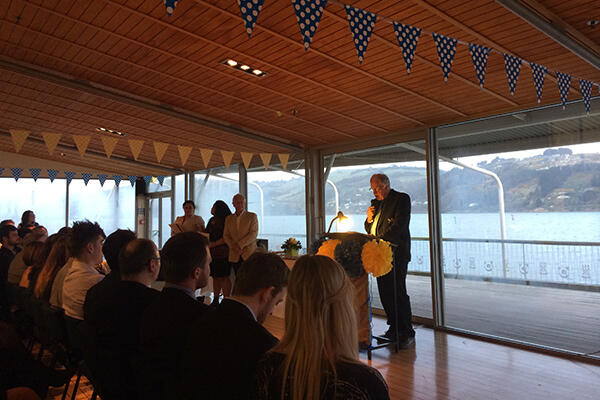
The University of Otago celebrated the success of sporting, cultural and service achievements at the annual Blues and Golds awards ceremony on Thursday 25 September at the University Rowing Club. OUSA Recreation Officer Henri Faulkner welcomed everyone to the event before introducing MBA lecturer and former Oxford University rugby representative Richard Higham as the MC for the evening. Higham really brought entertainment to what could have been a tedious hand-clapping session. Sportsman of the Year was awarded to Andrew Potter for his high achievements in rowing. These included his re-selection in the New Zealand under 21 team for 2014, his gold medal in the 5km and 2km under 21 Trans-Tasman rowing series and he won the best of three races in the St Petersburg State university test series. Jordan Housiaux received University of Otago Sportswoman of the Year, Maori Sportsperson of the year and an Otago Blue Award for her incredible achievements as a member of the New Zealand Paddle Ferns. Unfortunately, she was unable to attend as she was competing in the World Canoe Polo Championships in France. OUSA’s choice in Richard Higham as announcer was well received by the audience. When Tori Peeters received her University of Otago Blues for achievement in Athletics, Higham stated, “she is a person to watch – and I endorse that. She is a good looking person.” He also did a fabulous job at visualising the imaginary envelopes to announce award winners with, which OUSA failed to provide. Higham called on dancer Anna McBride who achieved her University of Otago Gold award, to show that she could actually dance and asked her to give a short tap performance, which she did abidingly – proving her ability and confidence on the dance floor. Kylie Price received a Gold Award for her success in music, having recently been announced as a finalist in the NZ National Country Music Awards for Female Country Artist. Price also performed a cover acoustic version of Joni Mitchell’s “Case of You,” despite the interruptions of a passing train. One of the most surprising awards was for OUSA Club Of The Year, which went to the Spear Fishing and Hunting Club. Despite only being two years old, the club has flourished with the support of OUSA. Alongside collaborating with other clubs for various events they held, they also put on “mean feeds.” Guest speakers Dr Graeme Downes and Alistair McMillan enthralled the audience with their insightful experiences as high achievers in music and sports, respectively. McMillan even went on to mention the small town of Twizel in his speech, verifying his well-travelled credentials. The most notable achievement of the evening was the Squash Club’s ability to not only be nominated for Club Of The Year for their achievements on the court and as a club, but also their ability to drink all the pinot noir before the awards ceremony had even begun.
-
News
Otago archives of early maori and european contact
The University of Otago’s Hocken Library will pave the way for influential research surrounding early Māori and European contact in New Zealand from 1808 to 1823. The Marsden Online Archive team will make Anglican cleric Samuel Marsden's personal, transcribed, hand-written letters and journals available on an online achieve, providing accessibility of the high-resolution images of manuscripts for researchers throughout New Zealand. Nine of Marsden's journals and 593 letters will be digitalised via the archive, which is set to launch in early November. Marsden's letters were to some of New Zealand's earliest missionaries, such as Thomas Kendall, William Hall and John King. These letters and diary entries outline early New Zealand life experiences, such as diet, culture and beliefs. It also includes the earliest written recordings of Māori language. Critic spoke to Marsden Online Archive Project Manager Vanessa Gibbs about the project. "The project commenced in September last year ... the project sponsors identified the bicentennial was coming up, so we aimed to have the archives ready by Christmas," said Gibbs. The establishment of the archive is to coincide with Marsden's first New Zealand sermon on Christmas Day, 1814. The new online archive will allow other researchers to search specific missionary or Māori names, dates, ship and place names to cut down on time spent analysing documents. The tool was made in collaboration with researchers from across disciplines. Gibbs noted, "We talked to researchers about what they needed from the site and they had some sort of ideas of what they would use it for ... There are some outputs already, for example Professor Tony Ballantyne has been looking into the language that was used. He's been looking at the key language that comes out of these documents." The project group has been talking to lecturers about using the archive programme in classes, as well as providing opportunities for classes to experience transcribing material. Use of the Marsden Online Archives will be available throughout New Zealand. "It’s completely open; the idea is that there could be people from the North Island who are interested. You don't have to be a researcher, you don't have to be a student to access this," said Gibbs. Plans for additional features of the database are being worked on, such as a space where academics can contribute to the scholarly conversation. There will also be an exhibit on 6 November at the Hocken Library, with early archaeological objects on show from this time.
-
News

Gecko geeks and preserving the peninsula
The Jewelled Gecko is one of Otago’s treasures. The lively green reptile is so rare and valuable that the location of its conservation sites cannot be disclosed for fear of eager poachers. Carey Knox, a herpetologist for EcoGecko Consultants, says the markings along their backs are like fingerprints, making each gecko unique. Knox works with the Department of Conservation (DOC) and Save the Otago Peninsula (STOP) researching the geckos and revitalising the natural landscape. There are over 100 species of lizard in New Zealand; 85 per cent are threatened or endangered. The jewelled gecko found in Otago and Canterbury varies in colour and pattern, but along the peninsula they are found in shades of lucid green and patterned with yellow, brown or white patches or stripes. With a price tag in the thousands on the European black market, the preservation team are hesitant to welcome newcomers to the area. Lala Frazer of STOP is hopeful that a recent change to the Convention on International Trade in Endangered Species of Wild Fauna and Flora (CITES) will repel prospective poachers. Raising native green gecko species from Appendix III to II allows poachers to be eligible for prosecution even once they have left New Zealand. Further, a Members Bill introduced by National MP Jacqui Dean in 2013 entitled the Conservation (Natural Heritage Protection) Bill has increased penalties designed to protect wildlife. Knox’s group Gecko Ecology and Conservation Otago (GECO) has become a way for enthusiastic science students to get up-close and personal with the peninsula. Frazer could barely contain her pride at having a group of enthusiastic youths continuing STOP’s work. The struggle for Knox, STOP, and the peninsula is funding. While donors sponsor many of New Zealand’s native bird species, most lizard species live under the radar. Conservation efforts are at the mercy of DOC’s tightening budget, an issue that Green Party MP Eugenie Sage speaks out against. “[DOC] is investing more in community partnerships, but for these to work, there needs to be more technical support. Funding cuts are stretching the resources,” she says. Until the funding can be increased, Knox’s next gecko mission is in the Catlins, where he has the chance to scope out the nationally endangered Southern Forest Gecko. Due to the species being hard to spot, Knox is testing new methods of detection, including an innovative foam cover attached to trees, and hopes to discover new populations. The world of lizard research and conservation is remarkably underground given the number of native species New Zealand has at its disposal. Despite the potential stumbling blocks, there will continue to be a team of dedicated gecko enthusiasts committed to the little-known world of the Jewelled Gecko. They welcome fellow lizard lovers – if you can find them, that is.
-
News
Otago students ignite dunedin in all the right ways
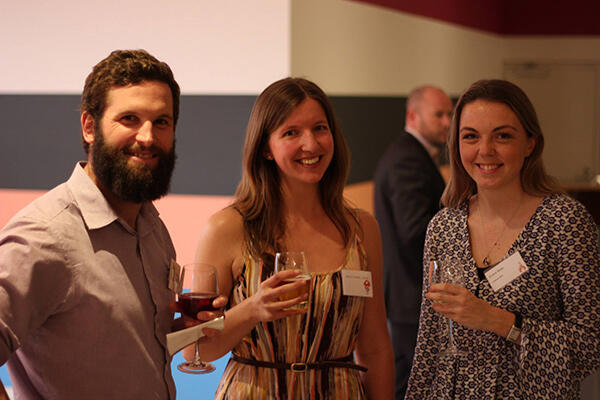
A group of 20 Otago students have injected their time and talents into Dunedin not-for-profit organisations as part of the Ignite Consultants program, blowing away expectations from the organisations involved. In the presentations evening held at the Dunedin Art Gallery on Wednesday 24 September, the four groups presented their organisation, the issues they were trying to resolve and their action plan. Some of the consultants’ recommendations included introducing a student intern to the Dunedin Curtain Bank, creating a triage procedure at the Community Law Centre to prioritise clients, establishing membership benefits at the Otago Settlers Museum and enhancing Dunedin Night Shelter’s event “sleep out” to create awareness for the entire community and to get local schools on board. “Not everyone has the skillset to fulfil the roles within not-for-profit organisations,” Ignite Consultants CEO Alex Devereux told the audience of approximately 50 people, reasoning why the diversity and skills of the students is invaluable to the organisations. “Our main goals are developing student leadership and improving student reputation within Dunedin and New Zealand. Not all students are couch-burning, binge drinkers,” Devereaux added, before the students presented how willing and capable they are of giving back to the community. Over the eight-week program, the four groups have been involved with four non-profit organisations in Dunedin: The Dunedin Curtain Bank; Community Law Centre; Otago Settlers Association; and the Dunedin Night Shelter. After each groups’ presentation, a representative from each organisation was invited to speak and there was a common theme of sincere gratitude and praise for the students. “The detail is amazing, we’re astounded,” commended Dunedin Curtain Bank’s Lisa Ford. John Le Brun from Dunedin Night Shelter recognized the impact Ignite is having on the Dunedin Community. “Ignite is making a big difference in a small city,” he told the audience of approximately 50 people. The students study a range of degrees, from law to history to pharmacy, adding diverse perspectives that combine to achieve the great results and make positive changes within the community. This year saw over 100 applicants for the program, a sign it is becoming increasingly competitive and a sought after CV enhancer. With the recent addition of a former Otago University Vice-Chancellor, Sir David Skegg, as Patron, Devereaux believes the organisation’s perceived credibility will only strengthen. The Dean of Commerce George Benwell said, "The Commerce Division, has provided space, housing, some operation expenses, furniture, business contacts and moral support and leadership advice." However, he adds, "But you know, none of that really counts. It is the dedication, the giving and the generosity of the students themselves that makes Ignite a success. What I give, other than thanks, really doesn’t matter." The Otago Settlers Association group summed up the evening with a present they gave to their mentor, Laura Black: a ring engraved with “Live, Laugh, Ignite.”
-
News
Proctology | Issue 25
All the Halls of Residence are now on alcohol ban, in preparation for the exam period. The Proctor notes, “This doesn’t mean their residents will stop drinking [but] it does seem to mean they will buy vast quantities of alcohol and sit in gardens and parks and drink it there.” The Proctor does not seem to agree with this policy though, saying that this ends up with students “peeing and breaking shrubs” at the local parks and gardens. He suggests, “It’s perhaps a good idea to forget about the alcohol and study and sit the exams.” The Blue Penguin Society has been cleaning up debris in the Leith River. “Young girls and old men” have been cleaning out the river, which contains mostly rubbish from a lot of flats on Leith Street Central. Campus Watch has visited all the flats and asked them to be considerate because they are “strangling penguins and things with your plastic bags.” A group of lads walking along Castle Street decided to place motor scooters on top of cars. The young women who owned the scooters jumped on their scooters and “raced after them and gave [the hooligans] a good description of their intelligence and hereditary.” They then passed on the delinquents’ names to Campus Watch. The Proctor says that they are now saving their money to pay a $150 fine and there will be compensation and apologies to be made. The Proctor advised students not to go behind the bar, steal a bottle of spirits, and then run on the dance floor and down the bottle. A student “got leapt upon by a large angry man.” The large angry man was security. The student was called upon to the Proctor and will be fined. The Proctor recently advertised for a new Campus Watch patroller for the academic year and, after receiving 93 applications, said he was “interested by the number of people who want to work with us, or just people wanting a job.” Campus Watch is also getting a new control room. It will be a “state of the art” centre, completed within the next couple of weeks. The Proctor does, however, assure students “it won’t be up to the standards of an emergency response centre.” Critic advises students, in the case of an emergency, to dial 5000. Unless it really is an emergency, in which case 111 will do.
-
News
Aaron Cruden and the irony of alcohol sponsorship of sport
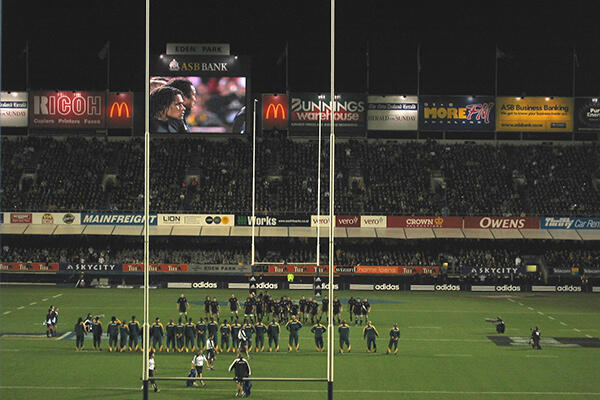
To the rugby desk, where a few weeks ago I touched on the subject of the media’s relation to sport and how it can be used as a positive or negative distraction from real issues. A timely example came immediately following a long and eventful election campaign when it can be difficult to fill a Monday news bulletin with anything actually newsworthy. Last week as Team Key celebrated smugly and with their smear campaign against the left complete, the media had to find a new bogeyman to demonise. So what is the solution for a post-election slow-news day? Create a controversy around a rugby player’s night out on the town and saturate your news bulletin and websites with multiple ridiculous reports about it! What is all the fuss about? Well, the All Blacks’ flight to Argentina was cancelled so the team had an unplanned extra night in Auckland and, with the permission of management, some of the lads went out for dinner, played some pool and had a few beers. Sounds fun. The party continued on and Aaron Cruden got separated from the rest of the group, who got back to the team hotel at a reported “reasonable hour.” The ONE News team seemed perplexed as to where he went and why (not that it is really any of their business). Was it an alien abduction? Did he spontaneously combust? Was he converted by Mormons and sent away as a missionary? Chances are that he hooked up and went off to try his luck. Good on ya, mate. The end result was that Cruden didn’t show up for the flight to Argentina the following morning and was subsequently cut from the team for last weekend’s test in Buenos Aires and this weekend’s decisive trip to South Africa. I get it, he let the team down but, no, it’s really not a big deal. Let’s all move on with our lives, shall we? How many of us have gotten on the rinse during the week and then been a no-show at your POLS lecture the next day? Pretty much the same thing here. All Blacks coach Steve Hansen gave his verdict on the subject with his typical monotone delivery that made it sound like he would rather be out drinking himself rather than fronting to the media. Reading between the lines of what he actually said suggested he really meant to say: “Yeah, Crudes had a few too many and stayed out late on the hunt then missed the plane, but we have plenty of quality Number 10s, so fuck off and do some real journalism, you hacks.” What Hansen actually said was: "He understands there has to be a consequence for his actions. Once we get this out of the way, he'll be coming back into the group when we go to Brisbane," and that Cruden's actions “were out of character.” What was also out of character was the rather polished and articulate statement that Cruden released to atone for his sins. His normal chat is usually full of “bro,” “cuz” and “sweet as.” That’s all pretty normal for a young guy from Palmy North. However, his rather lettered response said: "I accept full responsibility for my actions and the penalty of missing the next two games, and I will work with New Zealand Rugby to undertake any other disciplinary action to work through this situation." Whoever wrote this continues to embarrass Cruden further, saying: “I carry the burden of shame and disappointment and I am deeply apologetic to my team, to my family, and also the New Zealand public.” Wow, that is some soppy PR bullshit if I have ever heard it. Most Otago students “carry the burden of shame and disappointment” every weekend after a few bottles of Scrumpy, leading to some rather vague and hazy Technicolor memories of the Boogie Nites’ dance floor. I get so sick of the media framing these guys as infallible and suggesting that they should have to play by different rules than the rest of us. All of this OTT media coverage was very quick to paint Cruden as some sort of folk-devil who took one sip from Satan’s poisoned chalice and ended up going on a Charlie Sheen-style bender that ripped a hole through New Zealand’s social and moral fabric. Maybe only the 86,000 Conservative voters were actually upset by this latest “scandal” but most of us know and accept the everyday binge drinking reality of our booze-soaked society. Also, these sensationalised media reports contained more than a healthy dose of irony, as the faux outrage and anti-alcohol rhetoric sound bites were being played over B-roll footage of Cruden tearing it up on the field in front of the massive advertising hoardings belonging to sponsors like Heineken, Steinlager, Speight’s and Waikato Draught, to name a few, amongst various other wine and beer companies from Australia and South Africa. Sends a bit of a mixed message, don’t you think? It seems fine for the team to take sponsorship money from these alcohol companies and display their logos everywhere, giving the impression that alcohol and sports is a marriage made in heaven. But the second some of that sponsor’s product passes the lips of one of the men who has been directly promoting it, the media leaps at the chance to tear them down for what millions of Kiwis do every week, which is getting drunk and staying up all night to get lucky.
-
Columns

ODT Watch | Issue 25
A young woman has been awarded a literary award for tweeting. What a sad time we are in, when tweeting is being acknowledged as literature. It won’t be long until they start awarding the best YouTube comments. Even this woman stopped her limo on the way to get married to make her vote count! If she could make the time to vote on her wedding day, we wonder what the excuses of one million non-voters are. Regardless of the “not for human consumption” label on incense packaging, or even the potential lung cancer risk of inhaling the smoke, we’re quite impressed people can bear to be around the overpowering smell of incense long enough to get a high! The article reveals the ODT bought a packet of the very popular “Firebird” incense … explains a lot. What a breakthrough. A grown man, and a real estate agent at that, sent a sack of shit to a rival agent. The bag, apprehended by Police, was sent to experts for further examination because, apparently, if it “looks like faeces and smells like faeces, it’s still not necessarily faeces.” The ODT is gobsmacked: this article expresses surprise that students are actively engaged in activities that don’t involve pissing around and/or booze. Turns out we’re not all duds, contrary to popular belief (read: ODT). It seems some driven young students engage in a voluntary consultancy agency, Ignite Consultants, to enhance not-for-profit charities.
-
News
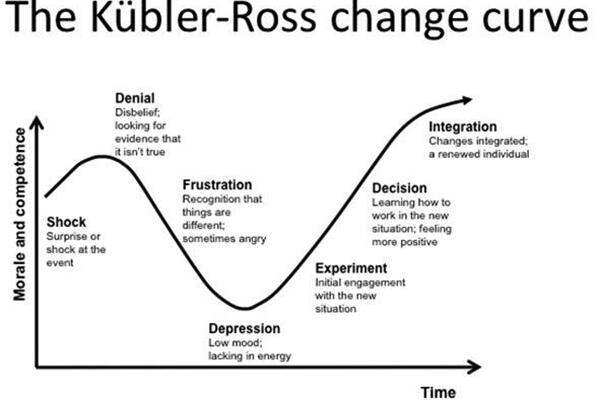
Critic (still) tackles election year
After the initial shock of Election Day, where, for all intents and purposes, nothing changed, have come the autopsies. For the left, whose momentum towards the end came from the revelations about the inner workings of the National Party as much as it did from their own parties’ merits, the result is frustrating. Nandor Tanczos, past Green MP, linked the graph above. While I never got so far in the denial stage to sign the petition for a recount of the results, it was frustrating to see so many people ignore the lies and what is going to happen to our environment in light of a third National government. Moreover, I just couldn’t see how it happened, when support seemed so strong. The question, for many, was “what went wrong?” Thus, the post mortems have come thick and fast, a blend of statistical polling booth analysis and emotional reflections; and an abnormally long Labour caucus on Tuesday that left a pack of journalists outside with only Twitter to comfort them. In reading through the wide variety of interpretations, one thing became abundantly clear: I live in an echo chamber. Beyond the hive of Young Nats, the majority of people I associate with are lefties; much of the political engagement I feed off inevitably comes to the conclusion that if people “understand” or have “empathy,” they’ll vote left. It’s only in the wake of the election that I’ve come to realise how dangerous this is. To be fair, I still believe that my party is the most empathetic and has the most comprehensive policies, but that’s what being in a party is about – this is not a critique of policy or marketing; this is a critique of myself, and others like me, who see progressive politics as inevitable purely because they’re progressive. Being on the right side of history is a thrilling prospect; it brings with it a relentless idealism that assumes our time will come, that people will realise this and jump on board. Well, they haven’t jumped; they’ve stayed on the shore. I took to Twitter to crowd source answers about why the National Party gained a much higher proportion of the Otago vote (37 per cent at the University polling booths, exclusive of the extortionate number of special votes, which haven’t been counted yet) than I anticipated; especially given the plethora of resources that indicated the left is better for students, women, the climate, you name it. Interestingly, this attracted David Farrar, who, unlike a certain member of the Young Nats, hasn’t blocked me on Twitter after my Nicky Hager article. The discussion generated two distinct factors, both of which I found useful and had suspected previously. First, the simplicity of the National messaging and the streamlined nature of the right-wing campaign in combination with a right-leaning media meant the YNs were easy to absorb for non-political students. If you sit on the right, the imagery is pure and clear: blue. The intensity of the right wing focus on voting for National was all consuming and probably effective. The second factor is the plethora of voting information that saturated the political sphere for months before the election. There was guide after guide, group after group, all providing reasons why voting for the left is better; but very little of that energy was dedicated to encouraging people to do as such. In its breadth, this information probably became white noise and off-putting to those who just didn’t care. While the raucous celebration of progressivity got louder and louder for those of us involved, a number of students fell through the cracks and we didn’t notice. One of the YNs responding to my Twitter question noted, “it indicates that student politics is not representative of students, and majority of student voices are passive.” All of the ruthlessly nonpartisan campaigns and analysis groups appealed not to the non-voter, but to each other. Thus, the young and left echo chamber was born. It also points to a wider issue in the way the left assumes informed voters will vote left. Much of the energy of lefties was spent, this campaign, on education; the assumption being that if the facts are hung out in full view, people will come to the “correct” conclusion. As we’ve seen from this election, this just isn’t the case. Providing analysis is, of course, an incredibly important activity. Educating students and wider New Zealand should undoubtedly be the focus of some election groups, as no one should ever enter the polling booth uninformed. Where it becomes problematic is where you add party lines. The conservative youth didn’t campaign on educating students, their message was clear and simple: vote National. To be honest, it has only been the progressive student groups who have focused on educating their peers; thus drawing energy and manpower away from political groups who would’ve undoubtedly benefitted from their help. George Lakoff, an American professor of cognitive science, has long since criticised the progressives for framing and campaigning poorly. He argues that in order for the left to get back on track, what must happen is “the abandonment of argument by evidence in favour of argument by moral cause; the unswerving and unembarrassed articulation of what those morals are.” According to Lakoff’s analysis, if the New Zealand left are to draw in the students and the apathetic, we can’t rely on the evidence-based resources that we did this campaign; and rather than pointing to a column on a graph that says Internet-MANA is strongly for students on the assumption that someone will absorb it, there needs to be the ruthlessly on-message intensity of the Young Nats’ campaign, however cultish it can seem from the outside. Lakoff further notes, “political ground is gained not when you successfully inhabit the middle ground, but when you successfully impose your framing as the 'common-sense' position.” If nothing else, this might help to explain why New Zealand First’s “It’s just common sense” resonated with enough of the population to gain nine per cent of the vote. In all honesty, it’s a catch-22. The job of educating students politically is one of the most important there is; but if it’s mainly initiated by people who’re members of Labour or the Greens, that leaves said parties with a substantial amount of their youth membership unwilling to express their party lines. If politics is as simple as popularity, it’s necessary that these parties seem popular. Perhaps, after all our effort, it comes down to this: people don’t want to be told how to make up their minds; they want to be told who to vote for.
-
News
Greatest hits / Greatest shits | Issue 25
Greatest Hit Without a doubt, Greatest Hit this week goes to John Oliver. Oliver is an American comedian who hosts Last Week Tonight, a show that essentially points out all the ludicrous things that have happened around the world. Last week, New Zealand featured! There’s nothing like a bit of international attention to put it all into perspective; Oliver had an enjoyable time mocking Steven Joyce’s flaccid defence of the Nats in Eminem’s lawsuit. “Pretty legal,” noted Oliver, is the same as “pretty dead.” Greatest Shit Kelvin Davis gets this one. Although a number of Labour supporters would’ve been happy he locked out Hone Harawira in Te Tai Tokerau, I personally think it was both damaging and ridiculous. The Nats actively encouraged their membership to vote for Davis, and in combination with Davis’ intense and public dislike of Kim Dotcom, it was enough to give Davis the seat. As a result, Internet-MANA got no seats. I, personally, would’ve liked to see Laila Harre and Winston Peters go head to head.
-
News
Politweets | Issue 25
Don’t we all. Whoops. Unfortunate. Breaking news.
-
News

Dunedin Craft Beer and Food Festival - Critic's pick of the crop
This Saturday 4 October welcomes back the Dunedin Craft Beer and Food Festival, organised by OUSA. Bridging town and gown, there’s something for everyone – the average Scarfie can (oddly) have their usual Speight’s and drink it too, while the more discerning palate can opt for something a bit more, well, crafty. It may not surprise readers that the team at Critic isn’t overly fond of the usual piss found in Scarfieville and we have thus experimented with a wide variety of hops. Here are our selections ... A sessionable sessionNot too intense but nor are they boring. Tuatara Wellington brewers Tuatara have really taken off recently. Heck, their volume is large enough to justify custom-made bottles featuring an imprinted tuatara spine. But the scale of the operation has certainly not been at the expense of their brews – staples include the smooth Helles Lager and a very sessionable take on the New Zealand Pale Ale in their Aotearoa Pale Ale. These feature alongside some more experimental work, such as the monster eight per cent Tiramisu Barrel Aged Stout. Their “Iti,” too, is an amazing big-hopped APA (American Pale Ale) that would hold its own well in the Hit the Hops category below. It slams you with huge flavour up front but without the drunkenness – at 3.3 per cent it’s arguably the most sessionable APA we’ve had. Emerson's How can you go past Dunedin’s favourite (and, by its age of 21, one of New Zealand’s earliest) true craft breweries? Critic recommends initially skipping on the usual Pilsner and going straight to the Festival specials. There’s a Salted Caramel Brown Ale and a Golden Bookie, alongside two other Brewer’s Reserves – Bald Eagle and The Rapture, both of which are heavy-hitting IPAs (India Pale Ales). Revert back to whichever of their standard brews you fancy after that – they’re all delicious and absolutely sessionable. Staples include Pilsner and 1812, which is an easy-drinking pale ale. Funk Estate Another brewery from New Zealand’s craft beer, and actual, capital, Funk Estate is relatively new on the scene but is certainly not lacking. The Parleyer Pilsner is a true staple, and the Sophisticuffs IPA is, as the team says, “funkalicious.” To be fair, the other beer that they’re bringing, Super Afro-disiac, isn’t exactly the sessionable type – coming in at a whopping 8.2 per cent – but it’s well worth mentioning. Released on 14 February every year, it combines such ingredients as honey, cacao, fig and chilli, and shouldn’t be missed. Likewise, we can’t wait to try their aptly named “Jam Grenade” when it arrives in Dunedin for the first time. Critic's supreme pick of the breweriesParrot Dog We can’t emphasise enough how exceptional this team from Wellington is. They haven’t yet got the same name recognition as fellow Wellingtonians Garage Project and Tuatara, but their brews certainly propel them above and beyond. We recommend parking up and trying everything on tap. Yes, everything. Start with the Bloody Dingo – a seven per cent Imperial Red IPA. Brewed with the explicit intention of “exploding taste buds,” this is a beer that perfectly exemplifies how flavour can dynamically evolve throughout the glass. Hard-hitting hops at the start are soon overridden by a full-bodied malt, before bouncing way back into the hop territory on the aftertaste. It’s no surprise this beer recently won the trophy for being best in its class at the 2014 Brewers Guild of New Zealand Awards. In fact, if anything asserts Parrot Dog’s status as the premier beer at this festival, it’s these very awards – all eight of the beers the brewery is serving won a medal. That’s a hell of a haul. As hop heads our top recommendations are the Bitter Bitch IPA, the Bloodhound Red Ale, and the Pit Bull American Pale Ale. Hit the hopsCritic has a heavy bias towards the dankest hops – different hops have huge variation in flavour and seem to have found themselves as the focal point of New Zealand’s craft beer movement. 3 Boys IPA This was the first IPA your humble reporter ever had, and it was mind-blowing. Returning to it as a heavier hophead doesn’t give you the giggles like it used to, but it’s a great gateway IPA and could very well do the same for other IPA virgins this weekend. It’s unique in its style for not being dominated by hops; rather it’s a dark, malty brew. You’ll find it at the Beer NZ stand. Garage Project’s Garagista Okay, we have to admit it – we haven’t actually tried this one yet. But going by Garage Project’s track record we’re more than comfortable recommending it. The brewery notes that it’s brewed and double dry-hopped with New Zealand, Australian and American hop varieties, so it should whack a powerful hop hit at the front of the mouth. The reason for our confidence is that Garage Project produces a number of crown jewels of flavoursome hoppiness. “Death from Above” in particular (not featured, unfortunately) features hard-hitting citric American hops in combination with what can only be described as a Vietnamese mango and chilli salad-taste. And, indeed, these are the ingredients used. The beer’s imagery is even derived from the poster for Apocalypse Now – a swarm of Hueys approaching a field of hops on a dulling, hot sunset. And what do you know, its original name was going to be Hopocalypse Now. Nailed it. Brew Dog Hardcore IPA Here’s a token international appearance for you – a HUGE buzz-out of an IPA from Scotland. At 9.2 per cent, you should probably save it ‘til last, but still be sure to try it. Quite frankly, the brewery’s tasting notes describe it perfectly and it’s be a shame for us to re-hash them: “2,204 malted Maris Otter grains gave all they had to offer the world to provide the robustly delicate toffee malt canvas for the ensuing epic. Four hop cones willingly sacrificed themselves to ensure your mouth feels punished and puckering for more. 9,900,000,000 yeast cells frantically fermented their little hearts out as the sugars became alcohol in the depths of our fermentation tanks.” Have some Kereru funThis brewery falls under the Crafty Beers banner at the festival, but they’re bringing a great selection that serves as an exposé of the varied, experimental wonder they’re capable of. For Great Justice, a wood-fired coconut porter, has been described by some of us as akin to drinking a Bounty Bar. At 4.5 per cent you could drink it all day if you felt like it, and it’s popular among beer-lovers and haters alike. Their other out-there brew is the Kereru Karengose, a five per cent “gose,” which is a German wheat beer brewed with salted water and lactic acid. The Kereru twist comes in the form of Karengo, which is a pruple seaweed found in Kaikoura. This beer in particular, to be quite frank, we fucking love. Tasting NotesNo, you’re not a wanker if you treat beer tasting as similar to that for wine. There are four steps in the correct tasting process: see; smell; sip; and swallow. Don’t be afraid to spend a prolonged period of time with each beer and really get to know it. See – you want to tip the beer away from you and look through the comparatively thin layer near the rim of the glass. This gives all sorts of hints and can be treated as preparation for the flavour buzz you’re about to immerse yourself in. A key rule to remember here is that colour correlates to the type and amount of malt used, and opaqueness correlates to filtration and/or levels of wheat and hops. Smell – Imitate your favourite wine snobs: swirl the glass before giving it a big nasal inhale. Remember that scents and flavours will often evolve at different points in the drinking process, so be sure to constantly check back in with your nose as you work through the glass. Sip – Yup, here’s the good bit. It’s difficult to describe exactly what to do here but mouth swirls and inhaling over a mouthful are both good ways of picking up accents based on viscosity and play-offs between different flavours. You should also note how the flavour evolves over time. Swallow – There is a lot more, taste-wise, to the swallowing act than you may be led to believe, and for that reason you should never, ever spit. For example, a hoppy IPA will often develop a completely different flavour as it disappears down your gullet.
-
Features

Alien speculations and human chauvinism
On 24 June 1947, private pilot Kenneth Arnold reported seeing a string of nine, shiny, unidentified flying objects flying past Mount Rainier at speeds of over 2,000 kilometres per hour. He described the objects’ movement as being “erratic, like a saucer skipping over water.” A newspaper journalist misinterpreted his words and reported that Arnold had seen “flying saucers,” and a phenomenon was born. This was the first post-WWII sighting in the United States that garnered nationwide news coverage and is credited with being the first time that alien encounters were taken seriously as real things outside of science fiction. Stories of alien encounters include UFO sightings, little green men, anal probes, alien lovers, mind control, crop circles, cattle mutilations, and other wonderful things. People have fantastic experiences, which they believe are alien abductions. While I don’t think it is impossible that aliens could visit us, it is remarkable that many alien encounters come across sounding like weird wet dreams. Would aliens travel billions of light years across to the universe to see what is up our bums? Our speculations on alien encounters often put humans, and even individual humans, at the centre of the experience. The similarities between eye witness accounts of what aliens look like has been used as evidence that they are real, but could conversely be seen as evidence that the encounters reflect pop-culture. The first depiction of a grey hominid alien with a bulging head and large, almond-shaped eyes was in an episode of Outer Limits in 1961, and the image had stuck with us since. This is an example of our unwarranted human-centric idea of aliens; as human-level intelligence in a bipedal primate species has only occurred once, by chance, on Earth, the likelihood of it happening again is practically nil. Or is it? Palaeontologist Simon Conway-Morris thinks it is actually quite likely that aliens would look like us. He also says given the way evolution tends to unfold, dinosaurs, had they not become extinct, may have evolved a highly intelligent bipedal reptilian humanoid. He believes that intelligence is conducive to the large head, forward-facing eyes, free hands, and upright stance of a human. Though the source is reputable, Conway-Morris’s theory has largely been dismissed as an example of human chauvinism, where we see our own example as the most logically superior idea. After all, of all the primates who have evolved on Earth, humans are the only ones to have evolved our level of intelligence, with the possible exception of Neanderthals, whose intelligence didn’t help prevent their extinction well before they had the chance to develop space-travelling technology. And the surviving non-human primate species don’t appear to be increasing in intelligence as they evolve, as there is no need for them to in order to survive. Our chauvinism about alien life extends beyond pro-primate assumptions. As Psychologist Michael Shermer puts it, “We are carbon chauvinists, oxygen chauvinists, temperature chauvinists, vertebrate chauvinists, mammal chauvinists, among many others.” But there are some assumptions that can be tentatively made about alien life. Biologist Richard Dawkins assumes that alien life will be Darwinian life, in that it will have evolved from simple forms into more complex forms, with something resembling (or even identical to) DNA or RNA. If the DNA is not made of carbon as Earth DNA is, it will be made of a substance with similar properties capable of “storing” information with which to replicate itself. He also predicts that, given enough time, aliens will evolve eyes, because they have evolved many times over on Earth and give an organism a massive evolutionary advantage. Similarly, our open-minded ideas of aliens being very different to us, in the form of giant glutinous blobs, sentient gases, or slithering worms may also be unlikely. If the creatures come from a planet with a sold terrain like our, then legs are an advantage, just as they are on earth. If they naturally live underwater, they would benefit from having fins to swim with, just like many sea-creatures. So if they come from an Earth-like planet, there may be a good chance that alien life will resemble Earth’s creatures in some way. Humans usually assume that whatever the aliens’ intentions are, they will care about the human race in some way, whether as novelty creatures to be studied, equals to be communicated with, or resources to be farmed or harvested. But why would aliens ransack our tiny world for resources when there are whole uninhabited planets made entirely out of water, diamonds, and metals floating around in space? Why would they want to give us their knowledge and have sex with us if a human is, to them, the intellectual equivalent of a hamster? How can we expect to ever be able to relate to an alien species when we can’t even be kind to chimpanzees, with which we share almost our entire DNA? We can’t even get along with other humans particularly well, or communicate well with someone who doesn’t speak our language. Scientists believe that the absolute best possible scenario for communication with intelligent alien life would be if we could exchange maths with them. Alien encounters used to be portrayed as malevolent colonisations, destroying or enslaving the human race. More recently, alien encounters have been characterised by the New Age movement as potentially enlightening meetings with superior, benevolent beings. Cognitive psychologist Susan Clancy sees this kind of belief in aliens as offering similar benefits as religion – meaning, reassurance, mystical revelation, spirituality and transformation. But why would an alien species travel all those light years just to tell us to be nice to each other, to have faith and to love? We all tell each other those things anyway. Some time-and-space-defying maths would be far more useful. New Age ideas of alien encounters are even more self-obsessed than those of science fiction, in that they focus on the experience of the human and the benefits we can gain from their knowledge and our relationships with them. Have you ever had patches of memory missing that you couldn’t account for? Have you ever woken up conscious but unable to move? Have you ever dreamt of having sex with an alien? Do you have any unusual markings that you can’t remember the source of, like bruises, cuts, or spots? According to regression therapist Barbara Lamb, aliens may have abducted you! One of her patients has memories of having married an alien, an amazing cat-faced primate whom she has drawn pictures of, and having borne him four children, two of whom live on Earth. I believed in alien abductions as a teenager around the time I also happened to have bouts of isolated sleep paralysis (ISP). I’d wake up in the night completely paralysed but conscious, with a roaring static in my ears and a deep feeling of dread. Sometimes my thoughts would mingle with dreams that were so lucid I believed I was having some sort of out-of-body experience. Terrified, I told my parents about it, who thought I was making it up. Then my uncle happily told me that it was an alien spirit. I interpreted the alien as having the form of a radio wave, which entered my body through my chest at night. For a while when I was about 15 I suffered through bouts of sleep paralysis almost nightly, and one night it happened over and over again until I was a near jibbering wreck. For sure, I was scared but, worse than that, I thought I was special. I thought the aliens had selected me for a special purpose. The last thing a teenager needs is to be convinced that some paranormal force is working through them. Thinking I must have gained some kind of superpowers, I convinced myself I could see auras, the future and the fabric of time. Luckily my friend told me people were starting to say I was crazy and, thankfully, I shut up. What I was going through was a very common form of ISP in which a person regains consciousness before the natural bodily paralysis that helps us to sleep peacefully has retreated. While we now know its probable physiological cause, different cultures have had varying traditions to explain what ISP is. In Scandinavia, it is a “mare,” a damned woman whose spirit leaves her body when she sleeps to sit on the rib cage of villagers to give them terrible nightmares. In Fiji, the sufferer is being eaten by a demon. In Nigeria, it is the devil on your back (in North America, it is an old hag or a witch on your back). In Turkey, the culprit is a supernatural being called a jinn that is trying to strangle the sleeper. In Thailand, it is a spirit that can reportedly leave physical bruises, and in Eastern China, a mouse who steals your breath. If you haven’t experienced sleep paralysis, these descriptions give some idea of how real and distressing the feeling is. But now, with the recent invasion of aliens into our social consciousness, it is common to credit ISP to alien abduction. If you believe aliens have abducted you, there are people who can help you remember what happened. Hypnotic regression therapy is a form of psychotherapy by which people believe they can uncover repressed memories years, or even decades, after they have been forgotten. Leading questions can manipulate people into constructing memories that never happened. The therapy assumes the brain is like a video tape recording its observations perfectly and then keeping or erasing them. But there is no recording device in the brain. Memories are pieced together in a kind of patchwork created by a combination of association between things and events in the environment. Repetitive replaying of a memory in your head is likely to alter it, so sometimes the memories we think we remember best are actually inaccurate. And we are highly susceptible to suggestion. In an American experiment in memory fabrication, adults were shown photoshopped pictures of themselves as children, doing things they had never done, such as riding in a hot air balloon or on a sailing ship. 33 per cent of people claimed to not only remember the experience, but could add details of their own describing what happened. I am in no way saying that people who report alien encounters or uncover repressed memories are liars or fantasists. The memories are real and may create real joy or trauma for their host. Barbara Lamb says, “When we do the regressions, it is like reliving the whole experience that they do not consciously remember.” What is actually happening may be the exact opposite – rather than uncovering memories that have been forgotten, the therapists are implanting new memories that never happened. The most damaging manifestation of this is when a patient is led to believe they have experienced some kind of abuse as a child. In the 90s there was a spate of people recalling their parents being part of satanic cults who they had witnessed murdering babies. In 1992 Missouri woman Beth Rutherford received an out-of-court settlement of $1 million from her ex-therapist for implanting memories in her mind that led her to believe her mother and father had repeatedly raped her as a child, and forced her to give herself two abortions. Tragically, she believed the memories were true until a medical examination revealed that she had never had penetrative sex or been pregnant. This is not to say that the memory does not now exist and the person is making it up. Implanted memories can be as real in the mind of a person as any real memory. Memory is malleable. Repressed memories have more to do with our own brains than extra-terrestrial beings. NASA has recently reported that we are probably not alone in the universe and that alien life will be found in the next 20 years. Italian physicist Enrico Fermi calculated the likelihood that aliens have arrived on Earth. He reasoned that any civilisation with rocket technology and some imperial incentive could rapidly colonise an entire galaxy, and, given the age of the universe, this has almost certainly happened, and actually should have already happened in our galaxy, so the aliens are here somewhere. This is called the “Fermi Paradox,” and has been compared to the horror story of a jigsaw puzzle that turns out to resemble your bedroom, with the final piece being a monster at the window, and when you turn around, the monster really is there! Perhaps even creepier is the “Simulation Argument” conceived by philosopher Nick Bostrom. He argues that if at least one of the following propositions is true, then we are currently living in a virtual simulation of reality: (1) the human species is very likely to go extinct before reaching a “posthuman” stage; (2) any posthuman civilisation is extremely unlikely to run a significant number of simulations of their evolutionary history (or variations thereof); (3) we are almost certainly living in a computer simulation. It follows that the belief that there is a significant chance that we will one day become posthumans who run ancestor-simulations is false, unless we are currently living in a simulation. If you combine Fermi’s Paradox with the Simulation Argument, then you can conclude that we are almost certainly living in a computer simulation fabricated by our alien colonisers. Maths + philosophy = doom. Fermi’s Paradox comes with the assumption that it is normal for intelligence to evolve. However, in our own world, human-level intelligence has only evolved once (as far as we know) with no other animals getting close to our mental capabilities. We are biased in thinking that intelligence is the most important factor in world domination. We are not the dominant species on earth. Beetles outnumber us millions of times, and bacteria trillions of times. Humans could be seen as mere vessels to harbour our microbial rulers, which keep many steps ahead of us by their rapid evolution and will certainly outlast us. Speaking of evolution on Earth, what if “alien” life doesn’t come from space at all, but from somewhere closer to home? We have two entirely different eco-systems on earth – land and sea. Humans have explored less than two per cent of the ocean’s floor, because it is so expensive to do, and is apparently fairly boring, thus far yielding not much more than some weird species of fish. There could, conceivably, be life-forms rivalling humans in intelligence who live in a place so disconnected to us that we haven’t been able to cross paths (unless their technology allows them to surface and probe us at night.) Vastly superior intelligence is incomprehensible to creatures like us. We are technically much more intelligent than cats, but cats probably believe us to be intellectual equals, or (maybe more likely) much less intelligent. My favourite analogy of aliens existing among humans came from David Wong at cracked.com. He points out that humans can often successfully convince other animals into thinking they are one of them by a simple trick, such as dousing themselves in the animal’s smell or putting on a costume with the appropriate markings. This can make the human completely undetectable to the animal. “If there was another species who wanted to study us the way we study gazelles or rare birds, if they’re that much smarter than we are to these animals, they would absolutely have ways to walk among us that are absolutely undetectable. In movies we always portray aliens as really clumsy in how they do it, like they don’t know how to mimic human emotion or they don’t understand love. We’re kind of insulting the aliens when we assume that. Just as we know how to smear animal urine over our bodies, they would totally know how to imitate love and charisma and all of those things.” Our human chauvinism may be useful in speculating what an alien encounter may actually be like, but it could be pretty boring. Realistically, we are far more likely to come across alien technology than the aliens themselves. The Search for Extra Terrestrial Intelligence (SETI) began sending out radio transmissions in 1960 as a signal that there is intelligent life on Earth. We may encounter aliens by their radio signals, discarded debris floating in space, or by a contraption sent out for space exploration. Like the robot rover Curiosity exploring the freezing, toxic surface of Mars, it is far safer and more logical to send machines into space than animals. With our diet of alien movies and real stories of alien abductions, it may be disappointing if our first verifiable alien encounter (if it ever happens) is a single-cells organism, a piece of space trash or a bit of maths.
-
Features

The master cleanse
For nearly 70 years, the Master Cleanse has existed to “detoxify” and shed unwanted pounds. Stanley Burroughs, who is conspicuously missing a “Dr” from his title, created it in the 1940s. Regardless of whether or not detoxing is a legitimate concept (it isn’t), the Master Cleanse has been at the forefront of “quick-fix” crash diet trends for years: Beyonce credited it for attaining a “Twiggy” figure before filming Dreamgirls, and Yolanda Foster does it once a year, urging her Twitter followers to join in. The Master Cleanse seems terrifying and unhealthy, but if masses of Instagram users can survive it then so can I. I will give up food, and only consume the supposedly miraculous mixture: two tablespoons of lemon juice, two tablespoons of B-grade maple syrup, and a pinch of cayenne pepper, all mixed with a cup of water. Along with me for the metabolic ride of a lifetime is my mate Kate, who has a much stronger will than I. Together we will shed unwanted pounds and flush our filthy systems. Day One: The Ease-In0900: I thought I’d convinced my boyfriend, Tristan, to do the detox with me: I cleverly called it “the lemonade diet,” and he got very excited. Now it’s Monday morning, and I walk into the kitchen to catch him halfway through a slice of pizza. He explains that he since hasn’t had any lemon drink yet, or done “the first evacuation,” the detox “hasn’t started.” I agree, fully aware I am weak-minded, and also have pizza, but just one slice. Then I have my first lemon drink. I think this is bad for my teeth (sugar plus acid). It doesn’t taste so bad, though! I could happily drink this more than once, but I don’t. Instead, I drink a lot of water and play Tomb Raider. 1200: We run into Tristan’s godmother, who was about to go to Rhubarb; we join her, and proceed to stumble at the first hurdle. We agree that we’re allowed to have organic lemonade – it’s basically the same as the diet; it’s just cane sugar and “natural lemon flavour” – which sounds totally bogus, but I seize it. Tristan’s mum turns up and the two women order lunch. Tristan and I are crying on the inside. “You’ve already had breakfast,” says his mum, “and you agreed to come over for dinner tonight. You might as well have lunch!” We relent, but I just get a small salad; I am turning this into a recommended “ease-in” day, and keep up the lemon drinks. 1930: My last supper was a delicious, healthy fish curry, and Tristan’s mum gave me a lemon for dessert. Day Two: Irritated0800: My teeth feel filthy, and I definitely brushed last night. Tristan’s mum and her friend are coming over for morning tea, and as a polite host I must provide baking. I scull a lemon drink breakfast and make some cookies, trying to imagine raisins in place of the chocolate chips. I make nine, and freeze the rest of the dough so I can gorge on it next week. 1100: They’re gone, and I feed the leftovers to Tristan, who is not doing the detox. He protests. I offer to eat them. In a valiant gesture of support, he crams all the cookies into his mouth and sits down for an hour to weep and digest. 1300: It’s lunchtime, and hunger is gnawing at me. I wish I could gnaw at something. I gulp down half a litre of water and the rumblies go away. Sometimes when you think you’re hungry, you’re actually just thirsty; the internet told me that. I’m very thirsty these days. 1430: Went to the doctor and had an Eclipse mint to reward myself for enduring minor surgery. It’s not cheating because you don’t actually eat mints; they just dissolve in your mouth. 16.15: Debating whether or not I’m allowed to chew things and spit them out. Kate says no. I’m very cold, and I don’t think I have any unwanted pounds. I play Tomb Raider, because if Lara Croft can survive days of killing and climbing on one deer steak, then I can lie down for a week with lemons. We’re allowed decaffeinated herbal tea, so I have a cup of chai. 20 minutes later, I discover that chai is caffeinated. I discover this when the caffeine starts to work on my fuel-less body: I feel sick, and my heart is racing. I don’t have any more energy, just nausea. Caffeine is terrible. 1900: Tristan mentions that it’s dinnertime. Should he go and get takeaways? Desperate for something to do, I offer to make him dinner. 1915: He doesn’t even eat it. What an ungrateful bastard. How dare he take pasta for granted? I am so done with him right now. He says I’m irrational, but there’s always an excuse to call your girlfriend irrational. I may be hangry, but I’m right, goddammit. 2130: Friends come over to see if we want to go to Nova with them. They know about the diet; they’re testing me. Assholes. 2230: Weakly resting in bed, I realise going without food is like being told to cut off someone I love. I want to text food, sneak out to food, even just watch food from a distance. Predictably, I have no libido; Tristan just holds me. “You’re cold and hard,” he mumbles into my back, “just like a lemon.” I glare yellowly. 0425: Woke up because I’m itchy ... down there. I head to the bathroom mirror to have a look. There, just inside the mouth of my vagina – the light fluffiness indicative of thrush. Better clean the whole apparatus and pop some Canasten up there. I should cut down the amount of syrup I’m using. Day Three: Fainting Fits0830: Feel slightly ill, and not like eating. Perfect! Time to spend some quality time with my partner in crime, Kate. Get some almonds on the way; Yolanda Foster says you’re allowed a couple of almonds when you’re feeling weak, and I sure am. 1030: Kate has two almonds to re-invigorate her before her tattoo. “Have you had a big breakfast?” the artist asks; “the biggest this week.” Afterwards, we make lemon drinks in jars, put crazy straws in them, and go to the park. We talk laxatives; I haven’t pooed since the detox began. She recommends alpine tea. 1400: I’m home alone now. I could cheat. I could eat something. I go to the pantry. I’ve already frozen most freezables to avoid this, but there is a single hamburger bun tucked into a back shelf. I reach for it and tear a piece off. I’m not thinking straight. I shove the chunk of gluten goodness into my mouth. It’s so dry, so plain, so worth it. I want to eat it forever. I throw the rest into the freezer and run away. Have I re-set my fast? Do I care? 1700: I’m having an alpine tea and playing Tomb Raider. Lara has had another scuffle with some Russians and isn’t looking good. Tristan’s mum comes in and is outraged that I’m still on the cleanse. I’m too thin to starve, she says. I’ll end up promoting anorexia. Starvation isn’t healthy, why do you think we have to send food to Africa, huh? She raises some very good points. “Not eating will make you irritable,” she serenely informs me, and has another cracker. “She is irritable,” Tristan lies, the fucking douchebag, “she’s probably irritated at this whole conversation.” Well, now I am. Fuck. All this after he called me a quitter for eating a chunk of bread. 2030: Still so cold. Cold all the time. Wearing three layers in a heated room. Lie completely still on couch. Blurrily watch Tristan play the final missions of Tomb Raider. 2100-2300(?): Foggily recall a car trip home, and something nice-smelling near my face. Day Four: Break the Fast0900: I feel very sick. The memory of that morsel of bread yesterday is making me feel sick. I just want oranges. I want oranges and kiwifruit. Kate texts me: “I really want carrot sticks like you can’t believe.” She asks how I’m feeling, and admits she couldn’t even make a drink this morning without having to lie down. That’s one level of bad for me, on holiday, but a lot worse for someone in the middle of twirling a resort wear collection at Polytech. We agree to end our fast tonight with a celebratory trip to Veggie Boys: if my experience with the bread taught me anything, it’s that my stomach is gonna take some breaking in. 1100: Found a Pita Pit wrapper in the car. 1500: It’s afternoon and I still haven’t pooped, despite many alpine teas, a bread ball, and potentially a Pita Pit morsel travelling down me. My colon must have totally slowed down, or maybe I’ve entered starvation mode and my body is hoarding everything. Oh gosh, that’s a fantastic way to gain weight. 1530: We’re meeting at Veggie Boys at 5.45 to go hunting. I swear it was 3:20pm an hour ago. Can’t tell if I’m hungry or nauseous; all I know is that I keep knocking over furniture, and apparently I’m repeating conversations. Feel like Tom Hanks on an island. I never saw that movie but I know I don’t have a basketball friend. I wish I could nibble a coconut. 1745: Finally it is time for V-Boys. Kate is looking haggard. We hardly talk, and load up our baskets with everything in sight. I stare the raspberry slices, sad I cannot enjoy them yet. Kate turns to me: “are we not eating meat?” I want to eat meat. Yes, we are going to eat meat. Screw the veganism, we’re launching into full-paleo. 1930: Back at her place, we baked and boiled and fried until now, our official fast-breaking time. I eat a whole carrot’s worth of carrot sticks, eight meatballs, three kale chips, a potato, a kumara, half a parsnip, and two bowls full of our evening’s masterpiece: a “salad” consisting of chicken, bacon, mushrooms, and cauliflower. It’s the best chicken I’ve ever tasted. We gorge ourselves until our teeth are coated in a lardy film and we feel the best kind of sick we’ve felt in a week. 2145: Kate snaps me a BK bag and the caption, “oops.” I act shocked, but really I just ate some toast, so we’re equally awful. Day FIVE: I’ve Made A Huge Mistake0930: I should not have eaten meat yesterday. I feel sick, like I ate poison. I’ve never actually eaten poison, so I’m not sure that’s a correct comparison. I did eat a dog biscuit once, but this doesn’t feel like that. My breath is the spirit of a rotting swamp monster. After an hour of lying around feeling sorry for myself, I manage a breakfast orange. 1100: Looking through my favourite recipe blogs, and all I feel is illness; even browsing the super-cutesy Vegan Stoner. For the rest of the day I can only eat carrots. 2000: I’m feeling better. Much more lively. I noticed that even this morning I was happier, and more helpful to my flatmates. I’ve been feeling ill on-and-off, but it’s a queasiness vastly preferable to that of starvation. I’ve just spent two hours making two perfect pizzas, because it turns out that food is one of my hobbies. Day SIX: Sugar Sugar0830: Felt sick again, and had another orange for breakfast. 1000: Got over feeling sick and made some uber- Mi Goreng (the packet plus red onion, other random vegetables, and a tablespoon of peanut butter. Keep some soup in it and add instant mashed potatoes for a wintery pick-me-up. You’re welcome). Obviously, I have given up being paleo. It turns out I really love my products of agriculture, and as someone with an Anthropology degree I occasionally question the accuracy of that diet anyway. Come on, hunter-gatherers did not eat any modern breeds of anything. 1500: Did my first poo of the week. It hurt a bit. 1630: I had a cookie and it was the best thing I have ever tasted. I want to eat so much that I gain a million weights; I bet it’d be totally worth it. I go out and treat myself to a Pepsi and some jet planes. 1830: Ooh, I feel sick. I’m going to faint. Spent last remaining energy sprinting to the door so I don’t collapse in public (embarrassing!) Need to lie down. 1930: I’d better stay away from sugar for a while. I started the Master Cleanse at 72 kgs, and I am currently 74 kgs. This is a combination of my body food-hoarding and my still-slow colon. It turns out that, unlike plants, we humans cannot rely on the elements to feed us. The only way I can see someone enduring the entire ten-day span of the Master Cleanse is by consuming gallons of the lemonade a day; and even that won’t supply your body with most of the nutrients it needs to function. After three days of starvation – because that’s what it is, it’s not even a diet – I was frail and sick, and a week later I’m still trying to bounce back. I’ve lost control of my eating habits: I have trouble portioning, and often crave high-calorie fast food. When I’m hungry, I need something to fix it ASAP, and when I’m not hungry I feel sick from whatever grossness I’ve put into my body. The Master Cleanse is a sham. The only reason people lose weight is that they’re not eating; they could just fast and get the same results (not recommended by the majority of healthcare professionals). Moreover, the entire notion that you can “detoxify” your body is unproven and generally considered “alternative” just like Homeopathy, a practice that gave me sugar pills for my speech impediment. Like many other things from the 1940s, such as electroconvulsive therapy and regular beatings, The Master Cleanse is probably better left to rot in the annals of history. Oh, and Beyonce? She gained all that weight back within weeks.
-
Features

A short introduction to Iraq and the rise of ISIS
Earlier this year I had several promising job leads surface in Kurdish Northern Iraq. As a student of Middle Eastern politics, Iraqi Kurdistan (effectively an independent state in all but name) represents the perfect compromise: it’s relatively safe, yet close enough to the region’s “hot-spots” to be immersed in events as they unfold on the ground. With only a month or so left until I permanently relocated to the Middle East, a ruthless and determined group of violent Sunni Muslim extremists known as the Islamic State of Iraq and Greater Syria (ISIS) have seriously started to fuck with my job prospects. My petty employment concerns aside, what is currently taking place in Syria and Iraq is a humanitarian catastrophe of epic proportions. I recently had a Skype conversation with a friend based in Baghdad. Her normally stoic demeanour was nowhere to be seen, in its place, a teary-eyed, expletive-ridden tirade about the “modern day barbarians” inflicting so much suffering on her country and its people. In late June ISIS declared the establishment of a new “Islamic Caliphate” spanning the estimated 35,000km of contiguous territory under their control in vast swathes of Syria and Iraq. The declaration – the biggest affront to the arbitrary borders imposed by the British and French Sykes-Picot agreement since their inception – occurred on the heels of ISIS’s surprise blitzkrieg offensive earlier that month, in which the group seized around a third of Iraq – including its second largest city – along with a treasure trove of sophisticated US-made weaponry that was abandoned by the Iraqi army. This is no rag-tag group of mindless fanatics. ISIS’s military success on both sides of the border has evidenced a level of strategic and tactical astuteness that would impress Sun Tzu. Furthermore, most analysts now believe ISIS has achieved complete financial self sufficiency – through a combination of extortion, taxation, old fashion pillaging, kidnapping and oil revenues, ISIS has become the richest terrorist organisation in history. With tangible gains and money on its side, the group has attracted thousands of fighters from around the world and continues to attract thousands more. Its savvy use of social media to spread propaganda and sew fear in its enemies is indicative of a Jihadi outfit aimed at the millennial generation. In the words of US Secretary of Defence Chuck Hagel, “ISIS is beyond anything we’ve seen.” A good news day in the Middle East is pretty much an oxymoron. Virtually every night our television screens bombard us with a morbid collection of images and sound bites from the three or four Middle Eastern countries that suffered enough that day to be deemed newsworthy. Context is always elusive. In its place we learn death tolls, see bloodied bodies, and hear a never-ending procession of angry Arabs chanting and grieving. The end result of all of this is banal expectation. Few horrors that emerge from this seemingly cursed corner of the world cause us to bat an eyelid – we expect them to happen. A sigh of sympathy followed by prolonged indifference is the best response most of us can muster. And that is a completely understandable reaction. War, revolution and political turmoil are (almost always) complex social phenomena to explain. Myriad casual factors, competing narratives and highly fluid situations often render such events inaccessibly complicated for the casual observer. The Middle East embodies this rule of thumb; narratives are oversimplified out of journalistic necessity or, by default, omitted altogether. Enter ISIS (a.k.a evil incarnate), if I attempted to detail all of the group’s (growing) catalogue of atrocities it would consume the rest of my word limit – indiscriminate bombings, beheadings, the mass enslavement of woman and children, the systematic use of rape as a weapon of war, attempted genocide, the list, unfortunately, goes on. Herein lies ISIS’s unique position within the stream of bad news emanating from the Middle East. Rarely has a news story been so morally unambiguous, the narrative so unanimously condemning across different, ideologically opposed news sources as the ascendance of ISIS in Syria and Iraq. This is reinforced by the fact that ISIS has precipitated an unlikely unity of purpose between long time geopolitical foes; Russia, Iran, Syria, Hezbollah – even Al Qaeda – are just as invested in the demise of ISIS as the US, EU, Israel, and Arab Gulf states. So now the Syrian regime (who the US has been actively trying to oust) and the US are simultaneously bombing the same organisation on different sides of a now redundant border while Al-Qaeda sits back and quietly hopes they succeed. Welcome to the world of Middle Eastern politics, never boring and always full of plot twists! For the remainder of this article I want to try and place ISIS in context. Most coverage to date has focussed on their brutality and/or the day-to-day ebb and flow of the battlefield (which looks set to change dramatically due to intensified US involvement). The following will instead attempt to identify and explain some of the major long-term and proximate casual factors behind the group’s meteoric rise. Fittingly, the ascendance of ISIS is a direct consequence of the two most cataclysmic events in modern Middle Eastern History – both in terms of geopolitical ramifications and human suffering: The 2003 US invasion of Iraq and the on-going Syrian Civil War. Iraq.Iraq is comprised of three main groups: Sunni Muslim Arabs (20 per cent); Kurds (20 per cent); and Shia Muslim Arabs (65 per cent). Prior to the overthrow of Saddam Hussein’s Ba’athist regime, Sunni Arabs had maintained a stranglehold on power since Iraq’s independence – often employing extreme violence to keep the Kurds and Shia in check. It was fairly obvious to many observers that the removal of Saddam would likely lead to sectarian score-settling as a new internal balance of power took hold. In a stunning example of great power hubris, it seems this possibility did not occur to the war’s key architects; George W. Bush reportedly learnt of the Sunni/Shia divide only weeks before the invasion began. To make matters worse, the Bush administration – blinded by overconfidence – adopted a criminally minimalistic plan for the post-war occupation of Iraq. As a consequence of this, the country descended into chaos in the invasion’s aftermath. Thus, in the absence of a functional state, sectarian identities became the new organising principle of Iraqi society, militias proliferated on all sides, and a bloody civil war ensued. A secondary pretext for the invasion put forward by the Bush Administration was the dubious suggestion that Saddam Hussein had links to Al Qaeda. Anyone vaguely familiar with the region knew this was an absurd claim. Saddam, whose regime was a secular dictatorship, considered Islamic extremists to be an existential threat and treated them as such. Ironically, the imagined anti-American Jihadist threat in Iraq became very real as the occupying US forces attracted thousands of Islamic militants from around the region begging for a crack at the “far enemy” in their own backyard. It is here we can locate ISIS’s genesis: Al Qaeda in Iraq (AQI). Founded in 2003, AQI successfully exploited Sunni fears of Shia domination and resentment towards the US occupation allowing it to establish large safe havens in the Western part of the country. Their puritanical brand of Sunni Islam held that all Shia were heretics who deserved nothing less than death. Accordingly, AQI split their energy between attacking the occupying forces and slaughtering Shia by the thousands, stoking the flames of a then nascent civil war. Despite only ever constituting a small percentage of the overall insurgency, AQI’s penchant for spectacular attacks and the West’s obsession with all things Al-Qaeda led to the group dominating media coverage of the conflict. By late 2006 AQI’s marriage of convenience with Western Iraq’s disenfranchised Sunni tribes came to an end. The group’s imposition of its medieval world view on the local population ultimately proved to be its undoing. Fed up, the tribes pragmatically opted for the lesser of two evils, reconciled with US forces, and turned their weapons on their former allies. The organisation persisted to cause significant trouble, but its operational capacity was greatly diminished and it continued to decline over time. Fast forward to 2011, after seven years of bloody conflict the Iraq War ended and the US swiftly wiped their hands clean of what had been a traumatic ordeal. Although militant attacks remained a daily occurrence, a modicum of stability had been achieved and the ball was firmly in the Shia-dominated government of Nouri-Al Maliki’s court. Tragically, instead of trying to quell Sunni anxieties with a conciliatory approach to governance, Maliki surrounded himself with sycophants and pursued a narrow sectarian agenda – alienating the Sunni minority back to the point of open rebellion. Inspired by the Arab Spring, Iraq’s Sunnis began a sustained protest movement demanding fairer treatment from the government. Their demands were met with harsh repression and after a particularly brutal government crackdown in late 2012, the situation began to spiral out of hand with the central government effectively losing control over parts of the country. Against this backdrop of increasing tension AQI – who had now rebranded themselves as the Islamic State of Iraq (ISI) – began steadily intensifying their attacks on Shia civilians and the Iraqi state. Once again, Iraq’s disillusioned Sunni majority areas became fertile recruitment grounds for AQI, and as things continued to deteriorate, a resurgent AQI – thriving on renewed social and political tensions – sprang back into the spotlight. In sum - whatever your opinion on the merits of the war is - it is an indisputable fact that the forces unleashed by the US’s illegal invasion of Iraq and its subsequent gross mismanagement of the occupation, directly led to the creation of the now out of control Jihadi Frankenstein terrorising the region. Another important interrelated outcome of the invasion’s fallout, perhaps the war’s main legacy, is how sectarianism has since established itself as the dominant prism through which regional developments are analysed and understood. Syria.As the years have passed by, the apocalyptic carnage taking place every day in Syria has predictably receded out of the headlines. With at least 190,000 dead (the real toll likely much higher), nine million displaced, and no end in sight, the Syrian Civil War is perhaps the greatest man-made disaster of our time. What began as a popular uprising against a brutal dictator has transformed into a multi-layered, internationalised conflict of daunting complexity. A couple of years ago, few would have picked that Bashir al-Assad would not only still be in power now, but also be slowly winning – street by street, neighbourhood by neighbourhood – in a gruesome battle of attrition. This is largely a result of the enormous amount of political and material support Assad has received from Russia and Iran, both of whom consider Assad to be an indispensible strategic ally; Kaddafi may well have still been in power if these two states considered him so useful. Like Iraq, Syria’s population is comprised of a diverse sectarian makeup. Since the early 1970s, Assad’s Alawite sect (an offshoot of Shia Islam) has enjoyed disproportionate representation in the upper echelons of state power – an inadvertent legacy of French colonial policy. Around 30 per cent of the population are a mixture of Christians, Shia, Alawii, Druze and Kurds, while the remaining seventy per cent are Sunni Muslims. Therefore, the political situation in Syria parallels Saddam-era Iraq, except the sectarian dynamic is reversed; a Shia minority dominates power at the expense of the Sunni majority. The regime responded to the protests that erupted across Syria in March 2011 with bullets, mass detentions and torture. Because working class and rural Sunnis were both a majority of the population and the most alienated from power, civil disorder was most acute in areas where they were concentrated. During their calls for freedom, democracy and social justice, protesters went to great lengths to emphasis tolerance and unity in order to address fears of a sectarian agenda. In turn, Assad labelled them terrorists hell-bent on the extermination of Syria’s minorities. After braving bullets day after day, for six months to no avail, members of the revolution began taking up arms against the regime. Between late 2011 and late-2012 the majority of the armed opposition fought under the banner of the Free Syrian Army (FSA) – made up of ordinary Syrians who felt armed struggle was their only alternative after non-violent action had failed so miserably. This situation started to change in the latter half of 2012. Syria had become the new Iraq, attracting thousands of jihadists from both the region and wider globe. In addition, as the West continued to debate the merits of arming the FSA, huge influxes of Gulf Arab money flowed into the pockets of hard-line Islamist groups, swelling their ranks and giving them a huge material advantage on the battlefield. Islamist groups – of all stripes and sizes – gradually began to supplant the FSA as the dominant fighting force on the ground. The Islamic State of Iraq entered the fray in early 2013, changing their name to ISIS soon after. Initially welcomed by an opposition desperate to receive whatever help it could get, ISIS quickly proved themselves to be a potent fighting force. But by the end of the year relations had soured, and a war within a war broke out between an alliance of Syrian rebels and the extremist group. Although ISIS’s brutal tactics and behaviour towards the local population played a part in this, the primary reason for the conflict was a divergence of objectives. Despite the ideological pluralism of Syria’s various rebel groups, which range from secular nationalist to groups similarly fanatical to ISIS, their shared primary objective is the overthrow of Assad’s regime. In contrast, ISIS is predominantly concerned with the creation of an Islamic State across the Sunni majority areas of Syria and Iraq (which it has since effectively achieved). After consolidating its grip on North-eastern Syria, ISIS redirected its energy back towards Iraq, merging the two conflicts in the process. Assad deliberately played the sectarian card to secure the continued loyalty of Syria’s minorities in the early stages of the uprising. Despite being self-serving propaganda, it worked and they coalesced around his rule out of fear of the unknown. Subsequently, Assad’s intransigence has imposed an atrocious war on the Syrian people, and because of this, Assad’s initial narrative – of Sunni terrorists trying to take over Syria – has become a self-fulfilling prophecy. Nowhere has Assad’s Machiavellian cynicism been more apparent than in his treatment of ISIS. Until recently, a mutual understanding between ISIS and the Assad regime resulted in little actual fighting occurring between the two. There are several reasons for this. Firstly, ISIS provides the ultimate bogeyman for Assad to contrast himself against in the eyes of both Syrians and the international community. Secondly, the areas of Syria ISIS controls are of secondary strategic importance to the survival of his regime. And thirdly, ISIS’s on-going war against Syrian rebel groups relives some of the burden on the army, reduces the capacity and presence of more moderate groups, and in doing so further delegitimizes the struggle against the regime. The recent spike in regime attacks on ISIS is likely better explained as a PR stunt by Assad – positioning himself as an ally in the war on terrorism – than action out of military necessity. A major debate is currently occurring in Western foreign policy circles about what could have been done to prevent the rise of ISIS. The main argument put forward is that if the West had armed the Syrian opposition with the weapons they needed during the early period of the war, before radical Islamists took centre stage, they could have overthrown Assad, ending the conflict and denying ISIS an operational safe haven. I was in Syria and Lebanon in early 2012 – just as the armed conflict started to dramatically expand. During my time there, and through a very fortuitous set of circumstances, I had the privilege of meeting a young opposition activist from Homs called Danny. The victim of a recent assassination attempt, Danny had become somewhat of a spokesman for the opposition and FSA in Western media due to the fact he was half British. When we first met in downtown Beirut, he had just returned from a meeting with several European governments in Brussels, his primary concern: weapons. He was incredibly specific about the kind of weapons needed to turn the tide, and emphasised the unanimous desire within the rebel ranks for urgent and large-scale foreign assistance. The weapons never came – not in decisive quantities anyway – and, unfortunately, hindsight does not enable us to know what would have happened if they did. In general terms, ISIS is symptomatic of much wider problems afflicting the Muslim and Arab world. The group is an extreme manifestation of a disturbing undercurrent within Sunni Islam, which has steadily grown in strength since the 1980s. The conservative Arab Gulf states bear much responsibility for this. Using their immense resource wealth, they have vigorously exported their puritanical brand of Sunni Islam around the world. In doing so, traditional religious authorities have often been subverted by a new wave of Gulf-bankrolled hardliners – whose exploitation of young Muslims justified anger at aspects of Western foreign policy, has had profound consequences. It is an uncomfortable reality that the gap between Saudi Arabia’s official ideology and that of ISIS is far smaller than some may think. Thus, the religious environment that incubates groups like ISIS can only be combated through a process of deep introspection within the Sunni Muslim community. During a recent conversation with an Egyptian friend he talked about the Arab world’s tendency to externalise blame and avoid realistic self-assessment. This notion is perhaps best captured by the prevalence of conspiracy theories on the Arab street. For example, the idea that ISIS is a deliberate US creation has gained traction in recent times. Robert Fisk aptly refers to this phenomenon as “the Plot” – the hidden hand behind all of the region’s misfortunes. It reflects the general malaise of the Arab world; a product of the sentiment that events are irrevocably beyond the Arab street’s control. There is an element of truth to this. Few parts of the globe can claim the degree of external meddling suffered by the Middle East. The initial promise of the Arab Spring bucked this trend, instilling a renewed sense of agency and hope in the Arab masses that were intent on reclaiming the right to control their own destiny. Tragically, subsequent events have largely extinguished that flame and ordinary Arabs, who merely desire the chance at a dignified existence, are increasingly caught between two unpleasant extremes: Islamic extremism and brutal authoritarianism. One thing is for sure, in the current socio-political climate, so long as Sunnis remain down trodden and disenfranchised in their own countries, groups like ISIS will continue to occupy our headlines.
-
Culture
Croque-Monsieur (A glorified toasted sandwich)
Somehow Aucklanders have managed to charge $8.50 for a glorified toasted sandwich by calling them croque-monsieurs. Essentially a ham and cheese toastie covered in a white cheese sauce, these things have suddenly become all the rage, and for good reason too. Think along the lines of the cheese roll’s far more stylish and sophisticated elder sister. As long as you know how to make a good béchamel sauce you can turn any old ham and cheese toastie into a French classic. When making a béchamel sauce it is important to never add any flour once you start adding the milk. This is a sure fire way to get lumpy sauce. If your technique on this staple skill is a little shaky just pop on over to YouTube where you’ll find oodles of excellent videos to assist you. Now, these are traditionally made with Gruyère. Not only does my impoverished budget not allow for such luxuries but also my local Countdown didn’t have any so I used trusty old Edam instead. Sprinkle a bit of grated Parmesan over the top to add extra flavour if you find some lurking around in your fridge. IngredientsServes two 4 slices of thick toast white bread 4 slices of ham ½ cup grated Edam ¼ cup grated Parmesan Béchamel sauce: 30g butter ¼ cup flour ¾ cup milk 1 teaspoon Dijon mustard ½ cup grated Edam Salt and pepper to taste MethodPreheat the oven to a high grill (220 degrees) and preheat your baking tray on a reasonably high shelf. Melt the butter in a small saucepan over a low-to-medium heat then add the flour. Stir until it comes off the sides and dough forms. Cook this dough (whilst still stirring) for another minute or so, making sure not to brown it. Slowly start adding in your milk and stirring so that the dough breaks up and becomes a thick sauce with the milk. Once all the milk is added, continue to stir over the heat until the sauce thickens to the same consistency as thick custard. Stir in the mustard and the cheese and leave to one side. Spread the Dijon mustard onto two of your bread slices. Spread a quarter of the béchamel sauce on top of that making sure you go right to the edges. Layer over the ham and then a small handful of cheese. Place the top bread pieces over the top and then spread over the last of the béchamel sauce. Top with the rest of the grated cheeses, place on your baking tray (lined with baking paper) and grill for five minutes – keeping an eye on it, of course! Remove from the oven and devour as soon as it is cool enough to stuff into your mouth. Brace yourself for the cheese coma that is sure to follow!
-
Culture

Unpainted
Blue Oyster Art Project Space Exhibited until 18 October 2014 I rarely get down to the Blue Oyster on Dowling Street, but every time I go there, I am always pleasantly surprised. Briar Holt’s Unpainted curation is a series of work by artists Kim Pieters, James Bellaney, Helen Calder and Fu On-Chung, whose work treats the medium of paint in an explicitly non-traditional way, drawing attention the out-datedness of generic painted canvas pictures. The exhibition shows the diversity of the medium, and how paint can be understood conceptually as well as aesthetically. “Considering painting as the premise for this exhibition but not the parameter ‘unpainted’ manifests in symmetrical configurations by drawing together four artists: two based in Dunedin, two based elsewhere; two positioned as emerging practicers, and two more established.” Each installation displays a different way in which the artist has used paint to remodel the idea of what a painting is, and how paint can be used. “Helen Calder’s suspended acrylic paint skins have no wall on which to hang, removing any framework that denotes that installation as a traditional painting.” Each red paint skin hangs from the ceiling from a silver hook – it kind of looks like silk that has been draped and solidified around a black rubber cord that swirls and accumulates on the ground, and at the base of each piece. The architecture of the skins is what the viewer is drawn to as it drapes and folds around the cord it is suspended by. In doing this, each piece, rather than reflecting some specific moment or object, appropriately draws attention to just the paint as it exists in its purest form. Calder’s use of intensely saturated colours is reflected in her title: “red, red, red, red.” “Kim Pieters’ dreamy moving image soundscape ‘Flame’ takes on a number of painterly qualities – picture soft focus renderings of Dunedin’s First Church steeple against a background of scumbling and swirling dabs of light.” The soft, low-resolution looking rendering of light works to attribute painterly qualities to the film medium – again, drawing attention to the idea of paint as a texture, a medium, and solo-substance, not just something which is used to reflect something else. James Bellaney’s pieces were my favourite in the collective exhibition. Bellaney’s work is generally quite dark and moody, with swirling brown and red and black paint often being used. But in this exhibition, Bellaney treats paint as what he referred to as a “purge” of his thoughts, which manifests in “dynamic and swirling textual elements which are created by the painstaking process of layering and manipulating the trajectory of paint as it travels across the surfaces of large scale panels.” The pictures are appropriately rested on the floor of the gallery, again, taking away that traditional feeling of “a picture on a wall.” It felt very saloon style and the paintings look like rainbow popsicles and marble bubble pictures. Definitely something different from James who claims colour is not his favourite thing to work with. Each of the works inherently imagine a sense of “painterly collapse” and Fu On-Chung’s canvases work most obviously to comment on the “potential redundancy of painting, masked with bright colours and light-reflecting wrapping.” His series of work almost look like microscopic photos of bacteria with bright-blotched colours in various shapes and forms on the canvas. Two of the canvases are covered in plastic which is so “unpainterly” to look at – it kind of rejects the whole point of looking at painting but, at the same time, is interesting and looks more like a sculpture attached to the wall rather than a painting. In doing this it appears that Chung’s work is a “bittersweet approach to painting as a practice.”
-
Culture

Predestination
Rating: B+ You may not know it, but there is a huge difference between cinematic and literary science fiction. Cinematic Science Fiction is interested in, almost exclusively, the spectacular side of science fiction, as speculative science allows you to explore aesthetically unexplored worlds and visual conceptions. However, literary science fiction is much more engaged with scientific concepts and themes than visual spectacle. As such, it is more of a spectacle of the mind than anything else. This is why literary science fiction belongs on the page, and seldom ever has it been properly adapted for the screen. The Spierig Brothers new film Predestination is an adaptation of Robert A. Heinlein’s literary science fiction classic “All You Zombies.” The film centres on a temporal agent (time traveller) who uses time travel to prevent crimes. As literary science fiction, time travel is not used as some device to create a platform for action, but rather the plot is created to investigate time travel itself and the paradoxes involved. As such, it is very intricate, complicated and convoluted, really requiring time to digest that film just cannot offer as the page can. To their credit, the Spierig Brothers created arguably the best adaptation possible of the text and the concepts were handled with all the finesse available to a filmmaker. However, I can’t help but feel that there was nothing to be gained by moving this very concept heavy work to the screen, only something to be lost, and indeed much of the complex scientific theory and narrative subtlety was lost. Despite this, it was still a joy to watch the narrative unfold. In particular the performances made the story come to life, especially the performance of Australian actor Sarah Snooks, who gave an extraordinarily varied and powerful performance in both a male and female role. This adaptation was at it’s best when it focused on the human emotional and psychological aspects of the narrative. Predestination is an amazing journey, but it achieves nothing that the short story doesn’t already do better.
-
Culture
Night Moves
Rating: B Night Moves is one of the most psychologically interesting movies I have seen this year. Shunning the paradigmatic fast pace and drama of the usual terrorism plot, Reichardt instead focuses her latest flick on the development of the characters in the undertaking. The three primary (almost only) characters of the film are Josh (Jesse Eisenberg), Dena (Dakota Fanning), and Harmon (Peter Sarsgaard). From the beginning, it is clear that the point of the film is not to hammer home a political point, or to propagandise an event; these are three individuals who are done with talking and are acting instead. In another off-the-beaten-track film for which they are becoming known, Eisenberg and Fanning bring the consequences of large acts down to the individual perspectives and make the viewer think about why they are taking the actions they are. Sarsgaard is a perfect counterpoint to the brooding Eisenberg and the somewhat naïve Fanning and almost certainly could have carried a larger role in the film without problem. The film is evenly split between pre-event and post-event scenes. The event itself, the blowing up of a large hydroelectric dam, is indicated by an off-screen explosion of which only the sound is experienced by the three perpetrators. Interestingly, the best elements of the movie come after the event, in the way each of the “terrorists” deal with the consequences of what they have done and not entirely in the emotional sense. The ambiguity of the ending sequence could be frustrating for some, but it completes the movies in the same spirit in which it unfolds. While I can appreciate the cinematic skill evident in Night Moves, it is not a movie to see if you want to relax; and unless your significant other is a political science major or an environmental activist, this probably not a go-to for date night. It deviates significantly from the fast-paced, dramatic, inevitably happy ending we are used to seeing come out of Hollywood – for that alone this movie should be considered.
-
Culture
Coco Avant Chanel
Foreign Film I don't often watch foreign language films. It's not because they're hard to understand, because the ones I watch are usually in French or Spanish, and I speak both. It's because I find foreign films just ... odd. Especially French ones, and especially French ones that aren't action films starring Jean Reno (dude is awesome). However, every once in a while a foreign film will catch my attention, and Coco avant Chanel was one such. First of all, it stars Audrey Tautou and I make it a point to see her films when I can spare the time. I've loved her since her quirky performance in the epic Le Fabuleux Destin d'Amélie Poulain, which should be MANDATORY VIEWING for everyone. Seriously. That movie is not just for French majors. Tautou has a magnificent ability to bring a certain je ne sais quoi to each of the roles she plays, and it's easy to see why she is an in-demand actress. She embodies each of her characters to the extent that it's difficult to see if she is acting or not, and she does it again in Coco avant Chanel. It is an interesting view of the life of one of the most celebrated designers of our time, and well worth the nearly two hours viewing time. Of course, since LOTR (bless you, P.J.) two hours doesn't seem all that much, especially when there are so many engaging moments of cringe-worthy humiliation, uplifting humour, cheeky witticisms and heart-breaking sadness. The development of Tautou's character from bawdy, obscure entertainer, to the elegant and critical designer of haute couture is a fascinating study in the creation, destruction and recreation of the psychological and emotional self. It is impossible to fit the entirety of a life like Gabrielle “Coco” Chanel into one film, but director Anne Fontaine has done an admirable job of selecting the important bits and coaxing from Tautou what I think is one of her best performances. So, if you're looking for something a little different, something that will get you an impressed eyebrow lift from whoever you're currently flirting with, give this a go. You won't regret it.
-
Culture

Mrs. Doubtfire
Classic Film Through the eyes of young me, Mrs Doubtfire was a hilarious film that made me cry with laughter. However, through the eyes of “adult” me, Mrs Doubtfire is actually a pretty heart-breaking film that just made me cry. Blame it on the cold, harsh realities that my sheltered, suburban life has given me. Mrs Doubtfire tells the story of cool dad, Daniel Hillard (Robin Williams), who abruptly quits his job and proceeds to throw a birthday party for his son, Chris (Matthew Lawrence) despite his bad report card. When Daniel’s humourless wife, Miranda (Sally Field), returns to a house full of barnyard animals, she angrily demands a divorce. Miranda is given custody of the children while Daniel can only see them on Saturdays. In order to spend more time with his kids, and with the help of his Hollywood make-up artist brother, Frank (Harvey Fierstein), Daniel pretends to be an elderly Scottish lady named Euphegenia Doubtfire, and he looks the part. Once the body suit and mask are on, all you see is Mrs Doubtfire. Mrs Doubtfire is hired by Miranda to look after her children, and he learns a thing or two along the way. As Mrs Doubtfire, Daniel cooks, cleans, and even gains a newfound perspective - one that allows him to see his past behaviour and his current situation in a serious and mature light. However, there are plenty of happy, light-hearted moments too; Daniel eventually lands himself a fulfilling job and gets to spend more time with his kids, as their Dad. I think what I found so upsetting about this film was that I was essentially watching a man’s desperate attempt to be with his children. However, Mrs Doubtfire is a comedy for a reason. The jokes that once went over my head were finally given their overdue laughter, and Williams’ impersonation of a hot dog is cinematic gold and undoubtedly the reason Mrs Doubtfire won two Golden Globe Awards! I highly recommend Mrs Doubtfire and it’ll always be one of those Saturday evening television films that I camp in the living room for.
-
Culture
New this week / Singles in review
Lydia Ainsworth - Hologram Whilst a student of film scoring, Canadian artist Lydia Ainsworth was secretly working on songs for her upcoming debut, Right From Real. “Hologram” is the first single to drop from the intriguing new artist. “Hologram” is an ethereal, piano-based, pop hymn. Decorated with haunting synths, a washed out drum loop, and almost Gaelic, chopped up, backing vocals. The track possesses an otherworldly quality, channelling artists such as Bat For Lashes, Kate Bush and Julia Holter. Lydia's vocals are the main highlight, singing a beautiful, gothic, vocal melody, that sort of makes you feel like you're walking through an abandoned castle in Scotland. Perfume Genius - Grid Perfume Genius is Mark Hadreas, a Seattle-based artist who is set to release his third album, Too Bright. Following his first single, “Queen,” a sprawling anthem, “Grid” is the second single to drop from what is shaping up to be a bombshell of a record. Known for his heart wrenching piano ballads, Grid doesn't exactly fit that mould. Instead the track is built on a pulsing synth bass and a booming kick drum. The track starts of slow but transitions into a climax of distorted moaning over a hypnotic, mantra-like melody. “Grid” is a beautiful, polarising track from a highly anticipated release. Mr Twin Sister - In the House of Yes Formerly known as just Twin Sister, Mr Twin Sister are a New York-based quintet who have just released their self-titled album, Mr Twin Sister. “In The House Of Yes” is the second single to come out from their stunning, nocturnal, disco album. The track starts off slow, with a plodding bass line and sweet, sensual vocals. When the chorus kicks in, though, it's like a rush of endorphins. Enhanced by soaring strings and, like, a saxophone? Or something that sounds like a saxophone, anyway. “In The House Of Yes” is a hypnotic, beautiful, washed-out dance track suited for after hours. Flying Lotus - Coronus, The Terminator With his new album, You're Dead!, on the horizon, the Los Angeles producer drops yet another single to give us a glimpse of what we're in store for. Boldly titled “Coronus, The Terminator,” kind of like a comic book villain, the track deals with themes of death and the afterlife. Not in a downtrodden way, however. Instead the track is a funky, psychedelic, gospel track. Featuring sweltering vocals by guest singer Niki Randa that sizzles and every now and then just smoothly burns. Andy Stott - Violence Coming off the brilliance of 2012's Luxury Problems, Manchester-based producer Andy Stott returns with “Violence,” the first single from his upcoming album, Faith In Strangers. His press release states the record features "an array of instruments, field recordings, found sounds and vocal treatments" to create "a largely analogue variant of hi-tech production styles arcing from the dissonant to the sublime." “Violence” is a melancholic, electronic sound piece featuring a haunting distorted synth line and sweet, ghostly vocals. It has a machine like quality and is cold as ice, but is strangely seductive in its delivery and texture.
-
Culture
Download of the week: Bandicoot - Happy Talking (NZ)
Perhaps one of the most important releases in the history of alternative New Zealand music, this little EP from short-lived Auckland three-piece Bandicoot really put the spotlight on local DIY music and influenced a handful of musicians in the process. A four-track explosion of noisy, lo-fi, pop punk tunes, channelling bands such as Deerhoof and Melt Banana. You can download Happy Talking for a deal from the group's bandcamp: bandicoot.bandcamp.com/album/happy-talking. The talented trio, which included Pearl McGlashan, Rueben Winter (Totems) and Daniel McBride (Sheep, Dog and Wolf), also went on to release a great second EP with Muzai records, Jurassic Warfare.
-
Culture
Ha the Unclear - Bacterium, look at your motor go
Rating: A- After releasing a handful of lo-fi pop albums, EPs and singles under the moniker Brown, no one suspected that the Dunedin/Auckland quartet was gearing up for a drastic makeover. In December last year the group released “Apostate,” the first single from Bacterium, Look At Your Motor Go. The song had surfaced before on an earlier release, however this new version featured a tremendous uptick in production. With the savvy team of Oli Wilson and Mike Holland at the helm, the result had a more polished, ambitious sound. This was a band that boasted a loyal fan following, a lot of whom seemed to revel in their fuzzy, bedroom aesthetic. The transformation was a gamble, and to further cement the change, the group resurrected themselves as Ha The Unclear (a name taken from a childhood pet of Michael and Paul Cathro). In a music scene that's inclined to put artists in boxes, it's important to take risks, either that or remain in your safe, stagnant bubble for the rest of your music making life. Ha The Unclear attempted to break out of that by stepping out of the bedroom to see what a bigger recording setup had to offer. This is not a whole new band, just a whole new dynamic and a whole new approach in terms of production. Michael Cathro's songwriting is still as strong as his great New Zealand accent. His best asset as a songwriter has always been his unique choice of subject matter and his delivery. Bacterium, Look At Your Motor Go has more than a few songs that fit that bill. Perhaps the most interesting of the bunch is “Secret Lives Of Furniture.” The narrative of this track is told from the perspective of a coffee table, who also happens to be in love with its owner, “I'm mute, I'm Rimu, I'm loyal.” It's an interesting take on the “love song,” and features a great, pulsing rhythm. “Growing Mould” finds the band at their catchiest, sounding like a mixture of The Ronettes and Jarvis Cocker. The backing vocals throughout the record are crisp and clear, and are definitely a highlight. Whether it's the interplay with the guitars, or the extremely talented rhythm section, the songs all have a great, subtle groove. That’s quite a unique quality to possess if you're an alternative pop band. One thing the clearer production really does well is bring this to the forefront. The drums sound rich and warm, and the bass has just the right amount of boom and crunch. At just under 40 minutes in duration, the album flows relatively well. There is a good mixture of slower, more stripped down numbers (“85,” “Infatuated”), singles (“Growing Mould,” “Apostate”) and album tracks (“Kosmonavt,” “Mannequins”). A nice touch is finishing with “Morality (A Million Years Ago),” a track that builds up into something quite beautiful. Overall, there are times I miss the familiarity of their more lo-fi recordings, but Ha The Unclear should be very proud of this album and what they've accomplished. The bigger sound should introduce them to a bigger audience; something that they truly deserve. There are no real bad songs, just songs that stand out more than others. Ha the Unclear Are playing at The robbie burns on Friday 17 October as part of their Album Release tour. Support acts to be announced.
-
Culture

High Fidelity
Though perhaps better known for being the novelist behind the film About A Boy (starring Hugh Grant and a small, creepy-looking Nicholas Hoult), Nick Hornby had already written a modern classic before that film came out. Written in 1995, High Fidelity is a timeless exploration of the modern, music-loving, hetero- male. It is only natural, then, that Nick Hornby himself is a modern, music-loving, hetero- male, having worked musically with the legendary Ben Folds and toured with his own band across the States. Arguably less isolated and icy than his characters, he is well known for giving insight into the male psyche. Rob Fleming, the protagonist, could have been on the cast of Friends, if Friends was sadder, less goofy and, for want of a better descriptor, more English. He’s 35 years old and is owner-operator of the far from booming Championship Vinyl. What’s more, his long-term girlfriend, Laura, has just dumped him. Rob’s bumbling and vaguely offensive mates-slash-employees are a source of comedy and insight. Indeed, their casual misogyny (and general pathetic-ness) leads Rob to begin to recognise his own pathologies and start a journey of self-discovery. An affair with the American musician Marie DeSalle kick starts this adventure through all of his ex-girlfriends and his search for “why.” Rob’s perspective on the break-ups can be narcissistic at times but the exes themselves can be a little unfair, too. People aren’t just cads and bitches and neither are Rob and his exes. Rob does begin to show some genuine self-awareness about his contributions to his bad relationships but really struggles to rid himself of his “woe is me” self-victimisation entirely. While the novel is from a largely male perspective, its female characters are humanely drawn, especially Liz. To me, Liz is the fairy godmother of this tale, who takes the role of “feminist voice of reason” and becomes the mediating bridge between Rob’s experience of his relationship with Laura, and vice versa. High Fidelity plays with the tropes of the mid-90s bohemian revival, cemented ever so firmly in my mind by the 2000 film version, but against a backdrop of grey, industrialised Britain rather than bright and sunny Chicago. Watching the film before reading the book did gift me with the beautiful image of John Cusack in the role of Rob (Gordon, rather than Fleming, in the film) and highlighted how beautifully cast Jack Black was in the role of Barry (one of Rob’s mates/employees). If I were to choose anyone to represent a cocky, in your face, mid-30s record store employee with a detached and/or deluded fascination with womankind (and probably has bad body odour), it would definitely be him. In some ways High Fidelity is the novel equivalent of a face only a mother could love. People have to be sympathetic to a particular breed of straight guy to have any chance of caring about the characters at all. The whole project could have been 300 pages of circle jerking, but a genuinely sweet love story is underneath the neo-masculine pity party – a believable, grown man does learn to face his fear of commitment and fight for the woman he loves (though a lot of that fighting involves Rob wrestling with his own thoughts, stuck, until she rescues him and takes him back). This review may sound a little disparaging, especially of some of its characters, but I’m genuinely fond of them (even if they can be kind of rubbish at times) and the book as a whole. It shows love in its most human form, when everything good has gone and you’re old and kind of a failure – love that is not necessarily dramatic or legendary, but real and bittersweet.
-
Culture

Destiny
Rating: B The hype machine was put into high gear before the launch of Destiny. Although Bungie, the celebrated studio behind Halo, met these expectations in many ways, they also fell well short of them in many more. My biggest disappointment with Destiny has to be in its storytelling. All aspects of the game, from its literal story to bigger concepts such as lore, tone and universe building, are all painfully weak. The base story follows you, a guardian who protects the traveller an alien artefact that brought prosperity and progress to our solar system. However, alien races pursued the traveller and destroyed almost everything that it had allowed us to create. The story follows your guardian as they seek to push back the Darkness, the name for the enemy alien races, and restore the traveller’s Light, the name given to the artefact’s power. You may think that this synopsis is incredibly cliché and you would be right. There is nothing original about the story and it certainly is not the best-executed version of these ideas either. The characters, dialogue and plot are all either utterly forgettable or cringe-worthy in their ineffectualness. The real issue is that the story is entirely unsupported by the lore, which for some reason Bungie seems to have taken as granted that we would fully comprehend from the beginning. But of course we don’t, and are not likely to considering that the lore is entirely text based and delivered outside of the game through the Bungie website. As you play the game you progress through achievement barriers, such as kill “x” number of enemies in an area, unlocking Grimoire cards, which are pieces of Lore unlocked in your Bungie account and accessed through the Bungie website or app. This creates an alienation between the lore and the game which makes the whole experience feel a little empty, almost like a balloon that is blown up to make it look massive in scale but in reality it has nothing in it but air; no substance whatsoever. This emptiness is further emphasised by the scale of the game. Its free-roaming nature means that Bungie had to develop one area for each planet in which the missions, as well as the free roaming, take place. The effect of this is that the entire games scale feels lopsided. You are an explorer in a spaceship who could literally explore anywhere in the solar system, and yet the only part of Earth, for example, you can explore is a spaceport in dilapidated Russia. Though it makes sense from a technical standpoint, it feels very claustrophobic. But the funny thing is, despite my disappointments in these aspects of Destiny, I can’t put the game down. There are a lot of people that argue gameplay will always be the most important aspect of any game, and though I have argued against this perspective in the past, it is hard to deny that though I think the universe of Destiny is almost entirely charmless, the gameplay is undeniably addictive. The gunplay is without a doubt the lifeblood of this game. Bungie has created combat that is beautifully balanced both in PVP and PVE, creating experiences that are simultaneously challenging while still being empowering. The challenge of PVP is obvious, other players will always be the ultimate challenge in their speed and unpredictability. However, for those who don’t enjoy this kind of frantic mayhem, progression is equally plausible entirely through the PVE. But this doesn’t mean that you are always going to have an easy time of it. Once you reach the level cap of 20, and begin levelling up your gear to reach the higher gear levels, the PVE combat becomes exponentially more difficult. Impressively, this is not only difficulty in that you take more damage and enemies take less, but the enemies become smarter as well. I was impressed (and annoyed) to find that the enemies began strategizing against me, often flanking me and pushing me out of cover. This excellent gameplay is supported by features and mechanics popularised by MMOs, including versions of dungeons, raids and loot drops. As they do in MMOs these mechanics give players a reason to keep playing as you seek to buy that ridiculously expensive legendary piece of gear, or to finish all of your bounties. Destiny was ridiculously over-hyped, and your experience with it may well suffer because of it (though the sales of the game won’t). However, if you aren’t looking for an amazing story or a well-crafted universe, but rather just an addictive shooter with some really fun co-operative play and progression systems then Destiny is a game well worth playing.
-
Columns
Science, Bitches | Issue 25
“We have got a body in that RV, and it's getting warmer outside, understand? And we have got to do something about that soon. And in a way that no one will ever find it. Now that last part is very, very important. Therefore, it seems to me that our best course of action would be chemical disincorporation.” In Breaking Bad, chemistry teacher Walter White turns to making crystal meth to support his family because the US health system sucks. However, in this line of work, disputes are typically resolved through violence. So, as the show progresses, Walter and his partner Jesse Pinkman (pictured above) occasionally find themselves having to dispose of the, uh, evidence. It is an interesting problem, the disposal of human corpses. There is a range of clandestine options, from a hole in the ground to a pig farm, but dissolving a body definitely has its advantages. For the job, Walter brings back hydrofluoric acid from the high school chemical store (a little unlikely, but we’ll roll with it). This is a solution of hydrogen fluoride, and while it’s not technically a “strong” acid, it’s still highly corrosive – it can dissolve rocks, metal and glass! I just wonder if Walt might have chosen something else if he had looked further into mortuary science. The main reason hydrofluoric acid is a bad choice is because of how toxic it is. The ideal outcome here is to destroy the body, not yourself – you’d have to take some serious safety precautions. Any contact with the stuff allows for penetration of the fluoride ion, which can bind the biologically important ion, calcium. It can cause really nasty delayed burns, nerve and bone damage, cardiac arrest and death. Hydrofluoric acid would actually make better use as a poison; don’t use it to dispose of evidence even if it could eventually eat through a body. There is more of a history to using sulphuric acid (H2SO4). This is what the truly despicable John George Haigh used to dispose of his victims, after selling their valuables. Unfortunately for Haigh, his final victim’s dentures were recovered and identified by her dental surgeon. According to the case write up in 1950, if these acrylic resin dentures had been immersed the acid for four weeks instead of three days, even they would have completely disappeared. If only Haigh had more patience! But serial killers aren’t the only people interested in body disposal; funeral directors can now offer an eco-friendly alternative to traditional cremation: alkaline hydrolysis, or “green cremation.” It’s a relatively new method, where the body is dissolved in a solution of lye (sodium hydroxide) at high temperatures (typically over 100 °C). In a few hours the soft tissues are liquefied to amino acids, sugars, and salts and the remaining bones are soft and easily crushed. Sodium hydroxide is typically used in drain cleaners and can be disposed of, along with the body remains, through the sewer system. Lovely. If so desired, the bone dust can be given to relatives in an urn. Some groups aren’t so keen on flushing their loved ones down the drain, but I bet Jesse Pinkman would share my enthusiasm for another practical application of scientific knowledge. That’s science, bitches!
-
Columns

Defending the kingdom | Issue 25
More and more people are rejecting the “absolute” nature of veganism. The “all or nothing” attitude can be very alienating, and even put people off considering going vegan. And it’s difficult in today’s world as well. We aren’t growing our own crops, instead relying on the integrated markets. Sometimes animal rights groups reject other groups that help animals because of ideological differences. However here at Otago SALDF we have a more pragmatic approach to the animal rights movement. We support anyone that helps animals. Period. And this is consistent with an emerging popular view on the appropriate manner of veganism. Very few people exclude “trace amount” quantities of dairy or egg because of their vegan lifestyle. Even “radicals” PETA are less interested in “personal purity” than in sending a message to producers that there is a growing market for food with vegan ingredients. There is an argument that we shouldn’t be supporting industries that use animal products at all, if we truly want to be vegan. But there is a fundamental difference between boycotting McDonalds and boycotting New World. Even “part-time” vegetarianism or veganism reduces the number of animals killed for our plates. There are bigger things going on than worrying about whether those Oreos may contain an undetectable amount of dairy because of the factory they were produced in. We’re lucky we aren’t in Europe, where pig bones and hooves are used to pave roads. Regardless of how committed you are and how deeply you care, it might not be possible to avoid using animal derived products entirely. Lack of funds is not an excuse for continuing to consume cheap, cruel meat or eggs, because plant foods are considerably cheaper. With the right knowledge and resources you can even save a lot of money. But I empathise. Our flats are cold and damp. We have little money for heating. In these circumstances, it is okay to hold onto those waterproof leather boots you’ve had for years, that ancient woollen jersey or your old duck-down duvet or puffer jacket. And by all means, eat that cheesy pasta thing that would be chucked otherwise. You just don’t need to buy any more. No, you really don’t. I know wastage is a pretty permissible reason to detract from purity for a moment, when 20,000 children will starve to death today (sorry to depress you, but it’s the reality of the world we live in). What is more important is that you’re reducing your consumption of animal-derived products, sending a strong message to marketers, and influencing others into making kinder choices every day.
-
Columns

Queer Eye | Issue 25
Firstly thanks to the readers of Queer Eye who responded to the guest columns on Lesbian Sex. My guest columnist appreciated the feedback and the discussion it inspired about the diversity of the queer community. In relation to this feedback I need to make the following declarations: the following column is no more than my personal thoughts on anal sex between two cisgender men. I do not purport to represent all forms of sex between men, nor all forms of anal sex. Instead I will set out some of the things I wish I knew before I first engaged in butt piracy. Firstly it would be useful if we all grew up without the stigmatisation surrounding what we do in the bedroom. Most people do weird and wacky things in the throes of intimacy and many people fantasise about doing even more varied and fantastic things to themselves and/or their partner(s). We must throw off the shackles of our puritan approach to what sex is “normal” and throw open our minds. We also need to break down our assumptions about who tops and bottoms in backdoor relations. Too much of this stereotyping is based on fear, ignorance and insecurity in one’s masculinity. Secondly we all must be good scouts and be prepared. This means having easy access to good quality lube (invest in some of the pricier, more slippery, less absorbent kind) and a large stash of condoms, which you can get cheaply and in ridiculous quantities with a prescription from your local GP. It also means getting to know yourself, especially if you are EVER going to bottom. Just like a good scout, you must go exploring. Let your fingers do the walking over your rolling hillocks, traverse your tussocky slopes, and poke around in your dark recesses. Locate your prostate and give it a good, playful massage. Do this while whacking off and you should be rewarded with a whole new level of orgasmic bliss. This is the prize that bottoms seek in a butt sex encounter, and is one which tops ought to be aiming to deliver for their partners. Don’t just explore once and think that you are now qualified, but do it enough to know what it takes to loosen things up and get things sliding smoothly. Another part about being prepared is keeping things clean. Obviously the butt is not the cleanest of spaces, as Rick Santorum found out thanks through a clever neologism made famous by Dan Savage (search for “santorum meaning”). One way to keep free of an excessive amount of santorum is to douche. This is a controversial practice in medical terms as it can irritate things internally so make sure you are fully informed if you want to try it. Otherwise keep things clean by your usual showering practices and try and time your anal sex experiences around an hour or so after you last evacuated your bowel. My final piece is to communicate. Seems simple enough but I find most people get pretty incommunicative during sex because they want to keep things “sexy” and are worried about “breaking the mood.” You have to get over that stuff especially as you build up confidence in anal sex because the last things that a butt needs during sex is fear. This will pucker things up tighter than Goldfinger’s tiger and make sex painful if not impossible.
-
Columns

Too much screens | Issue 25
An ungodly amalgam of basically the two most disparate genres one could think of — sketch comedy and hospital soap — Green Wing was basically conceived on a dare. A full hour-long in length, each episode of Green Wing is like a little oasis of strange, with comedic scenes of interpersonal drama and intrigue scattered among delightful sketch-like nonsense. The cast is expansive, including people working in many parts of the hospital, from administration to surgery to teaching. However, you're unlikely to get much insight into any of these jobs, as there are few to no plots actually involving medicine. Instead, the hospital largely serves as a serious backdrop to silly shenanigans and soapy relationship drama. Although much of the humour is strongly character-based, it is also consistently surreal, with the characters existing on a spectrum that runs from “fairly out of touch with reality” to “completely bonkers and probably dangerous”. Although all take part in bizarre games and unhinged one-upmanship on a regular basis, some are definitely more out of touch than others: not everyone would try to take out their romantic rivals with a crossbow (the incomparable Sue White) or engage in sapling-and-Puccini fetish play (the always almost-too-much Alan Statham and Joanna Clore). While some surreal shows' weirdness comes at the cost of characterisation, Green Wing's long episodes mean that there is always space for character development as well, and characters' odd behaviour in the more sketch-like scenes can be understood to be an extension of the posturing and uncertainty that underlies their personal interactions. If the show has subtext (and I'm not 100 per cent sure it does), it's that no matter who you are, social life is a performance, and a pretty ridiculous one at that. The seemingly effortless cool of surgeon Mac is contrasted with the try-hard, casual misogyny of anaesthetist Guy, who in turn is mimicked by anxious doctor-in-training Martin. Each of these men's self-image exists in relation to that of the people around them, all in constant competition for the respect and affection of each other and the rest of the hospital staff. Similarly, new hire Caroline is intimidated, and lets herself be walked all over, by confident blonde doctor Angela; and administrator Joanna, who is having a serious age and femininity crisis, often finds herself trying to gain the acceptance and respect of the indifferent young women who work under her in the office. The only person who exists largely above the interpersonal posturing is the puckish head of human resources Sue White, whose odd behaviour is frustrating to the other staff, and hilarious to the audience. Green Wing is a gem. Each episode is stuffed with moments that run the full range from delightful to distressing. First and foremost it's a really fun show, but the way that so many of its characters are horrendously insecure while interacting with everyone around them as if they're the king of cool means that it has some interesting things to say about the fact that, no matter your station, there are going to be people you desperately want to impress, and people you desperately want to leave you alone.
-
Columns

Love Is Blind | Issue 25
Critic’s infamous blind date column brings you weekly shutdowns, hilariously mismatched pairs, and the occasional hookup. Each week, we lure two singletons to Di Lusso, ply them with food and alcohol, then wait for their reports to arrive in our inbox. If this sounds like you, email critic@critic.co.nz. But be warned – if you dine on the free food and dash without sending us a writeup, a Critic writer will write one under your name. And that won’t end well for you. BillIt had finally arrived: the call-up for Critic’s infamous Blind Date. Not one to turn down a $100 bar tab and the chance to tick this iconic experience off the Scarfie bucket list, I accepted the invitation. Fast-forward to an hour before the date and I’m with my mates in the kitchen chucking some beers back and wondering what the fuck I had gotten myself into. Arriving five minutes early, I tucked into a pint and waited for her to pitch. All of my previous apprehensions vanished when she came in. She was drop-dead gorgeous with long brown hair, a tight skirt, long legs and a smile that would make even Judith Collins moist. At her suggestion we got straight into drinks. We skipped the wine and splashed out on some Long Island Ice Teas ($20 each!) and soon the conversation was flowing. She was doing an English paper that I did last year and we found mutual interests in literature and a shared disdain for Sylvia Plath. She was really intelligent and had a keen interest in art. It’s all about interpretation, apparently; you could shit in a bag and set it on fire and it would still be art. Beautiful. The bartender kept the drinks up and was an outstanding wingman by getting me to have a full conversation in French with him, much to the surprise of my date. I was playing my cards well until I smashed a glass off the bar. Despite my repeated apologies, he wasn’t best pleased. Sorry again, pal. The bar filled up & after some mingling we met the Dean of Students from the University of Seattle who shouted us some tequila. Champ! With our vision blurring we caught a gig at the Robbie Burns and then headed back to mine for some dirty politics beneath the sheets. After a cheeky bowl of Coco Pops the clothes were ripped off. She was great in bed and gave head superbly. Before class we went back for seconds with some steamy morning sex to herald in the new day. Cheers Critic for a great night! BelindaI’ve been on dates with strangers before but it usually consists of hitting up Tinder when bored and sober back home to seduce some poor fellow into buying me drinks (never povo students, so don’t fret), then disappearing into the night after throwing some banter his way that doesn’t stick. This, however, was not the outcome of my blind date. I arrived at Di Lusso with my only pre-game being the fumes from my fresh coat of nail polish. My date was already there – unsurprisingly, considering I was late. He was clean cut with a welcoming smile that calmed my nerves. I jumped straight into the deep end ordering a Long Island Iced Tea. He followed my lead and the night spiralled out of control from there. The chat was excellent though my words may have been slurred after my second wine. My date then proceeded to speak in French to the bartender and before my eyes a beautiful bromance blossomed only to be shattered by my date’s smashing of a wine glass across the counter. Though the bartender said it was fine I could see the heartbreak in my date’s eyes as he then got “the silent treatment.” Before we knew it our tab ran out. Although we were both significantly sloshed we began to hassle the helpless patrons of Di Lusso in hopes of getting more free drinks. This was not difficult with our spectacular drunken banter and an egotistical, rich, district attorney asshole. We then had acquired enough free drinks to pash in front of a stranger (who we learnt was a dean at Seattle University) who requested it. Our night followed with being outstandingly drunk at the Robbie Burns. I was past the point of making any decent conversation with anyone who wasn’t on my level. Luckily, my date was as we sipped water then disappeared back to his place before I could even verbalise any form of chat to my dear friends. He was nothing but gentlemanly as he made me a bowl of Coco Pops then proceeded to give me excellent head. Fortunately my date was sized perfectly as he hit all the right spots while having me bent over his pillow. In the morning we parted with a high five as I headed home skipping merrily past the elderly and school children in my see-through top, miniskirt and heels. It was a fantastic night that far exceeding my expectations.