
-
Columns

Editorial | Issue 24
This week is our politics issue. My sincerest apologies. We now have a brand-new “leader” of the “opposition,” who may or may not prove competent enough for us to drop the quotation marks to which we’ve become accustomed in recent times. David Cunliffe’s had an interesting couple of years – he’s gone from golden boy, to cunt, to somewhere in between (golden cunt?). Not only has his selection as Labour leader seen him shed probably his biggest redeeming feature – dat beard – but there’s also more than a whiff of “I see your John Key, and raise you eight smarminess” on Labour’s part. Cunliffe is basically a left-wing Key. He’s confident and greasy; he’ll grin vacantly and sidle up to the nearest baby. He clearly rates himself as a savvy political operator, even when most of his caucus apparently dislike him so much they ignored the writing on the wall and voted for Grant Robertson or – and this should really ring alarm bells – Shane Jones instead. As the media never tired of telling us, Cunliffe was the most popular candidate among the general electorate, and the most likely to beat John Key’s Nats at the next election. This sounds reasonable – after all, if Cunliffe is in fact the left-wing Key, Labour could certainly do worse than to replicate the figure who’s single-handedly propping up an increasingly unpopular government. However, it’s far from clear that this was true. Polling definitely showed that Cunliffe was the most popular among the electorate. But how many people genuinely liked Cunliffe the most, and how many simply backed him because they had internalised the media’s message that he was the most likely to beat Key? The media had quite obvious sticks with which to beat Jones and Robertson and call their viability into question. With Jones, this was legitimate – he got his freak on with the taxpayer dime, and there’s no coming back from that. But with Robertson the narrative was just sleazy: apparently Robertson was too gay to win. It was never entirely clear what counts as too gay to win elections. Certainly Robertson would tick none of the obvious boxes – he’s married, wears a suit and has a fairly deep voice. In most respects, he’s the picture of a white, middle-class square. But he likes men, and this fact alone was used by the media to sow doubts among Labour voters – in the process putting many off a candidate that pretty much everybody seems to like, and pushing them towards a candidate that most people don’t seem to like much at all. In a particularly lovely twist, this was blamed on the Polynesians – those backward Polynesians! I’d love to have a gay leader, but I’m afraid he’ll put off the Polynesians! Oh, darn! This might be hopelessly naïve and idealistic of me, but I really don’t think New Zealanders would be put off by the prospect of a gay Prime Minister, and certainly not one as middle-of-the-road as Robertson. In fact, one of the only times this issue was actually directly investigated was in a 3 News piece, in which reporters went to a protest with over a hundred attendants, interviewed around forty of them, found two who had a problem with Robertson’s sexuality, and strung this into a narrative about Robertson’s gayness being a electoral sticking point. What the fuck, 3 News? Having said that, Cunliffe was quite clearly desperate to become leader, and wasn’t going to stop stirring shit until he’d got there. So in a way this is a win-win – either Cunliffe loses next year’s election and gets the boot, or he wins the election and we get rid of National (not that I’m biased or anything – Civilian Party all the way). - Sam McChesney
-
News

Constitution in Tatters
Both of OUSA President Francisco Hernandez’s referendum questions may prove invalid, after one was ambiguous and the other improperly presented. Hernandez’s question “Should the Otago University Students’ Association (OUSA) adopt a Single Transferrable Voting (STV) system for its elections?” was tabled at an Executive meeting on 10 September, and will be voted on alongside the OUSA elections from 30 September to 3 October. STV is a voting system based on ranking candidates, and is usually considered fairer than First Past the Post (FPP), which is OUSA’s current system. STV is used in multi-seat constituencies, where more than one candidate is elected in the same round of voting. However, OUSA currently elects members of the Executive individually to specific positions, with separate rounds of voting for each position. Thus, the adoption of STV would have wider implications, implying the removal of designated positions on the Executive. In place of designated positions, candidates would have to be elected as general representatives and assigned portfolios once elected, in a similar manner to Cabinet ministers. Hernandez denied that the question would have that effect, claiming that STV can be used for single-seat constituencies as well as multi-seat constituencies. However, where there are single-seat constituencies and ranked voting – as in, for instance, Australia – this is generally known as Preferential Voting (PV) or Alternative Vote (AV). In the 2011 New Zealand referendum on changing the country’s voting system, STV and PV were listed as separate options. As a result, it is unclear what system students will actually be voting on, and many of the wider potential implications of a “yes” vote are not spelled out in the question itself. An STV system would also clash with s36 of the current OUSA Constitution, which states that candidates for OUSA elections must be nominated for specific positions. Therefore, this new system could not come into effect unless s36 is amended. Hernandez’s other referendum question, “Should the Otago University Students’ Association (OUSA) continue its membership of the New Zealand Union of Students’ Associations (NZUSA)?” was also tabled at the 10 September meeting, with the options to be either “no” or “yes, with reforms.” OUSA’s solicitor later pointed out to Hernandez that a referendum must pose a “yes” or “no” question. Hernandez then reworded the question to read “Should the Otago University Students’ Association (OUSA) continue its membership of the New Zealand Union of Students’ Associations (NZUSA) if it implements reforms that enhance its campaigning capacity?” This newly-worded question was not presented to the Executive, and the deadline for doing so in time for the question to be included alongside the upcoming OUSA elections had already passed. However, Hernandez still intends to pose the question to the student body. In any case, the referendum will not be binding on the Executive. Under the OUSA Constitution, referenda on any financial matter, other than the OUSA budget, will be non-binding. OUSA pays NZUSA an annual membership fee of $45,000. Students around campus were predictably outraged by such brazen and heinous breaches of their glorious Constitution. “This is exactly why we need VSM,” one law student fumed. “The OUSA Constitution is our founding document, and Fran is quite literally shitting on it. If our founding fathers like Mark Baxter and Logan Edgar were alive today, they would be spinning in their graves at this ruthless disregard for our basic rights and freedoms, like our right to not be able to decide whether to stay in NZUSA.” For more information on FPP, STV and PV, see page 20 of this week’s issue.
-
News

“Herod” Chapman Culls the Innocents at EXMSS
A group of Massey University extramural students have submitted a request for a Student General Meeting, at which they could move a motion of no confidence in Extramural Students’ Society (EXMSS) President Jeannette “JV” Chapman. Last month, MASSIVE magazine revealed that Chapman was receiving a salary of $53,000 for her part-time position. Since then, Chapman has obstructed attempts by EXMSS members to remove her and has fired MASSIVE’s web manager Adam Dodd, who was responsible for uploading MASSIVE’s content online. EXMSS member Joy Green delivered the SGM request to EXMSS Administrator Therese McCrae on 17 September. An AGM had been scheduled to take place on 5 September, but was postponed due to quorum requirements not being met. MASSIVE reports that earlier that day its communications manager and web publisher Adam Dodd had been fired by Chapman for leaking “private, confidential and legal information to the media.” He was initially suspended at the beginning of September. EXMSS’s constitution requires that a month’s notice be given for an SGM, and therefore the motion gave Chapman three days to signal whether or not she would attend. The accompanying letter, addressed to Chapman and Anne Palmer (an EXMSS area representative) read “until the meeting is held and this matter is resolved, JV is instructed to take no permanent or binding action of any kind in the Society’s behalf.” Green confirmed that McCrae passed on the letter to Palmer and Chapman mere hours before Dodd’s dismissal. The Massey University Extramural Community’s Facebook also saw removals, with over 300 members culled from the group. The reason cited for the members’ removal was an alleged failure to pay EXMSS membership fees, despite the page not mentioning that this was a prerequisite for joining the “open” group. Responding to questions about the name of the group’s page earlier in the week, Chapman blogged on 13 September that, “this is an EXMSS – the Extramural Students’ Society Inc – sponsored page. It is for distance and other students supporting students, to promote the success and engagement of students. Any student, whether they are members of the society or not, can share positive and helpful tips with other students.” The uproar from paid members who were deleted from the page prompted Therese McCrae to post on 17 September: “I was directed this morning to remove all non-EXMSS members from the EXMSS Facebook page.” The same day, Chapman posted: “Due to circumstances careful monitoring of our extramural community Facebook page is necessary for the time being.” Chapman did not respond to Critic’s request for information regarding the need for this “careful monitoring” and whether she informed members of the change to the page’s rules. Posts with information about the SGM and correspondence to Chapman and Palmer were also deleted. As Critic went to print, paid-up EXMSS members continued to be removed from the page. While removing members from a Facebook group is not binding or permanent, the communications manager for the Massey at Wellington Students’ Association (MaWSA), Mike Ross, told Critic that “dismissing someone [Dodd] is pretty binding.” Dodd’s lawyer is believed to have requested that Chapman provide full reasons for the dismissal. According to Ross, his lawyer has also asked MASSIVE editor Morgan Browne to be a witness for Dodd should the case go to court. Ross expressed concern at Dodd’s dismissal. “It leaves EXMSS wide open to a wrongful dismissal case,” he said, as inevitably EXMSS, not Chapman, would be liable. It is also believed that Chapman has hired a replacement for Dodd. Joy Green also contacted the New Zealand Union of Students’ Associations (NZUSA) on 18 September “regarding the possibility of ensuring that JV takes no permanent or binding action on the Society’s behalf in the required notification period between instructing the SGM to be called and the date of the meeting.” At the time Critic went to print, Green was yet to be contacted by NZUSA to clarify the position. Green’s motion, supported by 28 EXMSS members, declared the members’ lack of confidence in Chapman’s actions and called for her removal from office due to the unconstitutional removal of David Crampton and Linda O’Dea, the unconstitutional removal of Tiri Porter and Mandy Ward (on the grounds their services were no longer required), her unconstitutional actions made on behalf of the Society without quorum, Chapman’s failure to ensure openness and communication, failure in the duty of transparency in relation to her honorarium, and the fact that she has brought the Society into disrepute. At the time Critic went to print neither Chapman nor Palmer had commented on the SGM. EXMSS members are exploring new methods of notifying other members of the SGM, as both Chapman and Palmer have failed to do so.
-
News

NZUSA Finally Runs a Campagin
The New Zealand Union of Students’ Associations (NZUSA) has joined a Coalition for Fair Internet Pricing in an attempt to stop a nationwide tax on copper-based ADSL broadband services. The move comes after Telecom spinoff Chorus successfully lobbied for taxes on copper-based services to artificially match those of emerging fibre-optic networks, apparently in an effort to incentivise the adoption of ultra-fast broadband (UFB). NZUSA Executive Director Dr Alistair Shaw stated that “like the rest of the Coalition, we believe that the responsibility for determining the pricing of the monopoly is the Commerce Commission and not the Cabinet.” Shaw added that the emerging scheme will unfairly penalise a significant number of students, especially those in rural areas. “Some of the students who arguably need UFB the most, such as distance students, are likely to never see it, but under this proposal will be charged for their copper-wires as if they were getting fibre. It is simply not fair.” According to even the most optimistic predictions, UFB will be rolled out to only 30 per cent of the nation by 2020. Consultancy firm Covec has estimated that the so-called “copper tax” will cost consumers $600 million over the same period. On 17 September, responding to David Cunliffe’s inaugural questions as Leader of the Opposition, Prime Minister John Key raised doubts over the methodology of Covec’s study. Key singled out the references to a $120 million figure for 2014 as flawed, due to the maintenance of soon-to-be outdated prices throughout 2014. Regarding the tax’s effect on New Zealand’s students, Shaw believes students will see “no benefit from it whatsoever. “These are students where studies have revealed that one in six live in absolute financial distress, and we’ve all seen the stories recently about appalling living conditions. For Chorus to lobby the government so they can take an extra $150 per year away from their already pressured living costs is simply outrageous.” Shaw went on to further denounce Chorus’ conduct. “When we raise with government that student loan terms are onerous, we’re told that if students made loan agreements they should get on with paying them back. Well, Chorus signed a contract; they should get on with honouring it,” he said, referring to the $929 million interest-free loan that the government has granted Chorus to install UFB around the country over the next few years. Other members of the Coalition for Fair Internet Pricing include Greypower, Rural Women, and the Federation of Maori Authorities, as well as the internet service providers Slingshot and Orcon.
-
News
Governance Review Shockingly Fails to Deliver
OUSA’s Governance and Representation Review is now “not necessarily” expected to be complete by the end of the year, says OUSA President Francisco Hernandez. Hernandez told Critic that since recommendations made by the Governance and Representation Review Working Party (the Fun Party) “would not come into effect until next year anyway, it was worthwhile potentially carrying it on until next year.” However, this would be dependent on the incoming OUSA Executive and as such the Fun Party has “some recommendations,” which will be set out at the next Executive meeting. “Obviously, we will be looking at implementing some of those and if any future Executive wanted to carry on with it, then they will.” Hernandez felt that the one-semester timeframe given for the review was “probably over-optimistic” considering that OUSA’s last governance review took roughly two years. “But we will be in a position to make recommendations at Tuesday’s Executive meeting, so I think it’s done its job.” The Fun Party has been beset with difficulties this semester, including a constantly changing ambit and a notable lack of enthusiasm from the majority of its members. Hernandez came into office promising a comprehensive governance review. This was then narrowed in scope after members of the Executive considered another major review pointless, given that the last review only finished in 2010. However, once the Fun Party was set up and given autonomy from the Executive, Hernandez again pushed for a comprehensive review. This was once again narrowed in scope in the face of slow progress; the Fun Party lagged more than a month behind schedule, met only fortnightly, and barely met quorum when it did meet. “We did a brief review but we didn’t really look into the more tricky questions about the nature of student representation or that sort of blue sky thinking sort of stuff. We just did a ‘what are the impacts of the changes?’” Despite this, Hernandez described the result of the Fun Party as “mission accomplished,” perhaps because its mission was to waste everybody's time. Hernandez hoped to avoid being part of any future Fun Party work. “This is a worthwhile process but it’s painful and difficult,” he said. “If I lose the Council election, it’s probably as a direct result of this governance review. This just swallows up a massive black hole of your time; I’ve had zero time to do other stuff as I wanted to.” A draft paper of proposed changes will go to a Fun Party meeting on Monday. Here, the Committee will suggest changes and give feedback to be included when it is presented to the Executive on Tuesday afternoon.
-
Columns
Legalise It | Opinion
History’s progression has seen a steadily narrowing scope of self-determination. When once self-determination was thought of as the right of states, it has become in practice a right of individuals. Some of the fruits of this narrowing scope have been the abolition of slavery (and its pursuit as an evil), the enfranchisement and liberation of women, sexual liberation and free inquiry. The scope of self-determination is getting smaller and smaller, abandoning the state and wrapping itself around the individual. So the time has come for the legalisation of cannabis, yet another narrowing of self-determination. In the following weeks, I will elaborate on each of the “magic wand” proposals one by one. The principles behind my position are these two: every individual has the right to make his own decisions (if they do not directly harm others); and that the law should do no harm. Morally speaking, the best people to make decisions about what one does depends on who is involved. If an intended action leaves only yourself to live with the consequences, whether you accept them or not, then you should by rights be able to do it. Nothing is ever black and white, of course, but this is how we should regard other people – as individuals with autonomy. Using cannabis does no harm to those not directly involved. If you believe that humans are autonomous with rights, you should also support legalisation. Legalisation is also just humane. A WHO Health Survey in 2008 found that 41.9 per cent of adult New Zealanders had tried cannabis at least once in their lifetimes. A smaller proportion within that number use it regularly and a smaller number therein abuse it. For those suffering from abuse, help is fairly easily administered. Those using it responsibly are at risk of a criminal record, and those at risk of abuse shy from help because of the stigma. Let’s not forget the dangerous criminality added to the drug with its illegal status. I’ll leave you with words of Mr X (aka Carl Sagan) in an essay featured in Marihuana Reconsidered (1971) because they do sum up the madness of the present legal situation: “I hope that [legalisation] isn’t too distant; the illegality of cannabis is outrageous, an impediment to full utilisation of a drug which helps produce the serenity and insight, sensitivity and fellowship so desperately needed in this increasingly mad and dangerous world.”
-
News
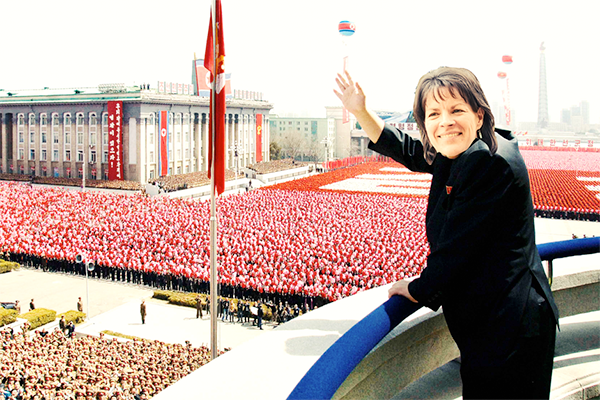
Minor Change Called “Attack On Democracy”
The University of Otago is looking to abandon a 120-year-old tradition in which Otago Graduates are able to vote fellow alumni onto the University Council. Established in 1891, the Court of Convocation has the sole purpose of electing three of its members from among the ranks of its 90,000-strong alumni to perform active roles on the University Council. However, the University Council has recommended a change to the process that will see Court of Convocation candidates elected by the Council rather than by alumni. In what has been labelled an “attack on democracy,” the University has attributed the change to the decline in turnout experienced under the existing system, with the most recent election having a less than six per cent return. According to a University spokesperson, “the new system will ensure that graduates continue to be represented on the Council.” When asked if the Court would continue to serve any purpose once the change has been implemented, the University said that by maintaining the Court of Convocation membership provisions, the process will still allow for members to nominate either themselves or another member when a Court of Convocation position is vacant. “It is hoped that the new system will encourage more members to put themselves forward for consideration and that a more diverse range of skills will be represented on Council.” Former student rights activist and OUSA life member Mark Baxter suspects that the University’s proposed changes are related to soon-to-be announced Tertiary Council reforms by the Government. According to Baxter, the change undermines the views of stakeholders who ought to be free to choose their representation. “Without such accountability the University could in effect appoint whatever yes-men it likes to the seat,” Baxter said. As to the upcoming government reforms to Tertiary Councils, Baxter suggested we will see representative stakeholders replaced by accountants and businessmen, a reform that Baxter claims the Government is “[dressing] up as ‘skill-based’ … accountants’ and businessmen’s views and advice are obviously needed, but they should not be the majority of people making decisions.” When asked if the policy change was made in anticipation of pending reforms to Tertiary Council make-up, the University remarked that it was “too early to comment.” The process of amending the Court of Convocation’s current function requires amending the 2011 Election of Members of the Council Statute, University Council approval and a recommendation to the Minister for Education. According to the University, “it is expected the new process will be in place late in 2014.”
-
Columns

ODT Watch | Issue 24
The ODT is so glass-half-empty! We preferred the images of Team New Zealand nearly capsising – these showed the world who’s the dog and who’s the lamppost. Breaking News: there is now a new oldest man. Critic wonders how regularly this title changes hands. It’s a totally new kind of burglary. Police are stumped as to how to proceed. We haven’t seen that one before! For the record, it wasn’t even the cyclist’s fault. Women are strong and capable? Breaking news, ODT! They are not even talking about prostitutes, but the new women in cabinet.
-
News

2014 Election Nominations
The nominations for the 2014 OUSA Executive have closed, and an array of good-looking candidates have put their names forward to represent you next year. Voting will take place on the OUSA website from 9am Monday 30 September to 4pm Thursday 3 October, with the winners announced that evening. There are 11 voting positions on the Executive. The top dog, and only full-time position, is the President. There are four 20-hour Vice-President tier positions – Administrative Vice-President, Finance Officer, Welfare Officer and Education Officer – and five 10-hour general representative positions – Recreation Officer, Campaigns Officer, Colleges and Communications Officer, International Officer and Postgraduate Officer. Voting for the International Officer position is open to international students only, and the Postgraduate Officer to postgrads only. The final position on the Executive is the Te Roopu Maori President, who sits as an ex officio voting member. Elections for the Te Roopu Maori Executive are also open, and candidate profiles are available at critic.co.nz/teroopucandidates. PresidentRuby Sycamore-Smith Kia Ora, I'm Ruby, your future OUSA President. First and foremost I would like to point out that I am passionate about everything I do, I sink my teeth into every situation and always give 110 per cent. I'm a third-year student studying communications and marketing, and I'm going to ensure that you get the year that you deserve! OUSA can and will do a better job of advocating for students under my leadership. With me as your President you can expect more from your organisation. I will be a President for all students and ensure that each and everyone one of you gets the most from your time at Otago. As your current elected Welfare Officer I’ve: - Delivered free breakfasts and five dollar meals. - Secured $10,000 in funding from the Ministry of Social Development to promote healthy relationships. - Successfully advocated for making the Queer Support Position full time. - Led OUSA’s stress-free exam efforts including establishing a puppy room! - Led negotiations with the University over establishing a student pub on campus. My record as your Welfare Officer has been extensive, and as your President you can expect more. I will continue my efforts on securing a student pub, promoting healthy relationships, lobbying to fix the Uni’s broken internet and delivering on better and bigger events. Expect more. Vote Ruby for President. Nominated by: Jarred Griffiths Seconded by: Paul Hunt Jordan Watts The OUSA should be more focused on students and not politics. Unfortunately in the largely satisfied apathetic contemporary environment the organisation is merely used as a tool at the mercy of a tyrannical minority who only advocate in order to reinforce the interests of a select politically minded group. The OUSA needs to build upon what it is really good at: recreation. Events such as the Craft Beer festival and the International Food Festival work because it showcases the uniqueness and diversity of the student voice within the university. If the OUSA is to continue to be supported and relevant to students in the post-VSM era it must focus more on what it can do for our welfare and support with the vast resources we have provided it. The OUSA does not need a President who only wants a good CV reference. The OUSA needs a President for the people. I am that resident for the people, and if you vote for me I’ll make sure to act only with the students best interests in mind and heart, and foster a truly student dedicated organisation. It’s time we started seeing more tangible, rewarding and exciting returns on our involuntary investment. Nominated by: Chris McKegg Seconded by: James Tait-Jamieson Zac Gawn Otago University Students’ Association. An association by the students for the students. The problem is I look around after my term as your Vice President and see students who are still oblivious to what OUSA is and has to offer. Further, it feels we have taken a backwards step in 2013 and it is time to vote in the lads who can bring OUSA and scarfiedom back. It is all well and good having fancy pants policies but if none of you students give a fuck then why should I. The majority of scarfie voters (I hope) will vote me in for these three reasons: 1) An inclusive OUSA 2) Hyde Street 2014 3) A student bar owned by OUSA Let us get the fundamentals right in 2014! Vote for Zac Gawn for President and Ryan Edgar for Vice. Nominated by: Logan Edgar Seconded by: Thomas Clarkson Administrative Vice PresidentRyan Edgar I’m no stranger to change and wouldn’t stand in the way of progress where it’s fit, though the decomposition of our student culture has come well before its time. The University is telling us how to throw our keg parties, where we can scratch our balls and which trees we can sink a 12 box in; we need student leaders who won’t be pushed around by the University and will stand up for what is most valued by the students. Vote Zac Gawn for President and Ryan Edgar for Vice, as some things are worth preserving, cheers! Nominated by: Logan Edgar Seconded by: Thomas Clarkson Paul Hunt Hey all, my name is Paul Hunt. I would like to be your Administrative Vice-President in 2014. I adopt a work hard play hard ethos to everything I do and am fully committed to making OUSA work for everyone. Admin VP requires hard work behind the scenes assisting the President, understanding a wide range of policy issues and collaborating with the exec. Through serving as President of the debating society for two years and one year on the law school exec I’m confident I have the skills for VP. I would like to see OUSA proactively engage with other student groups on campus, pursue the opening of a student bar and develop support networks in subject areas to assist everyone with uni work. Vote Hunt for Admin VP to get stuff done in 2014! Nominated by: Thomas Mitchell Seconded by: Jared Griffiths Kamil Saifuddin From Kuala Lumpur, Malaysia. In my fourth year pursuing a double degree in Arts (Philosophy, Politics and Economics) and Commerce (International Business). Previously, I was the President of Hayward College Students' Association, President of Otago Malaysian Students' Association and currently, International Student Officer at OUSA. This year I am running for Vice President and seek to be re-elected as International Student Officer. I believe I have a proven leadership, management skills and track record. Having a vast experience, passion and involvement with students from around the world gives me the advantage of understanding their needs. Key words: Kamil. Internationalisation. OUSA. Nominated by: Vivien Poon Seconded by: Rohan Saini Finance OfficerNick Tenci Hey guys! I’m Nick and for those of you who don’t know me I have been your Finance Officer for the latter part of 2013. As a third year finance student I know my shit, and will continue to fight to ensure you continue to get the most from your investment in OUSA. I’m looking forward to 2014, with a specific desire to work closely with the exec on welfare and environmental issues, and ensure that OUSA reaches out to all students. Vote Nick for responsible, inclusive leadership for 2014. Cheers guys. Nominated by: Beau Murrah Seconded by: Jordan Dougherty Education OfficerJordan Taylor Kia Ora, I’m Jordan and I’m running for re-election to be your Education Officer. I am studying a BSc in Chemistry and Food Sciences. I led initiatives such as the ‘Sex (Awareness) Week’ campaign that saw free HIV screening on campus. I brought a diverse perspective not only to OUSA but also to various University Committees. My focus next year will be on implementing my current projects: ratemypaper.com, a new class rep model which will ensure that the student voice is heard and fighting for fair access to education. Vote for a committed, strong and efffective voice. Vote Jordan. Nominated by: Scout (Yuxin) Liu Seconded by: Marino-O-Te-Au Wichman Thomas Mitchell Hi I’m Thomas Mitchell and I’d like to be your Education Officer for 2014! I’m A BSc student majoring in Neuroscience whilst working practically full time in website development and youth support. These experiences working have shown me the power that good governance and teamwork can have at improving organizations. I would like to represent YOU to make sure that your Uni education goes as smoothly as possible while making sure that if shit does happen there is great support from OUSA to get you back on your feet! Vote for Tom for experience and a passion for supporting students! Nominated by: Andrew Row Seconded by: John Brinsley-Pirie Welfare OfficerNali Lee Hello fellow Students, My name is Nali and I am running for Welfare Officer. I’m a third-year Marketing and Psychology student with an Education minor. I’m an active volunteer at organisations such as Victim Support and the Dunedin Special Olympics Summer Games, and am very passionate about what I do. My awareness of social issues relevant to students places me well to hit the ground running as your 2014 Welfare Officer. My hobbies include talking too much and befriending randoms, I do speak English so feel free to say “hi” if you see me around campus! Vote Nali. Nominated by: Nerida Kelly Seconded by: Katie Whitefield Payal Ramritu Student welfare is my mission, As part of exec in the welfare position, I will be enthusiastic, approachable and ready to listen, As a Phedder, BSc and TESOL student, I understand the struggles of Uni, Even though there are lots of people around, it can be easy to feel puny, I will provide a network of help and support. Vote for me; I’ll make sure your battles are fought! Nominated by: Jacqueline Louw Seconded by: Alexis Barltrop Jenna Bone Thought I’d give this a whirl as I care about the welfare of err’body, plus my flatmates are sick of me yelling at Seven Sharp, and have eyebrowsed me into actually doing something political. I’m really interested to see what I can do to support the clubs and societies affiliated with this position, and if I can help make a difference to even a few students' wellbeing, I would take this as a job well done. But all I really want is a Sudoku in the fucking Critic. Nominated by: Jordan Van der klei Seconded by: Meghan Roberts Postgraduate OfficerKurt Purdon Hi postgrads! My name is Kurt Purdon and I'm running to be your OUSA post-graduate rep for 2014. I'm currently in my fourth year at Otago studying towards a Master of Business in Finance. I will work tirelessly to ensure that postgrads are well represented on the executive. Due to the recent government cuts to postgraduate allowances, it's important that we have a postgrad rep who's willing to stand up and be heard. I aim to bring a practical and hard-working approach to the executive and aim to better involve Otago's distance learning students into OUSA decision making. Nominated by: Logan Edgar Seconded by: Thomas Clarkson Campaigns OfficerJarred Griffiths Students cannot afford OUSA to be silent while the Government continues to make education less accessible and more expensive. OUSA needs to run better campaigns and return to its roots of bona fide student advocacy. Having worked extensively in the political and charitable sector organising campaigns, I believe that I have the experience and skills to deliver on this. The role should not just be about organising campaigns, but making sure that Executive members have the skills to advocate for students in their relevant portfolios. Vote Jarred for Campaigns Officer! Nominated by: Thomas Mitchell Seconded by: Paul Hunt Hamish Barker Hey I'm Hamish and I've decided to run for your campaigns officer for 2014. I am currently third year studying a Bcom in Economics and Physical Education. I wanted to run for campaigns officer because I'm pretty keen on getting amongst and like to have fun. If you choose to vote me campaigns officer I will try and bring the best events and piss ups Dunedin is known and loved for. Also I aim to promote all the student support networks available through OUSA and Otago university. Cheers, Hamish. Nominated by: Daniel Sharp Seconded by: Logan Edgar Recreation OfficerDaniel Stride Recreation Officer is about representation: looking after the welfare of student clubs, whether they have ten members or a thousand. Having served you as Clubs’ Rep for two years, I’m the ideal person to serve you in 2014. I believe in excellent constituent service, and will push to restore $3 dinners as a Club-funding initiative. OUSA also needs to take a proactive role on student loan issues (access to education is so important), as well as a more prudent fiscal stance: OUSA’s cash reserves are our independence lifeline, and should not be frittered away. Vote Dan for dedication and sincerity. Nominated by: Lena Fraser-Landmann Seconded by: Donglie Xie Henri Faulkner My name is Henri Faulkner, I’m a local OBHS old boy studying Microbiology and running for the Recreation Officer position. Many people would call me a nerd, I run the OUSA Gamers Central and am the driving force behind E-Sports at the University of Otago. Shit that I want to get done: - Uniting and expanding the gaming and scientific communities of Otago - Getting Clubs and Societies to run more events - Help students become healthier, more fit and stronger by increasing participation in local sports - FASTER GODDAMNED INTERNET This is all. Nominated by: Connor Sherson Seconded by: Ewan Hunter Colleges OfficerBrydie Ockwell Hi there folks! I'm Brydie, and I'd love to be your 2014 Colleges and Communications Officer. I was a fresher once, so I like to think I know a bit about the things you're after - I've also got committee experience; you'd be in safe hands. I've got a few ideas for how to make that amazing first year of uni even better, but I really want to work with you because hey, you know best what you want from that "fresher" experience. Vote Brydie for your Colleges and Communications Exec, and I'll make sure you have a year to remember! Nominated by: Audrey Morgan Seconded by: Catherine Hart International OfficerKamil Saifuddin Kamil is also running for Administrative Vice-President - see above for his blurb.
-
News
Catholic Centre for Life to Provide “Non-Judgemental” Service
Family Life International has opened the doors to a new John Paul II Catholic Centre for Life on Filleul Street, Dunedin. This is the third Centre for Life to be opened in New Zealand, following those already running in Auckland and Wellington. Dame Colleen Bayer, National Director of Family Life International New Zealand, believes “the people of Dunedin have long seen a need for a crisis pregnancy centre in the Otago region.” According to Statistics NZ, 610 abortions were performed at Dunedin Hospital in 2012. The Centre for Life offers pregnancy testing and counselling, free of charge. There is also a library of books and AV resources on life issues, marriage, Catholic parenting, Natural Fertility Regulation (NFR), chastity and apologetics (the discipline of defending one’s faith). Frank Fischer, co-ordinator of Centre for Life, told Critic “the women do not have to be Catholic. They can just come in here and we’ll listen.” Stevie Jepson of Dunedin Reproductive Justice told Critic that “I think extra services for pregnant people who want advice and someone to talk to is good, but the Centre for Life does not provide a fair and fully informed service for those people.” Jepson points out that the Family Life International website reads “every abortion deliberately ends the life of a human baby, which means that it is a gravely immoral act of homicide against a developing baby in the womb.” Pregnantandworried.org, a site linked to Family Life International, also pushes the link between abortion and breast cancer, which, Jepson said, “has been proven to be false.” Jepson explained that “people who need advice about a pregnancy are already in a vulnerable situation [and] to not provide a neutral and non-judgemental space for those people is taking advantage of them.” Fischer claims, however, that the Centre is looking out for vulnerable women. “Abortion is not very nice for women. There are a growing number of studies which show all pregnancy loss is traumatic for a woman, but the trauma appears to last longer when the loss was a result of abortion.” The Centre also has an educational program on “pro-life, family, marriage and faith related issues.” They claim their services are “non-judgemental and totally confidential.” Dunedin Reproductive Justice has a pro-choice picnic planned for Saturday 28 September on the Union lawn in celebration of the Global Day of Action for Access to Safe and Legal Abortion.
-
Columns

The More Things Change | Issue 24
This week, science and technology progress in leaps and bounds. 27 September, 1066: Duke William II of Normandy set sail for England, and went about taking over the place in a significant, and ultimately successful, quest for the throne. (He is now known as William the Conqueror for precisely this reason.) It all started when the previous ruler died without leaving a confirmed heir; apparently he’d encouraged William to follow his dreams of becoming King, and William did just that. He wasn’t immediately popular, but eventually he managed to subdue the populace, introduce a lot of new government procedures, and do other Kingly stuff. 28 September, 1889: The metre was officially defined for the first time by the General Society of Weights and Measures. It was predictably scientifically rigorous: the international prototype metre was the distance between two lines on a metal bar, which was made of an alloy of 90 per cent platinum and 10 per cent iridium, measured at the melting point of ice. The convention was redefined in 1983, and is now officially the distance travelled by light in a vacuum in 1/299,792,458 of a second. And yet for all this specificity, we still can’t agree on how to spell the damn word. 27 September, 1905: The scientific journal Annalen der Physik received a paper by Albert Einstein, one of several important papers he published that year, and particularly notable because it included an argument for the equation E=mc2. The equation is arguably the most famous in physics, and is actually quite simple once you know what the letters stand for: E is energy, m is mass, and c is the speed of light. Many people are apparently surprised to learn that E=mc2 is actually used in real life (insofar as Level 3 Physics counts as real life). 29 September, 1950: The first electronic answering machine was produced by Bell Laboratories. The machines were significantly larger than what they are today and didn’t have a lot of storage capacity. It’s probably a good thing that they’ve developed greater efficiency levels, because otherwise it would be impractical to use them forebodingly in every second crime-based TV programme and horror movie produced. 25 September, 2002: Something happened in Russia that is simply called the Vitim event, because nobody knows exactly what it was. There was an explosion near a fairly remote mining town in southeastern Siberia, but no one can even agree on its magnitude: estimates range from 0.2 kilotons to five. It’s thought that the event was caused by the impact of a comet nucleus, but so far all attempts to reach the impact site have failed.
-
Features

OUSA Electoral System Referendum
An upcoming OUSA referendum, tabled by our illustrious leader Francisco Hernandez, is seeking the change the voting system for OUSA’s future elections. The question is “Should the Otago University Students’ Association (OUSA) adopt a Single Transferable Voting (STV) system for its elections?” Currently, OUSA uses First Past the Post (FPP), a system that’s easy to understand but also has a number of democratic shortcomings. A direct replacement for FPP that would address many of its shortcomings is Preferential Vote (PV), sometimes known as Alternative Voting (AV). This is the system used in Australia. STV is slightly different, because it involves electing multiple candidates at the same time, rather than holding a separate ballot for each position on the Executive. By making the question about STV, then, Hernandez is effectively suggesting that all Executive members should be general representatives, and would not be elected to specific positions (for instance, Welfare Officer or Colleges Officer). To clarify the situation, Critic has provided a rough guide to the three main options. For the sake of argument, let’s say there are five candidates: Fernando Hernando, Crack Yawn, Gooby Stickamore-Brick, Bogan Dredger, and Rihanna Macaroni. FPP - First Past The Post Most of the time under this system, the most popular candidate wins. However, there are a number of exceptions, as the following scenario shows. Bogan is a popular candidate, but he also polarises the electorate. You don’t want to vote for Bogan, but you can’t decide between Gooby and Rihanna. On balance you prefer Gooby, but Rihanna probably has the best chance of beating Bogan, so you vote for Rihanna instead. Bogan ends up getting the most votes, and wins the election, but he’s some way short of an absolute majority. Most voters didn’t want Bogan, but the vote is split among the other four candidates. While you would have liked to vote for Gooby, you felt it necessary to vote for Rihanna to have the best chance of keeping Bogan out. Not only did an unpopular candidate win, but you have compromised your values in the process! PV - Preferential Vote You rank your preferences from 1 to 5, although you don’t have to give a ranking to every candidate. You give your first preference vote to Gooby, second to Crack, third to Rihanna, fourth to Fernando and fifth to Bogan. All of the first preference votes are counted first. Bogan wins the highest number of first-preference votes, but with 30 per cent is short of the majority necessary to win. Crack is second, Fernando third and Rihanna fourth. Gooby wins the lowest number of votes and is eliminated, and Gooby’s votes go to her voters’ second preferences (in your case Crack). After Gooby is eliminated and her votes reallocated, the order is unchanged, and Bogan is still short of his majority. So Rihanna is the next to be eliminated. However, this time when Rihanna’s votes are reallocated, this pushes Crack above Bogan and above the 50 per cent mark. So Crack wins the election. This is a fairer outcome than FPP. Although Crack had fewer first preference votes than Bogan, he had more overall support. Likewise, Crack wasn’t your first choice, but you’d still rather have him than Bogan. STV - Single Transferable Vote This situation is different because instead of electing just one winner, you are actually electing multiple winners (in this case three). In order to gain one of the three spots, a candidate must score above a certain quota of votes (say, 25 per cent). You give your candidates the same ranking as before. After the first round, Bogan has 30 per cent and is the only candidate to reach the 25 per cent quota. This leaves two seats to fill. Now for the confusing part: Bogan scored five per cent above the quota, so when his second-preference votes are distributed, they are each worth 5 ÷ 25 votes, or one-fifth of a vote. Once Bogan’s votes are redistributed, there is still nobody else who has reached the quota, so the lowest-ranked candidate (Gooby) is eliminated and her votes redistributed. This pushes both Crack and Rihanna above the quota. So the three winning candidates are Bogan, Crack and Rihanna. Like PV, this is a fairer system than FPP, because the three winners are those with the strongest overall support. Bogan was a bit divisive, but he still made it due to his strong core of supporters, and Crack and Rihanna were both candidates with broader, if less enthusiastic, support.
-
Features
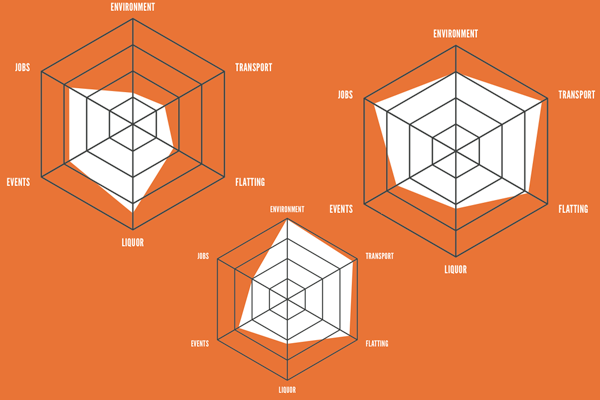
DCC Elections: Who Are the Most Student-Friendly Candidates?
Student voting turnout in local body politics is traditionally abysmal. The elections are seen as small-fry compared to their national equivalents, candidates are unfamiliar to the average student voter, and there are a variety of demographic impediments to students enrolling and voting. Critic thinks this is all a bit shit, so we undertook some polling to identify the most student-friendly candidates in the upcoming elections. First, we asked students to identify the most important local issues. Six main areas emerged – flatting standards, job creation, the environment, transport, events, and liquor laws. Next, we asked all Mayoral and Central Ward candidates a variety of questions about each of these areas, and graded how well their policies lined up with what students want. Finally, we put the data into what we hope is the most easily-digestible format possible. Getting over the information barrier is probably the single biggest obstacle to voting in local body elections. At a glance, you should get a good overview of the strengths and weaknesses of each candidate. Finally, a note on methodology. What counts as a “student-friendly” score in each area is based on our initial polling of Otago students. It captures what the majority of our respondents thought about the issues, but obviously will not reflect the views of all students. A candidate who scores highly on “environment” will take climate change seriously, and oppose actions like drilling, fracking, and burning lignite. A candidate who scores highly on “transport” favours the expansion of public transport options and cycle lanes. A candidate who scores highly on “flatting” favours using the DCC’s regulatory powers to improve the standards of Dunedin’s flats, and recognises that the free market favours landlords over students. A candidate who scores highly on “liquor” opposes a liquor ban in North Dunedin and will typically favour relaxed liquor laws. A candidate who scores highly on “events” thinks the DCC should take a more active role in supporting local artists and attracting large international music acts to the city, and will tend to think that student events get a bad rap in the press. Finally, in the area of job creation we deferred to the expertise of the University of Otago Economics Department, and asked the department to grade each candidate’s plan for job creation out of 10. Mayoral CandidatesHilary Calvert Affiliation: Independent. Previous Council experience: None. Also standing for Central Ward: Yes. You’ve probably already made your mind up either way about Calvert. The former Act MP made quite a stir in 2011 with her visible indifference to the student vote in that year’s general election. She’s been a lot cannier this time around; as well as granting Critic an interview, her expensive campaign has included numerous billboards in and around campus. She’ll leave liquor alone, but has predictably low ratings on the environment, transport and flatting. Dave CullStudent Friendly Affiliation: Greater Dunedin. Previous Council experience: Councillor 2007-2010, Mayor 2010-present. Also standing for Central Ward: Yes. Cull’s not the picture of a student-friendly mayor, but he’s shown a refreshing willingness to engage with students. He’s worked well with OUSA over the last year, particularly on raising flatting standards, and has been a strong supporter of cycleways and public transport. His job creation plan was mercifully free of bullshit and fluff, and was rated highest of any candidate. Cull should be one of your picks regardless of your political stance. Kevin Dwyer Affiliation: Independent. Previous Council experience: None. Also standing for Central Ward: Yes. Our expert rated Dwyer’s sketchy job-creation plan the lowest of all mayoral candidates. For a horticulturalist, Dwyer’s environmental credentials are also somewhat lacking. While he achieves decent scores on flatting, transport and events, Dwyer is far from being a true “student-friendly” candidate. Aaron HawkinsStudent Friendly Affiliation: Green Dunedin. Previous Council experience: None. Also standing for Central Ward: Yes. This is Radio One breakfast host Hawkins’ second mayoral bid, after an unsuccessful run in 2010. This time he’s running on the Green ticket, which, if the mayoralty seems like a long shot, at least gives him a good chance of securing a Council seat. As you’d expect from a Green candidate and campus figure, he’s student-friendly with a strong environmental focus. He’s a toss-up with Cull for our mayoral endorsement, but should definitely be one of your Central Ward picks either way. Olivier Lequeux Affiliation: Independent. Previous Council experience: None. Also standing for Central Ward: Yes. The publican and sometime-owner of hipster bar Mou Very is, somewhat surprisingly, one of the least student-friendly mayoral candidates. While he claims that protecting the environment is “very important” to him, he is also pro-fracking and a climate change sceptic. His laissez-faire attitude to flatting gave him one of the lowest scores on this scale of any candidate, and his job-creation plan was short on detail and rated poorly by our expert. Andrew Whiley Affiliation: Independent. Previous Council experience: None. Also standing for Central Ward: Yes. Though his views stand in marked contrast to the average student, Whiley at least has a fairly coherent platform. His plan for job-creation was peppered with right-wing buzzwords, but was forward-thinking and contained some promising remarks around green technology. He won’t crack down on student drinking, and he appreciates the economic benefits of attracting big concerts to Dunedin. Lefties should probably stay away, but Whiley’s a good pick for right-leaning students. Did not respond: Pete George, Lee Vandervis. Did not have contact details for Steve McGregor. Central Ward CandidatesDavid Benson-PopeStudent Friendly Affiliation: Independent. Previous Council experience: Councillor 1986-99. The former Labour MP and Cabinet minister has a strong environmental focus and was a key player in defeating the North Dunedin liquor ban earlier this year. He holds student-friendly positions across most issues. John Bezett Affiliation: Independent. Previous Council Experience: Councillor since at least 2007. Bezett is a current councillor, and one of the strongest supporters of the stadium. His answers were often non-committal and reflected a lack of knowledge of student affairs. Phillip Cole Affiliation: Independent. Previous Council Experience: None. Cole is the Chairman of the Dunedin Cable Car Group, and has a strong focus on improving public transport options. He’s not a huge fan of spending any money, though, and wants to cut all non-core projects to reduce Council debt. Ali Copeman Affiliation: Greater Dunedin. Previous Council experience: None. Copeman is a director of the Otago Chamber of Commerce and is heavy on the business-related rhetoric. She seems to be among the more right-leaning of the Greater Dunedin team, and is notably lukewarm on public transport. Julian Crawford Affiliation: Aotearoa Legalise Cannabis Party. Previous Council experience: None. The ALCP candidate comes equipped with a variety of predictably hilarious policies, including reopening Invermay as a dedicated marijuana and hemp research facility. His job creation plan didn’t cut the mustard with our expert. John Evans Affiliation: Independent. Previous Council experience: None. He refers to himself as “Good” Evans and his candidate bio on the DCC website consists largely of a list of things one can find in Dunedin. When we asked about climate change, he referenced the Nazis. It’s all a little bit bizarre. Christine Garey Affiliation: Independent. Previous Council experience: None. Garey has no previous Council experience, but has served on the Otago Peninsula Community Board. Although prone to quite generic statements, she strikes Critic as a kindly presence who would engage strongly with the student body. Doug Hall Affiliation: Independent. Previous Council experience: None. Hall is a local businessman who this year has locked horns with the DCC over the realignment of a state highway. His zero score for job creation comes from his failure to answer that part of the survey. Francisco HernandezStudent Friendly Affiliation: Independent. Previous Council experience: None. Big surprise – Hernandez was the most student-friendly of any candidate who responded. He scores highly across every category, and his six-point job creation plan was rated strongly by our expert. He’s not a polished performer, but has a good track record of representing students and is worth your vote. Paul Hudson Affiliation: Independent. Previous Council experience: Councillor 1998-present. A long-standing City Councillor who supported the stadium and has a pretty average track record when it comes to engaging with students. It wouldn’t be the end of the world if he failed to be re-elected. Jinty MactavishStudent Friendly Affiliation: Greater Dunedin. Previous Council experience: Councillor 2010-present. In her first term as Councillor, MacTavish has been a sensation – even Hilary Calvert, her ideological opposite, described her as “the most hard-working" Councillor. If she isn’t re-elected, it would be an outrage. Letisha NicholasStudent Friendly Affiliation: Greater Dunedin. Previous Council experience: None. Nicholas is one of two student candidates, and is currently studying a PGDip in Geography. She scores strongly across the board, particularly on environmental issues (as you’d expect from the co-President of Students for Environmental Action). Richard Thomson Affiliation: Greater Dunedin. Previous Council experience: Councillor 2010-present. Thomson favours stricter controls on the sale of alcohol, but opposes the liquor ban. While he holds fairly student-friendly positions, he’s also pretty much guaranteed to get re-elected, so you might consider casting a tactical vote elsewhere. Warren Voight Affiliation: Independent. Previous Council experience: None. Voight’s candidate profile on the DCC website is full of apocalyptic messages about Dunedin becoming a “backwater.” He takes a conservative approach to liquor, and supports a North Dunedin-wide liquor ban. Did not respond: Malcolm Dixon, Rachel Elder, Lindsay Harrison, Nigel Harwood, Tat Loo, Kim Mitchell, Irene Mosley, Kevin Neill, Neville Peat, Tom Ross, Chris Staynes, Conrad Stedman, Teresa Stevenson.
-
Features

New Zealand’s Refugees
So much for a fair goFor as long as Australia has been a go-to destination for “boatpeople” from places like Afghanistan, Iraq, Iran and Sri Lanka, the issue has been used as a political football to score points with the growing xenophobic constituency in that country. Indeed, Australia recently found itself in the international dog-box when news of (then) Prime Minister Kevin Rudd’s “PNG Solution” hit headlines. On July 19, the newly-re-instated-and-since ousted-again K-Rudd announced that no person arriving by boat without a visa will ever be granted asylum in Australia, regardless of whether they’re found to be a genuine refugee or not. Instead, such arrivals will be deflected to Papua New Guinea (PNG), a country that has been teetering on the edge of failed statehood for decades, or Nauru, a tiny rock in the middle of the South Pacific that Australia has ruthlessly mined for its phosphate since its independence in the late 1960s. (Ironically, the day will eventually come when Nauru’s 9,000-ish inhabitants will become environmental refugees themselves, and there’s no prize for guessing which country they’ll be turning to for resettlement.) From there, the arrivals will be detained for processing and settled in either PNG, a third country, or sent back home – a choice that often amounts to a death sentence. Australia’s “PNG Solution” violates various international human rights laws and abrogates its responsibilities under the 1951 United Nations Convention Relating to the Status of Refugees that Australia signed voluntarily in 1954. Unsurprisingly, the policy triggered condemnation from the UN, Amnesty International and others, who contemplated with horror what they saw as the first step towards what could possibly – should Australia’s “solution” set a catastrophic precedent for other signatories of the UN Convention – be an inexorable collapse of the international refugee framework. Aotearoa: land of tenuous moral superiorityAs protests against the “PNG Solution” erupted in every major Australian city, I found myself basking in something like schadenfreude as I thought about how great New Zealand is by comparison. Not only do we now have gay marriage to lord over those bronzed, well-paid bastards across the ditch, I could also rest smugly in the assumption that my country would never dream of passing such a draconian, mean-spirited piece of legislation (especially if someone were to order a hit on Immigration Minister Michael Woodhouse). I mean, hello! We just gave permanent residency to 30 Afghan interpreters! We helped bring down apartheid by refusing to play rugby with racist Yarpies! We said no to visits from nuclear-capable ships, we were first to give women the vote, and we are even (somewhat alarmingly) held up as a model for indigenous rights! New Zealand is, by all accounts, a noble David in an international arena full of megalomaniac Goliaths. Right? Wrong. The sad fact is, while we may after all be “100% Pure” in our milk products, this purity does not extend to our conscience. Our embarrassingly high child abuse, child poverty, teen pregnancy, youth suicide and obesity rates notwithstanding, we can also add another fun fact to our list of shortcomings: we fail to do our bit when it comes to refugees. That’s right. We’re even (severely) behind … Australia. ProofIn fact, our trans-Tasmanian sibling aims to resettle 20,000 refugees every year, compared to our 750 (150 of which are earmarked, under John Key and Julia Gillard’s agreement from February this year, to absorb refugees arriving in Australia). In this way, Australia takes five times the refugees per capita as New Zealand. Though we like to compare ourselves to socialist paradises like Sweden, we’re actually ranked 97th in the world for refugees per capita, just above developing countries Tajikistan and Malawi. New Zealand, however, doesn’t have an economic excuse to be stingy: we are now second in the OECD (behind only Australia) with regards to GDP growth and unemployment. Don’t be fooled by Michael Woodhouse’s claim that New Zealand comes sixth in the world for our UN High Commission for Refugees resettlement quota. In fact, there are two ways to become a refugee, and the system to which Woodhouse refers is the much less common path. Most refugees are settled after being assessed as asylum seekers – in other words, they have already fled their home country and are in now transit, “seeking” a new one. In 2011, New Zealand settled only 85 refugees in this manner, compared with the United Kingdom’s 12,202. The time has come to Do Our BitThankfully, Wellington-based former Critic columnist and inadvertent human rights activist Murdoch Stephens has launched a national campaign to change this. It began with a trip to Iran in 2009, where Stephens stumbled across an abandoned detention center in the middle of the Persian desert and discovered thousands of photographs of Afghan refugees who had been housed there from 1989-2005. Taking considerable pains to smuggle the photographs home, and following consultation with New Zealand’s local Afghan community, Stephens’ photographs are now on exhibition at Pataka Gallery in Wellington, affording us a profound insight into what it means to be a victim of one’s own geography. The exhibition will hopefully be shown around the country before being archived at Kabul University. It accompanies a social media campaign entitled “Doing Our Bit,” the goal of which is, according to Stephens, “very political and very direct: I want the refugee resettlement quota (so that’s not asylum seekers but people who have been assessed to be genuine refugees overseas) to be doubled, and I want funding for all the refugee-related services in New Zealand to be doubled as well.” As well as a website, the campaign has a presence on Facebook, Twitter and Avaaz, where you can sign an online petition to increase New Zealand’s refugee quota. Just a guyStephens has never worked with any refugee-related organisation and is not affiliated with any particular interest group. He is just a guy who has taken very much to heart the embarrassment of being from such a well-regarded country that fails to live up to its hospitable reputation. For Stephens, “it’s not even about being nice to refugees, it’s just simply the fact that we do so little and yet we think we do so much.” Stephens believes that if more New Zealanders knew about the issue, they would want to rectify this cognitive dissonance: “from a lot of people I’ve spoken with, the assumption is that we are doing our bit, and when they find out how little we’re doing, they’re shocked.” Though Stephens is in communication with the National party, its stance on the issue of New Zealand’s refugee quota was made clear in July when Woodhouse said National would keep the quota at 750 for the next three-year term. However, Stephens says that “if it came down to a conscience vote amongst MPs, I think it would pass easily.” The bare minimumDespite this, National’s announcement seems to have done little to dash Stephens’ hopes. After all, the goal is not actually a particularly lofty one, even though talk of “doubling” New Zealand’s refugee quota can sound intimidating at first. “The refugee quota was introduced in 1987 as 800 people and if it had kept pace with [population growth] it would be 1,000 by now,” he explains. “In fact, National reduced it to 750 in 1995, but even if 750 had kept pace … we’d be at 1,000 by now, considering our population has grown.” Stephens emphasises that, “even if we do double our quota, we’re not going to be world leaders.” The response from the general public, the media, and the Green and Labour Parties has been enthusiastic and supportive; indeed, Stephens admits he “never would have dreamed that it would have gone this well.” National Radio and various national newspapers have covered the campaign, and the Green Party’s Immigration spokeswoman Jan Logie has endorsed it on her blog. In fact, the Greens already have a policy that would see our refugee quota increased to 1,000, which Stephens concedes “is a good start.” He had another victory when deputy Labour leader Grant Robertson visited the refugee community in Porirua to discuss the issue. With Labour currently reviewing its refugee policy, Stephens sees it as only a matter of time before the quota is increased, and New Zealanders “won’t have to be embarrassed” any longer. ConcernsOne of the concerns raised about Stephens’ campaign pertains to where the money that would be required to resettle twice the number of refugees, and double the funding for refugee-related services, would come from. According to Stephens, “the problem isn’t the money.” Indeed, though Woodhouse claims that $58 million is spent on refugees every year, appropriations in the budget list the expenditure as $16 million, a figure substantiated by Woodhouse’s own office. But shouldn’t any extra cash be spent on struggling New Zealanders? Stephens argues that, “though refugees may be a short-term cost, in the long term they’re keen to pay their own way.” Indeed, in Australia, refugees are more likely to look for and find paid employment, and have a lower crime rate, than Australians in general. People tend to focus on the immediate costs of such a policy, but as Stephens says, “it’s not like were just throwing that money away – we’re actually creating new New Zealanders.” And with our ageing population and declining birth rate, maybe we need refugees almost as much as they need us. There is also the notion that refugees don’t assimilate. To this, Stephens replies that, “maybe in the short term, these people look different so they don’t fit in. But because their parents went through such trauma to get here, there’s a lot of pressure on their children to succeed. It is worth noting that John Key himself is a second-generation refugee. His mother fled Austria in 1939 and at that time, New Zealanders were very scared of Jewish people coming in. And as Stephens notes, “we might not agree with Key’s particular ambitions, but no one could say he lacks them.” Tich & TakundaI wanted to speak to students who might have particular insight into this issue, so I caught up with Tich and Takunda, two fourth-year guys from Zimbabwe. Though not refugees, both know what is to find their country suddenly unlivable, and to have to look for a new place to call home. Tich’s parents were wealthy medical professionals in Zimbabwe before the political situation and hyperinflation under the Mugabe regime “ate into all my father’s business interests and we went from being very wealthy to being average in the space of a few days.” He moved to New Zealand with his little sister on his nineteenth birthday. Takunda came to New Zealand for similar reasons: “it was more the unpredictableness of everything, it’s better to have some kind of stability – you don’t want to have everything today and then have to line up for bread tomorrow.” Both guys and their families found New Zealanders to be very friendly and welcoming. Tich says he was struck by the fact that “back home, you walk around and go about your business, but here you say ‘hi’ to someone and most of the time they’ll actually stop and have a decent conversation with you.” Takunda agrees: “even in school, the kids really helped me settle in. I never felt out of place or faced any kind of racism. For me, it was a great advantage and made me appreciate the country even more.” In light of this, did they have any thoughts about doubling the refugee quota? Takunda pointed out that “people aren’t just coming to your country because they see opportunities, but they also see the values that you have and they want to be a part of that. People are saying that your country is offering something that they can’t get in their country, and that shows the kind of standards that they live by.” Indeed, at the end of the day, Tich feels “it comes down to your humanity.” Doing our bitWith a two-fold increase in its refugee quota, New Zealand will hardly be the new Sweden in terms of refugee settlement and service provision. However, it would be a shame to waste this opportunity to bolster our international standing. The time will come where we won’t be able to rest on our anti-nuclear, “clean, green” laurels any longer, not in the face of obvious examples of our country dropping the ball. For the sake of our international image, but more importantly, for the sake of those who need our help, is it really so much to ask our elected officials to do our bit?
-
Features
Was Marx Right?
Socialist Simon used to be a Marxist. Then he got a life. Here, he picks through the detritus of his wasted youth to uncover the fleeting scraps of wisdom that Marx left him. Campus Marxism is an odd beast. Anachronistic, repetitive, and often demonstrating a startling lack of basic logical concepts, its proponents can often be seen huddling in small, despondent, raggedly-bearded circles, plotting revolution and bemoaning the advent of online OUSA SGMs (so much harder to stack, damnit!). Rarely does a card-carrying Marxist stand out as a person with whom one might conduct a reasoned, useful and intellectually honest conversation – not only about politics, but about anything. This is because, to most young Marxists, the class struggle between the bourgeoisie and the proletariat for control of the means of production explains, well, pretty much every facet of society. Why did the government lower taxes and cut public services? To benefit the bourgeoisie. Class struggle! Why did the government raise taxes and increase public services? To placate the proletariat and benefit the bourgeoisie. Class struggle! Why did they cancel Firefly? Because the market is directed by bourgeois tastes. Class struggle! Why are Pringles cans not wide enough? Because the bourgeoisie don’t do manual labour, and thusly have small hands. Class struggle! My foot hurts. Bourgeoisie! Class struggle! I may just be projecting, but the realisation that there is more to the story usually occurs to the average Marxist around second year. This is the point at which they learn what the word “falsifiable” means, after which they get bored of the ISO and wander off. They used to have a theory that explained everything and delivered easy, chauvinistic judgements; now the world’s ambiguities come flooding in and it’s all a little bit overwhelming. (In the interests of balance, I should probably point out that your average right-wing libertarian will rarely, if ever, experience such a moment of self-awareness.) In any case, the decline of Marxism as a theory that receives and (in its most common expressions) deserves attention is a loss. Marx himself was undeniably one of the most brilliant, perceptive thinkers of the last two centuries, so it’s a pity his reputation has been tarnished by a few campus shouty types and the odd genocide. As we emerge from the other end of the latest CRISIS OF CAPITALISM, it’s worth asking what, if anything, Marx can still tell us today. *** Karl Marx was born in Prussia (modern-day Germany) in 1818, the third of nine children. After avoiding military service at eighteen due to a “weak chest,” he became involved with the Young Hegelians, a group of radical thinkers, in the late 1830s. He moved to Paris in 1843, where he met long-time collaborator (and Robin to Marx’s Batman) Friedrich Engels. In 1845, however, his radical publications saw him expelled from France, and he moved to Brussels, and then England. During this time Marx and Engels formed the Communist League and wrote the pamphlet The Communist Manifesto. After moving to London, Marx wrote his magnum opus, the three-volume Das Kapital (Capital), the last two volumes of which were published by Engels after Marx’s death in 1883. It was in Das Kapital that Marx identified what he saw as capitalism’s fundamental flaw, and the flaw that would inevitably lead to the theory’s downfall and the rise of communism – the problem of overproduction. If you hire a worker to produce a good or service, which you then sell, you must sell this good or service for more than what you pay the worker. Your ability to make a profit depends on your ability to pocket the difference between the revenue you generate and the wages you pay. Writ large, this means that the total value of wages paid to workers must always fall short of the total value of all goods on the market. There are three broad upshots to this state of affairs. First, demand has to continually expand in order to catch up with this overproduction. The most obvious way to do so is by increasing wages. These wage increases, however, take the form of a Ponzi scheme: to afford them, employers must increase their revenue by either expanding their operations or increasing productivity; both solutions, however, worsen the problem of overproduction, creating a vicious circle. If these continual wage increases cannot be sustained, overproduction will reach a tipping point and the system will head into recession: workers will go unpaid and goods and services unsold, on a mass scale. Second, if wages cannot keep rising, demand can be artificially topped up by increasing debt. Allowing workers to borrow lots of money and repay it at some point in the future is, however, another Ponzi scheme that adds to and exacerbates the first. When demand collapses and a recession occurs, the presence of huge amounts of debt multiplies the severity of the recession – hence why the latest was one of the worst ever seen. Finally, whenever demand cannot keep up, some members of the profit-making class (the bourgeoisie) will simply be unable to deal with the problem of overproduction, and will fail. In the long term, this means that the bourgeoisie will gradually shrink, with wealth concentrated into fewer and fewer hands. The picture that emerges is of a system with a pathological need for growth, periodic recessions, increasing debt, a gradual concentration of wealth into the hands of a few, and constant productivity gains squeezed out of the working class. In modern times, this is a pretty standard view of capitalism. Marx called it in the nineteenth century. *** But if Marx was so perceptive, why are we not all enjoying the wonders of centrally-planned socialist utopias? Why are we not smoking Victory Cigarettes and chanting “four legs good, two legs bad”? Where did it all go wrong? The standard Marxist response is that we have exported the worst effects of capitalism offshore. Marx thought the proletariat would inevitably revolt due to their poor working conditions, and would set up a new, egalitarian system to replace capitalism. Rather than allow this to happen, though, the West has relied on sweatshop labour in the developing world, and has propped up governments that keep this underclass in line and out of the West’s sight. Meanwhile, Marx failed to anticipate the rise of the welfare state and the middle class it supported. This middle class, who would otherwise have joined the ranks of the proletariat, are given a comfortable living and so never develop a revolutionary mentality. But does the middle class even need to exist? An article published last month in Strike! magazine, entitled “On the Phenomenon of Bullshit Jobs,” has been doing the rounds on the Internet lately. The article, which was penned by David Graeber, an anthropology professor at the London School of Economics, contends that a large proportion of middle-class jobs have simply been “made up” to appease an otherwise non-working, restless portion of society. According to Graeber, these jobs – including but not limited to administrators, public relations researchers, corporate lawyers, lobbyists, private equity CEOs, actuaries, and telemarketers – are all “bullshit.” Graeber believes that while technology has made possible a 15-hour working week, we are working longer hours than ever because bullshit jobs have been invented to distract us. He points out that although the standard justification for this is an increase in consumerism, few bullshit jobs actually have anything to do with producing goods. In fact, people with bullshit jobs actively resent those with “real” jobs (i.e. jobs that involve the provision of a valuable good or service), because working at a job that doesn’t even need to exist is both unfulfilling and demeaning. Graeber undoubtedly glosses over many of the nuances of capitalism and, like so many aloof Marxist intellectuals (not that he ever mentions Marx by name), he romanticises factory work to a bizarre extent, even placing it alongside nursing in the category of fulfilling jobs. The Economist also debunks many of his arguments (as it would), pointing out that a large amount of clerical work is important for the smooth functioning of highly complex, late-stage capitalist systems. However, Graeber is right in that – at the very least – advertising, PR, and in-house lawyering are, from a social perspective, inherently useless jobs. They exist solely to provide a competitive edge to individual companies; but, in a classic Prisoners’ Dilemma, this advantage is nullified as soon as a competitor follows suit. What follows is an arms race in which bullshit jobs proliferate without any wider social or productive benefit. *** So, yeah! Revolution! Down with bullshit jobs! Emancipate the Thai proletariat! Chances are you didn’t get particularly inspired by that last part. Thing is, the call for revolution doesn’t stir us much because we haven’t developed a class consciousness. This isn’t because capitalism has somehow divided the proletariat by giving a portion of them bullshit jobs (at least not entirely). It’s occurred because increasingly, class is not the only – or even the primary – way we think about ourselves, and it’s not our only clarion call to action. As capitalism has advanced and markets become more prolific and varied, humanity has become more diverse. People’s politics are informed by much more than just class and material wellbeing; and differences, which used to exist on a group level, now exist between every individual human. This heterogeneity makes it more difficult to think about politics in terms of broad principles that treat everybody the same. Instead, the rise of identity politics requires a much more nuanced approach to questions of social justice. In other words, I’m not going to fight alongside the proletariat if “proletarian” only describes a small part of my identity. I may be a proletarian, but I’m also much more than that, and there’s a growing sense, even among socialists, that capitalism might be important for fulfilling the other, non-proletarian parts of me. Perhaps capitalism is actually laying the foundations for more freedom and open-mindedness, and giving me the opportunity to explore facets of myself that the endless class rhetoric of Marxism tends to supress or deny. Marxism is still useful because it allows us to look past the narrow focus on supply and demand to see the bigger picture. It opens our eyes to the limitations and flaws of capitalism, and suggests ways that we might humanise the economy. But it’s still only one perspective among many. It doesn’t provide a total explanation for the human condition, and thinking that it does is what makes Marxists so annoying. The final tool in the Marxist shed is the hilarious concept of “false consciousness.” Many Marxists would dismiss everything I have just said, and claim that all the non-class-based parts of my identity are illusions brought on by capitalism. False consciousness is a great theory because it allows you to completely ignore what the other person is saying (“I actually love capitalism!” “No you don’t, that’s just the false consciousness talking”). Of course people get sucked in by consumerism – that’s a no-brainer. But I can think of a few people (myself included) who got sucked in by Marxism, and its lofty claim to have provided, after only my first year of university, the answers to all of society’s problems. Breaking up with Marx was a slow and chastening experience. We’re still friends, but I’m wise to his ways now, and he’s not getting in my pants again any time soon.
-
Columns

Love Is Blind | Issue 24
RihannaCritic did well on the racial stereotyping this week, putting me with another dark beauty. But he was nice and buff and smooth and wonderful so I got over the surprise easily. We settled in to dinner quickly and happily. He complimented me a lot and proved to be an adventurous eater, ordering things I still can’t pronounce. Expecting Critic to provide really shit wine, he had even procured two marginally nicer bottles for us to drink, although I did make sure to check that the seals on them weren’t broken. Both in our final year of study at Otago, we compared plans for next year and vaguely agreed that we should meet up in Brisbane as we were both planning on going to Australia. Truth be told, saucy images of the beach and a breezy hotel room on the Gold Coast entered my head several times, but all he would’ve seen was me smiling to myself and looking away subtly. Anyway, dinner was great, the conversation was great and the views were great, so we decided to keep the night rolling by heading off to a bar. We never made it – his apartment was on George Street between the restaurant and the Octagon. We tried fluffing around with coffee for a brief moment but it turned out we had both been thinking the same thing all night and our clothes were off in no time. I had to tell him to chill out at one point – I’m not really a “slap her on the arse while she straddles you” kinda girl – but it was a phenomenal night other than that. He also lasted for a fucking long time! Thanks Critic for a great end to my degree! BrandonIn all honesty, I was really hoping for a loose Scarfie girl, but damn did I get a winner! Easily as much fun as anyone I’ve met before, she chose the busiest BYO location as it looked like the people there were “on form,” and we settled into conversation easily. She moved around so we were sitting on the same side of the table at the start of the night and we entertained ourselves for about half an hour taking a shit load of selfies. It was nice being so close and she was really good to talk to, but we didn’t look at the menus for ages and I think the waiter got a bit pissed off … The food was really good, as is usually the case when you order whatever the fuck you want – I mean, have you ever read a bad food review on the blind dates? – and, starting to feel the effects of the alcohol, we got quite close to each other. I think we were both pretty keen. She ordered dessert, which surprised me – I think she may secretly be a bit of a spoiled Parnellian – but she ate it seductively and tidily which was a real turn on. Itching to get moving, I explained that my apartment was basically just upstairs and she seemed to jump at the idea of heading there. I hadn’t counted on this but it was a perfect response. She jumped on me at the door and we kissed as I carried her upstairs. I tripped and dropped her at the top, which was awkward as fuck, but luckily she thought it was funny and we got straight back to making out on the kitchen bench. My roommate had been out of the city for two weeks visiting his family so the opportunity to fuck all over the house was too hard to resist. And so we did, again and again.
-
Columns

Get Out Of The Ghetto | Issue 24
Its name isn’t inventive, but at least it’s descriptive. Long Beach, a suitably extensive (not in 90-mile Beach terms, mind you) stretch of blondish sand, reaches 2.5km between two rocky headlands. Around the headland to the left you find Purakaunui Inlet; to the right, the sinisterly-named Murderer’s Beach, and Aramoana. It’s only a 30-minute drive north-east from Dunedin (turn left when you get to Port Chalmers and follow the signs for Long Beach and Purakaunui), but Long Beach’s sleepy serenity and calm tide make it feel a word apart from the relative bustle of the city. Maybe that’s why people built holiday homes there: Long Beach is home to a small settlement, with around 100 picture-postcard kiwiana cribs crouched in behind the sand dunes. (Fun fact: Out of the Blue, the movie about the Aramoana massacre, was filmed mainly at Long Beach. Both places have a similarly low-key, almost-too-quiet, this-is-a-bit-creepy vibe.) A visit to Long Beach is not complete without a foray into the massive cave at the northern end. This grotto is complete with a periodically-revived bonfire, burnt-out armchair and a roof blackened from the smoke of many a burning marshmallow (or joint, maybe). In fact, this amphitheatre-like formation was for many years the site of the infamous Rave in the Cave (a party held in a cave, just as the name suggests), now the stuff of Dunedin legend. The last of these, organised in 2010, ended up being held at that other cavernous Dunedin venue, Sammy’s, because of safety concerns (sheep have been known to kamikaze off the surrounding farmland-clad cliffs, and falling rocks remain a danger) and resistance from local councillors. Nevertheless, cave excursions – including overnight ones – continue to be popular. Take a torch and some blankets, though, as it’s chilly at the best of times. Long Beach’s other claim to fame is its dramatically beautiful basalt cliffs, which happen to provide some of the best rock climbing around. Local climbing enthusiasts have been challenged by the crags for decades, with around 130 routes now mapped out across their many faces. The Pinnacle, a rocky promontory rising about 30 metres out of the sand, gained popularity as a climbing spot way back in the 1950s. Since the Long Beach’s alpine club heyday in the 1960s, climbers have traded heavy tramping boots for slipper-like rock shoes, pitons and slings for permanent bolts, and wooden wedges for snazzy cams. Six people even hold the dubious honour of being members of the Long Beach Broken Back club. Many interesting birds, including blue penguins (and not too many seagulls) call Long Beach home. Enjoy. Get there: by car. Follow the signs from Port Chalmers. Stop in at the Orokonui Eco Sanctuary and check out the flora and fauna on the way. Do: try your hand at rock-climbing some time, if you can gather some gear and people who know what they’re doing. Don’t: bring your surfboard (the beach is sheltered, and generally calm), but do bring your togs for a paddle if you’re braver than we were. Eat: BYO picnic.
-
Culture

We Think Alone
Emails are one of those everyday mundanities. They are part of our daily routine, used by nearly every one of us to varying degrees and for various purposes. There is one email, however, that is deserving of special mention: that which appears in my inbox every Monday from the multi-talented actress, artist and director, Miranda July. As with most routine actions, we dedicate very little thought to email as a social experience, seeing it simply as a convenient form of communication. It is this oversight that July’s project aims to rectify. With a sort of post-modern (or “late-modern,” if you prefer) flourish, July’s self-referential, reflexive email-art project We Think Alone proposes a new way of looking at the emails in your inbox. Personally, I find emails, and the strange intricacies of their implicit-yet-universally-understood discourse, bemusing. Each individual, however, uses email differently, and it is this individuality that We Think Alone explores. July’s interest lies in the intimacy that is somehow relayed through seemingly mundane email dialogue, and in the fact that in composing emails people subconsciously develop virtual versions of themselves. As July explains, “a quiet person might ‘!!!’ a lot,” and “a person with a busy mind might write almost nothing.” Her work itself asked nine celebrities to share an intimate email from their sent-box every week between 1 July and 11 November. Each week had a specified theme, and subscribers received this themed compendium in their personal inboxes. Participants included the likes of Kareem Abdul-Jabbar (the NBA’s all-time leading scorer), filmmaker Lena Dunham (of HBO series Girls), actress Kirsten Dunst, Rodarte designers Kate and Laura Mulleavy, and even physicist Lee Smolin. Commissioned by Swedish art gallery Magasin 3 for the series On the Tip of My Tongue, July’s email-art formed part of a wider project aimed at directing attention away from the typical exhibition space, the gallery. To date, July’s project has included themes such as “about money,” “a business email,” and, particularly enjoyable, “an email you decided not to send.” Her work has been criticised for its inclusion of famous individuals, for failing to meaningfully convey the dynamics of email relationships, and even for its supposed lack of insight into Kirsten Dunst’s psyche. In my opinion, however, the work is highly successful: not only is it great value as entertainment, it also offers an intriguing commentary on the evolving nature of email and technology more broadly. Perhaps it is a bit of a voyeuristic experiment. Studying how people write to their mothers or knowing that artist Danh Vo once signed off an email with a bit of Spanish and a cute pet name (“besistos, baby monster”) seems to be bordering on the obsessive. Yet unlike text messaging, for example, emails span the formal-informal divide when it comes to communication. People use different language depending on whether the email is for business or for pleasure. Emails are also a form of multimedia: as part of July’s project we see a number of photos of Dunham in costume (originally sent to her lover) and a photo in which writer Sheila Heti plays with the tunnel effect on her Mac’s “photobooth.” July has thus chosen a complex “medium” to investigate, and one with a lot to say about how we virtually construct our lives. So far, the 12 weeks of July’s study have provided an interesting insight into people’s personalities and everyday relationships, and into the possibility that emails may constitute an artistic statement on the fundamental digitalism of our lives. It has also forced me to reconsider the way I write my own personal emails, and the way in which we interact with seemingly “ordinary” technology in this digital era. Last but not least, it’s a fun excuse to read other people’s mail. You can sign up to receive the remaining emails of July’s project at www.wethinkalone.com (or something like that)
-
Culture

In The Memorial Room
Janet Frame has a reputation as a serious New Zealand writer, and a truly successful literary genius. Knowing something of her dramatic personal life – she nearly had a lobotomy due to “psychiatric problems” – I half-expected this novel to be dark, brooding, and Sylvia Plath-esque. Instead, In The Memorial Room proved to be an incredibly amusing social satire. The novel follows Harry Gill, a fairly successful New Zealand writer, who has been awarded the Watercress-Armstrong Fellowship – a memorial to the poet, Margaret Rose Hurndell. He is sent off to Menton, France, where Hurndell lived and wrote. Harry is expected to spend time reflecting on her life and work, and to write some new material of his own. Throughout the book Harry is told repeatedly, “I’m afraid I haven’t read your last book … But I’ve heard so much about it!” by various people, even at his own award ceremony. Furthermore, one of Hurndell’s relatives, Michael Watercress, is described as looking like a “perfectly presentable stereotype of the modern author” and is often mistaken for Harry. Michael looks just like an up-and-coming writer, unlike our awkward, stocky protagonist. I couldn’t help but find myself laughing when the Mayor, coming to congratulate Harry on winning the Fellowship, assumes that Michael is the award-winning author and shakes his hand instead. The photographers take their photos before the mistake is corrected, and Michael rather than Harry appears on the front cover of the local newspaper. While out for dinner with the Watercress family, Michael is gifted three bottles of champagne after being mistaken for Harry once again. Harry states that Michael’s “protest was feeble; his delight was evident.” Harry’s talent is not the focus here; he is the successful writer, but Michael looks the part. It is likely that In the Memorial Room is partly autobiographical – Frame specifically requested that the book be published posthumously. Apparently she was afraid that some readers may recognise some uncomplimentary versions of themselves amongst the characters portrayed. Frame also went to Menton on a Katherine Mansfield Fellowship, and so it is fairly safe to assume that this book is about her experiences there. This book really struck me as a critique of, and commentary on, the sometimes pretentious literary community. More than anything else, this book is about people and their interactions. The observations that Harry makes of the Watercress family are both enlightening and amusing. In the Memorial Room has wonderful character representations, and each character is artfully and cleverly created. Janet Frame really is a wonderful, astute, interesting writer and is well worth taking time out from study to read some of her work.
-
Culture
Fruit Bread
This recipe is really an anything-goes kinda deal; it’s a great way to make use of those icky brown bananas you’ve been avoiding, the ripening apples sitting alone in the fruit bowl, the dregs of forgotten dried fruit mixes in the pantry, and those various other bits and pieces you’ve got crammed at the back of the fridge. There are heaps of possible variations, too – use carrot in place of the banana and/or apple, fruit juice or honey to sweeten the mix instead of golden syrup, or replace the chopped nuts with rolled oats. If you’re really keen (read: in procrastination mode) you can make a couple of loaves at a time and freeze them. Slice them when they’re hot, though – that way you can take a couple of slices out as needed and reheat them in the toaster. Serve with a sprinkling of icing sugar and a smear of butter for maximum deliciousness. Ingredients: - 2-3 ripe bananas, mashed - 1-2 ripe apples, grated - 2 free range eggs - 120g butter - 1 cup sugar (brown or white or a mixture of both) - 1 tsp vanilla essence - 2 tbsp golden syrup - 1 tsp cinnamon - ½ cup chopped nuts (I used walnuts) - ½ cup fruit – chopped apricots or dates / sultanas, raisins etc. - 1 ½ cups flour (plain or wholemeal) - 1 tsp baking powder - 1 tsp baking soda Method: 1. Preheat the oven to 180°C. Line a loaf tin with baking paper, or grease it well with some butter or margarine. 2. Cream the softened butter and sugar together. 3. Add eggs one at a time, beating well after each addition. 4. Stir in the vanilla essence, golden syrup, and wet fruit ingredients. 5. Add the remaining dry ingredients, including the nuts and dried fruit, and mix well. 6. Pour the mixture into the loaf tin. Tap the bottom of the tin against the bench a couple of times to settle the mixture into the tin. 7. Bake for approximately one hour. The bread should be quite brown on top and a skewer or knife should come out clean when inserted into the centre. 8. Remove from the oven and leave the loaf in the tin for about 15 minutes before turning out onto a cooling rack. 9. Devour with a piping hot cup of English Breakfast.
-
Columns

Daily Grind | Issue 24
Rating: 5/5 Mou Very / Mou Bar / The Smallest Bar In The World (or whatever the kids are calling it nowadays) is a back alley hot-spot nestled between Hikari Sushi bar and Café Nesli on George Street. Mou Very roasts its own beans on site daily and has a range of awesome beer and spirits on hand. Thankfully, the alleyway comes complete with both heating and seating. Less enjoyably, Mou Very shares this alleyway with Hikari and Chilli Planet, and is the only way to get to their respective bathrooms. If all you want is to enjoy your coffee in peace, it is easy to get tired of drunken freshers clambering over your legs on the way to take a leak. Conversely, if you’re at Chilli Planet and busting you will have to awkwardly dodge past the alty, late-night Mou crowd, and risk getting heckled on the way. Mou Very recently ran into a bit of trouble with the authorities for not selling enough food alongside their alcoholic bevvies. You can easily buy slices, a cheese roll, or a toastie, however, and the barista is only too willing to inform you that you are welcome to purchase food from neighbouring eateries and eat them at Mou Very. He certainly seems to rate Surfin’ Slices – the menu is even pinned up on the café wall. M is always impressed by the café’s layout. The back section is open and sports both a table and a few low-slung chairs that just beg you to enjoy a sneaky cig with your long black as you sit with your pals and talk about Otis Redding and the like. The freshly roasted beans make for a clean, crisp long black, which you can order takeaway from the kiosk style servery on your way to town.
-
Culture
Salinger
Rating: 3/5 J. D. Salinger is perhaps one of the most enigmatic figures of the twentieth century. The author of one of the period’s most infamous novels, The Catcher in the Rye, Salinger exploded onto the literary and pop culture scene of the 1950s and 60s. Then, as fast as he had appeared, he disappeared. Unlike most pop culture icons, however, this was not because his 15 minutes of fame were over, but because he chose a life of seclusion over a life in the spotlight. This documentary, directed by Hollywood veteran Shane Salerno, was nine years in the making and offers an in-depth look at a man who changed his generation and then refused to deal with the resulting fallout. Using a variety of interviews, footage, photographs and re-creations, Salerno attempts to uncover the history, intentions and secrets of J. D. Salinger once and for all. At times the film deals deftly with its material, making Salinger’s life experiences feel relevant not only to literature and pop culture but to humanity in general. The scenes detailing Salinger’s experiences during WWII are perhaps the clearest example, highlighting the impact that momentous event had not only on Salinger’s work but on every aspect of our existence. Unfortunately, Salerno’s constant use of tacky re-creations, as well as his inclusion of “fans” and “writers” who more closely resemble “stalkers,” lowers the tone of the film, and at times makes the whole thing feel more like a witch-hunt than a biography. Salinger’s life is absolutely fascinating, and peppered with incredible stories, but often these are buried beneath the director’s own theories regarding his personality and work. That being said, Salerno deserves some credit: while researching the documentary, he uncovered some information that was so mind-blowing the premiere had to be moved so as to allow for its inclusion in the news cycle. Salinger is definitely worth seeing if you are a fan of the subject’s work. His life story is fascinating, not least because of the effect his creations have had on our own lives and culture today.
-
Culture
Paranoia
Rating: 1.5/5 I wish I could provide an understandable synopsis of Paranoia, but I still have no idea what it is about. I think it is about Adam Cassidy (Liam Hemsworth), an intern at a large corporation that sells and distributes SmartPhones. Cassidy somehow gets his whole team fired by doing … nothing much. This is the first step in what proves to be a terrible narrative. He then takes the team out on the piss on the company credit card. Turns out this is a big no no – what a surprise. As a form of punishment, his ruthless CEO Nicholas Wyatt (Gary Oldman) forces him to spy on corporate rival Jock Goddard (Harrison Ford), who was once Wyatt’s mentor. Along the way Cassidy falls in love, but has to betray his new girlfriend in order to save his father, becoming just another pawn in the corporate battle. As if this wasn’t ridiculous enough, he manages to do all of this whilst remaining constantly topless. If I didn’t have to write this review, I would have walked out of the cinema. Hollywood today seems to be a massive machine that eats money at one end and squeezes out abysmal films at the other. The film plays with the new, media-saturated surveillance society that surrounds us – a great premise, if it was not so terribly explored. Basically, I sat through two hours of rubbish advertising the boundless new uses of SmartPhones. The cheesy voiceovers by Hemsworth about our greed-ridden humanity lacked merit, as he is clearly only acting in this abomination for money. In trying to show us how consumer culture corrupts, Paranoia instead condones it every step of the way. What with the constant close ups of MacBook Pros and the Ray-Bans wrapped around the actors’ beautiful faces, I quickly got tired of being sold things. After painfully enduring this fluffy, plotless junk, I think the advertisers at Apple made a grave mistake in having their products associated with the film. The mysterious “plot-twist” made no sense, and I actually laughed a few times at some of the shoddy writing. The real conspiracy here is, surely, who is continuing to pay to produce these films?
-
Culture
Blue Jasmine
Rating: 4/5 Forty-eight years since Woody Allen’s film debut What’s New Pussycat? and the reedy-voiced director is still bloody going. His latest film, Blue Jasmine, was promised by early reviews to be one of the best of his career. Though I doubt I’ve seen even half of his work, Blue Jasmine is certainly an impressive film for Allen to make this late in his life. While they may not always coalesce, the calibre of the direction, dialogue, story and performances is consistently high. Blue Jasmine follows the rocky road of the titular character Jasmine, masterfully played by Cate Blanchett, as she attempts to leave a dark past behind and settle into a happy, stable middle age. To my surprise, the film reveals at an early stage that it follows two narratives. One is set in the past, where Jasmine is young, wealthy and happily married to multi-millionaire Hal Francis (played by a smooth-talking Alec Baldwin). Over the course of the film, it is revealed that Hal is both unfaithful and a financial criminal. The other narrative is set in the present, in which Jasmine and Hal are divorced and Jasmine has moved in with her adopted sister Ginger until she “gets back on her feet.” After living so many years in luxury, Jasmine struggles to adapt to the life of work and modesty that Ginger has always known. Sparks naturally fly. For obvious reasons I won’t disclose how the “past” narrative leads into the “present,” or how the “present” narrative concludes, but rest assured that both are exciting and engaging. I will say, however, that the manner in which the film jumps between the two is a little confusing, and it can take you a moment to realise that one scene is set a decade before the last. Generally, the setting or the dialogue establishes which of the two narratives is in play fairly early on in a scene, but in a couple of cases the result is rather jarring. A little colour-grading to distinguish the two wouldn’t have hurt. But that’s a fairly minor qualm, all things considered. Despite its leisurely pace and lack of “oomph,” Blue Jasmine is an engrossing, amusing and occasionally heartbreaking film. You are made to invest in the characters, and follow them attentively through all of their daily ups and downs. This is particularly true of Blanchett in her mercurial lead role – I wouldn’t hesitate to call it the best performance of her career.
-
Culture

White House Down
Rating: 3/5 In my opinion, White House Down belongs to the same family as titles such as Snakes on a Plane, Tropic Thunder and Iron Sky – it’s a big, silly action film that understands that it’s a big, silly action film. John Kale (Channing Tatum, in his second film playing an army vet named John) is applying for a job in the secret service when the White House is placed under siege by terrorists. Despite the fact that there would, in reality, be numerous secret service agents on site, Kale is somehow the only one capable of protecting the cool-as-a-cucumber president, James Sawyer (Jamie Foxx, playing what must be the youngest president in history). If this plot sounds familiar, it’s because it is almost identical that of Olympus Has Fallen. But never fear, White House Down is far superior, primarily because, as I mentioned before, it doesn’t try to be something that it’s not. Screenwriter James Vanderbilt (from The Amazing Spiderman and the upcoming Robocop reboot) understands what audiences want in a blowing-up-the-White-House film, and gives it to them. Expect explosions, impossible near misses, a car chase on the White House’s front lawn and Tatum wearing a singlet that is far too small for him. Much of the joy of the film comes from the fact that Foxx is essentially playing Barack Obama – his wife even has the First Lady’s iconic haircut – and it’s nice to think that Barack could handle a bazooka if needed. That’s not to say, however, that there aren’t some things seriously wrong with White House Down. As is often the case with action films, the plotline is hollow, and it seems as though Tatum and the actress playing his beloved daughter had known each other less than five minutes before shooting began. Not only that, but I haven’t seen such obnoxious product placement since Katy Perry’s last music video. We mustn’t throw the baby out with the bath water, though. Of course this puppy was going to be plagued with a few Hollywood stupidities – it was directed by the guy who made The Day After Tomorrow, for God’s sake! This is a great action film that is just a bit of fun. No, scratch that – a lot of fun.
-
Culture

Grand Theft Auto V
Rating: 10/10 I subscribe to the idea that art should be entirely inclusive. True art should never alienate or exclude people, but rather should create ways in which cater to everyone. For some, this may entail being able to analyse every moment in relation to its thematic significance; for others, it may simply involve attractive aethestics. There is no right way or wrong way to appreciate art, but it is the artist’s job to create something that incites your appreciation. Grand Theft Auto V is the most organic example of inclusive art I have ever witnessed. With this game, Rockstar has secured its place as one of the world’s greatest art collectives. Grand Theft Auto has always been a series that pushes the boundaries, not only of what is socially acceptable but also of what games are capable of achieving. GTA V pushes these boundaries further than any previous entry in the series. Trying to decide which elements are most deserving of praise is like trying to organise a hay stack by straw length: there is such a wealth of incredibly conceived, designed and executed content that a novel would not be enough to do this game justice. This review will therefore but touch on its most obvious successes, but a true appreciation of the game will only come from playing it. Grand Theft Auto has evolved its narrative with each new game. Every title has centred around a new protagonist, and has offered more depth and emotional validity. With more complex characters have come more complex stories, ideas, themes and action. Not only has Rockstar advanced these elements even further in GTA V, it has done so with three protagonists, signalling what is perhaps the greatest paradigm shift in gaming history. Creating a game with three protagonists (that you can switch between on a whim) has a number of significant consequences: the gameplay becomes both more action-packed and more seamless, and the gamer is able to experience a greater number of complex emotions, motives and relationships. The game’s three protagonists – Michael, the semi-successful, semi-retired bank robber; Franklin, the young and talented up-and-coming criminal; and Trevor, the clinically insane sociopath – allow you to experience as wide a range of situations as is possible within this vast world. While the world is the same, it can feel incredibly different, depending on the character you are playing with at any particular point in time. One moment I was playing as Michael, driving around the swanky Vinewood area with Queen’s “Radio Gaga” playing through the radio of my expensive car; next moment I’m Franklin, breaking up a fight between my friends in the lower socio-economic area of Los Santos (or “the Hood”). Each character also has different missions and side quests available to them, which both highlight that character’s perspective of the GTA world and broaden your own understanding of who that character is, the world they live in, and the real world itself. This brings me to my favourite aspect of the Grand Theft Auto series, and what I feel allows GTA to truly move from the realm of entertainment to the realm of art: satire. Grand Theft Auto is a bitingly witty, stunningly conceived and skilfully crafted satire that offers a social critique of our own lifestyle, particularly the specific brand of Hollywood narcissism and materialism that has infected the entire Western world. Every aspect of the game, from the missions to the radio advertising and even the way people talk in the streets, presents a satirical view of modern America. The real accomplishment is that it is incredibly funny and entertaining, and as such its function as a social commentary does not turn off those uninterested in the re-examination of society. For those with more analytical minds, however, this world is an intellectual feast of which you will never grow tired. The radio is my favourite conduit for GTA’s brand of satire. The radio in GTA V offers a wealth of licensed music in all different genres, allowing you to personalise the game with the audio of your choice. My favourite channel is West Coast Talk Radio (WCTR). WCTR features several different radio talk shows, including CHAKRA ATTACK, which stars a pseudo-spiritualist and his disinterested producer discussing the ins and outs of Hollywood’s attempts to capture spirituality. The star of past GTA games, Lazlow, is back in all his glory, hosting not only a talk show on WCTR but also “Shame or Fame” – a parody of America’s Got Talent – that you can watch on any television in the game. The central storyline is incredibly engaging, and while you can complete the various missions at your own pace the content is so varied and entertaining that you’ll find yourself constantly eager to get going. Variation has always been something that Rockstar has attempted to offer in its missions, but it wasn’t until this game that they truly achieved it. Every mission allows you to interact with the world in a novel way, be it contextually, intellectually or simply by experimenting with a newly-introduced mechanic. The character-switching function means that you can always experience a mission in its most interesting and exciting form. However, there are two different stories in every GTA: the story that Rockstar creates, and the one that you do. It is the latter that allows for those epic moments with which you can later regale your friends. Rockstar has done a masterful job, not only in creating a blank canvas on which you can paint your own story but also in enabling your story and theirs to interact in seamless fashion. This removes the awkward disconnect that has existed between the two in the past. In designing the gameplay of GTA V, Rockstar drew inspiration not only from earlier GTA games but from all the games they have ever made. It is easy to spot elements from Red Dead Redemption, Max Payne 3 and Midnight Club, to name but a few. Red Dead has taught the company how to create a truly interactive world, in which there is something different to enagage with around very corner. You can play tennis, go skiing, or make it rain on a stripper, and there are new jumps and vehicles to play with. Rockstar’s newest feature is the idea of “random encounters.” These encounters vary in scale, and stretch from helping a kid retrieve his stolen bike to siphoning money from a truck as it is being unloaded. From Max Payne, Rockstar has learnt a lot about the shooting mechanic. The shooting in GTA V feels great, and offers gamers different levels of skill shots according to how (and from where) they choose to shoot. For example, you can go for headshots with a pistol or rain bullets everywhere with a shotgun. From Midnight Club, Rockstar has taken the mechanics for driving and vehicle design. There were many complaints about the way driving felt in GTA V, but rest assured that these concerns have been dealt with. GTA V has an excellent driving system which, when combined with the massive variety of vehicles, makes driving a great experience. GTA V is a masterpiece. In terms of video games it offers the largest, most varied and most impressively executed experience ever accomplished. All of the elements present in past GTA titles have been polished and refined, and entirely new elements have been handled with aplomb. Elements such as multi-protagonists are ground breaking, opening doors in video game development that, before this game was released, we never knew existed. The game is an artwork, plain and simple; an artwork that can be appreciated by anyone on some level, and revelled in by those who truly see the depth and breadth of its artistic integrity and execution.
-
Culture

Forest Swords - Engravings
Rating: 4/5 In the infancy of the twenty-first century, electronic music is really establishing itself as an unorthodox medium of expression. As the grind and excess of EDM declines in popularity, so grows acclaim for more reserved styles of electronic music. Among these new, more calculated artists are James Blake and Nicolas Jaar, two handsome men in their early twenties who independently make pensive, personal electronica. They incorporate a wide range of sounds, such as dubstep and soul (Blake) and downtempo and jazz (Jaar), rendering the terms “organic” and “eclectic” viable in a genre of music previously dismissed for its artificiality. Mostly written and recorded alone on their laptops, their music has a distinct intimacy to it, as if – while you’re listening to it – you and he are the only people in the world. With the release of his impressive debut Engravings, Matthew Barnes (a.k.a. Forest Swords) is very much set to join Blake and Jaar in the vanguard of this style of music. Forest Swords embraces the slow swells of dub and the gossamer beauty of post-rock, creating a distinctive sound sure to be widely imitated in the next couple of years. Instead of employing lush production like many electronic artists, Barnes favours a paler, more washed-out feel to his music. This lack of punch and definition may sound unappealing on paper, but in practice it is half of Engravings’ burnt-out beauty. The songs themselves on Engravings aren’t exactly mind-blowing from a songwriting standpoint, often latching onto a sighing groove or melody early on in the track and riding it for the duration. But, as with Barnes’ contemporaries, it is more often the mood conjured by the song that makes an impression than the complexity of the song itself, and each song here evokes a different emotional hue. While Engravings is comprised of similarly lonely echoes and waterlogged samples, each song manages to have a distinct flavour. The trembling opener “Ljoss,” with its swarms of guitar notes, distinguishes itself as a highlight, as does the bleak Western soundscape of penultimate track “The Plumes.” The only song here that fails to deliver is “Gathering,” a jerky call-and-response amalgamation of vocal samples that sounds like Kanye West’s “Power” left out in the rain. Its latter half does feature some lovely reverbed piano, but it’s too little, too late; I doubt I’ll be alone in skipping past this track. But it’s one disappointing track out of 10, and does little to sully Engravings as a whole. In a musical landscape swamped by bedroom producers and indie musicians, Forest Swords and his excellent full-lengthdebut stand out. Engravings is a beautiful journey of blanched, dreamy electronica that is well worth a listen. With any luck, this is only the beginning.
-
Culture

The Weeknd - Kiss Land
Rating: 2/5 An arsehole. A genius. Troubled. The second coming of Michael Jackson. Abel Tesfaye, known better by his stage name The Weeknd, has been called many things during his young career. After dropping his first mix-tape House of Balloons in early 2011, claims that the Canadian would become one of the premiere acts in modern R&B were prolific. His blend of pleading falsetto, melancholic lyrics and bassy production seemed to arrive at the perfect time, striking a chord with fans of Pitchfork-approved hip-hop groups and lovers of downtempo alike. Nine months, two mix-tapes and a torrent of gushing reviews later, and The Weeknd was nigh on a household name. So, where is he now? After dropping a ramshackle-but-still-kinda-awesome redux of Lorde’s “Royals” about a month ago, Tesfaye has finally released his debut studio album, Kiss Land. As his first proper full-length, there is a lot riding on it. He’s achieved a hat-trick in acclaimed mix-tapes, yes, but this is the point where he can and should truly prove himself. Sadly, and strangely, Kiss Land disappoints. Every element is in place; every facet of his sound that we’ve come to love is present. There’s the self-portrait Tesfaye paints of a broken man, battered and bruised by drugs and women. There are the layers of sub-bass and well-placed samples (including of Portishead on the dramatic “Belong To The World”) that make up the music around him. And, sure enough, he sings in the downcast falsetto that has become his trademark. But the magic is gone. Kiss Land is curiously, impossibly lifeless. I would love to tell you exactly what it is that the album is lacking, but I can’t quite put my finger on it. Is it the hint of boredom that can be heard too often in Tesfaye’s voice? Is it the too-slick production of Kiss Land, which leaves a cold gloss? Or is it the mind-numbingly repetitive way each track plays out – sombre buildup, explosive climax, sombre ending? Rinse and repeat. It is probably a combination of the above. Furthermore, Tesfaye strives to make Kiss Land a fully-fledged summation of his sound thus far, but it backfires. Instead of perfectly encapsulating and rendering The Weeknd’s aesthetic, he ends up making an album that feels complacent, even stagnant. It is far too comfortable with itself for far too much of its duration. Kiss Land does not define The Weeknd’s sound; it embalms it. It has scattered moments of beauty, such as the Daft Punk-influenced “Wanderlust” or the ending of “Love in the Sky,” but Kiss Land is, on the whole, a let down. Tesfaye treads water to the point of self-mimicry, and even in his own insular little sound-world the songs lack spark. If you’re new to The Weeknd (and provided I haven’t scared you off of him) I would strongly recommend that you pick up House of Balloons rather than this. Not a lot to see here, folks.
-
Columns

Hi Dr. Nick | Issue 24
Hi everybody, An obvious issue with writing a health column for a student magazine is the fact that the target audience is young and healthy, dramatically limiting possible topic selection. It would be far easier to write for the ODT – their target audience seems to be around 80 years old, judging from their “get off my lawn and out of my city, you young whippersnapper” style of reporting. Luckily, this week’s theme – politics – is a subject that affects the healthy young and the decrepit old alike. On the whole, New Zealand has it pretty sweet. Our healthcare system is, truly, one of the best in the world. That being said, our politicians still act like hookers in a centrifuge – they jerk us around a lot. The biggest problem we have is the National-Labour priority split. To simplify, National is all for cutting-edge technology and sexy specialists, whereas Labour is all for reducing poverty and improving healthcare access and shit. Both are genuinely interested in keeping New Zealanders healthy, but they adopt divergent and conflicting approaches. National pours money into catching people as they fall; Labour pours money into preventing the fall from occurring. When power changes hands, funding priorities shift dramatically, and as a result initiatives begun by one parliament are left half-completed and proposed follow-up work never occurs. Consequently, things slip through the cracks and everybody loses. Take doctor positions in New Zealand. Med student admission numbers were increased under the last Labour Government, but the Nats failed to follow through and increase the number of jobs at the other end. This year, a number of students graduated in New Zealand and yet failed to find work, despite the numbers being incredibly predictable. Next year will be even worse – we will need more positions for first- and second-year doctors. The current government, however, is taking a “we’ll scramble across that bridge when we come to it” approach, which – to borrow a phrase from next door – is just stupid, bitches.
-
Columns

Science, Bitches! | Issue 24
Pedants tend not to be popular people. They’re often seen as those who, rather than contribute to a debate on the tastiest berry, insist that strawberries are, in fact, aggregate accessory fruits, and not berries at all (you uninformed philistine). This derision is mostly deserved; if they’re going to ruin some good chat with superior-yet-irrelevant knowledge of grammar/ semantics/ botany, too right they should be shunned. There are some distinctions, however, that cannot be ignored and that pedants are right to highlight. Nothing quite irritates us science kids, for instance, like misuse of the word “natural.” While strawberries are naturally delicious and the use of the word “natural” is itself only natural, its use as a synonym for “good” is synthetic. Put simply, the “appeal to nature” argument assumes that natural things are good and unnatural things are bad. This seems intuitive – there is no doubt that the synthetic highs of Kronic and K2 are much more toxic than natural cannabis. However, it is hard to disagree with the proposition that while aloe vera and spinach are wonderful natural products, smallpox and Japanese Giant Hornets are not. This is a slightly crude deconstruction of the “appeal to nature” fallacy, but it does serve to demonstrate its silliness. Of course, this is not to say that all artificial products are necessarily superior to their natural counterparts. If you can remedy your vitamin deficiency though dietary changes rather than with supplements, go for it – it’s likely better both for your health and for your wallet. We must also respect the role of nature in providing the bases of many pharmaceuticals – just look at the origins of aspirin, penicillin, and the anti-cancer drug paclitaxel. Science appreciates the advantages of these natural products, and simply improves their production and efficacy through synthetic means. Thanks, chemistry! Without scientific advances, you’d still be getting precious penicillin extracted from the pee of the last person who used it … When you’re out in the wilderness and nature calls, it helps to know what kind of nature to look for. Wipe with poison oak, and you’re in for a bad time. This specific example may not be of much help in the New Zealand outdoors, but the message remains pertinent nonetheless. Not everyone is thankful for chemistry, though. Second only to “natural” is the word “chemicals” in the list of science-pedant gripes. Chemophobia – the fear of “chemicals” – goes hand-in-hand with the “appeal to nature.” I once saw an advertisement for amazing organic beer that contained “no chemicals.” How amazing – and impossible. Everything is made up of “chemicals.” A bottle of beer containing no chemicals is an empty bottle. Many people panicked when they found out that a famous shampoo contained the known carcinogen formaldehyde. This sounds, on the face of it, like a rational response. What was largely ignored, however, was the fact that the formaldehyde was not present in large enough concentrations (or in the correct form) to be toxic. Indeed, formaldehyde can been found in trace concentrations in apples! And let’s not forget that lethal poison dihydrogen monoxide (or, in other words, H2O, your average glass of water). Of course it’s sensible to be sceptical when it comes to what you put in your body, but don’t be fooled by overly simplistic ideas. “Natural” does not always mean good for you (although this isn’t an excuse to forget about your 5+ a day!). A little rational inquiry makes for great science, bitches.
-
Culture
Turning the Self Into a Statistic
“I was surprised to find myself so much fuller of faults than I had imagined, but I had the satisfaction of seeing them diminish.” – Benjamin Franklin Benjamin Franklin, noted Renaissance Man of the American Enlightenment, was a well-known advocate of self-improvement. He famously kept track of thirteen personal virtues every day in the quest for moral perfection, and was notoriously productive (and prolific) in his endeavours. If old man Franklin were alive today, he’d probably be a lifelogger and self-quantifier. Lifelogging is a movement that promotes the use of technology to track, weigh, measure and calculate just about any area of life. With the meteoric rise of smartphone culture, most of us are walking around these days with a GPS, pedometer, diary and camera in our pocket. Lifelogging takes advantage of these tools, allowing you to measure and catalogue your life and create objective data by which to measure your achievements and failures. Sound a bit intense? It is. With the help of technology you can record: - How many steps you take each day, and where you take them (pedometer apps) - How much exercise you’ve done, and your heart rate throughout (Nike Fitbit) - What you ate and the calories therein (MyFitnessPal) - When, how well, and for how long you had sex (Spreadsheets iOS app) - Your mood at various intervals (Moodpanda) - Which websites you spend your time on, and for how long (browser extensions) - Which Facebook friends you interact with the most, and which of your posts are popular (Wolfram Alpha) - How well you sleep every night (Sleep Cycle) And pretty much anything else you could care to measure. Several currently-trending apps take photographs at set times during the day, or prompt you to film one second per day in order to eventually create a short film of daily snapshots. Andy Warhol would love that shit. I admit that I’m fascinated by, and engage in, a little self-quantifying. Why? Because statistics are sexy. Let’s face it, if you want to achieve something, having some solid statistics to go on will help. Maybe you want to lose weight. Maybe you think you’re doing well at eating healthy things, and you congratulate yourself. Guess what? You might not actually be doing well. Your brain is an arsehole – it lies to you to make you feel good about yourself and activate happy feelings. Your brain is likely to forget to warn you that slathering aioli all over your salad ain’t helping your fat arse. You know who will warn you? MyFitnessPal, the calorie-tracking app. Similarly, Fitbit will let you know if you half-arsed your workout, and timeStats will reveal just how much time you spend scrolling through Reddit. Stop Smoking will tell you how long ago you quit smoking, and how much money you’ve saved by doing so. As wearable technology reaches its tipping point in wider society (think Google Glass and smartwatches), more and more aspects of your life can be logged, crunched and analysed. Lifelogging isn’t everyone’s cup of tea, and, admittedly, the uber-commited lot appear to be of the Tim Ferris, privileged-male, productivity-nut type. If you’re the c’est la vie, que sera, sera, YOLO type, lifelogging is probably quite unappealing. But for the more neurotic among us, or for those trying to achieve specific goals, using technology to help might actually be worth it. Track your sleep cycle for a few nights and find out if you’re sleeping well, or if you would benefit from cutting back on the Monster habit. Log your internet usage for a few days and you might just find that the hours you’re wasting on Pinterest just aren’t worth it – you could be using those hours to actually make one of those Pinterest projects. Self-quantifying doesn’t have to be hugely intrusive, or time-consuming, but sometimes a little statistical information can prompt a change for the better.
-
Culture
App of the Week | Issue 24
With semester two’s end now in sight, some of you might be thinking about your entrance into the working world. It’s going to be a little tough. Someone is going to expect you to be reasonably dressed and coherent by 9am, and to labour for eight hours toward vague and mystifying goals. You may have to use the phrase “working in silos,” or learn how to operate a fax machine (yes, really). Here’s a little advice: make sure your teeth are brushed, and carry mints with you. Brush your hair, check your flies and make sure your skirt isn’t tucked into your undies. Use deodorant. If you’re in an office job, you’re going to be stuck in a small space with a bunch of people who may or may not be pricks. Soon, the little things will start to annoy you – the loud breather, the clacky typist, the apple cruncher. Please don’t be that person. If you are that person, eventually someone is going to have to have to have a very awkward conversation with you. You may even find a box of floss placed suggestively on your desk. That is, unless this week’s app comes into common use! Hot Mess allows you to let others know, discreetly and anonymously, that their breath smells like a sewer or that there’s something green and gooby in their teeth. The app sends a text message, and warns the receiver to open the message in private, thus making the “uhh, there’s a gross booger in your nose” conversation much less awkward. “This is intended to break a social taboo,” says Hot Mess’ creator. “If someone is a close talker and has halitosis, or is too loud, it’s hard to share that without offending them. Why? You’re doing them a disservice by not telling them.” Technology! Helping humans to avoid awkwardness since aaaaaages ago.
-
Columns

The Loose Guide | Issue 24
Life isn’t always easy. Between busy schedules, peer pressure and a tendency to over-commit, many of us wind up with very little time for ourselves. This can lead to serious medical conditions like boredom, crankiness and strop. Sometimes all you need to do to reset the balance is take a pause for the cause and do something truly enjoyable – even if it’s just for an afternoon. While you may normally equate fun times with hanging out with your friends, solitude can be the fastest route to achieving peace of mind and body. When no one else is clamouring for your attention, it enables you to really focus on your own needs. Consider cutting off the rest of the world for a bit – turn your phone on airplane mode and log out of Twit-face-stagram (that way you can still play Candy Crush if necessary). Your friends will still be there tomorrow. Find a comfortable environment. If you’re a nature person, it’s probably best to turn to the great outdoors in your search for serenity. You may prefer a cosy nook in your house (e.g. your bed). Wherever it is, ensure that you are happy with the level and type of ambient noise. If you like music, headphones or a good sound system should be nearby. If it’s birdsong or silence you’re after, head to a garden/ park. Or Mosgiel. Your choice of activity (or lack thereof) during this time is a very personal one. Doing nothing at all can be very relaxing, especially if you’re always on the go. Some people like to cut loose by engaging in physical activity. Take a stroll, go for a swim or maybe shoot some hoops if the mood strikes you. If not, certain sedentary activities can reap similar rewards. Try to select pursuits that are relatively constructive and a little bit novel. You may be tempted to spend the whole afternoon catching up on your favourite TV show, but let’s face it – you’re gonna end up doing that anyway. That being said, if it’s what you really want to do, who am I to stop you? There is no correct way to enjoy your afternoon. This guide is intended as just that: a guide. When you resolve to set aside some time for enjoyment, it will soon become evident what you really feel like doing. Don’t resist it, just let go and treat yourself. There may not be any moonbeams lying around for you to fondle, but I guarantee that you’ll find something to scratch that itch. And for God’s sake, stay away from drugs/ alcohol – you really don’t need them today.
-
Culture

Interview: Isaac McFarlane (Two Cartoons)
The lead singer and guitarist of Dunedin band Two Cartoons, Isaac McFarlane is preparing to head off to London for a record label-sponsored soujourn. Loulou Callister-Baker caught up with Isaac after his final Dunedin show to ask about the big move and how he got into music. Let’s start from the start. Well, I’m not sure whether I was planned or not … When did you first start playing music? I was a very intense football player from the age of six. When I was twelve I got Osgood-Schlatter syndrome, which is a problem if you’re playing a contact sport. For a whole year I couldn’t play football, which was excruciating. A month later, my primary school teacher rang my Mum. She told her that I had to find a new hobby because I was distracting the classmates. I thought, “oh well, I’ll just play guitar.” I had about six months of guitar lessons but I got sick of learning “A Horse With No Name” and all that shit, and from then I taught myself. How did you teach yourself? Guitar tabs and by ear. I learn everything by listening and watching. I have absolutely no idea what I am doing. Does that ever become a problem? It’s never been a problem that can’t be overcome, but it creates funny situations when other musicians talk to me about what I am doing, or if I’m learning a song with someone. How did Two Cartoons form? Before Two Cartoons, I was in cover bands from the ages of 13 to 15. In year 12 my band came down from Timaru to Dunedin to play in Rockquest, and we got second in the regional finals and third in the national final – we were the first Timaru band to make it to the top six. In year 13 we started a completely different band called These Dancing Wolves and we got to the national finals again – that was probably the best band I’ve been involved in. It was very alternative and creatively fulfilling. When you’re making alternative music you … feel better about the music you’re making, but with pop music you receive more satisfaction from the crowd. Did you think that you and Brad [the other half of Two Cartoons] could be a band when you spent the day jamming together before Big Day Out a couple of years ago? Not at all. We literally went into his garage to try and rip off Wavves and Best Coast as much as we could for a whole day, then feel good about ourselves. For six months we forgot we’d done that, but then there was Battle of the Bands and we erroneously thought that there’d be free beer (not that I drink anyway) so we entered for fun. We sucked … really badly. It took us a long time not to suck. It’s a very different process playing in a band with only two people – if one of you isn’t in time that’s 50 per cent of the band not working – but we didn’t realise that for a long time. We would have never played another gig after Battle of the Bands except a guy called Joe thought we were cool and asked to manage us. Our first show was opening for Alizarin Lizard. Were you better by then? No. The first show we probably ever sounded good for was when we opened for Opossum. Part of that was because that night we split our guitar signal through both a bass amp and a guitar amp on the other side of the stage, so we had the bass tones coming out and onstage sound was better. Do you have to have a good connection with Brad to play well? Yeah. You have to be perfectly in tune with each other and listening to what [the] other does. It’s the Ian Malcolm Jurassic Park theory – the little things spiral and spiral into big problems. Did becoming a popular Dunedin band change your personality? No. I don’t think I’m in a popular Dunedin band. First, that’s hard to quantify, and also I’d hate to think that I was a person who thought about popularity. If anything, I get more self-conscious about being in Two Cartoons. Being in a band and the reception of that can become so personal because of the cult of celebrity – it’s hard for people to differentiate between the music and the people who are making it. I really don’t like that. It’s scary to think that because people don’t like our music they don’t like us. Has this happened? We haven’t been the most popular people. It’s just like primary school – not in a derogatory way, but people talk. We started off purposely making sillier music and everyone was okay with that but then we got $10,000 for Better Coast from the government and we were the first Dunedin band to get this grant. No one in Dunedin had heard of us, and other bands had been applying. This elevated us from a funny band who people kind of ignored to a “fuck those guys” band. It was sad for me because I am a massive idoliser. I love so many bands in the Dunedin music scene, [so] to be so quickly on the out and still feel this way is difficult. Striving for acceptance is really important to me. From other musicians? Yeah – I mean that’s all that really matters, isn’t it? At this point, a computer can make a song, put Miley Cyrus’ face on it, and … make a lot of money. Therefore, money doesn’t matter – it’s not a signifier of success. Awards and award ceremonies are usually vapid things voted on by people have nothing to do with it really, so they’re meaningless. Taste is so subjective, so you can be happy with the fans in the crowd that like your music, [and] because there are so many people and taste varies so much, there’ll always be someone who likes your music. As satisfying as that is, that’s not the best signifier of success for a musician. For me, the way I define my success is for the musicians who I respect to enjoy my music. Earlier this year you went to Thailand to record an album. How were you able to do this? Basically, we got lucky. A series of very fortunate events resulted in us being signed by a newly created and very innovative record company called Far South Records. I don’t actually like talking about it – I feel self-conscious. It’s the same kind of terrifying situation as receiving the grant for Better Coast. But, anyway, one of the main shareholders of Far South Records owns a music studio in Thailand. They wanted us to record an album at a proper studio, which meant we could go to Auckland, Australia or Thailand. The expenses for Auckland and Australia were going to be only a little bit less than going to Thailand (where we could meet this shareholder) so we went to Thailand. Surely this kind of support doesn’t make you feel ostracised from the music community? I’m not sure. The relationship between us and the people at the recording studio isn’t completely built on an artistic endeavour. This is a lot of it, but at the base of this relationship – no matter how amazing or friendly or jovial it is (which it absolutely is for us) – is a financial endeavour for everyone involved. You will never hear of a record label and a band losing a lot of money but still working together because they get along well. There’s this great quote from Yannis (the lead singer from Foals) when he was being interviewed about their latest album Holy Fire. He talks about the idea that he thinks every band has a bullet with their name on it coming towards them, and part of the game of being in a band is how long you can avoid that bullet before it gets you. That bullet gets every band at some stage. Getting over the hurdles we faced with recording – to me – got us away from the bullet … or closer towards a bullet coming straight at my face! What blew your mind about recording in the studio in Thailand? I’m a person who doesn’t get my mind blown by things; rather I place a lot of importance and enjoyment in people and human connections. Obviously I enjoyed the experience – I’m a human – but the trip was very strange. When we first arrived at the studio it was pretty crazy. Knowing that some of my favourite bands had recorded there – like Enter Shikari and Bullet for My Valentine – and seeing their personalities and fingerprints around the area was pretty impressive. But we were there to do a job; we weren’t there for a holiday. Everyday we worked from 9am until midnight and we had one day off. Fast forward now; tell me about moving to London in November! The record label is based in London, so for us to move forward with this album we have to organise this in person. Plus, it’s being aimed at the UK market, so we need to be there – it’s hard to be a successful UK band living in New Zealand. The record label initiated this, which means they’ll help us out a lot when we get there which is great for us. Again, it feels like we’re being spoiled for no reason. Charity is something I’m not comfortable with when it’s directed towards me. I don’t bemoan it, but it does make me work harder so I don’t disappoint. Is there a chance that it won’t work out and you’ll have to return home? There’s an overwhelming chance that it’s not going to work out. Will you finish your degree this semester? No, I’m leaving without anything. If a record label comes to me and says “we’re signing you as a band, go to Thailand, record an album, then we’ll send you to London to live, sort you out with everything and release an album for you,” am I going to sit there and be like, “naaah, I think I’ll stay in Dunedin and finish a BA”? No sane person – when this is your dream – would say that. You have to do it. I’m very nervous about it but it’s something I never thought I’d get to do. I thought I’d be living in Dunedin and touring New Zealand for the rest of my life. Would you mind that? No. But as the years go on, if you don’t reach a certain level of success your career starts to rely on other things, like having other jobs to support your addiction to music. I gardened at Victoria University for a whole summer – I was getting up at 5:45am everyday to start work at 7am and finishing at 3 or 4pm. I’d get home and I couldn’t be creative, I couldn’t make music, I couldn’t do anything. The musician Tono has this really great idea that finding the best job is finding the best balance between giving up this many hours of your life to give you enough money to do what you want with this many hours of your life. To find happiness you have to find the balance between this.