
-
Columns

Editorial | Issue 18
Today, I want to talk about rape. Jesus, I had better get this one right. Specifically, I want to talk about rape jokes. Last week, Critic’s comics contained a rape joke. Three weeks ago, the same comic also contained a rape joke. Over the last few days I have been flooded – or at least, lightly doused – with emails complaining about the comics, and accusing Critic of enabling rape and sponsoring rape culture. The first comic, published in issue 15, depicts a man having a conversation with his car. “This was going to be a Maori joke but the editor refused to print it,” the man says. “Print a rape joke then,” the car suggests. “No way,” the man replies, “they’re always forced.” The second, published in issue 17, shows a man telling his wife that he’d bang Selena Gomez, and his wife reacting angrily. The final panel shows a judge awarding custody of Gomez to her mother – Gomez having been the man’s daughter all along. (Some people have expressed confusion as to why this would qualify as a rape joke. Statistically speaking, father-daughter incest is almost always rape.) The debate about rape jokes and whether they are ever acceptable has received a lot of attention over the last few years – particularly in the last year, after “comedian” Daniel Tosh made his now-infamous remark that it would be “funny” if one of his hecklers were gang-raped. I have followed this debate with interest, but also with a certain amount of intellectual detachment. I have never found rape jokes funny and feel nothing but contempt for Tosh. But I am also extremely uncomfortable with declaring entire topics off-limits. Until recently, I believed that it was possible to make a largely unproblematic distinction between rape jokes that trivialised the act itself and mocked its victims, and rape jokes that attacked the culture of rape and the attitudes of those who rape. The issue 15 comic was, uncontroversially, the “wrong” sort of rape joke – it was a simple play on the word “force,” with little comedic value, insight, or commentary to make on the topic of rape. I apologise for publishing this first comic, which on reflection was an inappropriate and substandard piece of work. Critic has rightly received flak for this decision. The issue 17 comic was more in line with what defenders of rape jokes view as an “acceptable” rape joke. Taken the wrong way, the punchline could be read as “haha, she got raped” – which is always the danger – but the intended target of the joke is not the victim but the perpetrator. The comic is a (dark) commentary on the male psyche – that some men have, and act on, thoughts of incest – and, significantly, the comic shows the man being punished. When I first drafted this editorial, I stood by the decision to publish the issue 17 comic, citing the debates I’d read online, sticking up for free speech and listing, for context, a series of “acceptable” rape jokes from comics such as Louis CK and Sarah Silverman. Something about it didn’t sit right. I knew that I was hardly an expert on rape, so I took what was probably the best decision I’ve made all week, and ran the editorial past two female friends whom I could trust speak their minds. They tore strips off me. “Print an apology and move on,” they urged. I protested that as I did not fully understand the problem, such an apology could not be sincere. “Have you ever walked down the street holding your keys between your fingers because you’re afraid of what might happen?” one asked me. (I have not.) Some of the McChesneys were hanged by the English for sheep-rustling, and my grandfather was once detained in Iraq on suspicion of being a Jew (on account of his nose). This aside, there is nothing much in my backstory that speaks of oppression. As a white, middle-class male who scores around 1 on the Kinsey Scale, I simply cannot recall any context in which my identity has counted against me. This has been nice, obviously, but it also means I am less attuned to the kind of offence that Critic has caused with these two comics. When you cannot empathise with the experience of being raped, or with the fear that the threat of rape inspires, it’s difficult to understand just how traumatic the topic can be. And without this understanding, it’s easy to dismiss objections as over-reactions, or to see the objectors as unreasonable, over-sensitive, and misandric, or to lapse into talking about “free speech,” or some other such bullshit. When you exist in a male-dominated echo-chamber – which, for whatever reason, the Critic office unfortunately is – this attitude can ossify into knee-jerk defensiveness. It’s frustrating to be told that you are fundamentally unqualified to comment on a topic. It’s a characteristically male attitude that with introspection and deep, abstract thought, one can figure out most problems. Hence the obsession with free speech and other such rights: if I have my rights, I can exist in my own bubble, and I do not need to do any of my thinking outside of this bubble. In this way, many men (including myself) have been happy to “learn” about the problems with rape jokes by analysing certain abstract properties of the joke itself: does it have a certain motivation, does it have a certain target, does it reduce men’s inhibition to rape. Of course, these are all problems, but they’re not the only problems, or even the main problems, with rape jokes. The main problem with rape jokes is, quite simply, that rape is horrible. It is an utterly traumatic experience, and to raise it in a comic context – even where the comic means to condemn rape or express solidarity with rape survivors – is inappropriate, hurtful and disrespectful. As someone who writes for a living, and who tries to raise a few laughs along the way, this was a disappointing realisation, but it’s one I think I’ve finally come to terms with. Learning about these matters involves not abstract theorising, but listening. This is hard work at the best of times, made even harder in this case by the subject matter. I can sympathise, but as someone who has (and hopefully never will) go through these experiences, I won’t fully understand. At the end of the day, though, it’s good that these issues have been brought up – this will help me to make this magazine a more enlightened and accessible publication. Oh, and while we’re on the subject, can we please stop calling those moments where someone else accesses your Facebook profile and posts something offensive or embarrassing under your name “fraping”? Come on, “Facefucking” is a much better term.
-
News

Protestors Fight The Pows
Hundreds of protestors gathered in the Octagon on Saturday 27 July to demonstrate against proposed new legislation that would allow the Government Communications Security Bureau (GCSB) to collect private data from New Zealanders. The demonstration was held in conjunction with other protests throughout the country, just days after a packed public meeting in Auckland saw Dr. Rodney Harrison QC, New Zealander of the Year Dame Anne Salmond, Megaupload founder Kim Dotcom and Tech Liberty spokesman Thomas Beagle argue that the Government Communications Security Bureau and Related Legislation Amendment Bill represented an undue invasion of privacy and civil liberties and should not be passed into law. The Dunedin protest was attended and addressed by a number of local opposition MPs and city councillors. Following a long and ponderous speech by organiser Kieran Trass, Mayor Dave Cull told the crowd that the bill should be rejected. “We value civil liberties and privacy as much as our material security,” Cull said. “That is the essence of a democratic society. That balance is so easily turned over into a police state and a surveillance society. Government is reacting to the wrongdoing of one of its agencies by legalising that wrongdoing.” Cull’s observation that former United Future leader Peter Dunne’s vote would decide the future of the bill drew cries of “shame” from the crowd. A statement from Associate Professor of Information Science Hank Wolfe was read at the rally. Wolfe countered government claims that the new spying powers were needed “to look after New Zealand and protect New Zealanders’ safety,” and asked, “who exactly is the enemy that poses a serious enough threat to warrant such oppressive legislation? I am not aware of any rational justification for extinguishing the human right to privacy of every New Zealand citizen.” Dr. Wolfe later explained to Critic that the metadata that the GCSB would be empowered to collect could reveal everything about individuals’ electronic transactions, except their actual content. He believed that those parliamentarians voting for the bill were “bad people” who should be punished by voters at the next election. Labour MP David Parker was at the demonstration, and told Critic that “there is no reason to give excessive rights of surveillance to the state.” Parker also expressed concern that New Zealand’s international intelligence-sharing agreements meant that other governments and private contractors would receive any metadata collected. Otago students were also among those present. Chris Marshall, who carried a “Say no to Aoteamurica” banner, told Critic: “I’m concerned that it’s being rushed through, and there hasn’t been enough discussion of it. It strikes me as odd that the government needs another surveillance branch to do this.” Otago law student and American emigré Beau Murrah said he was wary of New Zealand following his home country’s path towards increased surveillance of its citizens in the pursuit of national security. Protests in Auckland, Hamilton, Wellington, Nelson and Christchurch also criticised the bill as an erosion of civil liberties, with speakers urging the government to reconsider its actions and citizens to continue their protests and lobbying of MPs. The bill has been returned to Parliament by the intelligence and security select committee, where it passed a second reading by a narrow 61-59 vote on Thursday. It will now enter the committee stage. This follows soon after Key’s justification for the bill on More FM’s Si and Gary Show Thursday morning, during which he was asked to explain why the Green Party’s opposition to the bill was mistaken, and ended up claiming that there were al-Qaeda-trained operatives in New Zealand. “Okay, so in the case of the Grains, they’re oppose, they just oppose, they do not believe in SIS and GCSB and their people are people like John Minto, and a bunch of other travellers and with the graste respeck, they’re oppose to thosots of pows, they don’t believe the state should have any pows,” Key explained. “Thut’s a luvely wurl to live in, but, um, azadatellya, in the rill worl in New Zillid, there are people, who are in, who have been train for al-Qaeda cams, who upperay owda New Zillid, who are in contact with people overseas, who have gone off to Yemen and other countries to train. I’m sorry, but the rill worl.” Labour leader David Shearer responded by pointing out that “if John Key has serious and credible information about security threats involving al-Qaeda it seems remarkable that he would choose to make it public on breakfast radio.” Dunne and ACT’s John Banks, along with National Party MPs, are supporting the bill. Dunne has agreed to support the legislation after negotiating a deal with the government whereby the legislation would be reviewed after five years, and the government would have to report the number of spying warrants and authorisations issued.
-
News

Two Guys One Sock (Puppet)
OUSA is going to the polls yet again, this time to find a new Finance Officer following Lucy Gaudin’s departure to the greener pastures of OUSA’s Accounts department. Critic thanks Lucy sincerely, as we have always loved covering fortnightly elections. Voting will commence on 13 August at 9am online, and will close at 4pm on 15 August. The voting has been delayed because OUSA Secretary Donna Jones is currently on leave. Nominations for the Finance Officer by-election have closed, with two students putting their hands up for the role. One of the nominees is even a finance student. Totes legit. Nick TenciSup guys? I’m Nick Tenci and I’d love to represent you as Finance Officer. As a third-year Finance and Biochemistry student, I bring plenty of relevant and irrelevant knowledge to the position, and would dedicate myself to ensure that OUSA makes the best use of your assets. Vote for me, I’ll do you right. Ryan EdgarI love Boogie Nights – who doesn’t? But when it becomes your regular bar there comes a time (and you may not have felt this yet, but it’ll happen) when you think, “what the fuck am I doing?” My point – we need the Cook. As last year’s Finance Officer I am in a solid position to hit the ground running and lay down a framework to ensure that you get the uni experience you deserve. Our culture is under assault and the voice of the Scarfie needs to be heard, so jump online – it just takes a second – and vote Edgar. Cheers :) No ConfidenceIf none of the candidates tickle your fancy, don’t ignore the election – vote No Confidence. You’re the people these candidates are hoping to represent, and you have the right to say “no” to them. It’ll mean another by-election if No Confidence carries the day, but it’s better for the search to go on than for you to be stuck with a Finance Officer you don’t think is up to the job. And hey, sock puppets need love too.
-
Columns

ODT Watch | Issue 18
This week, Critic was tempted to run with lines and lines of “I must deliver the newspaper every week”; but, dearest readers, we could already feel your disappointment. So turning to the website instead, here is a selection of your favourite newspaper’s best headlines. DCC to remove landslip as matter of ‘public interest’ As opposed to a matter of who else’s interest, we wonder? The landslip in question has been blocking access to a number of properties in Portobello since June 17, a fact that could possibly produce a more weighted headline. Rory ‘happy to get medal’ We were always the kids who found success devastating. Why isn’t the dude disappointed for the others? How selfish … Pharmac hears of priorities What are these “priority” things you speak of? Critic hazards to guess that big pharma companies have one priority: cold, hard cash. City library users book up debt Heeey! We see what you did there, clever reporter! Critic’s proud of you. Couldn’t have done it better ourselves. Prices hitting home Not at all the usual way to describe changing property prices. Never. Groundbreaking stuff. And finally: The roast goes international Damn! We kept it a New Zealand secret for so long!!!!
-
News

Dunedin Gets Cable in Confused Quest to Catch Up With Rest of World
A $21 million initiative to reintroduce a Cable Car link from the Exchange to Mornington is gaining support internationally and could see it become an “icon” for Dunedin. Over the course of two information sessions held at the Otago Museum, the Dunedin Cable Car Trust revealed that the project will be broken into steps, with the first to build a terminus and museum in Mornington Park, which will open in 2017. Other steps include the installation of tracks up High Street, at an estimated cost of $15 million, with the cable car to be in operation by 2021. Critic spoke with Dunedin Cable Car Trust Chairman Phil Cole, who hopes that reintroducing cable cars to Dunedin will “bring more people into the city [and] act as a catalyst to regenerate Princes Street between the Octagon and the Exchange.” Cole informed Critic that energy-wise, the cable cars are “more efficient than diesel,” and that given cable cars are “specifically for hilly suburbs,” they may be the most efficient form of transport available for Dunedin. “Over the last 130-plus years that the cable cars have been running, no replacement has been found yet, but that’s not to say one will never be found.” The estimated $21 million will be funded entirely through fundraising, including private, public and corporate donations, as well as grants and fundraising activities according to Cole. “We are not asking for any ratepayer money from the DCC or ORC. The stadium saga can be held up as a classic example of how not to go about fundraising.” As for whether the Trust will be able to secure support from Dunedin’s transient student population when the likelihood of them being around to see the final product is slim, Cole said there would still be something to gain from students supporting the Trust. “[Students] can help in various ways whilst they are here, both in a voluntary role but also in a practical way involving projects, 3D design and graphics, etc. that could be included in their course work.” The Trust also have support, including “technical support” from San Francisco, which had the first operational cable car service in the world. The project has yet to gain formal approval from the DCC, but Cole said the Trust were looking to obtain a memorandum of understanding. However, Cole remarked that the “building of understanding is a constant and sometimes long on-going task.”
-
Columns
Saying No to the GCSB and TICS | Opinion
As a member of a party that has offered its support to a Government that wishes to expand the surveillance powers of intelligence agencies, I am often asked a very obvious question: do I support the GCSB or TICS Bills? No, I don’t. I’m not an expert, either, in the fields that these bills affect, but it doesn’t take an expert to figure out that they are bad news. I’ve been encouraged by supporters of the bills to consider the details. (To squabble over the details of a bad bill, however, is still in some ways to implicitly support it.) We know that if the Law Society, New Zealander of the Year Dame Anne Salmond and even our own Mayor Dave Cull oppose these bills, then they are up against some thoughtful opposition. ACT Leader John Banks thinks the balance is possible; if democratic principles and human rights restrictions are included, then the expanded surveillance powers are acceptable. In other words, we just need to fight the right balance between freedom and security. It’s a well-meant offer, but neither he, nor John Key, nor the Labour Party (that launched this entire mess in the first place) can guarantee that the next person with the keys to the Cabinet will be just and noble. Nor can they guarantee that the cadre at the top will not give in to the most obvious, inevitable temptations that come with power of this kind – the power to watch you without you knowing and without having to tell you why. It is incumbent upon all of our political leaders to say no to these bills. Not just because they will lead to the most obvious of all places – state tyranny – but because they should be standing up to anyone who claims that such immoral and perverted powers are necessary. The United States, entertainment industries, nefarious influences in our own backyard – all should be stood up to and told no, we don’t want to go down this road. For we are free. We can live free, independent and private lives if we choose, and still be secure in our persons, property and communities. There need not be any tension between the two, nor any concession made to those who would have us secure, no matter the cost to freedom. Our message to the government should be, resoundingly, that “nothing to hide and nothing to fear” should work both ways.
-
News

Waterway Revamp Minimises Leithal Floods
Otago University has agreed to commit $204,000 towards the development of a beautified Water of Leith, adjacent to the Clocktower. This sum is only a fraction of the $5.4 million that the Otago Regional Council expects to spend on the project over the summer. The funds have been sourced from local ratepayers. The University’s contribution is likely due to its status as a non-rateable property owner. Possibly the most striking feature of the development is a shallower right bank (opposite to the Clocktower), which will bring pedestrians virtually within paddling distance of the Leith. This development will feature a grassed flat area, with a floodwall expected to be approximately 0.8 metres higher than it was previously. Much of the work on the project has been planned to coincide with the summer holidays in order to minimise disruption to students. The key function of the landscaping is flood prevention, with Otago University’s share amounting to only half the superficial aesthetic costs. Plans for the revamp have been in place since 2004, when the Otago Regional Council first pitched the idea to Dunedin residents. The Water of Leith has endured many spectacular floods throughout Dunedin’s history. The current record for flow rate occurred in March 1929, with an estimated flow rate of 220 cubic metres per second. Floodwaters reportedly travelled as far as Dunedin Railway Station, and over 500 properties were damaged extensively. According to the Otago Regional Council’s official 2006 Flood Protection Scheme, the project aims to “enhance the recreational values of these waterways.”
-
News
Otago’s Hip Hop Diversity on Display
Monday 29 July saw the annual International Cultural Night (in aid of the Otago Community Hospice) take place at the Teachers’ College Auditorium. The night, which was organised by OUSA and the International Cultural Council, began with a kapa haka performance by Te Roopu Maori. The audience was then treated to a variety of performances from ten Asian and Pacific cultural groups, as well as two dance items from the Afrotago group, all of which were ably introduced by ICC executive members Dean D’Cruz and Jayani Kannangara. Stand-out performances included the Otago Malaysian Students’ Association’s colourful folk dancing; a series of humorous musical items, sketches and skits by the Otago University Thai Students’ Association; masterfully choreographed Indian couples’ dancing; and the Brunei Students’ Association’s medley, which ranged from Bruneian folk songs to Madonna’s “Like A Prayer.” Many of the items included mixtures of traditional and contemporary dance and music, such as a brief “Gangnam Style” homage by the Pacific Island Students’ Performing Arts Group and an extraordinary display of hip-hop dancing by one member of the Sri Lankan Students’ Association. OUSA International Students Officer Kamil Saifuddin told the audience at the Teachers’ College auditorium that weeks of work had gone into the preparation of the pieces, and praised the work of all involved. Hospice Representative Lyn Chapman said the organisation was grateful for the effort the performers had put into the event. The results of the audience vote held after the performances revealed the Indian Students’ Association’s number to be the general favourite. Second and third places went to Otago Malaysian Students’ Association and the Brunei Students’ Association respectively. The evening ended with a prize draw from sponsors of the event, including ANZ’s Danni Pattison – who congratulated the performers in Mandarin – and Chopsticks 101 owner Dick Chou, who gleefully handed out meal vouchers to fortunate concertgoers.
-
News
Woe Men Week
OUSA Women’s Week was held from 29 July-2 August to promote gender equality and raise awareness regarding an extensive range issues, including feminism, sexism, abuse, discrimination and the inclusion of abortion in the Crimes Act. The week was organised by OUSA’s Women’s Representative Sam Allen, with assistance from OUSA Welfare Officer Ruby Sycamore-Smith. Events such as seminars, self-defence classes, debates and workshops took place throughout the week. Screenings of Buffy the Vampire Slayer were also held daily in the common room. On Tuesday 30 July, two teams debated the moot: “this House believes that the Dunners Babe of the Day Facebook page is sexist.” The affirmative team (Jasmine Chalmers, Hannah Kettle and Suad Muse) described the page as promoting patriarchal beauty ideals by consistently featuring thin white women. Muse also stated that what the negating team termed “healthy body representation” was really “a single representation for prescribing what we consider sexy.” In her humorous summary she reminded the audience that thanks to the media, “women [are often] viewed as parts.” The negating team (consisting entirely of white males, namely Guy McCallum, Zac Gawn and Ryan Edgar) believed the page was just an appreciation of a modern identity that explores western ideas of beauty and identity. They also implied that there was a “double standard,” believing males also felt insecure about their body image when looking at the Dunners Bloke of the Day page. Gawn argued that sexism exists on every continent and in many cases to an extreme extent, implying that the sexism of the page did not fall into this category. The negating team claimed that the page “appreciates intellectual pursuits and a healthy body image.” Voting came down to the audience, of which the majority was female. The affirmative team won by a landslide, with only three votes being cast for the negating team. Outside of Women’s Week, a feminist collective that Allen participates in is currently working with Rape Crisis Dunedin in the organisation of events such as Slutwalk. While males may assume there was some sexism in the running of Women’s Week, OUSA Welfare Officer Ruby Sycamore-Smith says that OUSA Men’s Rep Edgar is initiating a Men’s Week. As Critic went to print, Women’s Week was yet to be concluded but had already been hailed a success. As Sycamore-Smith stated, “the student body have been fizzing over the events.”
-
Columns
Jacobin on Hyde | Opinion
Every year I have been at Otago there has been noise about the death of Scarfiedom in this very publication. My noise is probably no different … except it is personal. The personal is not always political, but in this case it is. At the heart of the issue of Scarfiedom is a type of graduating class struggle. I never thought I would end up living on Hyde Street. But here I am, in the only brand-new flat on the street, which was completed a few weeks ago. I feel like some sort of shock trooper in a gentrification effort that my former self would have sneered at. Some people have given me odd looks, like I must think I am above them. I don’t, but I am torn. I am part of the last major population cohort still at Otago who saw all the major changes happen around them as an undergraduate. I once, like many others, thought that the stream of golden wine from the sack held above my head would be endless. But as soon as images of people rioting on Castle Street were broadcast on the news in 2007 it struck terror in the Clocktower. It was the beginning of the end, the reactionary phase of this struggle. Things I saw die: 1. The Fresher Toga Parade (walked in it as fresher; threw flour as second year) 2. Undie 500 (attended the last two) 3. The Bowler (uh … drank there?) 4. The Cook-a-thon (arrested, 2008) 5. Gardies 6. The Cook Things I saw rise: 1. Rent 2. Campus Watch 3. The Campus Code of Conduct 4. Gentrification of Castle St And, as I look at the street where I have attended the Hyde Street Keg Party a total of six times, I cannot but mourn the shadow being cast by my flat and what it represents. We can all become what we once sneered at.
-
News

Debaters Flare N'Australs
The Otago University Debating Society (OUDS) has put in a bid to host the so-called “Australs” tournament next year. Australs are the second-largest debating tournament in the world and bring together a minimum of 80 three-person teams from Asia-Pacific universities. The last New Zealand university to host the competition was Victoria University Wellington in 2012. Tom Mitchell and John Brinsley-Pirie, co-convenors of the bid, told Critic that “organising a tournament of this size and prestige will be both a challenge and a privilege, [as will taking] charge of the experience that 300-plus visitors to Dunedin [will] have in our city and at our University. We have prepared an experienced Organising Committee staffed with senior members of the Debating Society and hope that other Universities in the Asia-Pacific region support our bid to bring Australs 2014 to Dunedin.” Seb Templeton was announced last week as the Chief Adjudicator, who may be just a little self-promotional: he told Critic that “the competition promises to be very well judged.” The tournament will be almost completely funded by the registration fees of those who attend. However, the organisers will also be approaching Dunedin businesses for funding and other sponsorship opportunities. “Being so early into the bid process we don’t have a goal set, but [we] hope that the Dunedin business community will be supportive of our attempt,” organisers told Critic. Following the revelation earlier this year that OUDS was receiving $25,000 in funding from the University for travel to international tournaments, Critic questioned whether OUDS would be applying for less funding in 2014 if the bid was successful. The organisers responded that “we are grateful for the support that Otago University has gifted to us in order to attend international debating tournaments. “Australs is not the only tournament that has benefited from this funding, and if our bid is successful all Otago Debaters will still need to pay the registration fee for tournament costs and accommodation. In addition to the University funding, Debating Society members have run raffles, undertaken employment and borrowed money from family as no grant ever covers the entire cost of representing Otago at debating tournaments.” A decision is expected in about three weeks. It is unknown which other universities have applied.
-
News

Pope Cums Out in Support of Gays
In case you missed it, Pope Francis came out in support of homosexuality last Monday and is fast becoming the Catholic Church’s first popular leader. “If someone is gay and he searches for the Lord and has good will, who am I to judge?” Francis asked reporters on the Papal Aircraft heading back to the Vatican City from Brazil. (Critic would like to point out, however, that the Catholic Church is clearly still struggling with feminism.) “We shouldn’t marginalise people for this. They must be integrated into society.” Taking his name from the patron saint of nature, it is perhaps unsurprising that Francis accepts human nature in all its various forms. Nichi Vendola, a gay Italian politician, said “at a stroke, Pope Francis has done an astounding thing, separating the issue of homosexuality from paedophilia.” However, as with anything involving the Pope, the plot thickens. Rumours are rife that link the previous Pope’s resignation to the existence of blackmail and a gay lobby group among the Vatican’s priests. Considering that they can’t express any form of sexuality, Critic is baffled yet enthused. It is also important to note that this admission does not make the likes of gay marriage or gay sexual acts okay in the eyes of the Catholic Church. Rather, it forgives those who are inherently gay, and may go some way to decriminalising homosexuality in sub-Saharan Africa where Catholicism has recently exploded. The wider issue, however, remains somewhere in the grey zone.
-
News
Students Are Students Again
After hiding for most of the year, the traditional Scarfie again raised its hideous head last Saturday 27 July with nine Castle Street arrests and a group of international students wanting to go home after an early-morning break in. The Castle Street arrests were made after occupants called police to an out-of-control party at 11pm on Saturday night. 10 police officers, including a dog handler, shifted the 200-strong crowd outside within an hour and only made arrests when a student and eight “of the local ratbags decided they didn’t want to go home,” Constable Dean Pearce said. Glass bottles were thrown at police and one man allegedly spat at an officer during the clash, resulting in the man being charged with assault. All those arrested were males between the ages of 15 and 19. Six of the arrestees were given pre-charge warnings while the other three were due to appear in court last week. At 3:20am the same night, a group of international students living on George Street were awoken by loud noises when a drunken 20-year-old man broke into their flat. One member of the flat, a 27-year-old postgraduate dentistry student, described finding a trail of detritus (such as a jacket and tea towels) strewn throughout the kitchen and a metal fruit bowl on the living room floor. This led them to find the man sleeping on their couch. The tenants ran to call police, who arrested a “heavily intoxicated” man soon after. “If you drink and then you get drunk, that is fine. But if you drink and get drunk and then damage public property and throw rubbish around … that is a bit surprising for the best students in the country and the most renowned university,” the student said. She cautions that because “it has had an emotional impact in terms of fear and anxiety, and waking up at every small noise,” this would be something she would warn prospective international students about. It is alleged that the man, who thought he was breaking into a backpackers, broke pipes and weatherboards and smashed a window during his arrival. He also forced open three locked doors, resulting in a likely repair bill of several thousand dollars. The flat has seen similar incidents throughout the year, usually on a Friday or Saturday night.
-
News
Uni Tries to Steal Fran’s Thunder
In an excited Facebook status posted last Wednesday evening, OUSA President Francisco Hernandez announced the early drafting of a bill that would enable the Dunedin City Council (DCC) to create and enforce a housing warrant of fitness. He aptly called it “GREAT NEWS!!!” “We’ll be engaging key stakeholders and policy experts for feedback before opening it up for public consultation on 15 August at a Housing Summit during OUSA’s Housing Week,” Hernandez said. “With the accelerated timeframe, I’m increasingly optimistic about the chance of this bill hitting the floor of parliament before the end of the year.” The “key stakeholders” include the Property Investors Association, the Southern District Health Board, the DCC, the University, local MPs, OUSA and OPSA. Hernandez admitted that because there is no dedicated “tenants’ association” in Dunedin, there would be nobody representing the interests of non-student tenants. Because local bills are sponsored by local MPs, OUSA has been in preliminary talks with Michael Woodhouse to get the bill through Parliament without sucking up to chief fuckwits Peter Dunne and John Banks. Woodhouse has said he is “broadly supportive” of the bill, but wants to see the legislation before giving it further consideration. “We will of course be proactively engaging with Woodhouse as we will be with all the Dunedin North MPs,” Hernandez said. Friday then saw the release of the University of Otago’s plans for a “Warrant of Fitness for rental houses,” yet Hernandez was unsure whether this was directly related to OUSA’s efforts or not. The University’s scheme, which comes under their Housing and Health Research Programme and sees a collaboration with the New Zealand Green Building Council, aims to establish “a minimum standard for rental accommodation and encourage improved housing performance over time.” The two organisations are planning to create the Warrant of Fitness by merging their respective housing assessment tools: the Healthy Housing Index (HHI) and Homestar. Making this available to local councils, central government, landlords, tenants and homeowners would create a pass/ fail assessment to confirm whether homes meet “fit for purpose” health and safety standards. “While there are costs of implementing such a system, the costs of inaction are considerably greater, and are already being borne on a day-to-day basis by many individuals and whānau,” Otago researcher Dr Julie Bennett says.
-
News

The Fun Party
Last Monday, Critic was witness to a slightly bizarre spectacle, as the OUSA Governance and Representation Review Working Party held its second meeting. Although several members of the working party were absent, this was of little consequence; most of those present took on the role of slightly bemused spectator to a series of abstract and esoteric meditations on political theory. The offending parties were NZUSA President Pete Hodkinson and OUSA President Francisco Hernandez. Clearly desperate to impress the room with their detailed knowledge of students’ associations and methods of time-wasting, the two proposed a series of increasingly elaborate ways to skin a cat. In case you’re sane and have a life, the OUSA Governance and Representation Review Working Party (the Fun Party for short) is a body set up by OUSA to look into changes to the way OUSA is structured. The Fun Party was meant to report back to the OUSA Executive with any recommendations for change, and these recommendations be put to referendum, in advance of the elections for the 2014 Executive. This would have allowed any proposed changes to come into effect next year. Instead, after holding one meeting in its first month, the Fun Party has decided that things are moving too fast, and that more time is needed. In many ways, the Fun Party neatly demonstrates what happens when you give a bunch of slightly deranged politics graduates a real political body to play with. Fran was obsessed with structure and process, and had set homework for the other members – “come up with your ideal model for student representation and governance.” Pete was obsessed with consultation, keeping everything as vague as possible, and making everybody feel warm and fuzzy – to the point of claiming that everybody connected to the University in some way was a “stakeholder” in OUSA’s review process, and therefore needed to be met with and serenaded on guitar. For now the Fun Party, rather than actually get anything done, is to draw up a set of “discussion questions,” which will be put to a series of “Stakeholder Constitutional Congresses.” The congresses will be open forums, each representing different student demographics – for instance, Maori students, Health Science students, and students with disabilities. Students will be bribed into attending with the offer of food, because wanting a free meal means you have good ideas, right? From here, each congress – of which there will be at least 13, at an estimated catering cost of $1,500 – will elect two delegates to the OUSA Constitutional Convention, which we’ll get to in a moment. Meanwhile, the Fun Party creates a Governance Survey to put to the student body, based on the recommendations from the congresses, and will begin drafting changes to the OUSA Constitution. It will then put these draft changes to the Constitutional Convention (keep up), the Convention will recommend changes based on the results of the Governance Survey, and the final draft will be presented to the OUSA Executive and put to a referendum. Who needs a drink? The strange part is that we were here only three years ago: in 2010 Student General Meetings (SGMs) were canned in favour of online referenda and the OUSA Executive was restructured. 17 Executive members became 10: the Colleges and Campaigns positions were added, while the Women’s, Queer, Maori, Pacific Islands and General Representatives were removed, as were the representatives of the four academic divisions. Despite a long and drawn-out review process, the sweeping changes were pushed through swiftly with the Exec itself bitterly divided. In the aftermath of the referendum, eight formal complaints were lodged, and several members of the Exec staged a walkout to try and prevent the changes coming into effect in 2011 (to no avail). Oh, and the voter turnout in the referendum itself? Around seven per cent. Yeah, nobody really cared. Fast-forward to the present, and it’s easy to spot the baggage from 2010. Hernandez, who opposed the 2010 reforms, has previously characterised the Fun Party in several different, contradictory ways. He came into office promising a comprehensive review of OUSA’s governance structure, but this fell by the wayside in first semester, only to be resurrected in May. When Vice-President Zac Gawn spoke up against the review at an Executive meeting on 21 May, citing the very brief period since the last shake-up, Hernandez assured him that the review would be more limited, and was simply a check-up on how the 2010 changes were faring. That week, however, he also spoke of the review as a process that would “settle” the OUSA Constitution for the foreseeable future. At the next Executive meeting it became clear that Hernandez had something bigger in mind, his proposed timeframe for consultation being significantly longer than what the Executive were willing to countenance. This resulted in one of the more memorable meltdowns of the year, with Hernandez threatening to resign unless the Executive approved his timeframes. They didn’t, and he backed down; but now the Fun Party – of which Hernandez is chair – has “realised it needs more time,” no doubt a result of the convoluted consultation process that Hernandez himself has proposed. Mission creep has resulted in the Fun Party becoming not a check-up but a complete re-hash of the 2010 review. The problem, as former Executive member Dan Stride has pointed out, is that it may simply be too late in the year to carry out such a comprehensive process. Stride cited Exec foot-dragging in support of his May referendum to restore wholesale OUSA’s previous governance structure. The proposals attracted a slim majority of votes, but failed to reach quorum. Significantly, the Fun Party is already a month behind schedule. Nonetheless, Hernandez appears determined to finish the review by mid-September, in order to put any changes to referendum by the end of the year. In this way, Hernandez wants to have his cake and eat it too: he wants to undertake a comprehensive, meaningful and lasting governance review; but he also wants to finish it by the end of his term in order to leave a legacy, tick another item off his “Franifesto,” and burnish his City Council credentials. He also wants a second bite at some of the proposals that the Executive had shot down at the start of the year, such as a bicameral governance structure with a second political body beneath the Exec. (This system might work for the UN, but New Zealand – let alone OUSA – is considered too small for such a bloated structure.) Of course, it’s not going to come off in time, particularly if Hernandez takes Hodkinson’s advice and consults every sentient being under the sun. The 2010 process began a full year before it was put to referendum, and still managed to look like a rushed job. Currently it is difficult to gauge how the other Execcies feel about these developments, because they have been effectively gagged from speaking to the press. The OUSA President is the Exec’s only official spokesperson, and other members receive a slap on the wrist from OUSA’s communications department if they go on record to Critic without clearance. This means that Executive meetings are the only forum in which Execcies can freely speak their minds in front of Critic, and unless the Fun Party’s progress is discussed at these meetings – which so far has not been the case – then the Execcies’ voices cannot be heard. Behind the scenes, though, there is believed to be considerable exasperation with the way the review has been handled – although with the Fun Party’s workings largely autonomous from those of the Executive, most are understandably past the point of caring. The Constitutional Congresses are due to finish by 23 August. Students will be surveyed from 26 August to 2 September, and the Draft Constitution is to be presented to the Executive on 10 September.
-
Columns

The More Things Change | Issue 18
This week, technology progresses again, but politics doesn’t. August 6, 1806: The Holy Roman Empire ceased to exist after nearly 850 years of being neither holy, Roman, nor an empire. It was actually a union of Central European political territories (or something equally complicated) and had enjoyed many centuries of scuffles over the top job and people excommunicating one another. In the end, the last Emperor abdicated because Napoleon was causing a bit too much trouble – a disappointing outcome for such a grandiose name, really. August 9, 1859: The elevator was patented, and has since become more useful to humanity than might be initially obvious. As well as enabling us to climb as few stairs as possible, these charmingly practical machines were involved in the development of Einstein’s theory of relativity after he started thinking about being weightless in a lift falling down a lift shaft. They’re also twenty times safer than escalators and play gentle music to help calm nervous passengers, which is kind of cute. Perhaps the best thing to come from their existence, though, is “that” Facebook status: “this elevator is so dumb it has a button for the floor I’m already on.” Bless. August 5, 1914: In the endless quest for safer roads, the first electric traffic light was installed. It had two lights (red and green) and a buzzer that very considerately warned you when it was about to change. Doubtless this was very good for the drivers, but was probably even better for the policemen who no longer had to stand at intersections waving their arms around. Traffic lights, of course, are now in use all over the world: Queenstown has two whole sets. August 9, 1999: Boris Yeltsin, the first President of Russia, fired his prime minister and – for the fourth time – his entire cabinet. His strange behaviour has been attributed to either “strong medication” or to alcoholism, and sometimes to both. 1999 seems to have been a difficult year for Yeltsin either way, and he resigned that December. The new prime minister was none other than Vladimir Putin, who went on to replace Yeltsin as President, and whose actions since have been about as strange as some of Yeltsin’s. (Oh, those Russians.) August 10, 2003: A marriage ceremony was performed, and made it into the books because at the time of the wedding the groom was in space. He was on the International Space Station, about 385 kilometres above New Zealand, and the bride was somewhere in Texas. Apparently they’re still married and everything.
-
Features

The Scourge of Property Managers
Property managers are an increasingly common phenomenon in Dunedin, their purpose to negotiate between the needs of tenants and landlords. However, Brittany Mann found herself inundated with stories of property managers acting as absentee landlords' stooges and trampling on tenants' rights. What follows is a closer look at this under-examined group. The Problem with Property ManagersMy original idea was to write a feature on Dunedin’s worst landlord. But throughout the interview process, one thing soon became startlingly apparent: of those who responded to the Critic Facebook status and agreed to be interviewed, almost all had been dealing not with landlords, but with property managers. The Role of the Property ManagerI got in touch with Steven Sharp, owner of the Letting Centre and, according to his website, a realtor with 20 years’ experience in his field. I asked him to comment on the role of the property manager: “[a] property manager … is either a company or a person [who] takes over the function of being the agent for the owner of a property. We become a bit like the ‘meat in the sandwich,’ if you like – we keep the owner happy and the tenant happy in the property. We enter the tenants into a tenancy agreement [which] is governed by the Residential Tenancy Act in terms of what is expected of tenants and what landlords must deliver.” Sharp continued: “the property manager has all the rights and privileges of a landlord – tenants can inform us and let us know if something needs fixing, and it’s our job to fix that as quickly as possible for them … It can be awkward for a property manager [when], for example, a tenant may request ‘x’ but the owner’s saying ‘no, I don’t want to pay for that.’” 10A Jetty StreetThis tension is all too familiar to a former tenant of 10a Jetty Street. From the start of the tenancy, the seven-room property plagued the tenants with constant leaks. The landlord, Graeme Crosbie, has owned the building for 18 years and was aware of the problem, though in correspondence he asserted that “exceptional rainfall in early August brought major leaks from areas where none had been before.” The former tenants’ account of the problem conjures to mind that scene from Jumanji when a monsoon takes place indoors. “The leaks were all over the flat, inside and outside our rooms, lounge, open areas and kitchen. One room had a whole wall covered in water streaming down it – the other side of the same wall housed our switchboard. Leaks even came through the light fittings in our kitchen. This resulted in a lot of mould all over the place.” Property manager Christina Booth from Flat Out Accommodation was unsuccessful in her (presumed) attempts to get landlord Crosbie to remedy the leaks once and for all, which, according to the handyman Crosbie hired to undertake never-ending piecemeal patch-ups, required replacing the roof altogether. Instead of a roof, however, the tenants got a skylight (though Crosbie denies this), which allegedly also leaked. Compounding the problem, the handyman would come over often “at random times and leave all his tools. Our home looked like a construction site.” Anyone who has hosted a tradesman knows that one time can be a mild inconvenience, but the endless stream of such visits ultimately proved intolerable for the tenants of 10a Jetty Street who, in the end, just told the landlord to “stop bothering.” The former tenants suspected that this request was playing right into Crosbie’s plan; they claimed that it seemed he wanted to “wind out the process out long enough so that in the end we would give up on chasing them up.” Crosbie disagrees, arguing the situation was more complex than it appeared at face value. “Some leaks have been difficult to pinpoint as they would not leak with every rain event, giving the impression that the problem had been dealt with,” he said. “[But] the issue seemed to escalate in the last 18 months or so.” Indeed, according to the former tenant, “the tenants there this year have publicly claimed on Facebook that the leak situation is still going and have given the impression that the landlord had not made any steps to repair the ongoing problems because they’re too expensive.” This is despite the fact the lease ran for 11 months, giving Crosbie one month per year to address these problems before new tenants moved in. Crosbie claims he did in fact utilise this period for extensive maintenance and repairs. Despite the prolonged correspondence, the tenants of 10a Jetty St were only partially remunerated for the inconvenience and the costs of the industrial heaters required to fight the damp, and were unsuccessful in their quest for a rent reduction. Correspondence from Crosbie reads, “the rent being paid was happily agreed to when you all signed up for the apartment.” “If we had known the problems before signing the lease and moving in,” the tenants explained, “we would not have chosen to live here.” 171A Dundas StreetThough only three property managers out of a total of six who were emailed chose to exercise their right of reply, a common theme amongst the responses was the drastic difference in facts, which often reached the point of total irreconcilability. Take the case of 171a Dundas Street. A former tenant began his list of problems with his former property manager by mentioning, good-naturedly, that upon arrival “there was a dildo sitting on the bench.” Other problems included an upstairs cupboard “completely full of rubbish” that attracted rats, which their property manager, Jenny Martin (manager of the OUSA “Worst Flat” of 2010), allegedly left to the former tenants to clean out. When this didn’t happen, the tenant I spoke to claimed Martin “had the cheek to come back and say she wanted rubbish removed from [the] cupboard or they would have to pay $500 out of [their] bond.” Within minutes of sending Martin the former tenant’s statement for comment, I had received three phone calls from her. Although the story was corroborated by another former tenant, Martin vehemently denied what shall henceforth be referred to as Dildogate, but failed to comment (though asked repeatedly for a written statement by way of e-mail so as to protect Critic’s reputation for journalistic accuracy), on the other legitimate concerns raised by the tenant. Instead, Martin gave me the number of two tenants who had lived at 171a Dundas Street in the two years prior to the tenants to whom I had spoken. Jack Gavin assured me they had no problems with either Martin or the flat, and that, with regards to the cupboard o’ rubbish, the aggrieved tenants in question “sound like pussies.” However, when I explained to Gavin that the issue was not so much the cupboard as the threatened bond deduction, the line fell silent. System FailureThis anecdotal evidence appears to reflect the systemic nature of the problem with property managers. It seems intuitive that, given how difficult it can apparently be to negotiate even the simplest repairs in a bilateral relationship between tenant and landlord, adding one more person into the mix only serves to complicate matters further. There is a whole extra hurdle to overcome when it comes to communication, personalities and time. Almost all of the tenants I interviewed felt that dealing directly with a landlord would have yielded better and more timely results rather than going through a property manager, given that landlords (theoretically) have a vested interest in their properties, both emotionally and financially. Property managers, on the other hand, can claim their commission and be on their merry way, having appeared to do the bare minimum. After all, when a property manager assures a tenant that they have done their best to negotiate with a landlord on your behalf (which, by the way, is not them doing you a favour – it’s their job), the tenant must largely take their word for it. The power imbalance inherent in the property manager-tenant relationship allows little room for such questioning. Whilst it seems like a good idea to have a property manager deal with the day-to-day in the case of non-professional landlords (that is to say, landlords with day jobs), ultimately the property manger is paid by a company who is paid by landlords. It is in the former’s interest to keep the latter happy. Thus, a property manager’s loyalties ultimately lie with the landlord, not the tenant. The Grass Isn’t Always Greener: 279 Castle StreetHowever, the experience of the former tenants of 279 Castle Street would serve to enforce that which we all already knew – that landlordism is hardly a panacea for property management ills – and it is comforting to know that there are still plenty of atrocious landlords out there to hold their own against their property manager counterparts. When the tenants of the aforementioned flat were told their lounge was going to be turned into a seventh bedroom during the Easter holidays (after being assured they could still use it as a lounge and that the work would be complete upon their return), they were startled to come home to smashed walls and no carpet. Months went by, and the flatmates had to use their kitchen as a lounge and a laundry, not to mention foot the bill for all the power the contractors had used. The tenants contacted the Housing Department for advice, who suggested – rather too late – that they should have gotten the landlord’s renovation intentions in writing before work had begun. After a lengthy meeting, the landlord asked the tenants to suggest an appropriate form of compensation. Despite paying for, but being without, a lounge for the better part of six months, the tenants received just one week rent-free at the very end of the year. What’s a student to do?Those I interviewed wished they’d stood up for themselves more when dealing with their property managers, but at the time felt they lacked the time, energy or finances to be more assertive. However, the threat of a further deteriorating relationship and potentially withheld bond at the end of the year, and the fact that students rarely read their tenancy agreement properly or know their rights, conspired to make the tenants I interviewed feel as though kicking up more of a fuss just wasn’t worth it. Though awful, it is unlikely the reader has been all that surprised by the stories above. Through sheer repetition, we have become desensitised to the violation of our rights as tenants. Tenants have downplayed legitimate issues, indoctrinated by a Scarfie culture that takes masochistic pride in substandard housing and views it as a right of passage. Such an environment allows landlords to get maximum return on minimum input, so when students don’t speak up for themselves, they encourage and perpetuate these low-quality, high-cost living arrangements. Should you find yourself in a situation similar to any or all of those detailed above, the OUSA Student Support Centre on Ethel Benjamin Place (across the road from the Central Library) should be your first point of call, not your last. Matt Tucker, manager of the Support Centre and a familiar friendly face around campus, laughs that “if no one put up with these flats, then we would have better, more interesting rights of passage than living in a crap house. I dunno what you learn from it.” Tucker dispels the myth that dealing with problematic property managers (or landlords, for that matter) need take up much time or money, and strongly advises that students harness the power of the 14-day notice to spur those in charge of your flat into action. Indeed, a website is in the pipeline to smooth this process, but in the meantime, according to Tucker, “OUSA make it as easy as possible to file a 14-day notice. All property managers will have to respond because they know the consequences of not doing so.” Tucker continues: “students needs to realise that OUSA is here to do the hard work – we require something of a partnership but you don’t have to wonder what you can or can’t do – we’re here to assist. It’s only $20 to file a complaint with the [Tenancy] Tribunal.” And at the end of the day, he says, “it’s worth it – it costs you nothing if you lose.” The final wordMy personal preference and behaviour thus far has been to steer clear of property managers altogether. (Indeed, once this wildly biased feature is published, I may no longer have a conscious choice with regards to this.) However, Tucker takes the view that since property managers are more likely to be aware of the intricacies of tenancy laws than some landlords, they will be more motivated to act on them. Thus, whether you choose landlord or property manager will probably remain, as it has always been, a consideration secondary to location, amenities and cost of rent. In saying this, although a certain degree of confirmation bias is acknowledged (as Tucker says, “you never hear about good property managers”), I couldn’t help feeling whilst interviewing for this feature that these stories were really only the tip of the iceberg. Perhaps we should all begin to take Tucker’s advice and, when asked for a reference by your prospective rent-taker, call their bluff and ask for their references, too.
-
Features

How to Choose Flatmates
If you’re a first-year, you’ve probably started the flat-hunting process already. But chances are the people you’ve chosen to flat with are dicks, and you’ll end up wanting to kill them. Sam White shares some handy hints for picking your crew and avoiding any awkward homicidal incidents. When it comes to flatting as a student, there are always going to be horror stories. However, I was never actually told any before I started study, and was sort of thrown into the deep end when it came to picking the people I was to live with. I had no experience and no idea of what to expect at all. Whenever I tried to press my sister for details about how badly flatting can go, she always replied with the same answer: “no, I don’t want to talk about it.” Geez, it must have been bad. Still, you’d think that as an older sibling she’d have some great advice on how to pick your flatmates and not end up in a sticky situation. She was there for everything else, but when it came to helping me live as an adult with other people, her advice was sadly lacking. For better or worse, I had to navigate the tough world of flatting on my own, and it came with some consequential lessons. That’s why I am writing this: if you’re thinking of flatting next year and are new to this mixed up world, or even if you’re a pro and just had a bad year, I have some tips on how to pick your mates. Half of me would rather see you struggle to survive and go down like the Titanic the same way I had to, but the other half of me is nice, and wants to help you avoid the sorts of people I got stuck with. The first type of person to avoid living with is your best friend. If you decide to live with your best friend, you’re going to have a bad time. Even if you think you know them well, there is a high chance that you’ll end up hating each other. They’ll likely do something you won’t like or their opinion won’t match yours (particularly when it comes to money or, God forbid, dishes), and you’ll end up arguing as a result. As besties, you’re used to telling each other everything: who you like, who you slept with and who pisses you off. If it so happens that you’re pissing each other off, however, it’s hard to talk about, and this can lead to some serious tension. I’ve seen best friends fall apart and never talk again because of flatting. It’s a bad idea so it’s best to avoid this situation when first starting out. Following on from that, an even worse idea is to live with a couple – especially young couples. See, couples like to share things. They like to share things like a bedroom, and because of this often think they should each pay less rent. The thing is, they still use the rest of the house, and, even worse, get more sex than you. Hardly seems fair, right? They may also decide to pay for only half the power each because they have showers together and you get to have one long shower in the morning all to yourself. Okay, that’s a stretch but it can ring true to some extent. The other thing with couples is that if they argue (which they will even if they’re “in love”), the chance are you’re going to end up being a part of their argument. Whether you’re forced to pick a side or you have to get off the couch so they have a place to spend the night instead of their room, it will become your problem too. So, if you do flat with a couple, charge them each the same amount. If they don’t like it, then they don’t have to live with you. The crap they can pull is not worth them paying less rent. Another way to pick flatmates is to make sure you actually have some shared interests, and are therefore likely to get along. Don’t live with someone who is your polar opposite. Examples include not living with someone who is obsessively clean when you’re a bit lazy when it comes to cleaning. Don’t live with someone who likes to drink (a lot) and someone who studies all night and cries if they only get a B+. And certainly don’t live with a closet gay guy and a Youth Pastor. (I wish I’d made that last one up.) My final tip for picking a flatmate is to remember that if who you’re considering living with has one little flaw that annoys you or worries you even to the tiniest degree, that flaw will blow up if you live with them. It will become ten times worse and be in your face every single day. There is no denying it. If you choose to live with someone you know is kind of messier or lazier than you, they’ll be absolutely filthy when you live with them. If someone you know likes to tell far-fetched stories, then living with them will make for some very interesting reasons as to why or how your food, deodorant or vodka went missing. If you know someone to be slightly financially unstable, then living with them will result in missing rent and late power bills. And if you know someone to have been born and raised by mother and father’s money in the middle of Auckland, it’s unlikely that this particular individual will cope with the freezing temperatures of Dunedin and will have no issue blasting the heat pump every single day just so that they can still wear shorts and a t-shirt inside. A flatmate I had last year did this to us and we eventually kicked him out, replacing him with someone more acclimatised to the south. The result? A drop in our power bill by $150 a month. Considering there were three of us in the flat, that’s a big change. It’s also worth paying attention to whether or not the person you choose might have some serious underlying psychiatric problems. These are not always easy to pick, but be on the lookout lest you end up living with a sociopath like me. That can lead to some serious inter-flat drama, especially when it comes to bills, parties and pregnancy scares. That escalates quickly. I’ve been flatting for four years now and the two best flatmates I ever had didn’t come along until my fourth year of study and third year of flatting. Don’t fret if you don’t get it right first time. Thankfully, in the last six months of my study I had flatting perfected. And all my tips above contributed. They weren’t my best friends (at the time of moving in together). We kept our love lives separate from flatting. We all had similar interests in music and were as lazy as one another when it came to cleaning. We all enjoyed drinking just as much as we loved study. None of us were suspected sociopaths on the verge of a breakdown. And the only potential niggle was the concern that we didn’t know each other well enough at the time of moving in together. Basic shit. In the end, remember to be calm, don’t hate your flatties, pick people you don’t love and you know won’t bother you, and have fun. You’re all poor and stressed about the same things – why make living together one more thing to stress about?
-
Features

Should Dunedin Impose Higher Flatting Standards?
Aaron HawkinsEveryone deserves to live with dignity in a warm and healthy home. For the tens of thousands of Dunedin people living in flats, from students in the north end to families in the south, this means putting together minimum standards for rentals across the city. This will save tenants money, reduce the strain on our stretched health system and attract the talent we need to make Dunedin one of the world’s great small cities. Better insulation, more efficient heating and declaring war on moisture would all contribute to lowering the amount tenants spend on power. The cost of power has been increasing in New Zealand while real wages stagnate or fall, and therefore takes up more and more of your flat’s budget. Nobody should have to choose between heating and eating. Given how hostile and unpredictable the winters can be in Dunedin, this is more relevant here than in most other parts of the country. People who live in dry, warm and healthy homes get sick less often than those who don’t. No matter how many jerseys you wear, or how tight around your neck your sleeping bag is, breathing in lungfuls of black mould every day can make you very sick. Going to the doctor for recommended remedies is an expense many people struggle with, particularly young families, and reducing their need to do so would be a huge help. People getting sick less often due to their living conditions would ease the pressure on community and Student Health Services, and fewer sick days can only be good for our productivity as a community. Dunedin produces some of the greatest young minds in the world, thanks to the University and Polytechnic, and has international standing as a centre of creativity, ingenuity and passion. We need to encourage and support students who have the desire to set up here when they graduate, and lure back alumni after their overseas jaunts, but poor quality housing is a huge obstacle. Thousands of our smartest people leave town each year full of stories of winter suffering, fuelling the myth that the city is a cruel and hostile mistress. When our reputation for being a great city of ideas is no longer burdened by our reputation for being a city in which you have to freeze, great things will happen. Minimum standards for rental housing will go a long way to helping this. A Warrant of Fitness scheme doesn’t mean that the cost of rent will rise accordingly. There are currently schemes in Dunedin, run with the support of government agencies (both national and local), that will cover up to 90 per cent of the cost of winter-proofing flats. In some parts of the country this is as high as 100 per cent (and yet somehow some landlords are still reluctant!). Looking to expand access to these schemes should help to alleviate those concerns. This is also something that needs to be phased in over at least a three to five year period to give landlords time to adjust to the new system. As urgent as this is, rushing the process and excluding all interested parties would be fatal for its success. The argument against intervention has largely been based on Market Choices. If flats are bad, or too expensive, tenants will choose to live somewhere else and this will drive changes in conditions and pricing. For students, however, this has failed, largely because housing doesn’t exist in a vacuum. Our bus service is neither cheap nor efficient, parking on campus is scarce and it’s pretty dangerous for cyclists. Students have limited options in terms of where they choose to live if they want to be able to access their lectures and libraries. It is a captive population, and to suggest otherwise is disingenuous. Minimum standards for flats, managed by a Warrant of Fitness Scheme, will improve the physical and financial health of tens of thousands of people. It will also make Dunedin a more attractive place for people to live in, work in, move to and return to. As long as we don’t dive in without a robust consultation process, this will be hugely beneficial to the city of Dunedin. Guy McCallumEverything we do and don’t do sends a signal to anyone capable of observing your actions. It tells them something about what you’re doing, and allows them to relate it to what they’re doing. This is how markets work. Everything you do has a ripple effect. Changes in the market touch everything, no matter how remote. Signals also help us choose the best available option given the finite resources at our disposal. This is how we deal with scarcity in the economy – you manage what you have according to what you need or want. If you want to have more money after paying rent, you embrace the conditions that will make that possible. We all have to accept particular tradeoffs, both in order to obtain the things we most value and enable ourselves to make better tradeoffs in the future. Proposed regulations to force landlords to meet higher standards takes away certain choices in the market. It inevitably means higher rents as well. To say otherwise, as Mayoral candidate Aaron Hawkins does is, unfortunately, misleading. While it isn’t deplorable to want better quality housing, it isn’t reasonable to expect landlords to provide it at a loss, nor to expect that it will be any cheaper than higher quality housing that is already on offer. So the obvious question then, is this: are the proposed regulations going to have a positive effect? That is, will the tradeoffs between quality and price be any different than they are now? There will be better houses on offer, for sure, but not necessarily better prices. Under the proposed regulations, students would not have the option to choose between an older, (tolerably) less functional house in order to save money or a newer house with all the creature comforts; they will have to choose the latter and simply do without the money it costs. Under such regulations, you will be given only one option: better, but more expensive, housing. Regulations such as these have potential implications not only for housing prices, but also for the housing market. Many rental properties in Dunedin are owned by small-scale investors: Mums and Dads who own an extra home or two as a way of saving for retirement. These investors are low on capital, and so usually borrow to upgrade or fix a property of theirs. If the costs of upgrading to these proposed regulations outweigh the benefit of owning the extra house, they will have little choice but to abandon their investment. Either someone with more money will come along to buy the house, or some other investment owner will try the same thing but end up selling to a bidder with more economic pull. This will probably mean a gradual shift from dispersed rental ownership to the accumulation of rental property in fewer hands. Such regulations make economic ownership a reality only for those who can afford it. The higher the cost of the regulation, the more money you need to have; and the more economic power you have, the more your influence over price. I’m not saying there will be marauding rental monopolies overnight, but the creep will be noticeable over several years as the process of minor investors failing allows mightier investors to take over. So the tradeoffs are these: better housing at higher costs, or mixed quality housing at mixed prices? Dispersed rental ownership, or concentrated ownership? A housing market anyone can afford to enter, or one purely for those wealthy enough to meet the standards? As the consumer, and voter, it is up to you.
-
Features

Suits, Skylarking and Scarfies
Things change. Ten years ago the Bowler (a pub known only to few elderly students) was BYO crate before 6:00pm on Saturday nights. Twenty years ago a jug at Gardies was $3.80. Just over fourty years ago, boys and girls were banned from flatting together. In my first year I watched in disdain as the University bought Gardies before Marc Ellis could get his hands on it, and this year I’ve seen the death of the Cook. This has all been mildly upsetting, but pubs have closed in Dunedin before and the Scarfie culture is still as vibrant as ever. Instead of crying over spilled milk, I decided to look into a brief history of student culture in Dunedin to see how the roosters back in the day used to get loose. What follows is a lighthearted account of the “social” history of the university, just to remind you that we’re going to be okay. Early DaysThe University of Otago was founded in 1869 on the back of money from the Central Otago gold rush. Despite initially battling to maintain numbers, by 1914 it boasted 614 students pursuing a wide range of courses and engaging in the larrikin-like behaviour that would become the university’s trademark. Surprisingly, it was the Med students who, until the 1990s, set the “standard” for partying and general loutish behaviour. In the late 1800s, Med students bore a reputation for being womanisers or alcoholics (and frequently both), whereas Arts students were widely viewed as non-drinking “wowsers.” According to one Otago student from way back in the day, the typical Meddie would “[play] tennis and fives, and for relaxation [take] a class or two.” It is hard – if not downright impossible – to imagine a modern-day Med student with the same attitude. The whiff of arrogance that accompanies the general Richardson area, however, is something of a perennial stench: an anonymous student observed in 1893 that the typical Law student “is the cream that disdains but a nodding acquaintance with the milk.” Clearly, not much has changed. These early days were relatively tame. The boys wore three-piece suits to university and were too shy to talk to the few, long-black-skirt-wearing girls. There was no “Blackboard,” so lecture attendance was crucial, but there was no such thing as internal assessment either and so there was plenty of time to play up during the year. Come exam time, however, students would frantically pack out the library in a manner familiar to all those who have experienced the 7:00am “nerd rush” into Central. One student was quoted as saying: “I am so saturated with my subject that if you squeezed me, Latin would drip out.” The only things that would drip out a modern marketing student would be goon and pure THC. Capping ShowCapping weekend was the highlight of the year for students and Dunedin residents alike for much of the 20th century. The entire city would come to a standstill and watch as students paraded up and down George Street on floats – many of which were designed to mock particular political parties. It was the one time of the year where students could be as outrageous as they liked, and the parties are said to have rivalled today’s O-Week festivities, much to the dismay of some fun-loving local reporters. Apparently the Otago Daily Times’ penchant for writing bitter articles about the scourge that is the Otago University student has deep roots. Unfortunately, the Capping weekend died off in the 1970s, but its legacy continues in the form of the Capping Show – the second oldest of its kind in the country at 119 years of age. Wars, Jazz and talk about SexIn the years between the World Wars the University’s roll increased significantly, jumping from 614 students in 1914 to nearly 1,500 in 1939. This growth in numbers, coupled with the introduction of jazz and gin and the (relative) sanctioning of romance, made for more lively weekends in Dunedin. Think Sanatra, Martinis and scooping backless dresses. “Duckie, v’ya got enny mor gin?” would be the line of choice for any girl trying to weasel a drink from some poor drooling boy. The 1930s parties were based around weekly “bob hops” that were held in Allen Hall (located next to Unicol) and centred on jazz music, illegal booze and prowling. If the men were lucky they would woo a bird back to their car with the promise of more gin. Once at the car the man would continue to “spit game” with the hope getting a goodnight kiss. Kissing is as far as things would go, though – sex (of the insertion or digit kind) was off-limits, according to most reports. Sex was something boys talked about, but rarely did P go in V unless a couple were married. Knox boys were notorious for oiling their bed springs in macho shows of self-confidence, but in reality were all about the talking and less about the doing. It was not until the advent of the contraceptive pill in the 1960s that students’ love lives really began to take flight. The 1930s saw inhibitions start to break down in both students and society in general. The 1930 graduation in the town hall turned into a “riot” as drunken students poured flour down the organ pipes, dangled crayfish above Professors’ heads and let off fire-crackers. Today, this sort of drunken revelry is seen as typical of the average university student. People get loosePost-World War II things continued to “loosen up” – people began to wear blazers to university, grow long hair and even use scarves … very rebellious behaviour. Initiations became popular in halls and sports teams as “freshers” were subjected to the public humiliations familiar to virtually every Otago student (not for long, eh Ms Hayne?). The roll of the University continued to increase: 3,462 students in 1964 became 6,377 by 1972. As the general roll increased, the proportion of students living in flats rose from 17 per cent in 1956 to 39 per cent in 1972. During this period the ghetto-like conditions we are familiar with became firmly entrenched in North Dunedin. Students turned family homes into the pits of squalour in which many of us still live. Dunedin was truly becoming a student city, and with the advent of rock ‘n’ roll and the introduction of the pill the 60s and 70s were always going to be mayhem. The swinging 60s and the 70s, manStudents really found their voice and created an identity for themselves in the 70s. They began to rebel by participating in protests and being generally defiant. Luckily for the University’s men, some women viewed sex as an act of defiance against the outdated morality of an older generation – awesome. The 70s was also the decade when most of our parents were at university, so keep that in mind as you read these few paragraphs. With the introduction of the pill, people could happily engage in coitus without the worry of making a “fuck trophy.” Even Student Health encouraged sexual freedom by happily handing out the pill to female students. The Beatles came to Dunedin in 1964 and were interviewed by Critic. Unfortunately, the two individuals who interviewed them had the combined imagination of a brick and the interview makes for incredibly dry reading. The sex and booze culture gained momentum in the 60s and 70s with drinking competitions gaining popularity and a Miss University competition beginning in 1965. Sadly, feminists brought a premature end to the Miss University competition in 1971 – they saw the competition as sexist and entered Mabel, a particularly attractive goat, in the 1971 competition in protest. Mabel won a fifth of the votes but failed to claim the coveted title. There were big dramas in 1967 when a boy tried to live with three girls. Mixed flatting was a practice banned by the University, and anyone caught living in a mixed flat could be kicked out. The bloke in question was asked to leave either the flat or the University, prompting around 1,000 students to march on campus and stage a co-ed slumber party in Union Hall (loose protest, I know). The University was forced to accept mixed flatting, welcoming in a decade of free-loving carnage. Students from the 70s that I talked to all remember that marijuana was endemic, acid was rife and sex free-spirited. One issue of Critic from the period is quoted as saying that “everyone gets ripped to their tits on most every kind of mindfood there is around at the time and grooves to whatever band has agreed to play.” In one of my favourite stories from the 70s, some of the Med “lads” created a Boob Appreciation Club. The club would come together to discuss cup sizes, nipple texture and other boob-related matters. The meetings would generally deteriorate quickly as there were no females present to calm the larrikins (I wonder why?). One particular meeting descended to its normal level of chaos with food, vomit and furniture being thrown across the packed hall, and culminated with the leader of the Boob Appreciation Club turning off the lights, inserting the base of some birthday candles under his foreskin and mesmerising the crowd with a dangerous fire dance/ windmill. As Marc Ellis told me, “it’s the high-risk performances that are the real crowd pleasers.” O-Week became a big deal in the 70s, with freshers being actively encouraged to lose their gherkins. The head of OUSA in 1977 wrote a guide to O-Week for freshers: “have fun this week. Get pissed out of your brain as often as your tired body can stand.” It’s hard to imagine Francisco Hernandez (this year’s OUSA president, for the majority of you who won’t know) having the same sort of encouraging words for 2013’s freshers. The 80s, 90s and todayThe 80s saw the trends of the 70s continue: pot was smoked and partying did not slow down. These were the days when you could afford to get drunk at a pub instead of having to pre-load. Mark Baxter, with an illustrious student career that spanned from 1988-1998, remembers O-Week being a massive event with huge parties that only students could attend. Mark grew up on Castle Street (when it was still a normal residential street) and saw the transformation of family abodes into a student ghetto. The first supposed “riot” on Castle Street happened in 1990 during Easter Tourney (the University Games sports tournament). People had been drinking at a flat on Castle Street before moving down to Gardies, where things got a wee bit out of hand. The drunken mob had flipped a car and collapsed a garage roof by the time the police were called to disperse them. One policeman got a dart to the neck for his efforts. The media had an absolute field day: students were torn apart for displaying the sort of appalling behaviour that would be repeated from 2006-2009 during the infamous Undie 500 event. The Undie 500 would see students from Canterbury University purchase a car for less than $500 and then pub-crawl their way to Dunedin. Initially, the event was held to raise money for charity, but in 2006 things got out of hand and Castle Street was, yet again, the epicenter of a drunken riot that was plastered across every media outlet in the country. Thousands of Otago and Canterbury students were seen charging around the street performing Hakas and being pushed back along the street by a riot squad. The 90s were the era of the Scarfie. The Scarfie would religiously make the trip out to Carisbrook to watch legends like Marc Ellis in action as Otago rugby dominated the national competition. Ellis had his fair share of laughs down here, or as he put it, “high spirited nonsense.” The University in the 90s was still a very provincial place, with most students coming from places such Hawkes Bay and Taranaki – the majority of Aucklanders and Wellingtonians would stay with Mummy and Daddy during their uni years. It was not until the early 2000s that large numbers began to move down here. They bought with them their puffer jackets and ecstasy. Instead of beers and stubbies there were “pingas” and Bath Street (a grimy dubstep bar). Bath Street closed in 2010, largely because people were not buying alcoholic drinks but would instead order water to quench the thirst induced by hours of shoulder-dropping. What Now?The University has, for a number of years, been trying to clean up its image. The Undie 500 riots and the carnage at last year’s Hyde Street keg party were two events on which the media had an absolute field day. Whilst it is often assumed that student behaviour has deteriorated consistently over time, researching this article has shown the Otago students have been living it up for years. It is certainly true, however, that partying has become a much larger-scale phenomenon and that today’s students have less respect for personal property. Marc Ellis was scathing of the “agenda being pushed by the University’s grey-haired Board of Directors to encourage high-paying foreign students to come to the university.” Ellis said it’s a real “cock up,” and that “the University should – to an extent – embrace the student culture down here, not try and sanitise the place.” But enough whining. No other university in New Zealand can offer the same student lifestyle and student culture as Dunedin. Nowhere else are there 10,000 students living within three square kilometres, doing red cards, lock-ins and occasionally each other. Don’t get your knickers in a twist if pubs are closing or the University keeps pumping the place full of cash cows. Embrace your time down here. For most of you these will be the best years of your life, and like I said: things change. Credit must be given to Sam Elworthy and his book Ritual Song of Defiance. Many of the quotes and anecdotes have been taken from this book, which is well worth a read. Thanks also to Rosie and Hannah for your editing.
-
Features

From the Crypt: Flatting Horror Stories
Flatting can be one of the most enjoyable experiences of a student’s life. But what about when it goes horribly wrong? Critic readers open their scars and share their most horrific tales of flatting misadventure. The Witch of Union Street EastBy Baz Macdonald Gather round, my fellow Scarfies, and hear my tale of how a humble group of students faced their evil landlord head on and emerged victorious. It was late 2011, and the mad rush for flats had begun. Freshers could be seen flooding the streets in droves, easily identifiable by their puffer jackets and optimistic looks. I had long since lost my naïveté in regards to flatting, having already seen the filthy underbelly of the beast that is renting in Dunedin Central. Yet despite my cynicism I once again began the intrepid quest for the coming year’s accommodation. We searched high and low for a flat that fit all of our criteria. All hope seemed lost … until, that is, we stumbled upon a flat on Union Street East. This is perfect, we thought; less than a block from university, cute, quaint, quiet and cheap. What’s the catch? That was when we met the Witch of Union Street East. This 80-something-year-old woman had all of the characteristics of a witch; she was old and mildly racist. However, like all witches, she hid her evil nature from us on our first meeting. We were trapped under her spell, and so one by one we signed our souls over to the wicked witch in the form of a bond. It wasn’t long into our new residence that we began to see glimpses of the witch’s agenda. The witch had cast spells on all the ancient appliances, which made them appear in working order until the tenants entered the residence. At this point, all of the appliances would simultaneously die. I can almost imagine her cackle as we emailed her telling her of this horrible misfortune that had befallen us, and her replying that it was, of course, our own fault. It wasn’t until the end of the year, however, that the witch truly revealed herself as the agent of Satan that she most certainly was. In an attempt to avoid the witch’s machinations we left that flat in the best condition it had been in since the damn thing was built. We were sure that we had satiated the wicked witch, and left feeling relieved that we had finally escaped the clutches of such a nefarious force. But when we requested that the witch return our soul bonds she informed us that our treatment of her flat had warranted her keeping our bonds forever. My brave friends weren’t having this, though; they suggested we take up arms and fight the witch. We tried to attack the witch head on, but she ignored our attacks. That is when we employed the mighty arm of the Knights of the Small Claims Courts. These knights called the witch before them, and after hearing the heartfelt stories of us downtrodden youths and the lies and personal attacks of the witch, they ordered that the wicked witch return us our soul bonds. Let this be a cautionary tale, both to those currently flatting and to those currently searching for residence. Student tenants are often abused by their landlords in this city and we seldom fight against it. The only way for things to get better is for us to take up arms against the injustices we suffer at the hands of these tyrants. Leslie: The Unwelcome Sixth FlatmateBy Brittany Mann My second-year flat on Lovelock Ave soon acquired a sixth member – a rodent we christened Leslie. Leslie was first heard scampering around in the walls and roof, but soon proved his or herself to be an audacious little fucker, brazenly eating our fruit and shitting on our couch. He/she was even occasionally spotted scuttling in and out of the cupboard in which we kept our pots. It got to the point where we kept a pool cue outside the door to the kitchen which we would bash on the floor before entering so as not to be confronted with Leslie’s furry, disease-ridden presence. We laid rat poison and ominous-looking traps, and we whiled away many happy evenings by throwing Biros at their clenched jaws to watch the pens explode. On one glorious morning, we discovered the poison had gone and we assumed we had seen the last of Leslie, once and for all. However, it was not to be. One morning soon after the poison had been taken, I came downstairs to the kitchen to have breakfast. Looking over at the small space between the oven and fridge, I saw Leslie’s furry body spilling guts and blood across the floor, having met his/ her Maker at the hands of the mighty rat trap after all. I squealed, much like the rat itself might have done when it realised it was about to be partially decapitated, vaulted over the sink and ran back upstairs to my room. There, I did what any rational person would do in that situation: I called my mum, who, living five hours’ drive away, asked me what I thought she could do about it. Studiously avoiding the kitchen for the rest of the day, my flatmate (who incidentally graced the cover of Critic two weeks ago) disposed of the carcass at some point, leaving nothing but bloody smears. When I worked up enough nerve, I shut my eyes and sprayed bleach in the general direction of the remnants, and that was that. Noodle Western ShowdownBy Lucy Kavale Our flat has had a problem with mice ever since we moved in (no matter how many we kill they just keep multiplying), so when I heard one rummaging around in a garbage bag I knew I couldn’t miss the chance to get one up on them. I located the hole through which it had gnawed its way in and carefully placed a mousetrap below, blocking its only route of escape. I was not disappointed. Whilst preparing an afternoon snack of two-minute noodles and coffee I heard a snap, followed by the most haunting mouse screams. It had managed to trap one leg and responded to this by furiously attempting to run around the kitchen whilst dragging a trap three times its size. Grabbing the only weapon at hand – the metal tube for a vacuum cleaner – I attempted to bludgeon to death the frantic, screaming mouse. At some point I managed to free it from the trap, allowing the presumably concussed mouse with a broken leg to run underneath the couch, beside which I moved the trap. Victory was short-lived for our rodent friend: two hours later I checked the trap to find one squashed mouse. That’s for a year of eating our noodles, muddafucka. The Living-Room StandoffBy Daniel Lormans As the first semester rolled towards the Easter break, Tom’s* behaviour was becoming stranger than it had been all year. Several of us had received creepy and confusing “gifts,” ranging from dying roses and chocolate eggs in the girls’ beds to a well-worn birds-of-paradise necktie and a pedometer left at my door. We became increasingly worried as a shrine to our past meals appeared on our outdoor table, but it wasn’t until the incident involving the cupcakes that I knew we had to act. The next full moon was fast approaching and I didn’t know what was going to happen when it arrived. Returning home one night after a morale-boosting roast dinner with my family, I was surprised but glad to find the lights off and no one home. I entered into the darkness and, as I reached for the light switch, was confronted with a chilling sight out of the corner of my eye. I caught a glimpse of the moonlit silhouette of a familiar figure waiting in silence. As light flooded the lounge, Tom seemed confused and surprised. It was then that I became aware of the large knife on the table, for which he was making a move. After a tense standoff I managed to defuse the situation, and was treated to the ravings of a crazy mind for several hours while I alternatively played the roles of concerned citizen, amateur psychotherapist and good cop/ bad cop. During this spiel, Tom made enough threats of violence and self-harm to convince me that he could no longer live with us and needed professional help. After another rant about exploding ATMs and throwing his Bibles into the Leith, I convinced Tom that it was in everyone’s best interests if he left immediately. Little did I know that his final act of voyeurism and insanity would be to steal our towels and bathrobes – but not before turning his heater on high with a pile of clothes and rubbish pushed around it in an attempt to burn the house down. As he left, my parting words to him were “get your wok and get the fuck out.” We all lived happily ever after. Except for Tom. He was institutionalised. My Flatmates, the BDSemosBy James Cagney He was a speckly emo with a penchant for noisy masturbation. She was an uptight Science student with a major in passive aggression. They were a match made in bad-flatmate heaven. In third year I moved in with a crew of randoms. At first the two were sufferable, their moodiness and general loser-ish tendencies adequately diluted in the dank six-person flat. Each would post friendly little notes to remind us of our obligations. “Bright idea #37: rinse your dishes and put them in a neat stack, rather than dumping them in a dirty pile in the sink,” read one from Her. “Turn off your fucking light when you leave,” read another from Him, this one on my flatmate’s bed. “It’s not fair that we’re subsidising your laziness.” The chemistry was undeniable. It was only a matter of time. It began with a sneaky hand-holding session in town one night. Soon afterwards they were snapped in the kitchen, making out beside the bolognaise. This was not okay – we had to eat that bolognaise. One night I awoke to a creaking sound, and realised the dreaded day had finally come. I invested in a pair of noise-cancelling headphones and a bottle of whiskey. This lasted me a couple of weeks. Then they really found their feet. Strange packages began to arrive, accompanied by a sharp increase in the noise and intensity of the pair’s lovemaking. Noise-cancelling headphones ceased to do the trick, as small rhythmic tremblings began to distract me from my musical reverie. One time after a package arrived I was foolish enough to go headphone-less. I overheard a box being opened, the clanking of chains, and a variety of dominatrix-themed utterances. When the next package arrived, my flatmate prised it open with a craft knife, and found a double-ended dildo and a whip. We offered to cover their existing rent if they moved out and got a new place. Thankfully, they accepted.
-
Culture

Dial M for Murder
Rialto Cinema - Moray Place Saturday 17 August 8.30pm Sunday 18 August 5.45pm Dial M for Murder has everything you’d expect from a great Alfred Hitchcock movie: Grace Kelly, greed, and scissors as a murder weapon. Driven by betrayal and lust for money, ex-tennis star Tony Wendice (Ray Millaird) hatches a plan to have his wealthy and unfaithful wife Margot (Grace Kelly) bumped off, only to have his plan foiled by a conveniently placed pair of scissors. Released in 1954 to rave reviews, the film’s critical acclaim has grown to the point where in 2008 the American Film Institute canonised it as the ninth-best mystery film ever made (quite a feat considering the number of noir films produced in the 50s). Based on a highly successful stage play by Frederick Knott, the film has theatrical leanings – it takes place almost entirely in one room and is dramatically ironic in the sense that the audience often knows more than the characters than they know about themselves. But surely I could just rent this on DVD; why see it on the big screen? Because you can see it in 3D! The movie was filmed carefully with the now legendary Natural Vision 3D rig – the technology that sparked the 3D craze in House of Wax and Bwana Devil. Hitchcock even went a step further by placing his camera in a dug out pit on set to add extra depth to the low angle shots. Unfortunately, however, post-war Hollywood had a blink-and-you’ll-miss-it interest in 3D projection, and Hitchcock just missed the bandwagon. By the time the film was released the general public had fallen out of love with the new technology and cinemas played Dial M for Murder in conventional 2D. As Hitchcock said himself, 3D is “a nine-day wonder, and I came in on the ninth day.” With today’s broad acceptance of 3D projection, Warner Bros. completed the long and arduous job of digitally restoring the film so it can be played the way Hitchcock originally intended. The bold colours and stereoscopic photography of Dial M for Murder are beautifully complimented by the 3D, and it is refreshing to see the technology used for a film style other than extreme action or fantasy.
-
Culture
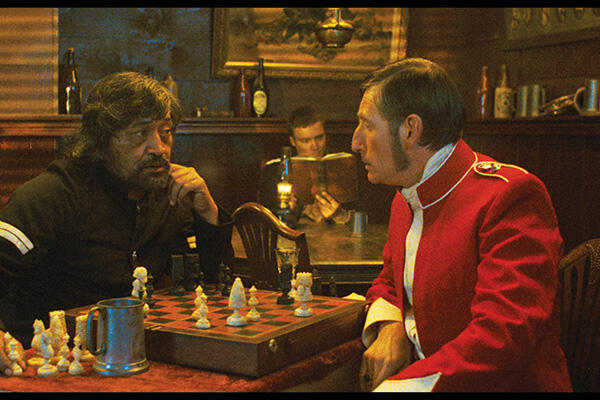
Utu Redux
The Regent Theatre - Octagon Saturday 10 August 8.15pm Thirty years since its release, Geoff Murphy’s Utu will be hitting the silver screen again this August, digitally restored and remastered for the International Film Festival. Starring Anzac Wallace and Bruno Lawrence, Utu is a story of one man’s dangerous attempt to reconcile the wrongs done to him. Described as a “western-cum-war film,” with dark humour used to shed light on the state of affairs in colonial New Zealand, Utu is based on true events that remind us of the country’s troubled past. Set during the land wars of the 1870s, Te Wheke (Wallace) works as a soldier for the British until they betray him by slaughtering his iwi. This injustice turns Te Wheke into a dangerous renegade as he swears utu (revenge) upon the colonials. His actions in turn provoke the vengeance of Pakeha settler Williamson (Lawrence). The cycle of revenge – its passion and its emotion – is excellently performed by a talented cast. In 1983, Utu became the first New Zealand feature film to be invited into the Cannes Film Festival. The producer of Utu Redux, Graeme Cowley, sought to restore the film after being appalled by the the deterioration of the original’s quality when it was screened on television in 2010. Digital restoration will allow this cinematic work of art to maintain its intended beauty, while some re-editing allows for clearer communication within the narrative. The original film received criticism for its overly-fast pace: although the action and violence will grip you, make sure to pay attention to the important points raised by the dialogue. Utu Redux provides an insightful and emotional reminder of the violent tragedies of the Land Wars of the 19th century. Arguably this insight played a role in promoting biculturalism during the 1980s. Now, in 2013, Utu Redux allows this historical reflection to be experienced by a new generation. Exciting, emotional, action-packed and reflective, Utu Redux will provide a thought-provoking and new experience for acquaintances of the original film and new-comers alike. This is a great representative of New Zealand cinema within the International Film Festival this year.
-
Culture

The Gilded Cage (La Cage dorée)
The Regent Theatre - Octagon Friday 9 August 6.30pm Tuesday 13 August 11am This upstairs-downstairs drama/comedy was a break-out hit in France, closing on 1.2 million admissions and sparking a Latino remake that is currently in the works. Set in present-day Paris, The Gilded Cage tells the story of vibrant middle-aged couple Maria and Jose Ribeiros, who emigrated from their home of Portugal when their children were very young. Maria works as a concierge for the building in which they live, where she can be seen polishing, gardening and taking care of the inhabitants even on her days off. Her husband, a respected construction foreman, is also an integral part of life in the Parisian building, and the people that live there have become highly dependent on, and fond of, the Ribeiros. The Ribeiros’ dream of returning to Portugal is suddenly made possible when Jose inherits a contested family property, meaning that the they can retire early to the beautiful family home they have always hoped for. Ironically, the employers for whom Maria and Jose have been working tirelessly are the reason why they hesitate to leave – the people of the building rely so heavily on the Ribeiros that they cannot find it in their hearts to break the news. The Gilded Cage is the debut feature film from director Ruben Alves, whose experience as a Portugese immigrant in France makes the film a personal one for him. He’s helped along by a wry and heartfelt script written by director and producer Hugo Gélin, and by former French Writer’s Guild head Jean-André Yerlès. The cast is huge, kooky and nameless, a welcome break from Hollywood’s tendency to throw the same handful of French actors at any film that requires a shot of sophistication. Despite being a French/Portugese film, The Gilded Cage has themes and concerns that will resonate with a Kiwi audience. As a country full of immigrants (especially from Europe and Great Britain), many will understand the paradoxical feelings of wanting to return to where our family originated from, yet feeling at home in our current surroundings. This film centred on family, identity and friendship is set to be one of the Festival must-see “warm fuzzies.”
-
Culture
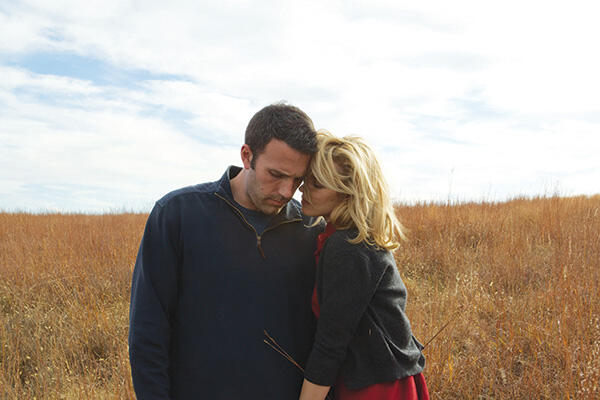
To the Wonder
The Regent Theatre - Octagon Sunday 18 August 8.45pm Rialto Cinema - Moray Place Tuesday 20 August 4pm Terrence Malick is a director lucky enough to have been stamped with auteur status. Nature, love and religion are the core of his past works Badlands, Days of Heaven, The Thin Red Line and Tree of Life, and his newest feature To the Wonder is no exception. To the Wonder follows the romantic connections made and broken by American man Neil (Ben Affleck). Having fallen in love with Ukrainian divorcee Maria (Olga Kurylenko) whilst travelling around Europe, Neil brings Maria and her 10-year-old daughter Tatiana (Tatiana Chiline) to live with him in his home of Oklahoma. However, Maria and Tatiana become increasingly unhappy, and eventually return to Europe on the expiration of their visas. Neil finds solace in old flame Jane (Rachel McAdams), but his connection to Maria remains strong and their love story is far from over. Despite the narrative being primarily focused on the connection between man and woman, Javier Bardem is also an important figure in the film as Father Quintana, a Catholic priest struggling through a loss of faith. Quintana’s internal battle is the epitome of Malick’s filmic concern with fragility – in a Malick film, nothing is stable. To the Wonder is completely characteristic of Malick. Simply viewing the two-minute trailer leaves no doubt as to who made this film. With its lingering shots of sparse fields, heavy use of orchestral music and religious musings in the narration, it appears this film is another of his philosophical examinations of humanity’s relationship with nature and what it means to live. To the Wonder happens to be the last film ever reviewed by legendary film critic Roger Ebert, so thank God he loved it. Giving the film a generous three out of four stars, Ebert commented that “Malick, who is surely one of the most romantic and spiritual of filmmakers, appears almost naked here before his audience, a man not able to conceal the depth of his vision.” This film is cinematic, intense and thought-provoking – exactly the type of film you want to watch on the Regent big screen.
-
Culture

Gardening With Soul
Gardening with Soul is a New Zealand documentary film that tells the story of a year in the life of Sister Loloya Galvin, the 90-year-old head gardener of Wellington’s Home of Compassion. Director Jess Feast follows Sister Loyola through the four seasons, in which their conversations and Loyola’s gardening bring forth themes of nature, spirituality, parenting, and above all, love. Critic’s Rosie Howells spoke to director Jess Feast about Sister Loyola, spirituality, and the experience of documentary film-making. A year is a long time to be following someone around, it’s a big commitment. What was it about Sister Loyola that confirmed to you she was your next documentary subject? There are a few things that really appealed to me about Sister Loyola. She really embodies an old wisdom that I love. I have two grandmothers in their ninties and I’m so aware of how much knowledge I get from them and how much they’ve lived, how much they’ve lived through. I heard her interviewed in 2008 with Kim Hill when she won Gardener of the Year. I just loved her vitality and her cheekiness and her humour – what she was about. The world has a lot of problems and she’s about solutions and I like that. There were a lot of things about her that I wanted to preserve and communicate and get out there to an audience. You describe yourself as having no religion, how did this affect you time with Sister Loyola? I think it was more how our time together affected me. I say I have no religion but I certainly have spiritual questions and spend a lot of time thinking about that part of existence, and this was part of the curiosity that sparked me to go and talk to her. I definitely came to understand not religion but spirituality more, and the role of love that she is so clear about and comes back to time and time again. That’s also one of the reasons I made the film: there are lot of people in New Zealand, and perhaps around the world, who feel spiritual but are not tied to a certain religious doctrine. I feel people want to connect with that side of themselves but may not know how to. I think this film is as much for those people as people who are Catholic or have other specific religions. It’s not about firm doctrines, it’s about following your own heart. What informed your decision to have no narration and only appear once in the film? I knew from the beginning I didn’t want any narration, but I feel as though I put myself in there enough. I’ve made a couple of independent films now and when I get to choose, I do appreciate the honesty of having the filmmaker present. Because I think that these stories come about because of filmmakers, I personally like having a sense of who the filmmaker is and what they’re about as part of the film – as a sort of transparency. I loved the use of children’s voices and moments of music. How did you decide what scenes warranted music? For me, the process of editing – and for Annie [Collins, the film’s editor] too because it is very much a collaboration – is actually just instinctive. It’s not an intellectual thing, so you kind of know when you need it. We had an amazing composer David Long in on the process, so he did a lot of the composition. And we also managed to license a couple of Preisner tracks. So a combination of that, and also a guy called Peter Scholes who is another New Zealand composer. So we had a whole lot of music that we were thinking might suit the film. We were really lucky working with someone like David Long, who makes it for us. What was Sister Loyola’s reaction to the film? She just said, “there is far too much of me!” She’s quite a humble person – I think it would be difficult for anyone to watch 90 minutes of themselves on the big screen. So actually, I think she did very well. She wants to spread that word, too – she knows why she did it and she trusted that I was coming at it from the right place. A lot of trust was involved. Do you have an advice for students who are interested in filmmaking or documentary filmmaking? You need to be proactive. But most importantly I think you need to choose your stories wisely. If your story can’t sustain you … It needs to give you as much energy as you need to give it, so choose things you really want to make films about because that passion is what will fuel you through those difficult periods. ReviewThe Regent Theatre - Octagon Saturday August 17 1:00pm Tuesday August 20 10:45am Sister Loyola, the 90-year-old head gardener of Wellington’s Home of Compassion, is the kind of character documentary filmmakers dream of: intelligent, kind, cheeky, open, interesting and brave – so fantastically brave. Throughout New Zealand documentary Gardening With Soul, Sister Loyola has no qualms about speaking of the issues the Catholic Church has faced in the past decade, from feminism to child abuse. Sister Loyola exclaims that the latter “sickens me,” and says she would never try to protect the Church by covering up such behaviour. It is these kinds of moments that makes Gardening with Soul a film that can appeal to all generations – Sister Loyola may be old but her views are not behind the times. The film treats Sister Loyola with dignity and reverence, with director Jess Feast knowing exactly the right times to question her and when to remain silent. As Feast says herself: “if you’re going to make a film about one person, it relies on that one person being quite open.” I personally found the most fascinating moment in the film to be the one occasion on which Sister Loyola becomes slightly guarded. Her past boyfriend is obviously a difficult subject for her, and you get the feeling that the concept of marriage and family is one with which she has battled. In one particularly poignant moment, Feast asks Sister Loyola if she has any photos of her old boyfriend, to which she quietly replies: “not anymore … something happened to them.” Gardening With Soul is a very well-crafted piece of art. The film is divided into the four seasons, each of which links nature to the different concerns of Sister Loyola’s life, and indeed of life in general. For Feast, winter represented nurture and beginnings; spring vulnerability and change; summer fruition; and autumn death and decline, but also rebirth. Feast definitely did not leave the film’s heavy lifting to Sister Loyola, but created a beautifully structured and thoughtful format through which Sister Loyola could tell her story. This documentary is nourishing not only for the soul, but for the eyes: stills taken from the film could win any nature photography competition. Sister Loyola’s garden (and even her much adored compost) are a focal point of the documentary, and we are treated to a plenitude of shots such as tulips in the rain, cabbage in the snow and Virgin Mary sculptures nestled among summer flowers. The image is notably sharp, clean and vibrant, making you realise how the blockbusters to which we’ve grown accustomed don’t experiment enough with their cinematography. Some of the most beautiful points in the film are when these stiller shots of nature or Sister Loyola are matched with music. Music is used sparingly, and therefore marks important scenes that became all the more special for being paired to relaxed acoustic tunes. At one point, Sister Loyola sits on her bed holding her rosary beads, obviously thinking deeply, whilst choral music swoops in the background. It’s so perfect it almost seems as though Feast told Sister Loyola to do that – but you can tell Loyola wouldn’t put up with that kind of shit. Gardening with Soul is a film about old people, but certainly not a film for old people. Its notions of love, growing up and spirituality without religion are universal, and will resonate with anyone who appreciates the knowledge of those who have been here far longer than us. This film is like receiving an hour and a half of the best advice your grandmother can muster, but all to a smooth soundtrack and stunning photography. Go see it. Rating: 4/5
-
Culture

The World’s End
Rating: 4/5 I feel there should be a disclaimer up front: when I left the movie last night I fully expected to give it a rather mediocre score. However, having slept on it, maybe I judged too soon. The World’s End is the third instalment in the “not a trilogy” Cornetto trilogy that includes 2004’s Shaun of the Dead and 2007’s Hot Fuzz. Simon Pegg and Nick Frost team up once again as Gary and Andrew, who, along with Peter, Oliver and Stephen, are high school mates who have since drifted apart. At Gary’s wish they return to the town where they grew up to finally complete the infamous Golden Mile pub-crawl they attempted at the end of high school. Cue the odd people in the town who don’t recognise the protagonists, and all the usual sci-fi shenanigans from earlier films. The movie is hilarious until about two-thirds of the way in, and then starts to get a bit mushy. At the time this annoyed me: I emerged from the movie feeling that the outstanding comedic writing was hacked at by the forced attempt to portray a message. Looking back on it, however, this does not detract from what was an excellent British comedy. Pierce Brosnan is outstanding as the protagonists’ former teacher, Mr Shepherd, and Rosamund Pike brings her sultry Bond Girl demeanour from Die Another Day and Johnny English to provide the romantic interest. Yet both are outshone by Martin Freeman’s star performance as stuck-up estate agent, Oliver. Freeman, who is great in everything he does, provides the refined British male that balances out Pegg’s useless yobbo quite perfectly. Overall, the great dialogue combined with a mostly brilliant storyline means The World’s End stands as a fitting companion to Frost and Pegg’s other endeavours. If you liked their previous efforts you’ll be satisfied, and if you like British comedy you’ll be laughing the whole way through. If the end of the world is to come, I’d wager most of us would like see it off at The World’s End.
-
Culture

Ping Pong
Rating: 2.5/5 Ping Pong is a documentary that follows eight competitors at the World Over-80s Table Tennis Championships in China. These elderly sportspeople include such characters as terminally ill Terry from Great Britain, 85-year-old Texan first-timer Lisa and 100-year-old ping pong superstar Dorothy from Australia. The film opens with interviews with the contestants in their homes before cracking into the game play, where more sporadic interview footage works to explain our eight competitors’ psychology. As lovely as the competitors’ interviews are, it seemed as though the director didn’t know what to do with the footage. This film has no idea what it’s trying to say. For the most part, it’s an examination of death – both what it is like to lose someone, and preparing to lose yourself. But this seems coincidental more than anything; the theme is not properly highlighted and not every competitor discusses moving on. It appears there wasn’t a standard set of interview questions used for each interviewee, and while this gave the film a great sense of variation, it robbed it of any real focus. Ping Pong is unfortunately weak on the technical side. Apart from the brilliant intro credits (which involve computer animated ping pong tables), the graphics tended to be amateurish and included only intermittently throughout the movie. The directors also seemed to enjoy filming television screens playing news casts about the tournament, which isn’t exactly a blast to watch. Even more frustratingly, viewers are forced to watch the opening ceremony via another fuzzy television screen – clearly the directors were denied filming rights at this event. What saves this film is the eight ping pong players, whose stories of war, grandchildren and their deceased spouses are funny and heartfelt. You will be confronted with the reality of just how hard it is to grow old. In one soul-crushing monologue our German first-timer tells us how she stopped eating after her husband died, because nothing tastes good dining alone. At the end of the day, this film is sweet, but poorly made. Give it a watch if you’re prepared to pick out the significant moments yourself.
-
Culture

The Wolverine
Rating: 4/5 It takes a movie like The Wolverine to make you realise why all of the superhero films (particularly Marvel’s) are beginning to feel stale, and it is because they all feel exactly the same. Although they all have different heroes facing different situations, they share virtually everything else. The Wolverine is the first in a long time to break free from these chains. Tonally it is different from every other X-Men movie, and yet it is informed enough by them to bypass all the backstory and jump right into its own epic tale. The Wolverine is set after the events of X-Men: The Last Stand, but aside from Logan being haunted by the memory/ghost of Jean Grey, the X-Men do not factor into this film. Hugh Jackman once again reprises the role of Wolverine as he ventures to Japan to say goodbye to a man he saved from the nuclear bomb dropped on Nagasaki during WWII. The story interweaves deep psychological issues with a filmic mash-up of Western action and Eastern kung fu, and the result is a unique adventure. The film has some really breath-taking action sequences that are approached in a way that challenges many of our expectations. A good example is the fight scene on the bullet train, in which the laws of physics are used to exhilarating and hilarious effect. At the same time, however, the film isn’t scared to drop the action so as to truly develop characters and relationships. This film is so refreshing because it utilises all the things that make us love superhero films while at the same time daring to try something new. Watching the film, I got the overwhelming feeling that it wasn’t made to trick us out of our money (as seems to be the case with many of the films in this genre), but rather that it was a real labour of love in which all involved had a reverent respect for both the Marvel source material and the eastern influences to which they were paying homage.
-
Culture

It’s A Wonderful Life
Frank Capra’s 1946 It’s a Wonderful Life is the best Christmas film ever made. Don’t worry, not in an oh-my-Jesus-I’m-so-hipster-I-can-only-appreciate-films-made-before-the-advent-of-the-toaster-oven kind of way, but in a highly-accessible-heart-warming-life-affirming way. James Stuart, in the role of his career (I don’t care if I’m laying it on thick. You need to watch the film), plays George Bailey, who may just be the gosh darn nicest man in Bedford Falls. Throughout his life George has sacrificed his own happiness and dreams of travel to help others, to the point where one Christmas Eve, facing personal ruin through no fault of his own, George stares into the raging river of his home town about to commit suicide. Cue his guardian angel Clarence (Henry Travers). Clarence comes down to Earth wearing a medieval nightie and bowler hat (I told you it was awesome) to try and change his mind, and takes George through an alternative Bedford Falls – one in which George had never been born. I’m not going to tell you any more, but godamn, you better bring your hanky! Despite being a commercial failure that wrongfully confirmed the industry’s claim that Capra had lost his artistic marbles, It’s a Wonderful Life gradually went on to become one of the most loved classics in history. Ranked number 11 on the American Film Institute’s “100 Best American Films Ever Made” and number one (!) on their “Most Inspirational American Films of All Time” (I question the Institute’s decision to make the names of the lists slightly different), it has been unanimously decided that the film’s just bloody lovely. Sure, there’s some casual misogyny and a borderline offensive depiction of an African American maid, but this film has a lot more right with it than it does wrong: some of the most famous film quotes of all time (“Zuzu’s petals!”), a dance sequence on top of a moving floor and a lot of sassy high-waisted pants. But most importantly, it could make the poorest, laziest, most unpopular sewage worker feel like they’re loved. Don’t wait till December to watch this bad boy, warm your heart today!
-
Columns

Love Is Blind | Issue 18
YokoI knew I was either going to have the best night ever or leave immediately, and it was totally up to mystery boy to impress me. I was worried he’d be a stereotypical Scarfie there for the free feed, but I was very wrong. After a small pre-load, the BYO was alright and I really enjoyed the conversation. We turned out to be quite similar, and I have my suspicions that the Critic staff had Facebook-stalked us for a decent setup. A simple comparison of music taste will always put you on the right track for a partner. He was good-looking; tall with dark hair and a solid jawline and a calmness about his persona. He’s probably the first guy I’ve ever met who had an interest in my ironic retro Barbie collection – but then again, maybe he was just being polite. Anyway, without further ado I’ll get into the raunchy stuff, because I know that’s why people read this. For the record, I was surprised it went so far. We decided to go back to his place for music and bong time but soon I was getting really horny. So as he hit that elaborate bong of his for the third time I didn’t hesitate to kneel in front of the bed. I was certain he was keen, too. Timing my movement with the sound of the gurgling, I knew I was doing a good job when the bong thudded on the floor and spilt water everywhere. But neither of us could really care less. Switching roles, I came really fast. But it was one of those times when I just wanted more. Stripping down I saw he was quite hot, too. We went at it for ages but neither of us could get enough. I lost count of how many times we woke up for more, both that night and the next few after. I guess we’re a thing now. Oh, and he’s a real sweetie. Breakfast in bed and shit. Thanks Critic for a year-defining night! JohnI was disappointed at first to find out that the blind dates are no longer at Angus. Even though everyone lately seems to go just for the free meal, I thought it would be a sweet locale for a semi-casual date night. Regardless, after a pre-date hit on the bong I went up to the Critic office to pick up the bottles of wine and money for the BYO. My to-be-date and I arrived at the door at the exact same time, which got the excitement going. I could tell she’d be a fun one – a good looker with light brown hair and a wide smile – and we got to talking pretty easily when we set out for the restaurant. Dinner was good – typical Indian fare – and we were in a good place after finishing off a bottle of vino each. Conversation flowed really easily and I found out she was into similar stuff to me – in fact, I recognised her vaguely from a couple of ReFuel gigs. We were both planning on hitting up Camp A Low Hum early next year and made tentative arrangements to hang out there. It was an exciting date. Draining the bottles, we decided to head back to my place to get high and listen to music. She could hit the bong impressively hard; an obvious veteran. After the first hour of just chilling, things got a bit frisky when we hit the bong again. We were getting on royally, so it seemed almost natural when she went down on me as I took a hit (lifelong fantasy fulfilled, by the way!). I fell back onto the bed as the weed hit and the pleasure skyrocketed – she gave great head. Stopping her before it was too late, we switched positions and I went down on her while she smoked. She had a similar reaction to me, which was a huge turn on. Before long our clothes were all off and wow! I wasn’t wrong – what a looker. We made love several times throughout the night. We’ve spent the next three nights together, too. What a date. This is how life should be.
-
Columns

Get Out Of The Ghetto | Issue 18
Contrary to popular belief, minigolf is not simply the domain of awkward family holidays in smalltown New Zealand. In fact, you might say that minigolf is undergoing something of a sporting renaissance, enjoyed as a fun flat outing by many an Otago student as well as by hordes of overly-competitive children and their long-suffering parents. OUSA even held a minigolf tournament a few weeks ago. Should you want to partake in this test par excellence (geddit?) of putting accuracy, Dunedin offers two minigolf options. There’s a slightly fatigued, mini-minigolf course (featuring just 12 holes) located indoors at Laserforce (on the Anzac Avenue/Frederick Street corner). Sure, the astroturf might have seen better days, and the course might be a bit squished together in a minigolf-in-a-small-indoor-warehouse sort of way, but it can still be a fun time – especially if you combine your visit with some Laserforce action too. And then there is the Get-Out-of-the-Ghetto-endorsed superlative option: Wal’s Plant Land minigolf course. Situated in the unlikely location of Mosgiel, it would be easy to complete an entire degree at Otago and miss out on this hidden minigolf gem. As the name suggests, Wal’s Plant Land sells plants. It also sells fruit and vegetables (it’s Mosgiel’s answer to Veggie Boys), has the aforementioned above-par outdoor minigolf course, a mini train that loops around the complex, and a surprisingly excellent café. In short, there is something at Wal’s for everyone. The minigolf course itself is no walk in the park (although, with its charming park-like settings, you could be forgiven for thinking so). Each of the 18 holes references a local, if lesser-known, Dunedin landmark, such as Scroggs Hill, the Wingatui racetrack and Outram Glen. Many holes have challenging contours and niggly tricks to test even the most avid minigolf aficionado. You will bless the person who decided on a nine-shot maximum score for each hole, believe me. There’s a water feature or two, a fair amount of tussock, and even a bathtub. It ain’t quite as fancy as, say, Caddyshack Queenstown with its fully-articulated model gondola, but it’s rather picturesque. And at $6 a round, this is bargain fun, and much more affordable than real golf. On a beautiful crisp Dunedin day, there is no better place to pass a few hours than at Wal’s, playing minigolf with friends on the sunny Taieri plains. It’s open every day from 9am until 5pm. Enjoy. Get there: by car. Do: rug up, and go when the weather is nice – the course is outdoors. Don’t: get too competitive – it’s just minigolf. Eat: at the café, which has excellent cabinet offerings.
-
Culture
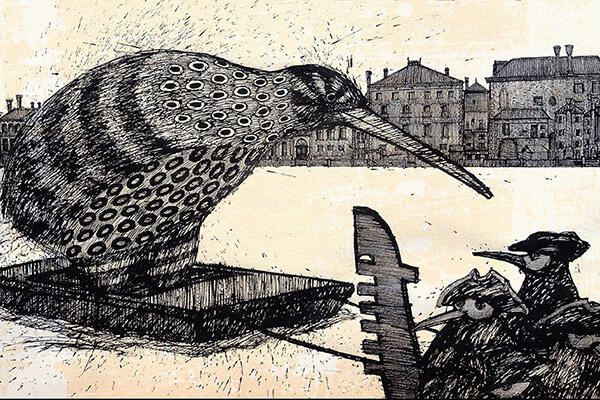
A Micronaut in the Wide World
Hocken Library, 15 June – 10 August Exhibitions featuring an illustrator are few and far between. Depending on the number of bedtime stories you demanded as a kid, they can plunge you nostalgically back into childhood. Although he lived most of his adult life in London, Graham Percy was one of New Zealand’s most well-known and distinctive illustrators, having provided visual material for more than 100 children’s books. However, A Micronaut in the Wide World – currently showing at the Hocken Library – demonstrates that his ideas extend far beyond the realm of storybooks. Graham Percy was unknown to me upon entering the exhibition, but his illustrations were oddly familiar. They reminded me of Maurice Sendak: realistic enough to recognise what was being depicted yet with enough of a twist to be disconcerting. The human figures are out of proportion, their heads too large and their figures squashed in a way that makes you want to adjust them / push them into the correct mould. Percy’s style is highly memorable: his plump figures sit in beautifully detailed environments, often with scrawling text hanging in a top corner. Carefully constructed and quirky, they verge on graphic design. Bordering the two fields of art and design, illustration involves very specific representations of subject matter – much more so than the significant majority of recent “high art.” This level of focus allows illustrations to fit in with a body of text. Illustration has often been considered one of visual art’s “lesser” forms, but this attitude seems to be changing. In many of Percy’s drawings you notice a distinct awareness of artistic movements such as Bauhaus, possibly a result of his training at Elam School of Fine Arts. In 1994 he published a book called Arthouse, in which he designed each room of a house in the style of an artist he was influenced. (Joseph Cornell was lucky enough to be represented by the bathroom.) This exhibition gives viewers an overwhelming sense of Percy’s artistic and creative capability, and an insight into his ironic sense of humour. There are endless pictures of famous composers placed out of context, mostly in typical New Zealand landscapes. Franz Schubert emerges from a stream with a trout having found the inspiration for his “Trout Quintet,” and Beatrix Potter, her head an inflated balloon, is depicted casually observing some rabbits above the caption: “Beatrix Potter in her own special balloon watches rabbits dressed for occasion …” Interestingly, the most captivating part of the entire exhibition is not the works themselves but a 10-minute video of Percy’s house in London, created by the illustrator’s son after his death. Everything is immaculately laid out, each room bursting with art works and collections of objects. One object that stands out as a representation of Percy’s personality is his printer, on which painted black and white squiggles accompany the words “un homage à Wassily Kandinsky.” Percy died after catching pneumonia on a trip to get art supplies. He was creating and observing the world around him right until his death. With any large exhibition it becomes difficult to maintain the focus needed to really “look” at each drawing, but A Micronaut in the Wide World offers many gems that may touch your heart and possibly make you snort a little with laughter.
-
Culture

Let’s Explore Diabetes With Owls
This entertaining read is the newest collection of short essays from humourist and writer David Sedaris, who burst onto the scene with his second book Me Talk Pretty One Day. As with his previous essay collections, Sedaris’ essays cover his childhood in North Carolina, the state of present-day America, his family and his life abroad. Several of his essays are (hilariously) told in the voice of different characters, like an obnoxious American girl who talks in a British accent and a ridiculously conservative idiot redneck. Sedaris’ writing style is witty, fluent, and easy to read, and he is astutely observant of both the ridiculous and sublime detail that peppers everyday life. Sedaris is also completely willing to be unselfconscious about his own foibles; clearly he has no problem coming across as finicky, judgemental, macabre and just plain weird. These are the only adjectives you can use to describe a guy who devotes one whole essay to his disgust at Chinese social habits and food and another to taxidermy. In the latter, he attempts to find the perfect Valentine’s Day gift (a stuffed owl) and ends up quite willingly touching a dead man’s preserved arm. Sedaris’ self-deprecating sense of humour is fairly low key – more baleful wit than belly laughs – and perhaps this is why I finished the book feeling somehow underwhelmed. Maybe it was my expectation that the book would be funnier than it actually was; maybe it was my assumption that I’d be ROFLMAO at least some of the time. Regardless, the book induced in me wry smiles rather than actual laughter. On the other hand, it’s worth noting that he was named “Humo[u]rist of the Year” by Time magazine, and he won the Thurber Prize for American Humo[u]r in 2001. Clearly, he knows what he’s doing. But he’s not a comedian, and perhaps I got the two mixed up – hence my sense of slight deflation when I finished the book. This is not to say that I didn’t enjoy reading it. The essays are often amusing and sometimes thought-provoking, and a few of them (particularly the ones written from the point of view of a fictional character) were viciously funny. In fact, these latter essays were the ones I enjoyed the most, primarily for their bite. The essay “Just a Quick Email,” for example, is a tour de force of succinct, concise, passive-aggressive bitchiness at its best (the fictional character is writing this “quick email” to her paralysed-from-the-waist-down sister and ends the email with “Gotta run!”). In total, Let’s Explore Diabetes with Owls is a breezy, easy read, and probably great for the beach.
-
Culture

Pumpkin Pesto Risotto
Tis the season for pumpkiny goodness. I picked up a fine, fresh looking specimen from the Dunedin Farmer’s Market last weekend for just $2 and managed to make this, a few servings of soup, and even had a little left over to go with the roast last night. Cooking with seasonal produce requires a bit of research and imagination, but you’ll save heaps if you can manage to put a few recipes together each week that make the most of what’s currently (and locally) growing. Substitute your green salads for a roast vegetable salad once in a while – root vegetables like parsnip, carrots, and beetroot are all reasonably priced this time of year. This risotto is another combination recipe, and what it lacks in appearance it makes up for with scrumptiousness. Pesto and pumpkin are a match made in culinary heaven. Ingredients:- 1 onion, finely diced - Olive oil - 2 cloves of crushed garlic - 2 tablespoons basil pesto - 3 tablespoons grated parmesan - Approximately 300g of pumpkin, grated - 200g mushrooms, sliced (optional) - ¼ cup white wine - 1 cup Arborio rice - 3 cups of hot water or vegetable stock* - Salt and black pepper to taste - Fresh basil Method:1. Fry the onion and garlic in a large saucepan or frying pan and cook for about three minutes until the onion has softened. Add the grated pumpkin and sliced mushrooms and heat through, stirring frequently. 2. Remove the vegetables from the heat, place them in another dish, and set aside. 3. Put a tablespoon of olive oil in the pan and place on a high heat. Add the rice and fry it off for a couple of minutes, and then add the vegetable mixture. Stir gently, add the white wine and one cup of the hot water or stock, and reduce the heat. Let the mixture simmer and stir every now and then until most of the liquid has been absorbed. 4. Add another cup of the liquid, stir occasionally, and again – let it simmer until the liquid has absorbed. Repeat this process until you have added all of the stock and continue to stir it frequently. Test the rice to see if it is cooked, and if not, add some hot water and repeat the process until the grains are tender (take care not to over-cook it, there’s a fine line between creamy risotto and sticky mush). 5. Once this rice is cooked, stir through the pesto and the parmesan. Season with salt and black pepper and serve with parmesan shavings, freshly chopped basil, and blanched broccoli. *If you’re ever boiling vegetables, it’s a good idea to keep the water you usually drain off. You can freeze this and use it as stock for soups, risottos, casseroles etc. #thanksma
-
Columns

Daily Grind | Issue 18
Rating: 4/5 Unless you’re regularly around the Teachers College area of campus you may be unfamiliar with Fluid Espresso, which is located on the corner of Union East and Forth Streets next to the Campus Wonderful Store. The small coffee bar is buzzing early in the morning, especially with University staff, but the place closes pretty early in the afternoon as they’re usually cleaned out of food just after midday. Fluid Espresso has a few seats and a bench, and some cute wee boxes they pop outside on sunny days, but it’s usually so busy that you’re better off getting takeaway. This café uses the popular Allpress beans, and the baristas make an excellent cappuccino – ideal for those walking to uni from the Dundas/Harbour Terrace area. Fluid’s treatment of their beans is pretty admirable – they can cram a triple shot into a small cup without it tasting too bitter. M and G recommend the muffins and sandwiches they have on offer. Fluid also has a pretty good stamp card system – although often you have to stamp your own card, Fluid trusts you not to snake a few extras. There is nothing worse in M’s book than having to wait an eternity for a long black or cup of tea behind a backlog of milky coffees when all you need is a dash of water in a cup. Fluid is one of those great cafés that seem to understand that frustration, and so they don’t piss around when they are pumping out the orders. Fluid is a popular hangout for those milling around PolyTech, T-Col and the Bill Robertson Library. As it’s such a hot spot, don’t expect to waltz in and out of this wee coffee bar without having to wait in a sizeable line. Around peak times, ain’t no thang to see a line going out the door onto the street with a crowd around the counter as everyone waits for their coffee fix. However, M and G find it a blessing to be able to get a great takeaway espresso in such an isolated corner of campus.
-
Culture

State of Decay XBLA
Rating: 9/10 No doubt many of you have noticed that the world seems to have come down with a nasty case of zombie fever. Films, books, video games – name it and there is probably a large number of zombie iterations currently being developed or hitting the crowded market. This is the fifth game this year that I have reviewed that has some form of zombies in it, but despite the overuse, zombies seem to be a game genre that inspires innovation. Two of the best games released in recent years are The Walking Dead and The Last of Us, and now here we have yet another game in the zombie genre that will no doubt further ignite our zombie obsession. State of Decay is an open world zombie survival game, that much like other games in this genre (such as the popular Arma 2 mod DayZ) has players exploring the map in order to find weapons to use as protection from the zombie threat. However, layered on top of this are a number of gameplay features which make this game a unique experience. The first of these is the establishment of a home base in which the player must manage survivors, supplies and crises. Although the game has a number of narrative threads running through it, your primary focus is always the protection of your people. This is emphasised by the fact that once a person has been invited and ingratiated into your community you can play as them, meaning that you get to know and care for the personality and wellbeing of each individual character. This ups the stakes associated with keeping every single one of your survivors alive. You feel genuine fear for your fellow survivors when you get a call over your radio saying that zombies are attacking your base. There are many tasks tied to keeping the people in your base safe, including ensuring you have adequate supplies. This requires you to venture out and search buildings, which considering the zombies in this game is an alarming prospect. The game can support an impressive number of zombies on screen at one time, meaning that getting swamped is likely. One zombie is easy to dispatch, but if you are too loud or not careful enough you will suddenly be stormed by every nearby zombie. Both fighting and running cause your character to fatigue. Consequently, when you run out of energy you can neither fight nor escape. However, with practice it is possible to sneak around towns, searching buildings and dispatching solitary zombies without too much trouble. Supplies can either be thrown over your back and carried home, or you can call in a fellow survivor to come and pick them up. State of Decay may not be the prettiest game in the world, and it can be quite buggy at times, but once you really become invested in the experience these concerns seem arbitrary. What the game lacks in these areas it more than makes up for in the experience it offers. Every aspect of gameplay creates tension and emotion which work in tandem to make something really special. It could stand toe-to-toe with many $100 titles that have been released this year and yet it only has a $25 price tag. If you have a 360, it will be the best $25 you spend in a long time. PC gamers, however, will have to wait until later this year.
-
Culture

μ-Ziq - Chewed Corners
Rating: 3.5/5 Michael Paradinas, most commonly known as μ-Ziq (pronounced “music”), is an English electronic musician. Though an influential figure in IDM (Intelligent Dance Music) over the last 20 years, he has never received quite the attention or acclaim of his contemporaries, such as Squarepusher, Autechre or Aphex Twin. Some would call this unjust; with perhaps the exception of Autechre, μ-Ziq has been more active in recent years than any of his peers, releasing albums under numerous pseudonyms and running his own eclectic label, Planet Mu. Others would draw a direct parallel between μ-Ziq’s prolificacy and his lack of a magnum opus; while a group like Boards Of Canada emerge from their cave once every few years with a fresh masterpiece, μ-Ziq simply spreads himself too thinly over too many projects, never focusing his efforts long enough to produce one truly extraordinary work. Chewed Corners is Paradinas’ eighth studio album under the name μ-Ziq. As with every new μ-Ziq album, Chewed Corners arrives with the task of being his overdue masterpiece. Furthermore, it comes at a fertile time for electronic music: 2013 has already seen acclaimed releases from close relatives Autechre and Boards Of Canada and distant cousins Daft Punk and The Knife. In short, the bar has been set very high. As I anticipated, Chewed Corners doesn’t quite deliver. It doesn’t rank among 2013’s best electronic albums, nor is it μ-Ziq’s masterpiece. As disappointing as this was, this doesn’t stop Chewed Corners from being a solid album. To its credit, it bares little resemblance to any other music being made today. “Taikon” is perfect as an opening track: tinny percussion and a haunting keyboard melody twitch against a queasy wall of bass, recalling horror soundtracks of the late 80s and early 90s. A synthetic choir fades in and out of the latter half of the track; though in isolation this would sound angelic, in Chewed Corners’ soundworld the result is chilling. Across the album, sounds are placed in an unfamiliar context and their nature inverted, such as the dancefloor pulse in “Christ Dust” or the house piano in “Houzz 10.” What would otherwise ring rich and optimistic here sounds bleak, empty and pixelated. So why doesn’t Chewed Corners compare to an album like Tri Repetae, or even Exai? It certainly has a sound as coherent as either of those albums, though I can’t help but feel this is the result of μ-Ziq drawing from a limited sonic palette rather than honing in on a particular idea. You also have to be incredibly tactful to do retro well (as Daft Punk did earlier this year with Random Access Memories), and Chewed Corners’ backward-looking philosophy takes away from its overall effect. Though it does occasionally nod towards more recent veins of electronic music, much of Chewed Corners sounds suspiciously akin to the skeletal IDM μ-Ziq and co. were cooking up two decades ago. Though this album is certainly worth your time, I was left wishing Chewed Corners were better than it is. On reflection I should have lowered my expectations and I would have enjoyed it more as a result, yet I held out for a masterpiece all the same. We all know μ-Ziq has it in him. It may take him shelving a couple of his pet projects, but one day he’ll concentrate his talents and come out with one. One day.
-
Culture

Bliss N Eso - Circus in the Sky
Rating: 2/5 When their new album Circus in the Sky materialised in the Critic office, I hadn’t the faintest idea who Bliss N Eso were. However, I fell hook, line and sinker for the ludicrously shiny packaging the CD came in, making me just curious enough to find out. For a long time I simply admired the artwork; planets, stars and angels with rainbow wings, all presented in a rare-Pokémon-card-like sheen. This paradisiac imagery, combined with song titles such as “Sunshine” and “Animal Kingdom,” had me expecting something along the lines of The Lion King soundtrack in space. While I would have loved some massive Technicolor world music, Circus in the Sky proved instead to be an album of overproduced Australian hip-hop. Oh ... okay. Needless to say, it took me some time to digest the chasm between what I had hoped for and what I received. Now that I’ve properly listened to it, I can safely say that Circus in the Sky isn’t for me. Beyond the music not really appealing, I take issue with how insincere Circus in the Sky feels. Bliss N Eso spend half the record asserting their own intelligence – look how cultured we are, look how socially conscious we are, look how politically aware we are – and yet not once does it feel genuine. Whether they’re sampling Charlie Chaplin’s famous speech at the end of The Great Dictator, referencing Hunter S. Thompson and Bill Hicks mid-rap, or dedicating songs to certain late astrophysicists (“Pale Blue Dot”), it all rings a bit hollow. If Bliss N Eso had any confidence in the calibre of their music, surely they wouldn’t feel the need to dress it up in such hip name drops, or such lustrous artwork for that matter. It’s curious, as Circus in the Sky does have a lot going for it: heavy beats, colourful production, big guest appearances (including Nas), and even bigger choruses. For a certain group of people out there, this will be as good as it gets. Is it my own cup of tea? Yeah, nah.
-
Columns

Hi Dr. Nick | Issue 18
Pop quiz: what’s the most common mental health disorder in New Zealand? If you’ve seen John Kirwin on TV, you probably answered depression. If you’ve read Te Rau Hinengaro: The New Zealand Mental Health Survey (or copied from the guy sitting next to you) you might have answered anxiety disorders. Or you could have just guessed C and moved on. Given that 15.1 per cent of people our age (16-24) meet the criteria for major depressive disorder at some point, depression’s not a bad guess. Heck, if you look at all mood disorders that number creeps up to 20.7 per cent (that’s one in five people), making it about as common as cougars at Fever on any given Saturday. The level of anxiety disorders in New Zealand is even larger than said cougars, however (which is staggering considering the waistline on some of them). 23.9 per cent of people our age have some form of anxiety disorder. Last week we briefly touched on one manifestation of this (panic attacks) before diverting to a gay-joke-riddled spiel on not making gay jokes. This week I want to pick up where we left off. Panic attacks are severe attacks of fear and anxiety that hit without reason or warning. In terms of vindictive combinations of symptoms, this one takes the cake. One is an irrational fear of dying, and others include things like chest pain, palpitations, shortness of breath, and light-headedness. Y’know – the rational “oh shit, I’m dying” kind of symptoms. Attacks usually last 5-10 minutes but can go on much longer, with symptoms surging and resurging throughout. Most people only need to ride them out, understand that it’s not because of any underlying physical problem, and focus on breathing deeply and slowly. For a small minority of people, however, further steps like antidepressants or therapy are needed. People with panic disorder (frequently recurring panic attacks with persistent concerns about their health) can have further problems like agoraphobia if left unchecked, so if anxiety’s got you worried, see your doc.
-
Columns

Science, Bitches! | Issue 18
We all know that the living standards in the ghetto of North Dunedin can be pretty bad. Images of mouldy rooms, condensation on the windows every morning and milk being left on the bench (since it’s colder in the flat than in the fridge) spring to mind. Staying not only warm, but also healthy, is something of a skill around here. Keeping your flat warm and dry can be a challenge, and half the problem is sub-standard insulation and shitty upkeep by landlords. You could hound your landlord for some upgrades if they’re willing to cooperate, but failing that, science has a couple of tips to improve your living conditions where possible. When drying your clothes, should you use a dryer or a line inside? The moisture has to go somewhere, and damp air means your clothes take way longer to dry. Without a way of getting rid of the excess moisture, you also risk encouraging the growth of mould. Mould loves the damp and grows like crazy if left unchecked. What you can do is open some windows. I know it’s cold out, but by closing all doors to your laundry/bathroom/wherever and opening a window you can force the damp air outside: the drier atmosphere (unless it’s raining) draws the moisture out until the amount of moisture outside and inside is the same. This is called equilibrium. When the fresher flu (or any other winter ailment) comes and rudely interrupts your busy schedule of procrastinating from assignments, you might head down to Student Health. If you decide to see a doctor, there is one key thing to remember: if you have the flu, or some sniffly cold, it’s caused by a virus. If you’re hoping for some antibiotics, therefore, you’re out of luck. Antibiotics only kill bacteria – they can’t kill viruses. What (generic) antibiotics can do is kill some of the “good” bacteria that normally inhabit your gut. Killing these good bugs can create problems. Where the bugs die, new ones will take their place. Hopefully good bugs will replace good bugs, but occasionally a bad bug may take the space and use it as an opportunity to start a nasty infection. This bug may be resistant to the antibiotic you took. Misuse of antibiotics has contributed to the evolution of “superbugs,” as only resistant bugs will grow where others died. Don’t let this scare you if you do need antibiotics, just don’t expect a prescription every time you get the sniffles. Going out? Decided to choose your booze blanket over a jacket? The idea that a couple of drinks makes you warmer is actually a myth. Yes, drinking makes you feel warmer. If you touch your cheeks, they might seem warmer. What’s actually happening is a little less fun. When you’ve had a drink or two, the blood vessels in your skin dilate (they widen a little, allowing more blood through). Since they’re close to the surface, they let heat out. This makes your skin feel warmer, but that is heat leaving the body. This is the same way your body (intentionally) loses heat when you exercise. The problem is that when it’s a balmy Dunedin 4˚C out, your core body temperature goes down. This could actually cause you harm, especially if you are outside for a long time. Don’t let yourself get hypothermia – put some clothes on. Despite the fact that Dunedin’s flats more than live up to their icy reputation, remember these tips to get you through those wintery weeks with science, bitches.
-
Culture

I Just Want to Watch Game of Thrones, Damnit
Television networks have pulled their socks up over the past few years. The proliferation of piracy online means it is no longer acceptable to air international TV shows in New Zealand months, or even years, after their inception. Not that it was ever acceptable, really – we just didn’t have much choice in the matter. We’re no longer slaves to the television networks, and they’ve had to work hard to keep their viewers. Last year TV3 managed to broadcast Homeland mere hours after it screened in the USA. It was almost quicker than piracy but you still had to sit through obnoxious Harvey Norman ads, so piracy remained the more attractive option. A for effort, TV3, but what can I say? I’m a fussy customer. Here’s what I want: TV shows and movies in high-quality digital formats that are mine to own and watch as I please. No ads, and bonus points if it’s all legal and reasonably priced. Who’s going to give it to me? Overseas, services such as Netflix and HBO Go, which allow instant streaming of a huge range of TV shows and movies, have become extremely popular. In New Zealand, though, piracy remains the most reliable method for watching shows soon after they air overseas. For local content, TV on Demand offered by local networks is fairly reliable, but no one cares that much about New Zealand’s Hottest Home Baker, do they? New Zealand’s answer to Netflix, Quickflix, might be a step in the right direction, but its current catalogue is pretty lackluster (unless you’re really into Poirot). Besides which, if I want to watch a show more than once it’s going to eat up some serious data, and that shit’s expensive in New Zealand. So what about films? You want a legal, digital copy of a film? Sure thing – you just have to buy the DVD or the Blu-ray first. Or the DVD and the Blu-ray. Point is, you need the physical copy. Alternatively, you can buy a film on iTunes. That’ll be $29.99 for Life of Pi, please. Available only on your iDevices because fuck you, that’s why. I’d rather not invest in DVDs, a format that will linger for some time but eventually die. Discs are a hassle and if I want to play them on my tablet I have to rip them anyway. Ain’t nobody got time for that. Blu-rays are nice, if you have a Blu-ray player, but like DVDs they aren’t particularly portable. At least piracy provides a portable, reliable format that will work with most devices. In an ideal world, there would be a legal way to buy a high-quality, DRM-free copy of whatever show you want to play as many times as your heart desires on whichever device you choose … at a reasonable price. Hell, there’s even money to be made off our collective thirst for nostalgia, as video game purveyors Steam have discovered. Offer up a high-quality digital package of The Simpsons complete seventh season for $10 or less and I’d buy that shit. Somebody take my money! Whatever. Until that day arrives, piracy is easy, reliable, quick, and comprehensive. If you want digital copies of Gilmore Girls, or new shows that are yet to air in New Zealand (Orphan Black, Black Mirror, Fresh Meat), piracy is pretty much your only option. When it comes to Game of Thrones, piracy is definitely your only option. It is known.
-
Culture

App of the Week | Issue 18
Weebly is a drag-and-drop, no-coding-required platform for creating websites that actually look good. If you need to create a quick website to advertise your tutoring skills, or your Mum’s clothing-swap event, Weebly is the way to go. Think of it as the 2013 equivalent of GeoCities, with nicer design options. Much nicer. Weebly offers hundreds of themes that you can customise with its drag-and-drop interface. If you’re comfortable with HTML and CSS, you can add your own code for even more customisation. It offers mobile-friendly themes, search engine optimisation, slideshows, contact forms and pretty much anything else you might need for a simple website. A nice touch is Weebly’s site planner, which helps you to think through the web design process clearly. It encourages you to think about site navigation options, the aims of your website and other little things you might not think about if you’re not used to designing websites. Weebly isn’t as robust as a fully-fledged content management system like Wordpress, Drupal, or Joomla, but it’s absolutely perfect for simple web design needs, and practically idiot-proof.
-
Culture

Interview: E. L. Katz (Director of Cheap Thrills)
Rialto Cinema - Moray Place Saturday August 10 8:30pm The Regent Theatre - Octagon Sunday August 11 - 8:45pm Director Evan L. Katz’s latest film, Cheap Thrills, is a devilish morality tale in which a wealthy couple (David Koechner and Sara Paxton) test how far a poor couple (Ethan Embry and Pat Healy) will go for some extra cash. The film has been selected for the “Incredibly Strange” section of the New Zealand International Film Festival, and Radio One’s Aaron Hawkins spoke to Katz about the film, Drafthouse, and television’s current renaissance. Aaron: Cheap Thrills feels like Indecent Proposal meets Jackass as written by Roald Dahl, by way of bunfights.com. It’s a macabre concept, but a very simple one, which is a challenge for a director to maintain over the course of a feature film. Evan: Yes, but I think it’s a good way to go when you don’t have any money. The whole point of it was: how do you make four people talking crap to each other in a house enjoyable? It’s not like a home invasion film – we don’t benefit from having people chasing other people around with hatchets and stuff – so there has to be some ideas to play with there. Well you kind of do have people chasing each other with hatchets and things. Well, actually no. They willingly offer up their body parts [laughs]. [Laughs] Right, which inevitably leads us to questions around exploitation… It is essentially exploitative – how far will a poor person go for a rich man’s entertainment, and subsequently his money? Yeah, and I think in life people will go pretty far. At what point would Evan Katz have backed out in the film? Um, before cheating on my wife! That’s certainly a watershed moment. I think that sometimes if you have to pay the rent, there [are] a lot of allowances that can probably be made. But I think at some point, your wife won’t give a shit if the rent’s paid. It’s a conversation that everyone’s had at some point, often late in the evening and early in the morning – “what would you do for 50 bucks; would you drink out of this ashtray for 100 bucks?” I wondered about the arc of the story – are you interested in taking that concept to its logical conclusion or is the premise a way of working back from the more pulp-ish excesses of the film as it escalates towards the end? I think it’s balancing the two. I think I definitely have my own interest in lowbrow and highbrow simultaneously, so I wouldn’t pretend that this is purely a think piece and I don’t think it’s purely escapist. It kind of manages to be both. It’s kind of a smart bar conversation that goes to hell after too many drinks. There [are] some good ideas there, but there’s also a lot of madness and testosterone and really brutal stuff that happens. … You go out with some of your friends to the bar and you never know what’s going to happen after too many drinks. You might end up punching the dude in the parking lot, or whatever, but you’re still friends the next day. This is where you keep it going and keep the drinks going, and just see what happens. It’s a fine balancing act, but it certainly feels like it’s being pitched at a more lowbrow audience, or at least an audience that is more interested in lowbrow films. It played at midnight at South by Southwest; it’s been selected for this festival by Ant Timpson of Incredibly Strange films. That is a particular audience. So how do you transcend that to get the more serious material out there? Because it is a lot more thoughtful than splatter films and Drafthouse films often are. Well, The Act of Killing they just put out recently, which was really incredible and so much more vicious than almost anything I’d seen recently. So we have good company. I think the Drafthouse label has been able to mix things that are purely party-escapist with something a bit more high-minded. So I don’t really worry about it – we’ve gotten the movie out to people that just want to see a late-night horror film and have a good time. But we’ve also shown it to some critics who are pretty serious and kind of intimidating and don’t typically seem to like that kind of stuff, and they’ve really responded. So … it can reach people who just want to have a good time, and people who want to think about stuff. It raises interesting questions for me around censorship because I feel that the message and the subtext of the film is almost more offensive than the visual elements of the film, but [the latter are] more likely to get you grief at the censor’s office. That sheer exploitative nature of humanity is far more repellent to me than someone getting their face punched in. And I don’t know what that says about me or society, but … I think it is more offensive, and I think it’s more sad, too. I mean, special effects – we’ve seen a lot of them, and it’s really not going to stick with us for too long. But the ideas of how people treat each other – that’s what keeps us up at night. What is it about Ethan Embry that impressed you so much it made you want to cast him in this film? I really liked him in Brotherhood – in that one he was kind of playing a character out of Breaking Bad, which is one of my favourite shows. There’s a lot more to him, and when we met with him and sat with him, at first he actually seems quite intimidating – he rode in on a motorcycle, he was kind of legit, he had all these tattoos. But then we actually started talking and he likes a lot of smarter genre stuff, and crime films, and just had his head wrapped around the script and the character … I think it’s fun to have the Can’t Hardly Wait dude suddenly be, like, the heavy. August 11, series 5b of Breaking Bad begins, the end of an era. There’s a lot of talk around it being some of the greatest, if not the greatest television writing of all time. That one and The Wire. The Wire’s a little harder to get into, I think Breaking Bad starts off so amazing and quick, but I think The Wire’s also a pretty good investment. It’s interesting that you mention [The Wire], because I think there are similarities. I mean, that too … is fundamentally about one man constantly making choices between bad and worse. [Laughs] Yes, and I think that’s a fun kind of storytelling that seems to be dominant. Heroes on television now are people who are doing kind of dodgy stuff to pay the rent … and I think people like watching that. It’s a golden age of television. It really is. It’s better than film, I’ll say that. Why is that, do you think? What are the preconditions that exist to have elevated a medium that has been so mocked so often by cinema to have almost usurped it? I think that it’s traditionally been a writer’s medium, and I think that a lot of the people that get tired of being sort of dicked around in feature film development, really solid writers, are like “no, I’m not going to work in feature films any more, I’m going to TV.” So there’s a brain trust, there [are] a lot of really smart people – the development executives that they hire are a lot smarter. I also think that long-form storytelling just makes for a better story. It’s like the difference between a book and a 22-page pamphlet. There’s only so many things we can do in a feature film sometimes, and sometimes it comes across as shorthand. Whereas in a TV series, you can spend an entire season working on a single character arc. And investing in production values, which is something that television hasn’t necessarily done well until the last five, ten years. Yeah, I mean look at Game of Thrones – that’s crazy. I mean that’s better looking than almost any fantasy film that we’ve seen in a long time. I haven’t seen a swords or sandals film that’s felt in any way like Game of Thrones. It’s just that they deliver on the promise of the escapist. They actually give you a whole world to jump into. It’s just harder with feature films. The film adaptation of the TV series has existed almost as long as that medium has. Can you see a point where people are essentially making films as pitches to get into the television business? I think that’s dead on. I’d love to break into TV, and I completely see Cheap Thrills as something I’d love to show TV execs. ... You break into TV and you can create all kinds of worlds. You’re not investing six months of your life into just telling one story. Who do you think will win – Hank or Walt? Nobody will win. They’re all going to lose. It’s going to go down in flames, man, that show is not going to have a happy ending.
-
Columns

The Loose Guide | Issue 18
As a tolerant and diverse educational institution, Otago welcomes thousands of international students every year. Naturally accommodating and patient though we are, Kiwis sometimes still manage to inadvertently offend visitors of other cultures – usually by way of well-meaning narrow-minded ignorance. While some people deliberately choose to be obtuse, others only need a few pointers to improve their outlook and ultimately change their attitude toward our foreign students. Familiar New Zealand fare might hit the spot for many of us, but in some cultures our cuisine would be considered quite bland and boring. Because of this, many students prefer to cook and eat food from their home countries – often in common areas around campus. Unfortunately, what seems delicious and flavourful to them sometimes translates as disgusting and offensive to our vanilla senses. Granted, pigs’ feet stew and bee larvae tacos probably aren’t the most sensible things to microwave in the Link, but to them it tastes like home. Try not to wrinkle your nose, make overt retching motions or barf when exposed to the sight/smell of international food. If you really can’t handle it, hold your breath and smile politely until you’re able to get the hell out of there. The wide variety of languages and accents we hear daily makes our campus an interesting and colourful place to study. If you’re not totally hopeless, you might even speak one or two of them. If not, don’t worry. You shouldn’t have to bother anyway, right? That said, just because you don’t speak another language doesn’t mean you get to make fun of people who do. Refrain from reflexively imitating funny-sounding words, names or accents out loud – especially when the other person is still within earshot. Some people find this upsetting. Also, don’t speak to international students like they are deaf, stupid or very young just because English isn’t their first language. This can come across as incredibly patronising, and they will notice. Keep in mind that they are studying at university, too. Their English is probably better than yours. Don’t stereotype or assume things about our international students. Not all Asians are Chinese and Canadians hate being mistaken for Americans (God knows why). The Arabs I know are really lovely, kind people who wouldn’t hurt a fly, much less an airplane. You wouldn’t want to start wearing a kilt just because you’re studying in Scotland – it wouldn’t be comfortable. A woman wearing a burqa isn’t necessarily oppressed or carrying a bomb. Comments and prolonged staring are rarely appreciated. Let them wear their gear in peace. It really doesn’t affect you. One world, guys.
-
Features
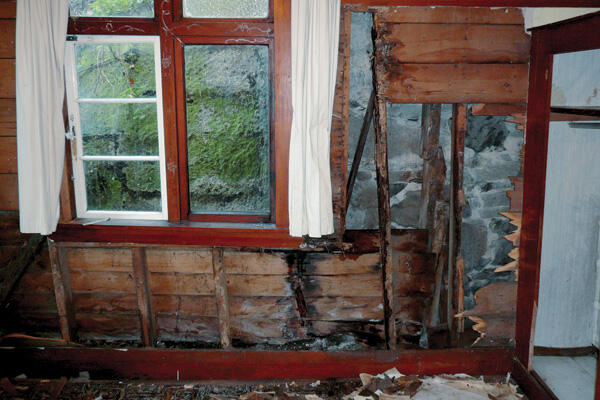
The Shit Show Chateau: From P-lab to Penthouse
Rank flats and ranker landlords bring us students together. These flats give us something to talk about even in the most awkward of lab pairings and unite us in a general disdain toward the dreaded landlord (scum level equal to Dennis from Jurassic Park). But while we league together in our bitch-fests, a few of us wanted to see if we could turn all of that on its head. So six of us banded together to get the grossest, rankest, dirtiest, smelliest, coldest (and all the other “-est”s) flat in Dunedin and get our landlord on side to do it up. Our goal: we meet our landlord halfway (they front up the money, we front up the labour) to get the place insulated and energy efficient. And boy did we find the worst flat. Literally. Voted the worst flat by former OUSA president Logan Edgar and Mayor Dave Cull last year, the ShitShow Chateau ticked all of the boxes: no insulation, no form of heating, more holes than Lucky Seven, dicks erected on every wall and a solid level of general grottiness. (PS – did I mention we’re living in it?) So we began the DIY process. We did everything from draught-proofing to hacking down vines, and from clearing gutters to sifting dirt for glass and spraying for mould. It hasn’t been without its holdups, however. Opening up a wall to insulate we found that one entire side of the house is rotten right through, giving the term “indoor-outdoor flow” a whole new level of meaning. Oh, and it has no foundations. With one room now out of action, we’re having a sleepover round robin and putting pressure on our landlord to make renovations snappy. We’re the first to admit that we may have had our beer goggles on when we saw the place and thought it would all be finished and toasty warm by the time winter came around … ha, ha. It’s still far from a warm, healthy flat. But in saying that, we have convinced our landlord to make more than a few thousand dollars’ worth of improvements to the place and have learnt some things along the way: From cunt to caring: How to get your landlord eating out of your hand-Frame issues as long-term investments rather than reactionary quick fixes. Brownie points for making them think it was all their idea in the first place. -50 to 60 per cent of your heat is lost through your ceiling and floor, so insulation is gonna slash your heating bill big time. This insulation costs your landlord a one-time payment of roughly $2,500, and when they’re raking in upwards of $20,000 from annual rent, $2,500 no longer seems that much. This includes the 30 per cent government subsidy (a 60 per cent subsidy is available with community services card), and the Dunedin City Council currently runs a targeted rates scheme to pay it off over 10 years. Use this as bargaining power with your landlord and don’t let them convince you otherwise. -The Department of Building and Housing has templates where you just fill in the form and send it to your landlord to get your issue sorted within 14 days. Easy as pie. Go to dbh.govt.nz/pub-sorting-out-problems#map4 -If your landlord’s a Grade A wanker, you can always take them to the Housing Tribunal (or just threaten to). You get can up to $2,000 in compensation if they’ve been douchebags. Get amongst: what you can doLook around you. Is your flat shit? It doesn’t have to be. -Draughts are major culprits. Draught-proof your house to make sure that whatever heat you have stays inside. Walk around with an incense stick to see where the holes are. Use newspaper if you’re poor, otherwise get gap filler. -Water heating is also a biggie – you or your landlord can insulate your hot water cylinder, and this will save you a heap. -DON’T DRY YOUR CLOTHES INSIDE. The stats around heating dry air vs. wet air are insane and one load of washing can put upwards of 5L of moisture in your room. Whack the clotheshorse outside. So all together now – don’t dry your clothes inside!


