
-
Columns
Editorial | Issue 14
Several depressing things occurred over the break. Babe of the Day happened, the Western Black Rhinoceros became extinct, the Cook closed, and there was that thing on Game of Thrones. I could have devoted this editorial to a rant about any one of those occurrences. But then Josh Pemberton came along and put the problems with Babe of the Day far more eloquently than I ever could (page 20). Following that, I discovered that the Western Black Rhinoceros was actually declared extinct in 2011 (poor dead unheralded schmucks; somehow the news that this news wasn’t news made the news even more depressing). Finally, I think we can all agree that it’s been five weeks since that thing happened, and most of us are over it. They were boring characters anyway, and I’m sure at least fifteen new ones will spring up in their place. So I guess that leaves me with the Cook. Personally I hardly ever went to the Cook because – and this is kind of the point – it was a shit hole. Even so, I and many others just assumed it would always be there, for no other reason than that it always had. If people had heard of one bar in Dunedin, it was the Cook. The vast majority of new arrivals in the city will have heard about the Cook long before moving here. Its closure still seems somewhat surreal, akin to TVNZ deciding to scrap One News and replace it with a game show, and I keep half-expecting the bar’s owners to turn around tomorrow and say, “LOL! Us, close? What are you, drunk?” But the Cook is gone, and it’s probably not coming back, and now I feel a little lost, as though I were David Attenborough browsing the video store and I let my mind wander and suddenly I was outside and the store was gone and someone came up to me and showed me the Internet and gently explained that I was finished and should probably just go home. It’s possible that someone will buy the Cook and reopen it. More likely, though, its second coming will be at the hands of some rich clueless philistine who turns it into a kind of horrible tacky neo-Cook – possibly with an original cobblestone that lay outside the entrance in 1860, and Tuatara on tap. This, after all, is how bars survive these days – with gimmicks and overpriced semi-craft brews. Needless to say, this would be a fate worse than death: no place that trades on twee nostalgia rather than cheap beer and pash rash is worthy of the Cook’s name. I’m sad that this is happening to Dunedin. But I’m also mad. Sad and mad. Sad-mad. I’m sad-mad because bars have been priced out of the market by alcohol laws that impose a uniform levy across on- and off-licence premises. Basically, bars have to pay the same rate of alcohol tax as supermarkets and liquor stores. Given that bars have higher staffing costs and strict legal responsibilities around client supervision, and suffer a fair amount of property damage and theft, this makes their business model inherently less viable than that of off-licences, and alcohol tax merely exacerbates this problem. This is why drinks in town are so expensive, and why the Cook was unable to make any money off its cheap beverages. As is well known, the prohibitive prices in town encourage people to stay at home, or to pre-load at their houses and flats, moves that further undermine bars’ business models. This also encourages irresponsible binge-drinking: people buy alcohol in bulk – a 12-pack, a bottle of spirits, one or more bottles of wine – and, because there is no marginal cost involved in having another drink, will be more likely to finish what they have already bought (and quickly). Of course, we’ve all had three-figure nightmares in town, blowing all our Studylink treasure in one go. But for the most part, going to the bar and paying for every new drink presents us with a clear cost-benefit decision. And if we make bad decisions, at least we’re in a supervised environment in which friends, bar staff, bouncers, or emergency services are on hand to look after us. But hey, at least we still have Sammy’s. To me, Sammy’s, not the Cook, is the embodiment of Dunedin culture: it’s cold, cavernous, rarely full, and has the inimitable feel of a venue whose glory days have long since passed. It’s beautiful. If I had to list the top five gigs I’d ever attended, at least two would have been at Sammy’s; if it ever closed – and it’s come close a few times – the Dunedin in my heart will have finally died, and off to Wellington I shall trot. On a more uplifting note, welcome back to Critic! It’s been too long. We’re particularly excited to present our social media issue, which, at 64 pages, also happens to be the biggest issue Critic has ever published (probably – we only looked back to the start of 2011, but that was aeons ago). We’ve made a host of changes over the break, and we hope you like them. Our ranks have also swelled – I’d like to welcome on board our new sub-editor Sarah, food editor Kirsty, technology editor Raquel, and columnists Guy and Jacobin. They’re here to keep your belly satisfied, your mind limber, your phone stocked with apps, and your eyes shielded from the harsh glare of incorrect apostrophe usage. And if you made it through this (somewhat engorged) editorial, congratulations, go have a drink.
-
News
UBS: Unemployed Book Sellers?
Staff restructuring at the University Book Shop (UBS) has seen a number of positions made redundant, with those staff members affected invited to reapply for newly-created positions. The restructuring is the culmination of six years of falling profits due to the difficult trading conditions faced by many bookstores. UBS ran its first deficit in recent times last year. Critic spoke with UBS CEO and manager Phillippa Duffy about the restructuring. “We had already scrutinised and worked on every other cost area, but unfortunately the sales that we have at the moment could not continue to sustain the size of the staff that the business was carrying,” Duffy said. Duffy took over as manager at the start of the year following the retirement of long-serving UBS manager Bill Noble. When asked if the restructuring could be attributed to deficiencies in the previous management, Duffy insisted that this wasn’t the case. “I came into a particular organisational structure and in the context of the trading environment that I inherited I just didn’t think it was the right one for the challenges down the track … the size of the staff was an issue relative to sales.” UBS had around 19 full-time equivalent staff, and the restructuring made significant changes to many of the existing positions. While Duffy remarked that a “small number” had chosen to take voluntary redundancy, most elected to apply for the new positions, which have now all been filled. Rod Morris, the husband of a laid-off staff member, told the Otago Daily Times on 7 June that staff were “shocked and stunned,” and felt “utterly betrayed” by the lay-offs. He also said that six of the key staff members, including his wife, each had more than 20 years’ experience which “could be lost.” “There’s a huge amount of knowledge accumulated in those staff,” he concluded. Following revelations that the current UBS on campus was set to expand into the former OUSA Events office, there has been speculation that UBS’s recent move onto campus might be the first phase of a complete relocation. There have also been rumours that the Great King Street address was in need of earthquake strengthening. Duffy denied these accusations, telling Critic that “there are no plans at all to close Great King Street.” The move to the campus premises, which have been in place since earlier this year, was a “decision to get closer to the students” and has been “fantastic,” according to Duffy. She stated that the new location has prompted an increase in textbook sales for the first time in around six years. Duffy added that the two stores have completely different product mixes and customer bases, with the campus store focused on textbook sales and Great King Street appealing to the wider Dunedin public as one of the country’s leading independent bookstores. According to Duffy, the space UBS occupies on campus was “already earmarked to be extended as part of the OUSA extensions.” The expansion will enable warehousing onsite, which will allow for easier and more efficient receipt of stock. It will also give a larger retail space for UBS on Campus to expand from its current stock of textbooks to include other books and stationery of interest to both students and general academic staff. While the fate of bookshops in general is unclear, Duffy remarked that sales at UBS had stabilised in recent months, which she saw as “encouraging.” Book launches have also proven successful. Duffy reiterated that UBS is a commercial business in a very competitive environment and that she must react accordingly. “The prudent thing is to be managing a business that is secure in its future for its customers and its staff, and for our shareholder, OUSA.”
-
News
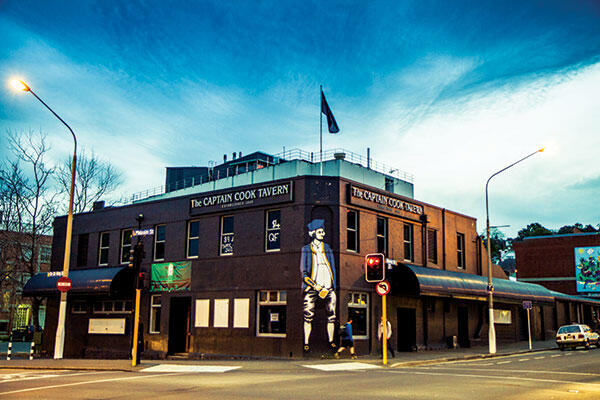
Captain Cook Runs Aground, Is Eaten by Savages
Hold back the tears everyone – the Captain Cook Tavern will have its doors shut throughout Re-O-Week and potentially for good, although the owners are still looking to have someone take over the lease. Dominion Breweries and James Arnott, one of the owners of the Cook, are no longer interested in continuing the lease as the bar has made a continual loss for years. To anyone who has spent sober time there this year, the shortage of funds is obvious: broken concrete dance floors, fewer staff, seatless (and toilet paper-less) toilets, and the persistent tendency to “run out” of aioli for the four dollar meals are all testament to the fact. In a disastrous 3 News interview, OUSA President Francisco Hernandez agreed that “it’s a bit like a toilet – you need to just bowl it and start again,” despite having earlier stated the importance of the establishment remaining open. This was met with laughter from interviewer Rachel Smalley. The George W. Bush-like fuck-up could, however, be put down to a hearing problem, as evidenced by his earlier response: “and as for your second question, I think … wait, what was your second question again?” Despite this, Hernandez told Critic he shares the sadness of many students at the loss of a “treasured scarfie institution.” OUSA, however, has no intention of buying the Cook. Rumours have emerged that the University offered $3 million for a 200,000-year lease, but received a counter offer of $6 million, which was not met. The Cook has been a much-loved Scarfie bar since 1860 and has outlived other favourites such as Gardies and the Bowler. The closure of the Cook leaves only Starters Bar and Re:Fuel as the true student holes. Baa Bar is also starting to gain a larger student crowd due to the shortage of drinking venues in North Dunedin. Recent changes in the drinking culture of students is the likely cause of bar closures, both here and abroad. Students “pre-loading” means bars are experiencing dramatic decreases in income and cannot compete with off-license and supermarket prices. The Cook’s final night (14 June) welcomed in excess of 600 patrons, from freshers to pensioners. Those with affectionate memories of the bar started showing up from midday. Even the late former owner Phil Ruston was on hand, his granddaughters Nik Watts (née Ruston) and Sarah Ruston bringing along a large photo of him dressed as Captain Cook. The Cook was a special place for them because of the family connections, Ms Watts said. According to the Otago Daily Times, “[Ms Watts] was conceived here,” a detail Critic appreciates. Some things never change as far as antics at the Cook go. We wonder how many more babies were conceived in the classy tavern we all know and love. For now it is goodbye, but the future of the Cook remains uncertain. If you can’t hold back the tears at the thought of Re-O without the Cook, go and drown your sorrows elsewhere – if only to prevent further closures.
-
News

Re-O-Week to Bring Paint, Sexism
OUSA has been working around the clock to deliver students the biggest Reorientation Week yet, say OUSA figures. Critic staff members dispute the accuracy of this statement, however, having observed the Events team working only until 5pm. Wednesday 10 July sees the return of the Illuminate Paint Party to Dunedin, and it is set to be the most extravagant yet. In lieu of the plastic-covered Union Hall of years gone by, this year the party is being held at the Forsyth Barr Stadium, with over 3,000 tickets already sold. Partygoers can expect an almost tenfold increase in the amount of Illuminators wielding paint-guns at the crowd, as well as a giant inflatable slide and “paint pool” for attendees to frolic in throughout the evening. The party begins at 6pm and, at 9pm, four tons of paint will drop from the ceiling in order to facilitate the organisers’ hopes of inventing a Guinness World Record for “biggest paint fight.” Tickets can be purchased for $40 online or at discounted rates from the OUSA office. However, concerns have been raised about the involvement of Illuminate, after 2011’s Paint Party, held during O-Week and also run by Illuminate, left paint throughout Union Hall. The lead-up to the event is also set to herald Dunedin’s biggest setback to gender equality since Tui billboards first arrived. Organised alongside the controversial “Dunners Babe of the Day” Facebook group, a promotion entitled “The All-Female Painted Undie Run 500” will be held at 2pm Tuesday and is the only ticket giveaway Illuminate are offering, with 50 up for grabs. As the name suggests, it involves female contestants getting down to their underwear to “take on our specially designed commando course around the Otago Uni campus.” The course consists of seven stages, with a paint fight, “high knees” and “burpees” among the challenges. Critic encourages all transgendered students to attend the event, as we love it when misogynists get confused. As the event was organised only shortly before Critic went to print, OUSA Events staff were unavailable to comment on the presence of OUSA’s logo on the Facebook event page, alongside those of Illuminate and ZM. OUSA President Francisco Hernandez did, however, write on Facebook that he “can confirm that this is unsanctioned and that we are in talks with the people who put it up.” On Thursday, Re-O-Week revelers will return to the Stadium after a hasty wipe-down for Comedy Night, a much-loved feature of past years, which will feature 7 Days star Ben Hurley, with support from Kiwis Tom Furniss and Nick Rado. Tickets are $15.50 from OUSA or TicketDirect. Saturday is set to round-out Re-O 2013 with a pleasing mix of tastes and tunes. From 6-9pm, the sixth annual International Food Festival will be taking place on the Otago Museum Lawn. In 2012, the Food Festival drew the biggest crowd of the year on campus, with 3,500 people flocking to the Union Lawn to sample cheap and diverse international fare. This year, the Festival will be taking place across and road and has expanded to include not only the usual 13 or so OUSA Clubs, but also the Te Tumu department (who will be putting on a hangi) and companies like Tex Otago. $2 tokens can be purchased from on-site booths to facilitate quick queuing. These can be traded for meal items costing between $2-$6, allowing students to partake in a round-the-world culinary experience for less than a combo from McDonald’s. Entertainment will be provided by the appropriately titled reggae band Reo, winner of this year’s local Battle of the Bands, as well as world music ensemble Mama Yeva, the Otaiko Japanese Drummers, and a fire show extravaganza. Though the Festival is weather-dependent, food will be cheaper and better than anything your flatmates could make and industrial heaters promise to battle the potentially chilly temperatures. Finally, Kiwi drum & bass act Shapeshifter is back in Dunedin as part of the national tour for the group’s recently released eighth studio album, Delta. Playing at the stadium with support from AHoriBuzz, doors open at 8pm and tickets have very nearly all gone – discounted student tickets are available for $30 from OUSA.
-
News

Peter Dunne: An Obituary
It is with great sadness that Critic farewells an old friend – a rooster of epic proportions who once crowed the loudest stories of incompetence and befuddlement. Although not yet dead, the career of MP Peter Dunne has been given only a year to live. Long holding a cherished position in the hearts of Critic staff members as “best Photoshop subject,” Dunne was cruelly yanked from his life support on 7 June after continuing to fight his brave battle against governmental cancer. Dunne told reporters it was “with a heavy heart” that he gave in to such pressures. Reporters are, however, still calling for the release of medical records that placed him in this situation. “Those records contain very personal details,” Dunne has responded. “I won’t even let my wife see them.” It is understood that Dunne has backtracked on one of his most controversial policies – the fight against synthetic drugs – as he is expected to indulge heavily in such substances for pain numbing and distraction in the coming months. This comes only days after his first child, United Future, died suddenly and spectacularly following the realisation that it was exceptionally unpopular not only in school, but also in its wider social circle. “I’m the only kid with fewer than 500 friends on Facebook,” the suicide note lamented. Born in Christchurch on 17 March 1954, Dunne’s life as a career politician has been overshadowed only by his signature hairstyle. From 1984 to 1994 Dunne was a not-so-closet Rogernomics right-winger in the Labour Party; however, he resigned from the party when fellow righties such as Roger Douglas and Richard Prebble (known collectively as the Act Party) exited stage right. Seizing his opportunity, Dunne then formed the Future New Zealand Party, which, through a clusterfuck of name changes and mergers with other “centrist” parties, became the United Future Party in 2002. Throughout this time, he tickled the fancy of Prime Ministers left and right with his bow ties and glazed eyes. His ensuing policies were delightfully liberal: supporting the decriminalisation of homosexuality, favouring more liberal drinking laws, and calling for a review of New Zealand’s abortion laws, which would leave the decision to a woman and her doctor.
-
News

Yet Another Fran-Said-Dan-Said
The OUSA Representation and Governance Review is now underway, with a Working Party appointed over the break. The Working Party will hear student submissions and make recommendations on changes to OUSA’s governance structure and constitution. The Working Party is comprised of 11 members, including four members of the OUSA Executive, three Otago students, and four external figures. The appointees represent a diversity of viewpoints and collectively boast a wealth of experience. The review comes in the wake of last semester’s referendum, proposed by former Executive member Dan Stride, which aimed to significantly alter OUSA’s governance structure. The referendum gained 50.93 per cent support, but failed to reach quorum after attracting only 856 votes. Stride seemed pleasantly surprised by the composition of the Working Party, describing it as having “an interesting political makeup,” though he predicted that the group would have difficulties arriving at a consensus. “[Hernandez] has basically locked a bunch of very different people in a room and asked them to come up with an idea that satisfies everybody.” Stride himself had decided not to apply for one of the student positions on the Working Party, having been “utterly put off” by Hernandez’s conduct during the referendum process. Stride believes Hernandez had “destabilised” the referendum by running a “No” campaign. “The way OUSA referendums are conducted, they’re not decided through the merits of your arguments, they’re decided by how many Facebook friends you have, and how widely you can project your views on campus,” Stride said. “When a student president goes in to bat on this issue, they have a much larger microphone than any individual on campus, and they can project their views in a way that I can’t.” Hernandez denied that he had abused his position, and pointed to articles 10.10. and 10.11. of OUSA’s referendum policy, which allow Executive members to state their own opinion on matters before referenda so long as they clearly state that the opinion is their own and not those of the Executive as a whole. The policy does not show up on a search of OUSA’s website, and the copy Hernandez provided to Critic did not state when it was ratified. Prior to the referendum, Hernandez was the host of a Facebook event entitled “Vote NO for a more inclusive and effective OUSA,” of which Execeutive officers Pippa Benson (Colleges), Rachael Davidson (Campaigns), Lucy Gaudin (Finance), Gianna Leoni (Maori), Keir Russell (Postgraduate), Kamil Saifuddin (International), and Ruby Sycamore-Smith (Welfare) had clicked “attending.” The only Executive members who were not “attending” were Zac Gawn (Administrative Vice-President), Blake Luff (Recreation), and Jordan Taylor (Education), though nor had these Execcies “declined.” Stride claimed that the current Executive is not motivated to seek change, and doubted Hernandez’s ability to lead. Hernandez is understood to have supported governance change when he took over as President, but has met with sustained opposition from his Executive, particularly Gawn and Gaudin. “It’s quite clear that Fran has lost control of his Exec in this respect,” Stride commented, referring to the Executive meeting of 4 June at which Hernandez threatened to resign when the Executive opposed his timeframe for the Working Party. Hernandez later backed down from the threat. Stride believes that Hernandez had “left it too late” to achieve any meaningful governance change. “If Fran had wanted to do this he should have done it the second he set foot in office. Realistically, this should have been done in the first semester.” He predicted that any recommendations that the Working Party made would have to be deferred until 2015. This would give next year’s Executive the ability to reverse any changes made this year before they came into effect. Hernandez disagreed that the governance review process had been neglected. “At the end of the day, I felt like securing funding from the Ministry of Social Development to run campaigns against violence against women and putting student poverty first was more important than a governance review … but just because you leave something until last, doesn’t mean it’s unimportant.” The OUSA Representation and Governance Review Working PartyFrancisco Hernandez (President) Zac Gawn (Administrative Vice-President) Lucy Gaudin (Finance Officer) Gianna Leoni (Maori Officer) Liam Kernaghan (current student) Lisa Pohatu (current student) Emily Sutton (current student) Mark Baxter (OUSA life member) Fiona Bowker (OUSA life member) Pete Hodkinson (NZUSA President) John Philipson (Exec member 2009-2010)
-
Columns

Liberty: How to Spot the Fakers
I love liberty. And we all enjoy the benefits of it. As it turns out, whether or not you have a job you can still pay for all the basics even if you do find yourself struggling. And because of liberty, life is more than what you can do from your wallet: in New Zealand you have the freedom to be yourself (sometimes with the requisite courage), the freedom to decide what you want from life, and how you go about your relationships. Liberty is behind this standard of living. How so? Well, if weren’t for all of us going about our daily business of earning more money than we spend, meeting our obligations and making choices about employment, education, health, recreation and how to live (or think) – and being free to do these things – then the provision of a $23.6 billion welfare state, a $12.4 billion education system, and a $15 billion health system would be impossible. There’s always room for improvement, despite this being a situation in which Flight of the Conchords not only pay for the benefits of society, but also help to construct a society in which being as goofy as they are is a career path. But here’s the crunch: everyone’s about liberty. So how do we know they mean it? Here’s a way to catch out the ones who will achieve only the opposite – those whose underlying (and usually hidden) premise contains the idea of undeserved entitlement. It is, briefly, an entitlement that goes beyond your rights, and expands into someone else’s. And it’s also the resting pulse of big government. Thomas Jefferson (the famous President) once warned that a government big enough to give you everything was also big enough to take it away. That kind of “entitlement to control” can take not only your money, but worse, your freedom. Having said this, I should be clear: a conflict between liberty and entitlement shouldn’t be confused with a conflict between wealth and need. Clearer still, there is a stronger case for providing better public services, and reducing demand on them, than getting rid of the lot. That is, for reducing the use of force to fix problems, and empowering the voluntary. Thanks to those who arrived at the end of this inaugural column – it was intended as a broad introduction. If your intellectual curiosity is as strong as mine, I hope you’ll keep reading.
-
Columns

ODT Watch | Issue 14
Now, now, ODT. We know you represent New Zealand’s farmers, but this headline describes a speech given at St. Margaret’s College: Ever resourceful, the “Opinion” section is forging a new route for print media at large with the informatively entitled rant: Meanwhile, our favourite paper is gutted that the international war policy of “kill only women” has come to an abrupt halt in the turmoil of Iraq: But at least the entire reason anyone goes to Queenstown is well understood: Speaking of travel, if you were looking at enjoying a holiday abroad, you can take the Philippines off your list. The ODT has kindly reminded us that it is Finally, even the ODT isn’t deluded about the state of Dunedin’s upcoming council elections:
-
Columns
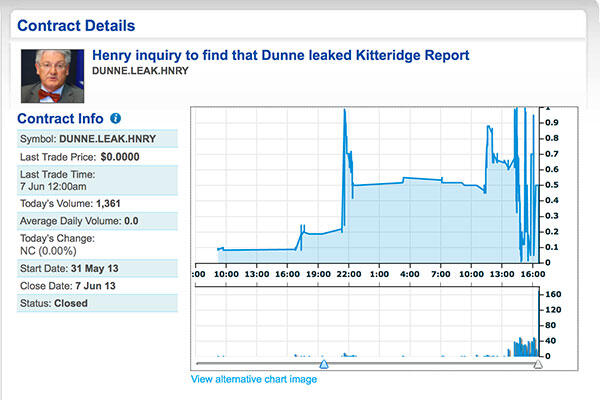
Peter Dunne, Meet Your (Market) Maker
IPredict.co.nz, the New Zealand news-based stock market, is particularly notable for its explicit endorsement of insider trading, which is illegal in the “real” stock market. This lies behind iPredict’s amazing track record: it’s more accurate than most professional political polling companies. However, the exalted insider trading aspect of iPredict is exactly what makes it liable to hilarious market manipulation. This is exactly what I did to Peter Dunne’s stock immediately before the fallout of the Henry Inquiry (the inquiry that led to Dunne’s resignation as Minister). Here is how to gain maximum LOL per dollar invested in iPredict: 1. Identify a well-traded primary stock of importance, e.g. “NZ Minister to go in 2013.” 2. Identify a secondary stock that would provide a logical explanation for a big move in the primary stock, e.g. “Peter Dunne more likely than not to be found the source of the GCSB leaks by the Henry Inquiry.” 3. Watch the primary stock for any strong movement, which could indicate betting by real insider traders. 4. Place a well-timed bet on the secondary stock to give a further appearance of insider trading and make the observer put two and two together in their mind. 5. Watch as greed and fear drive relatively massive speculation and people spread the idea you implanted (or at least take the idea seriously). A bet on the secondary stock does not even need to be particularly large because they are traded in such low numbers. The $60 I put on the Henry Inquiry’s findings resulted in some 1,361 stocks being traded that day, when the average had previously been fewer than five. My small bet resulted in the iPredict website crashing several times from increased traffic, a Stuff.co.nz news article specifically about the stock movement and dozens of re-Tweets by well-followed politicians and pundits. You can’t buy that sort of press impact anywhere else so cheaply. The fact that my hunch about Dunne turned out to be correct when the actual report came out was an added bonus.
-
News

Dunedin: New Zealand’s Second-Best Wellington
On 14 September, OUSA will be bringing the inaugural Dunedin Craft Beer Festival to Forsyth Barr Stadium. The beer brands involved are still being finalised; however, they are likely to include such South Island companies as Emerson’s, Mac’s and Moa. Many different food vendors will also be on hand to sell seafood, meats, cheeses and wild food. Up to 20 food stalls are expected, with a Masterchef-type demonstration among them. To fuel participation and engagement, OUSA will be running a home brew competition throughout the day. The entrance fee will be $50 and the winner can expect to brew the official beer for next year’s festival. Furthermore, the stadium’s car park will play host to an entertainment tent, which will broadcast to screens inside the stadium. Bands include Sola Rosa and a Bavarian-style oompah band, lederhosen included. The entertainment tent will also hold a discussion area and guest speakers, who are yet to be confirmed. There are plans for a special VIP area containing 10 private spaces at a cost of $1,125 each, because corporates love beer. Tickets will be on sale in “about a month,” and will cost $20 for students or $25 for the public.
-
News

What’s Up, Doc? Not Much
Doc’s Coffee House has sadly closed up shop in George Street and filed for bankruptcy after a series of relocations saw it go from a profitable business to “essentially drowning.” Critic spoke with Doc’s owner/ operator Phil McDonald about the future of the café, which is looking to return in mobile form within the month. It is hoped that the affectionately named “Doc’s in a box” will transform into a mobile coffee cart business. McDonald declared himself “90 per cent certain” that the transformation would happen in the next month, and that only a few details still needed to be finalised between the business partners involved. Doc’s had previously been based at the garage in the OUSA Recreation Centre building, but relocated to Albany Street after the lease expired and OUSA only offered a periodic lease. McDonald said it was “heart-breaking” to see the site still empty after 15 months. When asked what he thought about rumours that OUSA may be about to reinstall a café, McDonald wished them luck. Little remains of Doc’s after McDonald took to Facebook and sold the contents of the store – from coffee cups and tea pots to the one-of-a-kind dragonfly-embellished stone that held down the Doc’s sign – to willing buyers. McDonald appears excited about the prospect of returning the business to its former glory, and depending on the success of the mobile unit may look at adding additional units. His long-term goal is to establish a Doc’s Roastery.
-
News

Students on the Streets in Turkish Turmoil
What began as a protest against the construction of a shopping centre has turned into the largest public demonstration seen in Turkey in recent years. Students have been at the forefront of the protests, which erupted in Istanbul, Ankara and many smaller cities and towns. “Innocents have been right in harm’s way,” said Sam Blood, an activist from the student-led Generation Zero climate change movement. Blood, who was visiting Istanbul for a conference, claimed that he has “witnessed old women and children in the midst of teargas.” At least seven people have been killed, over four thousand arrested, and over seven thousand injured in the protests. On 30 May, protestors opposed to plans by the ruling Justice and Development Party (AKP) to build a shopping mall on Istanbul’s historic Gezi Park were ejected from the park by police armed with pepper spray and batons. The demonstrators were arrested and their tents were burned. Turks were quick to return to the park in Taksim Square to protest police tactics. Yeşim Tokgöz, 22, a law student at the University of Istanbul, was one of the first to retake Gezi Park, where protestors chanted “against fascism, we stand shoulder to shoulder.” Tokgöz, who underwent surgery after being hit by an exploding tear gas canister, told Critic that “the police were actually trying to cause injuries.” Water cannons, baton charges, rubber bullets and large amounts of tear gas were used against the largely peaceful protestors. Prime Minister Recep Tayyip Erdoğan soon addressed the protestors on television, and called for their dispersal. Instead, hundreds of thousands of Turkish people protested against the government’s repression. The police responded with further violent tactics. In recent days, people have returned en masse to Taksim Square to protest against the treatment of protestors in Lice, a district in Kurdish-majority Eastern Turkey, where people were killed while opposing the construction of a new police station. The protests initially received little coverage by local media. CNN Turkey incurred the ire of protestors by broadcasting a documentary on penguins while tens of thousands marched through Istanbul and the capital, Ankara. Instead, news of the events in Istanbul was spread around the country through Turks using Twitter and Facebook to upload text, photos and videos of the events. Even in the relatively conservative town of Konya, demonstrators gathered, chanting “everywhere is Taksim, everywhere is resistance.” Erdoğan has condemned the reports for provoking protests, and called social media a “menace to society.” Students in the western city of Izmir spoke to Critic on condition of anonymity. A number of their fellow protestors had been arrested in the city for inciting a riot and arson at the city’s AKP offices through social media. The students claimed that police had chased them through alleyways and beaten them severely. Others had only escaped by hiding in the houses and cafés of sympathetic residents. As police violence has increased, young people have increasingly found themselves amongst the tens of thousands of protestors. Gözde*, a student at Istanbul University, told Critic she had been prevented from going to the protests due to university exams, but was moved to action “after the police brutally attacked the peaceful protestors.” In the square, medical students and doctors worked together to treat demonstrators who had been injured by police, while law students such as Gözde issued a joint declaration condemning police brutality and challenging the legality of the government’s Gezi construction plan. Others played music, built barricades across narrow streets and donated books and food. “If it weren’t for the taste of tear gas,” Gözde said, “it would have been like going to a summer music festival.” Blood recalled seeing his youth hostel receptionist leaving for Taksim Square as police sought once again to remove protestors. “You’re not going out there, are you?” Blood asked. “If I die, I die,” replied the receptionist, donning a Guy Fawkes mask as he left. Universities have been disrupted by the events, with several postponing their examinations. For Tokgöz and Gözde, however, exams continued as planned. Gözde attributes this to Istanbul University’s pro-government Vice-Chancellor. At Bogazici University, 204 academic staff signed an open letter calling for a halt to “irrational violence” and the government’s redevelopment plans. Some have since been the subject of police investigation, including those who allowed their students to skip class to attend the protests. While Gözde believed that the majority of students are in favour of the demonstrations, students have been present on both sides of the confrontation. Blood and others to whom Critic spoke claimed to have seen “armed thugs,” believed to belong to the AKP youth wing, carrying sticks, bars and knives with which to attack any protestors who escaped the police onslaught. Some students were also present at a rally staged by the AKP, which attracted tens of thousands of Erdoğan’s supporters. Despite the protests, Tokgöz describes modern Turkish youth as an “apoliticised generation … students talk with their friends and go, that’s what I see.” A survey conducted by Istanbul’s Bilgi University found that demonstrators were disproportionately young, and 70% of those surveyed reported no political affiliation. Nonetheless, the overarching conflict has been one of a young, secular opposition against the Islamist AKP government. Damla*, a 22-year-old student at Yilmiz Technical University, told Critic that demonstrators outside the Prime Minister’s office in the Besiktas district of Istanbul had chanted “we are the soldiers of Mustafa Kemal,” in reference to the Turkish Republic’s secularist founder, and that Turkish flags bearing Kemal’s image were seen in many protests. “The government is against the Turkish Republic,” Damla claimed, and suggested that the AKP sought to alter Turkey’s secular, democratic constitution. Gözde was more circumspect about the protests’ republican dimension. “Of course, everyone is fed up by the government trying to regulate everyday life, like telling women to have three kids, or trying to restrict abortion or alcohol sales,” she said, referring to a recent law which prevented liquor being sold after 10pm. “On the other hand, there are very religious people out on the streets protesting as well; we do not raise our voice just because there is a religious party ruling the country. We are protesting because the government does not respect the people who believe in different religions, because of the corruption and manipulation, and because of our freedoms.” The future of the upheaval in Turkey remains unclear. Some protestors have taken to standing motionless in public places, after one man who stayed still for hours after police tried to search his bag. Although a one-day strike was organised by the Confederation of Public Sector Unions (KESK) in response to what it called the government’s “hostility towards democracy,” the protests have sustained themselves with little organisation. A few ad hoc organisations have formed in the course of the protests, such as the Turkish Youth Assembly (TGB) and Kollektifler (The Collective), and local assemblies have been held in local parks and squares. Erdoğan has suggested that the protests had been provoked by what he called “the interest rate lobby.”
-
News
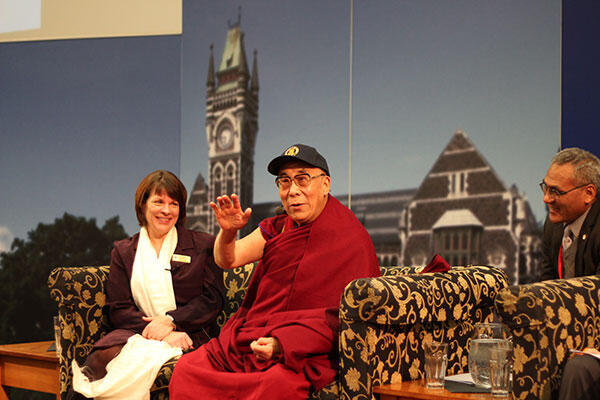
Dalai Lama Visits New Zealand’s First University
The Dalai Lama’s recent visit to Dunedin was, in local terms at least, quite the scandal. Before the visit, Mayor Dave Cull had joined the ranks of other esteemed political figures (Barack Obama, Julia Gillard, John Key) who, wanting to be BFFs with China, have refused to officially welcome his Holiness. While Cull later backtracked from his comment that the Dalai Lama was “the leader of a minority sect,” he did not budge on his stance. The University of Otago went out on something of a limb in welcoming his Holiness, while the University of Auckland, for example, reportedly refused to do so. Any controversy was far from the mind of his Holiness as he was welcomed, grinning, into the St. David lecture theatre for a question-and-answer session with University staff and students on 11 June. His smile only got bigger when Vice-Chancellor Harlene Hayne presented him with his very own official University of Otago cap, which he wore with glee throughout the session. This was his Holiness’ first official visit to a university in New Zealand, so, as the Vice-Chancellor pointed out, it was appropriate that he should begin with New Zealand’s first university. In order to obtain tickets, audience members had submitted questions – over 2,000 were received – from which a few were selected and posed to his Holiness. Sitting Oprah-style on some rather hideous couches, flanked by Hayne and chair Mark Henaghan (whose well-known loquaciousness got a run for its money from the guest of honour), his Holiness proceeded to offer deep wisdom, anecdotes and a lot of cheeky chuckles to the packed-out lecture theatre. Tenzin Gyatso, who was identified as the reincarnation of the 13th Dalai Lama at the tender age of two, has been officially recognised as the 14th Dalai Lama since 1950. A casual 63 years on the job has left him jolly, unbelievably youthful, and down-to-earth, despite the politically difficult past of his nation. (The Tibetan government, with his Holiness as its spiritual leader, has been in exile in Dharamsala, India, since it was expelled from the People’s Republic of China in 1959). In the session, which lasted close to 90 minutes, his Holiness did everything from getting the Vice-Chancellor to inspect his bushy eyebrows (and returning the favour by admiring her wrinkles – “a sign of wisdom”) to giggling at the ferocity of the kapa haka welcome, and making jazz hands to match their farewell wiri. A theme of several questions – obviously pertinent to the University audience – was the interaction of science and religion. His Holiness said that “faith and reason must work together”: faith exists only among humans because it is a product of human intelligence, providing hope to sustain humans as they pass through difficulties in their lives. But faith and science are not antithetical: Buddha said “you should not accept my teaching out of faith” and followers should remain sceptical of their beliefs. They should investigate and experiment, and only then accept teachings. So scientific method and Buddhism can actually be good friends. His Holiness mentioned the 2011 death of Dunedin’s monk Thupten Tulku, who reportedly stayed in death meditation – with his body showing no signs of decomposition – for 18 days after he was declared medically dead. This phenomenon, unexplained by science, has been observed in devout monks before. His Holiness said this was an example of the faith and science interface: this phenomenon should be measured and analysed in a scientific way – with fancy neurotechnology and everything – as well as simply revered. When asked to compare creationist religions to Buddhism, his Holiness was all-embracing. While for him “it’s hard to feel their reality,” he said that if people find peace in Christianity or Islam, for example, more power to them. This sort of love-thy-neighbour simplicity was enough to send shivers down the audience’s spine. How good would it be if everyone thought like that? In addressing the only openly political question put to him – “do you really want to separate Tibet from mainland China and why do you think the Chinese government portrays you as a separatist?” – his Holiness was his usual stoic and cheerful self. “They describe me as a demon,” he cackled, making mock horns with his two index fingers to emphasise the point. He said that misinformation – the only type of information available to most Chinese, thanks to Party propaganda – fuelled misunderstanding: “many Chinese have no opportunity to hear the correct news.” His government in exile seeks autonomy in order to protect Tibetan Buddhist culture, basic constitutional rights and the region’s unique ecology, rather than full independence from China. Mainland China’s own Buddhist population have said “please don’t forget us.” Henaghan asked his Holiness for one word which students could take away from the talk. “One word: for me, not possible!” came the reply. What he offered was powerful, if not as succinct as his minders (trying to whisk him away for lunch before his next speaking engagement) would have liked. He urged the audience to think globally: everyone wants a happy life, regardless of secondary differences like race or religion. “You must think more objectively, more holistically and with more vision” to make the 21st century one of peace and happiness, in contrast to the century of global conflict and suffering that his generation lived through. Like your kind and really wise old grandpa – complete with infectious chuckle and gleeful old-person cheek – he reminded us that exterior beauty is great, but that inner beauty is what really counts. “Please think more seriously about your inner values, because inner value creates peace of mind which is key for a healthy body and family.” It was impossible not to leave without feeling uplifted. Three Peace and Conflict Centre post-grad students – Joe Llewellyn, Apusva Mahire, and Lisa Brockbank – all of whom are practising Buddhists, were enthusiastic about the talk and His Holiness’ visit, having earlier organised a protest against Mayor Cull’s reaction (they called it off when he apologised). “If you take his your-suffering-is-my-suffering principle, it really changes your actions and how you respond to things,” Llewellyn said. His Holiness communicates a universal and unifying message, with which everyone can identify and from which everyone can benefit. On ya Otago for hosting his Holiness and choosing freedom of expression over pandering to political pressure. Want to know more? Check out Soka Gakkai International (sgi.co.nz), a lay Buddhist organisation; head along to one of the Buddhist meetings at Clubs & Socs (7pm on Wednesday evenings); or to the Dhargyey Buddhist Centre, which offers teachings three times a week.
-
Columns

The More Things Change | Issue 14
Welcome to the second semester of “The More Things Change” – now with more historic events to commemorate as you please. This week, there are some great successes and some even greater failures. 11 July, 1776: Captain Cook set off on his third voyage, an attempt by the Admiralty to find the Northwest Passage under the guise of taking a French Polynesian guy back home. They briefly visited New Zealand, but the most notable thing about the voyage was that it was remarkably ill-fated. It led to Cook’s unfortunate demise in Hawaii, to someone dying of tuberculosis, and ended without anyone finding the passage at all. This seems not unlike the fate of the Dunedin institution that was named for the very same Captain. 9 July, 1872: The doughnut cutter was patented by John Blondel, in a glorious day for stereotypes of North America. Apparently the modern shape of the doughnut, called a torus by mathematicians, was adopted after a teenage sailor punched a hole through an old-fashioned doughnut with a pepper container. For such humble beginnings the doughnut is doing quite well – there’s a Dunkin’ Donuts in Hamilton now. 9 July, 1893: American surgeon Daniel Hale Williams performed the first successful open-heart surgery, an accomplishment made all the more impressive by the fact that it was achieved with no penicillin, transfusions, or advanced anaesthetic. The patient, a stabbing victim, left the hospital a couple of months after the surgery and remained quite alive for 20 more years. Doubtless the stabber was quite disappointed. 10 July, 1923: There was a hailstorm in the west of Russia, which would have been unremarkable except that the hailstones weighed about one kilogram each. Given that it was Russia, the reaction may well have been something like the one observed when that meteor showed up early this year: nobody batted an eyelid. One can only assume that there were a few fairly extreme snowball fights. 9 July, 1997: Mike Tyson was banned from boxing for one of the more ridiculous incidents in the sport’s history, in which he bit off a one-inch piece of his opponent’s ear, and then bit his other ear after the fight resumed. There is no apparent record of Tyson’s reasoning for doing so. He was permanently banned from boxing (but his licence was restored a year later), ordered to do community service, and fined about US$3 million. The other guy forgave Tyson, and presumably now spends his time coming up with wild stories to explain why part of his ear is missing.
-
Features

www. Online Hookups 4 Students .co.nz
The concept of online dating has quivered menacingly on the edge of my consciousness ever since a friend of mine began using it a few years ago. While I am yet to overcome the mental hurdle of actually signing up to one of the numerous sites on offer, I found myself intrigued by fellow students who have done this very thing. AliceImpatient with the desolate Dunedin dating scene, Alice* signed up to NZDating at the tender age of 19. “My flatmate and I thought we’d try it because we were sick of the state of the guys in Dunedin. Not that they’re all bad, but we were looking for something a bit more serious.” Whilst it could reasonably be argued that at 19 it is unlikely that one could already have truly exhausted one’s entire potential romantic cohort, Alice nonetheless threw caution to the winds and for three months was part of that parallel universe that lies behind sites like FindSomeone, MatchFinder and DatingNZSingles. Alice was immediately inundated with requests for close encounters of a carnal kind. “You can choose if you’re looking for sexual meetings or just for friends or a relationship. I think my profile said just ‘looking for a relationship’ but it didn’t stop some people. I had an influx of old men messaging me, one offering $200 for me to sleep with him, as well as lots of young couples wanting threesomes.” Unable to handle the pressure, Alice’s flatmate abandoned ship almost immediately. But they say that good things come to those who wait, and Alice was pleasantly surprised when Charlie*, an apparently “normal” law and politics student, messaged her wanting to get to know her. The two ended up being together for several months. But although Charlie had no qualms about the way the two met, Alice did. When anyone asked her, Alice would “think up an excuse and just say though a friend or something. It just sounds like you’re really desperate for a boyfriend if you do online dating.” This stigma led to some intra-flat tension for Alice, as one of her flatmates never warmed to Charlie – “the only reason she didn’t like him was because he was from online dating and she didn’t trust him.” Indeed, though she was perfectly positive when describing her now ex-boyfriend, Alice herself was never fully able to shake the suspicion that there was something shady about him. “Even now I think, ‘why were you on that website?’” OscarIt was back in third year that the now 23-year-old Oscar felt he was getting a bit long in the tooth when it came to romance. The time had come for him to start being proactive, and he got into online dating after lamenting his lack of a love life to an older gay friend who recommended he try it. Using sites like NZDating, Manhunt and Bro2Bro, Oscar has since met with approximately 20 men he has found online – not always for sex, but most of the time. Oscar disparagingly recounts that he’s been “propositioned to sleep with someone for beer and pizza. He was 64 and he had a wife.” However, such solicitations have by no means been his worst online dating experiences. Oscar considers the dishonesty that can be associated with online dating (that is, meeting people that don’t look like their photograph) to be its main disadvantage. “I’ve had two of those [experiences] – where I go to someone’s house and they look like a troll – and they’re very distressing.” “I was going to meet up with this dude – he sent me photographs of himself frolicking on the beach looking amazing. In retrospect, I should have realised that somebody who looks that good probably isn’t going to be on NZDating. I turn up to this house in South Dunedin (should have known) and it was a creepy Buddhist guy who ushered me into his room that had chanting and incense and a single bed.” Fortunately, Oscar was able to extricate himself before ending up as some sort of Tantric sacrifice, and he did not allow this one untoward experience to stop him getting back on the Manhunt horse. However, he had another similar incident only this year. “It was in the North East Valley,” Oscar sighs, resignedly. “I am now loath to go out to South Dunedin or to the NEV because … the people that live there … I’m probably not going to find attractive. This guy was in this crappy house and I got down to the end of the hallway and there was this strange dog and crap everywhere and he was like, 4’11”, and came at me.” Revelling, as we all are, in that illusion of invincibility afforded to us by youth, I was unsurprised when Oscar admitted that safety is not his primary concern when it comes to arranging these meetings. However, referring to the NEV incident, Oscar muses that “if he hadn’t been a little ugly man, he could have kept me in his rape dungeon at the back of his house.” Indeed, before going on any late-night excursions, Oscar “makes sure that I always save a search of the Google-mapped address, so that if ever I don’t come back, the police can look at my computer and track him down.” Remind me again why this is a good idea?I was becoming increasingly less sold on the presumed merits of online dating. (Surely I am not the only one to be put off by a veiled reference to Alf Stewart’s depraved extra-curricular activities?) It was obvious to me why middle-aged-and-older people use these sites, whether they be recently divorced, looking for an affair, or simply out of the game for too long. But it was less clear why my own peers – brimming with sexual promise and with an apparently endless stream of opportunities to socialise in real life – would resort to online dating. It had seemed to me that once one has crossed this nefarious threshold – admitting romantic defeat in the real world – one is only a pair of stomach-controlling knickers away from dying fat and alone, as Bridget Jones always feared, to be found three weeks later, half-eaten by Alsatians. When I asked Alice why she thinks our peers use sites like NZDating, she answered that students, particularly those of the international and homosexual persuasions, “are kind of out of their comfort zone when they move to Dunedin – they want to find someone and don’t really know how. Because when people go to town, they’re not usually there looking for a relationship.” Not only does meeting people online omit much of the ambiguity that real-life courtship can entail, but it also enables people to expand their social circle beyond those with whom they would usually come into contact on a day-to-day basis. Jorge*, a friend of Oscar’s who utilises similar sites, notes that “students are by far not the majority of users.” This widened cohort is particularly significant for the gay community. According to Associate Professor Chris Brickell of the Gender Studies Department here at Otago, because it is “a small community within a community, it’s easier to find out who is gay by going online and having a bit of a ferret around.” Brickell chuckles. “It makes finding a needle in a haystack a bit easier.” Oscar is inclined to agree. “I don’t really see any fair excuse for straight people, it’s easier for them to meet other straight people – if you’re wanting to have a gross hook-up, surely a straight guy or girl goes to Monkey? It’s not that easy for gay guys.” Jorge concurs. He first looked at one of these sites as a young teenager before he had come out, and explains that “when you’re not out, it’s kind of hard to see a gay scene. It was kind of a curiosity thing, at first.” On that noteThe differences between the straight and gay communities on these websites, both demographically and they way each group seems to use them, has long been a source of interest for me. Most if not all of Jorge’s gay friends use online dating sites, while Oscar can’t think of a single straight friend who does. Further, in Oscar’s empirical experience, “the heterosexual male category is older than the gay ... Obviously, there are still older gay guys on the sites, but there are way more 38, 45, 53-year-olds that are heterosexual on them, whereas the gay group is a little bit younger.” Brickell also notes that gay men seem more likely to have sexually explicit profile pictures – “cock shots” – than heterosexual men, and the normalcy of this seems to have made it an accepted part of gay online dating culture. Dangerous liaisonsWhilst the horizon-broadening aspect of online dating can be something of a mixed blessing, having a whole world of potential flings and friends at your fingertips is what drives the explosive popularity of apps like Grindr and Blendr, which literally show you, in real time, another user’s geographic proximity in relation to your own. According to Jorge, Grindr has even become integral, for some, to the coming out process itself. But do these apps normalise and enable behaviours that are potentially damaging to an individual or society’s health? Brickell notes there has been a public health argument made against online dating – that “the ease of hooking up with people online has led to an increase in unsafe sex practices.” However, a person inclined to engage in unsafe sex may have this proclivity wherever they happen to meet the people they bone – online or at Monkey Bar. Brickell himself remains unconvinced. “They’ve never posited a causal mechanism that I think’s convincing. I suspect that, if there is an increase in rates of unsafe sex in young people, it’s partly got to do with the perceptions of treatability of sexually transmitted infections, and HIV in particular.” Blurry linesGiven how technologically savvy we Youth Of Today are, how Facebooked, Instagrammed and Tweeted our lives have become, and our generation’s seemingly inexhaustible capacity to do things “ironically,” the stigma attached to young people using online dating is, in some ways, difficult to understand. Surely it is more in keeping with the way we conduct our social relations in general to think about online dating as simply being on a “trajectory of evolving ways of meeting people,” as Brickell puts it. It is, after all, a means to initiate relationships that generally seem to follow the typical dinner-and-a-movie path, even though they were formed via a URL. Given that interfacing is done increasingly via smart phones in pockets rather than boxy PC monitors in darkened rooms, online dating could certainly drift, slowly but surely, into the mainstream. Contrary to Alice’s experience, both Oscar and Jorge have found they can speak of their online dating experiences freely with friends, who, though intrigued, are not at all bothered by the guys’ virtual courtships. For this reason, Jorge thinks that online dating is becoming more socially acceptable, even amongst young people. Sooner rather than later, online dating might be truly considered complementary to, or even a logical extension of, the way we conduct our romantic relations, rather than a mark of having given up. Indeed, according to Brickell, the “real and virtual lives” dichotomy has become an anachronism: “the online social world and on offline social world are overlapping constantly. While the Internet transforms some elements of social relationships, it’s not completely another world.” Proponents of online dating like Oscar and Jorge feel that, though relationships may be conceived online, the world into which they are born and nurtured is very much one not of pixels but of flesh and blood. “Give it a go, what’s the harm?” says Oscar. “I don’t think there should be a social stigma about online dating at all. None of my friends are mad online dating losers that just sit on their computers all day.” In truth, the demise of so many of our favourite watering holes could make online dating increasingly appealing – even necessary – as Dunedin morphs, with grim inexorability, into a wasteland of bygone, pub-based promiscuity.
-
Features

Life Online - It's a Beach
A MetaphorHow I use and regard Facebook is similar to the experience of driving alone down a very long street. A person alone in a car is isolated from society by the physical barrier of the car, but that person must still carefully abide by certain rules. The street, called Facebook, is crowded with a mixture of people, from acquaintances to those with whom I have grown up; either way, each person is someone I have personally selected or accepted as my “friend.” Like in a nightmare, however, all of these people are wearing masks, depicting their own interpretations of the best version of their faces. Driving down the street is like scrolling through my News Feed. I view the world passing by with mindless complacency and contradicting insecurity. Most of my selected “friends” don’t notice or interact with me and remain deeply engaged in social experiences that either I wasn’t invited to or couldn’t attend. Occasionally, a closer friend will recognise me and yell at me using nouveau-gangster language. I will yell back with a similar response. As my friend and I briefly wallow in our ironic use of language (which only serves to perpetuate our privileged position in society), a few people will walk by giving us the thumbs up. Some may even pause to participate in our language jerk-off. Sometimes, people who sit on the periphery of my selected friends will arbitrarily appear, causing me to pull the car over and (embarrassingly) spend hours analysing why that person chose to make his or her existence apparent to me. This thought process often ends with me erroneously assuming that I am famous and talked-about in my wider social circle. At other points of my journey down this street, I will swap my own carefully constructed mask for a new face that represents and summarises my existence. If I am lucky, an unexpected crowd of people will surround me and I will suddenly become popular. On another day, when my mood has inevitably diminished again, I will repeat the same mask swap and sit in desperate anticipation for the crowd and their thumbs up. On these days, I allow the obscurity of it all to spread through my veins, fuel me and eventually engulf me. It is miserable. The more I return to drive down the street of Facebook, the more I rely on the mostly inane interactions occurring on this street to validate my existence and define me. It is ill and yet I keep going back. Is this me? Is this my generation? Your FacePeople like to fantasise that when the brilliant and socially awkward Mark Zuckerberg founded Facebook in 2004, he envisioned it purely as a means to “connect with friends.” However, even those with a vague understanding of Zuckerberg’s history will realise that the network’s origins and inspiration stem from much darker elements. Before Facebook, Zuckerberg created a website called Facemash by hacking into Harvard’s databases of student IDs. Facemash allowed visitors to the site to select the best-looking person from a choice of photos, which quickly created a ranking system of hotness. Although the website only lasted a few days before being shut down, Zuckerberg identified people’s perverse desire to freely and arbitrarily rank the people around them; he also created an accessible tool by which people could do so. Underlying all these so-called “friendly connections” is a concept that unifies all of Facebook’s 1.1 billion users, and this concept is judgement. While growing paranoia about our online presence can seem exaggerated, I am certain that the value we place in how we present ourselves online is exponentially increasing (while at the same time diluting the meaning of “value”). Like the time when the Cat in the Hat came back, the negative aspects of maintaining an online social presence start off as a pink ring around a bathtub. In haste, someone uses his or her mother’s dress to clean the stain and eventually everything becomes covered in this awful pinkness and we’re all standing around, shaking our heads and murmuring things like, “that escalated quickly.” A dramatic comparison perhaps, but things have escalated quickly. Since Facebook was launched in 2004, there have been a total of 1.13 trillion “likes,” which averages out at 4.5 billion “likes” a day. These are astronomical figures. A Den Made of MirrorsBefore we get lost in these astronomical figures, it’s important to work out where our heads are at when we use social media. In two studies by Humboldt University and Darmstadt’s Technical University, involving 600 people, it was discovered that one out of every three people was more dissatisfied with their life after visiting Facebook. As mindless as our use of social media platforms may be, how many times do you leave a site like Facebook with a sense of motivation and life positivity? How many times do you end a session with the fear of missing out after mirthlessly “liking” several photos and statuses? How many times does the guilt experienced after wasting time cause you to exit the website? Writer and researcher Daniel Gulati identified three fundamental issues created by our use of Facebook. The first issue Gulati identified is what he described as Facebook’s creation of a “den of comparison.” Daily, we are confronted by people’s successes in the form of status updates on professional goals achieved, newly purchased items and new relationship statuses. These updates cause us to reconfigure our own interpretation of success in line with what we interpret our Facebook friends’ view of success to be. Research from the aforementioned German universities found that the den of comparison becomes particularly gloomy when people are confronted with photos of their friends on holiday. Imagine the scenario of Facebook friends who turn the cogs of the mundane corporate machine all year long, then for five days they take a trip to Samoa. On their Facebook page we are not confronted with photos of their bosses scalding them with tea and throwing tomatoes at them as they weep in their corporate barracks. No – what we are bombarded with are these Facebook friends posting 50 photos of themselves looking radiant on a beach. If you have 450 friends who each post 50 photos of themselves on holiday once a year, then over that year you face the trauma of 22,500 photos of happy people being happy without you. That’s approximately 61 photos a day. Life on Facebook is a beach – a yeast-infected beach. The Value of LikeThe second-largest cause of Facebook envy, as found by these German studies, occurred when people compared the number of Facebook birthday greetings they received, as well as the number of “likes” and comments on their Facebook pages, with their Facebook friends’ pages. In our online worlds an accumulation of Facebook “likes,” Twitter “favourites” and Tumblr “loves” defines the value we place in certain moments, people and feelings. In the quest for “likes,” we learn to create and ruthlessly edit our ideal personalities online and in this way we embrace judgement. By extensively documenting our experiences online, we allow our “friends” and their “likes” to be the final say on the value of our experiences. A few years ago, while at school, I had a friend who lived her life like this. At events we attended together, she would spend the whole time taking, deleting, then re-taking photos for Bebo (later Facebook). She made an effort to allow non-participants of these events to decide the value of her experience and her net social worth. She never seemed happy taking copious numbers of photos, but rather exhausted by it (as was I). But the worst part, like a self-fulfilling prophecy, was that it worked. People began to believe she was popular because of her excessive online presence and therefore, to a certain extent, she became popular. I Can See You But You're Not HereThe second issue Gulati identified is the “fragmentation” of our “real” time due to the time we spend online using multiple devices. Most social media takes a variety of forms – from websites to apps on smartphones – which maximises accessibility for their users. This “horizontal” strategy is pushed particularly hard by Facebook. As Mark Zuckerberg described in an interview with Michael Arrington on TechCrunch, “we’re trying to build a social layer for everything. Basically we’re trying to make it so that every app everywhere can be social whether it’s on the web, or mobile, or other devices.” This strategy encourages users to be active online on range of devices from smartphones to iPads to laptops, creating a warped understanding of the idea of being “present.” The decline of close relationships caused by our exponential use of social media is another issue Gulati identifies. As Gulati observes, “gone are the days where Facebook merely complemented our real-life relationships.” As Facebook spreads its reach, it defines a model of how we interact online. The risk is that the more we use Facebook to socialise, the more likely that this online model of interaction will become a model for offline interaction as well. While the ability to communicate online with friends and family around the world is wonderful, each time a Facebook interaction is used instead of an in-person meeting or get-together we miss opportunities to connect with people on a deeper level. In this way, social networking is creating and spreading its own type of isolation. Late at night, scrolling through my News Feed with the only light in my room coming from the sterile shine of my laptop screen, I’m not sure if I could feel lonelier. Interactions on Facebook are filtered through a layer of plasticity that ought to separate our online personae from our real selves. However, unless we consciously acknowledge this layer, Facebook can make us believe that this plastic skin is really our own. Current-day revolutionaries demand deactivation, but realists suggest less extreme measures to alter how we use social media and strengthen our real-time, real-world relationships. Some measures Gulati has described included “blocking out designated time for Facebook rather than visiting intermittently throughout the day, selectively trimming Facebook friends lists to avoid undesirable ex-partners and gossipy co-workers, and investing more time in building off-line relationships. The particularly courageous choose to delete Facebook from their smartphones and iPads, and log off the platform entirely for long stretches of time.” Snap Out Of It?Recently, a novel interpretation of social networking has gained momentum in my friend group and the rest of the world. When I explained Snapchat to my Dad and ran him through the process of taking a photo (or video), drawing moustaches on it, writing a quirky one-liner, setting it to a time under 10 seconds long and then sending the “masterpiece” to one or all of my absurdly-named contacts, Dad found the concept bizarre. But for my generation, who have grown up leaving endless trails of our lives all over the Internet, the ephemeral nature of Snapchat comes to many of us as a relief. In an interview conducted by The New Yorker’s Matt Buchanan with Snapchat founder Evan Spiegel, Spiegel couldn’t conclude whether Snapchat was part of a bigger movement against the permanent nature of our online worlds, but he did state that the service allows users to “free yourself from an amorphous collection of who you’ve been forever.” As Buchanan remarked, “Snapchat highlights the power of deletion in resisting the gentle totalitarianism of endless sharing. Deletion pokes holes in these records; it is a destabilising force that calls into question their authority, particularly as complete documentation of a person’s online identity, which Facebook and Twitter increasingly purport to be.” A Boot Stamping on the Human Face36 years ago, in an essay entitled “The future of the future,” J.G. Ballard predicted the very forms of social media in which we participate daily. In the essay Ballard speculated that new devices, especially “video systems and micro-computers adapted for domestic use” will achieve what he takes to be “the apotheosis of all the fantasies of late twentieth-century man – the transformation of reality into a TV studio, in which we can simultaneously play out the roles of audience, producer and star …” Ballard further speculated that “every one of our actions during the day, across the entire spectrum of domestic life, will be instantly recorded on video-tape. In the evening we will sit back to scan the rushes, selected by a computer trained to pick out only our best profiles, our wittiest dialogue, our most affecting expressions filmed through the kindest filters, and then stitch these together into a heightened re-enactment of the day. Regardless of our place in the family pecking order, each of us within the privacy of our own rooms will be the star in a continually unfolding domestic saga, with parents, husbands, wives and children demoted to an appropriate starring role.” Ballard’s dwellings on the future and how we presently use social media are uncanny. But before we swoon, it’s worth pointing out that Ballard was known for his novels about post-apocalyptic, dystopian worlds. Like Zuckerberg, Ballard recognised humanity’s inherent obsession with judgement and control. Ballard predicted a world in which developing technologies could take our obsessions to the next level and, knowingly or unknowingly, people like Zuckerberg are fulfilling his predictions.
-
Features

A Weekend Trolling
Ines Shennan attempted to teach herself in a day how to become an Internet troll. Employing techniques from the utterly pretentious to the obviously ignorant, what follows is an account of what happens when someone tries to abuse Internet anonymity. It all started with Tunnel Bear. An application available across various operating systems, Tunnel Bear allows you to fictitiously alter the location of your web presence. This was going to be an all-or-nothing experiment. Armed with the mental security that I would appear to be trolling from the majestic United States of America, land of absolute Internet freedoms and total privacy, I was ready. I hope you’ve noticed the sarcasm; PRISM is kind of a big deal right now, and on the personal front I couldn’t be less ready. I had no idea how to troll the Internet. I use Facebook primarily for its private messaging as an alternative to conventional emails and would consider myself an occasional poster who doesn’t particularly care for public commenting. Internet forums are a foreign concept to me. I needed a persona. Seemingly out of nowhere came the name “Cody Grey.” Okay, that’s a lie. I Googled baby names, because every name that popped into my head would be that of friends or family, whom I didn’t want to bring into this unfortunate collection of affairs by way of innocent association. I scanned through the first page I clicked on, and quickly had a name. Arming myself with this and a false birthdate, I created a Google account for forwarding all confirmation sign-up messages to. This was becoming quite a finicky process. Now to embark on the actual experiment: posting inflammatory or extraneous messages to disrupt the otherwise peaceful World Wide Web. So I took a cheap shot, and slinked along to Stuff.co.nz’s “Life and Style” section. After some browsing, I found an article about a Danish singles dating site pitched at those who wanted to be inseminated, or inseminate another, and soon. Long walks on the beach, a GSOH and romantic getaways might be favourable for the users, but having children is certainly the core purpose of the site. I hated it immediately. Relief washed over me; surely I would be able to troll this quite easily. Yet I was stumped. Do I criticise the site? The article? The scourge that is toddlers, in their vegemite-smeared-faces glory? I opted for a crude criticism of a quotation from the article, and waited. And waited. And waited some more. I had not done enough to unleash the trolls. Seven hours later and there were only three comments on the page, including mine, which had not appeared to have even mildly insulted anyone. I was distraught. Particularly upsetting was the fact that I had deliberately forgone proper grammar (including a missing apostrophe), for the sake of authenticity. I felt dirty without having caused any drama. I needed to step up my game. Next on the agenda was Yahoo! Answers. If you’re unfamiliar, it’s probably best you stay clear of this cacophony of questions and answers that span the mundane and the outrageous. I attempted a funny retort. “Cody Grey” proffered the following advice about a first date: “hi i find the best thing is to only ask questions and if she asks you a question just respond with a question it gives a very international man of mystery aspect to yourself and you find out lots about her [sic].” Turns out it was just lame; no cutesy “thumbs up” for me, let alone the healthy collection of “thumbs down” I desperately craved. Later, I realised that I had actually responded to a question from the Yahoo! Answers Team. I could have at least picked a real person, with real feelings to be squashed. By the way, the highly rated responses on here were rubbish. I did learn that apparently you’re not meant to talk about politics on the first date. Or your pets. Or the weather, your parents, religion, “prior sexual conquests,” finances, even “Mario vs. Sonic.” The list goes on. It was lunchtime and my trolling was so far unsuccessful. I slurped up a bowl of soup and a cup of Lady Grey. I hoped the sustenance would provide me with a new lease of life and renew my keyboard warrior energies. Seeing as the dating scene was slow in providing responses, I mooched along to some parenting forums. My rationale was simple: parenting is stressful. There are a ton of emotions caught up in the life lesson of bringing offspring into the world. Perhaps I would finally get some angry replies. Unfortunately, most of these forums were largely deserted. I needed the numbers so I moved on to the next forum. Next I tried my luck with the “Virtual Teen Forum.” With a design aesthetic hailing from the mid-to-late 90s, one might expect a touch of nostalgia. Not a drop. I was nothing less than bamboozled as to how to navigate the site, eventually signing up as a 16-year-old from the East Coast of the United States. The threads did not appear to have a lot of recent activity, with only a handful of users browsing each at any one time. I kept telling myself that I was doing legitimate feature research but I couldn’t help feeling creepy as a university student browsing forums designed for those in a much younger age bracket. Thankfully the chat room required a plug-in that my computer didn’t have. I don’t believe I could have handled that. I commented on a forum someone had posted about sitting their driver’s licence and waited for the abuse after commenting: “If you didn’t drive the whole test in reverse its probably nothing to brag about tbh [sic].” Yeah, I know, incredibly lame. Yet again. By the way, I didn’t choose that profile picture. It was automatically selected, though it does echo the uneasiness I felt as I clicked my way around the forums, looking for someone to bait with some provocative comments. I decided to leave the site altogether, and return later to see if I had stirred up any controversy. By this time I was feeling quite mentally drained and unsure where to make my way next. I started wondering just how deep I would need to go. Maybe the crucial ingredient I was missing was not extra wit, or a larger helping of inflammatory content, but some other keyboard warriors who would be eager to start a battle. The epiphany soon came. I needed a tech forum. Eventually I stumbled upon Geek Zone, and this is where the magic started. Within minutes of posting a thread premised on computer illiteracy, I had several replies. They continued to flood in, stretching the limits of my trolling to the extreme. “This happened last night for the second time in 5 days so I took a screenshot and worried it’s going to happen again,” I commented beneath an indecipherable, pixelated screenshot of a Mac OS in a Microsoft Windows forum. “Yes the error means you need to up the resolution on your camera.” Thanks Klipspringer for the astute observation. “Do you realise that you can use Alt + Print Screen to get a screen capture? What you’ve uploaded seems to be a very blurry picture you took with your mobile phone and it’s impossible to read,” ubergeeknz suggests. “I can’t read it but have you done a Google search on the error message?” Me: “Sorry my webcam isn’t very good.” “LOL. You have just made my day!!!!” Well you know what, you’re welcome. However, johnr continues to fall for the madness: “Would you not just do a screen grab??” The smart ubergeeknz picks up on the fact that this malarkey has been posted in a Windows forum and points this out. I upload a screenshot of the thread itself, with the comments “hope this helps ... i only have bing [sic].” Everybody’s favourite hero, ubergeeknz, suggests the thread is closed, so naturally I battle on, with my cloak of stupidity firmly tied around myself: “yes i have a mountain lion [sic].” And offer further information: “i called my nephew and he said it could be my hard drive but i have a laptop??? [sic]” Ta da! The thread has been revived. Thanks Klipspringer for your suggestion to check the floppy drive. ubergeeknz changes tack and offers some helpful advice: “yes, blow all of the dust out of it, that might help.” Either I’ve been caught, or johnr is delighting in my apparent ignorance, quoting my post “yes i have a mountain lion [sic]” and responding with “does it cost much to feed per day and is it house trained?” I am being ridiculed by anonymous people on the internet when all I wanted to know was what was wrong with my computer. Minutes later I suffer further teasing from johnr: “you took a screen shot of this Geekzone thread, I am just about to wet myself at my desk please stop it!!” I hope you didn’t do that johnr because your fellow employees would probably be highly unimpressed. Moments later the thread is wiped except for my original post, most likely by a moderator who could see through the whole facade. Paradoxically, they continue to offer assistance. The suave looking xpd, a moderator and self-proclaimed “Minecraft n00b” asks that I take a “decent screenshot that we can read,” with a link to an about.com tutorial. (Which gets me thinking - perhaps I should troll them next week.) Then an administrator jumps on the bandwagon. “What xpd means is that it’s impossible to read anything on that photo. You can follow these instructions to get a screenshot (not a photo) of your computer’s screen. Make sure you take just of the area on the screen you need, not the whole thing. Then upload here on Geekzone and post the link so we can see the error message.” Thanks freitasm – now I’m feeling guilty about the effort people are going to in order to rescue me from my apparent inability to take a screenshot. With such morality shining through, I glumly realise that my days as a troll are probably short-numbered. However, by this time my dating advice on the Yahoo! Answers page had picked up a positive response: With five thumbs up, maybe there’s something I’m doing right. But for now, I am mentally drained and have realised the room I’m sitting in is now dark. It’s been a long time trolling, with mixed success. In the days that followed, I returned to my laptop, switched on Tunnel Bear, on and resumed the trolling. Laying bait is a process that requires a lot of digging around. It’s not as simple as just delving into the first thread listed in a forum and posting an inflammatory comment. Finding the right topic and posting a comment that is the right blend of eloquence and utter stupidity is a learned skill. With only a day’s practice under my belt, posting “being high is not a victory” on a subreddit about partial marijuana decriminalisation was admittedly naïve. I tried spearheading political debate with the admittedly contentious “sometimes you need to trust the state to protect you, when you clearly can’t protect yourself.” This provoked some responses, but nothing as dramatic as I had hoped for. Trying to spark further controversy, I claimed that the great grass is “scientifically proven to make you shrink.” The response was quick and smart: clearly this is “a cure for obesity” then! Unprepared to let this one get away so quickly, I retorted with: “you will shrink vertically but your mass stays the same so you will just become wider.” I was unable to keep up with the vitriol that followed, and my comment clearly veered too close to moronic, with AmKonSkunk stating “Has to be a troll, no one is that stupid.” Congratulations AmKonSkunk, I trust your perceptiveness will carry you to great heights. I was also dubbed Buzz Killington, the out-of-touch character from Family Guy. I also attempted to rouse the bigots on Stormfront, a white nationalist forum. Surprisingly, those whom I assumed would be most likely to succumb to my troublemaking remained largely quiet. Posting on threads, starting threads, sending private messages and even adding other users as friends was entirely fruitless. I yearned for them to hate me, but I didn’t get as much as a single reply. Though anti-climatic, it was admittedly a relief to extricate myself from the myriad of narrow-minded opinions that formed the fabric of the site. With this, I had come full circle. Beginning with a Stuff article and receiving no direct responses, and ending with suspiciously quiet bigots, I doubted my longevity as a successful Internet troll. The deep-rooted desire not to deeply offend anyone probably had something to do with it, though perhaps my technique just needs refining. What I have learnt, however, is that it’s much harder than it would seem. So give the trolls some credit. They’ve got their work cut out for them.
-
Columns

Love Is Blind | Issue 14
Michael CeraFirst off, I would like to thank the misfortune of betting against the Germans for bringing me out on what was, well, let’s just say a rather mediocre night. While the mates came round more times than I could count, I somehow managed to be the only one to not have a memorable night. My mates dropped me off a little bit early so I took a seat at the bar where I could watch the door, hoping for my beautiful date to arrive. To my mild pleasure I saw her waiting at the reception, and after a quick exchange of names we took our seats. Lo and behold my best mates and their lovely ladies decided to take part in a date of their own right beside our table, directly in my line of sight. My date, however, was pleasant conversation and was able to hold my attention without me getting distracted. The first drink order was a good indicator: she had a nice dark ale, which I found more than attractive, and her looks also helped boost my interest. Conversation seemed to exchange quite well while waiting for our meals. She was a 20-year-old third-year theatre student looking to make a life as an actress. After a few pre-drinks, and looking to have a big night, I asked if she would like to do some shots. Lo and behold my night took a horrible turn for the worse when I learned she was no partier. She was a bartender, despite not being as rowdy as I had hoped. Conversation flowed consistently through the meal, of which I was absolutely enjoying every bite. Part way through the meal, my flatmates appeared in the bar as well, now bringing the total number of people watching the date to seven. I was under a lot of pressure to make the night something special, but I was unable to succeed. Sorry to Critic and its readers for not delivering the spectacular article I was hoping to write. The bar tab was left with $12 to spare, and I was more than happy to break away for a cigarette when given the chance. Thanks to Angus and Critic for a great meal! Alia ShawkatSo where the hell to begin? I walked to Angus and basically froze my tits off on the way. I was too cold to be nervous, though as I walked in just slightly late I felt a momentary flutter of nerves. What if he was really cute? What if I was blatantly reaching? What if he was super smart and I felt like an idiot? I shouldn’t have worried. The waitresses got my date, who was wearing a beanie and … he was cute enough, but just kind of inoffensively average looking. He was Canadian, an exchange student, and as we sat down a very generic ice-breaking conversation unfolded. It’s kind of weird, I’m trying to remember what we talked about at this point, but our later conversations – or should I say, his monologues – kind of eclipse the earlier parts of the date. I get that students are poor, and that it’s probably an incentive for going on the date. God knows I can’t afford a nice steak, but this guy was really poor. And I heard all about it: tax fraud, debt collectors, a diet consisting solely of beans and white bread, below the poverty line. Seriously, no girl wants to hear that on the first date. Or second. Or third. I also heard about pregnancy scares, working for Audi, arrest warrants for Nevada, the girls he’d gotten with during O-Week and Hyde … oh my God. We did talk about tattoos, which could have been a shared topic of interest, but it felt like he was just filling in the time till the food arrived and gave zero fucks about mine. The date ended with us getting a cocktail at the bar, him leaving before I’d finished mine, and parting ways with a handshake. Cheers, Critic, for hooking me up with a guy who was literally only there for the free food and some counselling.
-
Culture
Frankenstein, or the Modern Prometheus
Mary Shelley, at the age of 21, published what is arguably the first science fiction novel; a fantasy story with a scientific rather than supernatural explanation. Shelley had apparently heard of recent experiments to “reanimate” corpses by making them jerk around with electric shocks, and dreamed of a “pale student of unhallowed arts kneeling beside the thing he had put together,” a human form made from parts of stolen corpses and brought to life by an undisclosed scientific method. So Shelley created Victor Frankenstein, the original mad scientist. Having discovered the secret of life, he embarks on his creation with manic enthusiasm, neglecting his health and loved ones, without considering the moral repercussions of creating a living human out of corpses. It is only when the creature comes to life that he sees it as a hideous abomination. Terrified, Frankenstein chooses to ignore the monster in the hopes it will go away. The monster escapes out of a window to fend for itself in a German forest. Contrary to depictions in popular culture, the monster is not green, not grinning, not grunting, and is not called Frankenstein. He is yellow, miserable, and eloquent, and he is called Adam. Despite being the archetypal horror story, Frankenstein is much more sad than scary. Shelley sympathetically gives Frankenstein’s monster a voice, so he can tell his creator the story of his miserable time in the outside world. The book’s main theme is people’s fear and hatred of the unknown. The monster starts as a benevolent, childlike creature, wanting affection and explanation for the world in which he has found himself. Instead he is hated on sight; people throw stones thrown at him, he makes children scream and women faint. Being ignorant of physical danger, it seems that nature is against the monster. Delighted by the warmth of a fire he finds in the woods, the he puts his hand in it and suffers a burn. He slowly realises his own wretchedness in the eyes of humans, finally declaring “I, the miserable and the abandoned, am an abortion, to be spurned at, and kicked, and trampled on.” After being shot, the monster spends weeks in the cold woods waiting for his shoulder to heal. His bafflement turns to anger at the creator who abandoned him. When the monster tracks down Dr Frankenstein, he is no longer gentle and innocent, but abused and violent. He demands a female companion and a safe place to live apart from humans, and threatens terrible revenge on Frankenstein if he will not appease him. Published nearly two hundred years ago, Frankenstein deals with many of the same suspicions that still plague modern science. People of the time harboured the same instinctive horror as many do now at the thought of creating human life or sentient minds artificially, of messing with dead bodies, reanimation of the dead and genetic engineering. But foremost, Frankenstein is a story of the misery caused by human prejudice against those who are different.
-
Columns

Get Out Of The Ghetto | Issue 14
Whether on a beautiful bluebird Otago day, or a nightmarishly stormy one, the quaint seaside town of Moeraki is worth a visit. Just a smidge this side of Oamaru, on State Highway 1, it’s famous for its large-ish and inconceivably spherical boulders which lie strewn around the beach – grey marbles tossed there by a grumpy giant. Local Maori legend has it that the boulders are eel baskets washed ashore from Arai-te-uru, a shipwrecked canoe. Geology has it that the boulders are septarian concretions formed from Paleocene mudstone, round because of something called mass diffusion, and uncovered slowly by the tugging tide. There’s even an old lighthouse, built in 1878. Have a good old frolic around/on/off the boulders (tide permitting), engage in some quality Instagramming and appreciate the surge of the Pacific Ocean as it brushes past your ankles. Before things get too poetic and this turns into a Year Nine exercise in writing cheesey similes, I should mention that the best thing about Moeraki is not its unusual geological offerings, but its unexpected culinary delights. Moeraki is populated by cribs (that’s “bach” in southern vernacular) that mainly see life on weekends and in the summer holidays, and by a few permanent residents, mostly fishermen. Picturesque Moeraki Bay is peppered by barnacled vessels, which set out daily and come back laden with kai moana delights. Waiting poised to deliver up these treats in simple and delicious fashion is Fleur’s Place, a weather-beaten waterfront restaurant and shrine to seafood. Perched on a promontory and surrounded on three sides by sea, it’s hard to imagine a quicker way to transition from ocean to plate. Fleur O’Sullivan, local legend and all-round GB, used to have a wildly successful joint in Central Otago – Oliver’s – before moving to the beach, but we’re glad she did. The place is so awesome that when the Daily Mail told British fish-guru/chef Rick Stein that he could write a travel piece on any spot in the world of his choosing, he made a beeline straight for Fleur’s Place in little old Moeraki. We’re not talking Squiddies-esque fush’n’chups here: this is Plato-level seafood deliciousness, and the price is comparable (read: quite expensy). There’s lots of fish, of course, but also muttonbird, mussels, scallops … and lots of pretty garnishes. Choose chocolate marquise for dessert – you won’t regret it. Prepare to fight the “foodstagram” urge. Fleur’s is a damn fine spot; the atmosphere is nowhere near as pretentious as the prices might otherwise suggest, and the seafood is about as fresh as you’ll find anywhere. Take someone you like a lot, go with an empty belly, throw student-loan caution to the westerly wind and eat Otago’s finest fruits de mer. Enjoy. Get there: by car. There are two turn-offs: one to Moeraki proper, and another to the boulders about 1km further from Dunedin. Both are signposted. Do: stay overnight at the motor camp if you like. Don’t: forget to book a table. Eat: at Fleur’s Place.
-
Culture
Boards Of Canada - Tomorrow’s Harvest
Rating: 4.5/5 No electronic composers affect me quite like Boards Of Canada. With but a few notes the Scottish duo can fill me with loneliness, nostalgia, dread, or a mixture of all three. Since their 1998 debut Music Has the Right to Children they have maintained a distinctive sonic aesthetic. Their sound is of lonely keyboard melodies, soft-focus synths and alien vocal samples, all presented in a polaroid-like haze. Music Has the Right to Children was an album of ambient electronica laced with the laughter of android children, a record at once euphoric and deeply unsettling. The style of melody was reminiscent of 80s science documentaries (the “this ... is Mars” variety), while its percussion drew from hip-hop. Sophomore Geogaddi proved a far more sinister record than its predecessor – inspect any of its songs closely enough and you’ll find the devil staring back. Third LP The Campfire Headphase attempted to recreate the serenity of Music Has the Right to Children with the introduction of acoustic guitars, but the result wasn’t nearly as coherent or unique. On new album Tomorrow’s Harvest, the duo avoid making the same backwards-looking mistake by taking their sound and looking to the horizon. Tomorrow’s Harvest is by some distance the darkest Boards Of Canada album, built around the concept of Earth after a nuclear war. Its promotional videos showed shots of barren deserts and abandoned buildings – the album cover could either be a warhead detonating over modern-day San Francisco or the sun piercing its irradiated ruins in the future. Listening to it feels like wandering around the rubble of the 21st century, your radio picking up snippets of distress signals and radiation-distorted music. Its songs are sparser and more desolate than Boards Of Canada’s previous work, beautifully capturing the loneliness of a post-apocalyptic world. Despite some stunning results, this stride into more ambient territory is both a plus and a minus. Compared to the intimate, womb-like nature of Music Has the Right to Children and Geogaddi, Tomorrow’s Harvest feels a little agoraphobic. Though there is beauty in its wide, haunted spaces, they don’t feel as precious as the biosphere of Children or Geogaddi’s cocoon. But even if Tomorrow’s Harvest lacks the warmth of their earlier material, in a number of other ways it surpasses it. Boards Of Canada have never constructed their songs with such attention to detail – chuck on a pair of headphones and lose yourself in the shimmering layers of “Cold Earth,” “Nothing Is Real” or the sublime “New Seeds.” The album also has a fantastic sense of momentum, beginning in the pulsing mirage of “Reach For The Dead” and culminating in the epic “Come To Dust.” Where previous BoC records were content to simply breeze along, Tomorrow’s Harvest swells and soars like a film soundtrack. It may not be the isolated listening experience of, say, Geogaddi, which currently stands as my favourite electronic album of all time. But Tomorrow’s Harvest is Boards Of Canada’s most impressive and cinematic release yet, one that will undoubtedly continue to grow on me. Take its ghostly soundscapes as a warning of the lifeless world we’re building towards. For the seeds we sow today will be reaped in tomorrow’s harvest.
-
Culture

The National - Trouble Will Find Me
Rating: 3/5 With every listen of The National’s latest, I have become more and more conflicted. This time around, should I be expecting something refreshing and innovative from the Brooklyn quintet? Or should I be satisfied with something familiar, a more reassuring release? In brief, Trouble Will Find Me reiterates the charming and distinctive elements of previous albums, with elegance and sophistication inherent in every track. Matt Berninger’s gentle and nonchalant crooning is once again compelling, set against a sonorous and driving ensemble. It is the lushest and slickest sounding of all their albums, which unfortunately is to its detriment. The National’s grit and energy, initially so vital to their aesthetic, has been almost completely filed away, traded for an accessible veneer. Mood-wise, opener “I Should Live in Salt” sets a mournful, wistful tone, crafting a melancholic atmosphere that frames the entirety of the album. Tracks such as “Demons,” “Sea of Love” and “Graceless” are trademark compositions, adorned with rolling percussion and waves of churning guitars, sullen pianos and euphoric strings – surely satisfying any existing fans. Lyrically, it is far from uplifting; regret, fragility, nostalgia, and loneliness are frequently the thematic base of Berninger’s moody ballads, notably “I am in trouble, can’t get these thoughts out of me.” After the acclaim of 2010’s High Violet, the band broke free from their peripheral “alternative rock” chains, attracting an expansive and diverse new audience. Though The National maintains their consummate songwriting standard with Trouble Will Find Me, they’re in danger of alienating their devout cult audience – the album’s distilled and polished packaging emanates the vibe of a soon-to-be-overplayed coffee shop soundtrack. Maybe, as Berninger prophetically drones, they’re “just going through an awkward phase.”
-
Culture

Beady Eye - BE
Rating: 2.5/5 There is no shame in not knowing who Beady Eye are. After a tumultuous relationship with brother Liam for the entirety of Oasis’ 18-year career, chief songwriter Noel Gallagher exited the notorious Britpop group once and for all in 2009. Intent on carrying on making music but not wanting to do so under the Oasis brand (an admirable move), the remaining members christened themselves Beady Eye and have been striving for fame and fortune ever since. To nobody’s surprise except perhaps their own, they’re yet to achieve it. Most would put this down to the uninspired nature of their debut album, 2011’s competent yet hackneyed Different Gear, Still Speeding. Consisting of the same sort of brazen, middle-of-the-road Beatles homages that plagued Oasis’ catalogue, it showed a band already in need of a creative overhaul. Such an overhaul appeared to be coming courtesy of sonic extraordinaire David Sitek (The Yeah Yeah Yeahs, TV on the Radio), who was announced as producer of the allegedly “more experimental” sophomore album BE. Things were looking hopeful. Unfortunately, BE only improves on its predecessor by a small margin. Sonically it is a far richer record, Sitek giving the songs a flattering backdrop of horns, drones and synthesizers. However, the songs themselves aren’t much more sophisticated than those on Different Gear, Still Speeding; still loutish, still marred by vapid lyrics, still trapped in 1969. BE features a few glints of creativity (such as imperial opener “Flick of the Finger”), but for the most part it isn’t the songs you’ll find yourselves admiring, it’s the gleaming wallpaper behind them. The conclusion should not be that the lads are incapable of writing in an experimental vein, as Oasis’ trippier tracks can contest – see “Who Feels Love?”, “Gas Panic!” or when “Fade In-Out” goes apeshit around the three-minute mark. But for some reason Beady Eye chose to write BE on autopilot, leaving the promised “excitement” and “experimentation” entirely up to their producer. While the end result sounds great, ultimately that isn’t enough. Maybe next time.
-
Culture
Sigur Rós - Kveikur
Rating: 4.5/5 Fairies. Fireflies. Icebergs. Rain. Learning how to fly. Whatever imagery people associate with Icelandic post-rockers Sigur Rós, there is a common sense of wonder to it. I’ve always likened listening to them to diving into an ocean, the way their music engulfs you and makes gravity a distant memory. This is true of their latest album Kveikur, though this time around the waters have never been darker. Kveikur comes a mere thirteen months after the release of their previous full-length, Valtari. A vast album of piano, vocals and little else, Valtari saw the band exploring old ideas in a new, much more ambient context. Though no less gorgeous than any of their previous work, many fans concluded the record was uneventful and didn’t push Sigur Rós’ sound forward. Luckily for those who felt as much, Kveikur is a big leap into the unknown. Following the departure of long-time keyboardist Kjartan Sveinsson, Sigur Rós went in a heavier and more experimental direction on this album. This change in sound hits you like a ton of bricks on opener “Brennisteinn”; distorted bass riffs suggest a dubstep influence, rumbling beneath layers of percussion and detuned guitar. Jónsi Birgisson’s melancholy falsetto soars far above the chaos, creating a remarkable heaven/hell juxtaposition. A disclaimer for the metalheads: Kveikur only gets this aggressive twice. The other hard-hitter comes a number of tracks later. Though I’ve occassionally described them as “heavy” in the past, never in my life did I think I’d call a Sigur Rós track “evil.” However, Kveikur’s title track necessitates it. After years of soundtracking Attenborough-narrated documentaries of melting icecaps and baby polar bears falling over, here they are dabbling in some of the darkest sounds known to man. Kveikur’s industrial beats and contorted metal riffs form a hellish groove, whilst a children’s choir straight out of The Omen looms in the background. Even Jónsi isn’t there to save you, dropping his fairy godfather role and becoming a cloaked, ringwraith-like figure. I’ll go ahead and say it; it’s evil stuff. But like any good horror film, Kveikur uses its scares and gore sparingly. The songs without monsters prove just as tense and exhilarating, granting the album the ingredient Valtari was most sorely lacking: tension. Even when Kveikur gets seriously poppy (“Ísjaki,” “Rafstraumur”), the molten lava of “Brennisteinn” is still fresh in your mind. Menace still hangs in the air. This sense of vulnerability sustains until the album’s final track, the aptly titled “Var” (“shelter”). Arriving at this wordless piano piece is like climbing into bed after a night of terror. But what a night it has been.
-
Columns
The Loose Guide | Issue 14
Welcome back, Scarfies. It’s that time of year when, freshly relieved of any responsibilities or parental supervision, you’re probably gonna get plastered. Repeatedly. That’s fine, but remember: a sloppy drunk is a lonely drunk. Here are a few tips to help you keep your cool, avoid embarrassment and not repel the few friends you may have made thus far in life. If staying upright on your own starts to become difficult, find a way to maintain a roughly vertical position. Surrendering to the horizontal will give the game away almost immediately. You may be able to find a conveniently placed barstool, chair or couch to prop yourself up on. Better still, this will force people to come to you as opposed to you chasing after them – instantly establishing your superior social status. Failing that, nominate someone to latch on to for support and hope to hell that they’re not as wasted as you are. When talking to another human being, try to stay alert and engaged. People are sometimes offended when met with blank stares, drooling, or unannounced naps during conversation. Just be a polite listener and offer a few encouraging responses. Try not to speak too much. Your alcohol-fuelled opinion on the subject at hand is almost certainly not worth sharing. It is imperative to adhere to a certain standard of hygiene so as not to be mistaken for a lower life form and dismissed from the party/bar/bus shelter. Depending on your drinking activity of choice, you may wish to bring along a plastic bib to catch spills, or some baby wipes to clear any stray chunks of vomit from the corners of your mouth. Chewing gum is essential – your breath probably smells like adult diapers. Do wear perfume/deodorant; but don’t go overboard with it, or it will be evident that you are trying to disguise something. If you’re lucky, people will assume that it’s because you haven’t washed your clothes in a while. Finally, keep in mind that your hair is unlikely to stay where you left it at the beginning of the night. Frequent spot checks are recommended. At some point, you may experience an overwhelming urge to communicate your thoughts and feelings to the wider community via social media platforms, text messages or phone calls. Don’t. If your insights/confessions are really as poignant as you have led yourself to believe, you will remember them the next day and can share them then. Leave your ex and your mum alone. They already know you love them. Before taking any of these corrective measures, go home. You’re drunk.
-
Culture
The Last of Us (PS3)
Rating: 10/10 The gaming industry is abuzz with anticipation surrounding the impending new generation of consoles and games, as am I (turn the page for my coverage of E3 2013). However, while we are all dreaming of what the next generation has to offer, the future of gaming is right before us. As this year’s E3 (Electronic Entertainment Expo) drew to a close, the greatest ever feat in video game storytelling hit the shelves. That game was Naughty Dog’s survival action-adventure game The Last of Us. From the developers that brought us Crash Bandicoot, Jak and Daxter and the Uncharted series comes the most brutal, intense and emotionally engaging journey this generation of gaming has ever offered. Every aspect of this game is immaculately conceived and executed, from its darkly beautiful story to its diverse and engaging gameplay. The Last of Us is set in post-apocalyptic America twenty years after the Cordycep plague began. For those fans out there of David Attenborough’s Planet Earth, Cordyceps may sound familiar. It is in fact a real strain of fungus which infects insects and takes over their minds, forcing them to kill themselves in densely populated areas so as to spread the spores that have infested their bodies and hence infect all nearby insects. The premise of this game sees this strain of fungus passing over, and nearly wiping out, the human race. This fresh and chillingly real take on the zombie genre is just the tip of the iceberg when it comes to the ingenuity and creativity Naughty Dog applied to this game. You play as Joel, a man in his late fourties who is escorting a young teenage girl (Ellie) across this post-apocalyptic America. This simple premise is absolutely brimming with diverse experiences, locations and ideas, while at the same time telling the most engaging emotional story of the relationship between these two meticulously thought through and beautifully acted characters. Troy Baker and Ashley Johnson – the actors for Joel and Ellie – are both veteran video game actors and are living proof that video games require a different skill set for every facet, including acting. The gameplay is third-person action-adventure, though through this scope you engage in many different forms of gameplay. The world in which the game is set is absolutely stunning. Walking through the ruins of a city you reach a gorgeous swamp from which wild deer drink; this swamp used to be an intersection. The traffic lights are now wrapped with ivy, and as you look up you see that you’re in the shadow of the skeletons of great empty skyscrapers. The exploration of these environments is rewarded with items that can be used in a crafting system, allowing you to construct new weapons and consumables. The combat is thrilling, whether it is against Cordyceps or humans. Due to scarcity of ammo, the best initial approach to combat is always stealth. The stealth systems are fantastic – you stalk your prey and take them down as quickly and quietly as possible. The odds are always against you, though, and generally stealth is only a temporary measure before you are spotted and the all-out carnage begins. Whether using firearms, melee or hand-to-hand, the combat is realistically visceral. Hitting an enemy in the head with a lead pipe will cause his skull to cave in with gut-wrenching accuracy. To me the standard of storytelling, gameplay and design of this game represents the greatest achievement of this generation of games. It gives me great confidence that the coming generation will only continue to grow and evolve, hopefully giving us many more experiences as fulfilling as Naughty Dogs’ The Last of Us. If there is only one game you play in this generation of games, let it be this one!
-
Culture

E3 2013
The next generation of gaming is upon us. Despite industry assurance that the next generation of consoles would not hit the market until 2015, it seems that fierce competition between Sony, Microsoft and, to a smaller degree, Nintendo, have pushed that date forward a year. Nintendo launched their version of a next-generation console last year with the Wii U. However, many agree that specification-wise this system is not a part of the next generation of consoles but is in fact a late addition to our current one. Nintendo acknowledged this, opting for a pre-made video at E3 instead of the massive press conferences prepared by other companies. In doing so Nintendo have essentially taken themselves out of the war and left Microsoft and Sony to battle it out … and boy have they been doing that. Sony first announced the PlayStation 4 in February. This impressive conference saw many game demos and specifications but no physical console. Microsoft announced their new console – the Xbox One – in May. Microsoft’s conference contained little game information and instead demonstrated the console as more of an all-round entertainment unit than a gaming console. After these two companies’ conferences, rumours and speculation abounded. Now, after E3 and the subsequent fallout, many of these questions have been answered. This is how the consoles currently stand. I have decided not to include any technical specifications in these outlines for a number of reasons. Firstly, few people will understand their significance. Secondly, the consoles’ specifications are ridiculously similar. And finally, I agree with Microsoft executive Albert Penello, who recently argued that the comparison of specs is “meaningless” because in the end the real determination of specs is which console allows you to "to play great games and have great experiences.” Ultimately, both of these consoles are capable of playing the same games to the same level of quality. PlayStation 4: $649 NZDIn many ways the PlayStation 4 is just a gruntier PlayStation 3. The real differences in the PlayStation 4 are going to come from the new experience Sony is trying to create with their latest console. From what has been demonstrated of the PS4 user interface it looks in many ways like the current Xbox 360 UI. It seems to have moved away from the tab system the PS3 currently has and instead has gone for a large, block-based aesthetic, in which an assortment of cubes demonstrate applications or folders. From what has been shown it seems a lot more user-friendly than the current UI, which can be restrictive. Last year Sony bought cloud service Gaikai and now it is blatantly apparent why. The PlayStation has a big emphasis on cloud-based services, which offer gamers access to an incredibly easy and fluid way to share and access information. Sony has bragged that this service will allow PS4 users to stream their games on a PlayStation Vita with this service. The PS4’s controller, the Dualshock 5, clearly demonstrates this new emphasis on cloud services with its share button, which will allow gamers to instantly upload and share gameplay footage with their friends and the whole world. Many consider the current Dualshock 4 inferior to the Xbox controller, but the Dualshock 5 seems to have a sleeker design with better-designed triggers that could level the playing field. Xbox One: $749 NZDMicrosoft’s introduction of the Xbox One may go down in gaming history as the greatest fuck-up of all time. The console itself looks amazing, the UI superb and the controller even better. Here is where they went wrong: - At their first conference they neglected games, which is the fastest way to piss off gamers – their biggest market. - They announced that the console would be DRM, essentially meaning that it always needs to be connected to the Internet. - All Xbox One games were announced to be code-based, meaning that they were restricting how people could share their games and stopping them from selling them altogether. - Every single Xbox One will be bundled with a Kinect, an accessory which many consider a dismal failure. - The always-online function, combined with the Kinect, encouraged rumours of Microsoft being able to listen and watch people at all times. Essentially Microsoft made themselves seem like a money-hungry corporation that didn’t give two shits about gamers. This caused many gamers to revolt by preordering the PS4 instead. The low preorder sales caused Microsoft to go back on a few of its decisions. The Xbox One will no longer require constant connectivity. Instead, you will only ever have to have your console connected to the internet during initial set-up. Microsoft has also done away with any code-based games, meaning that you will be able to share and sell your games just as you can with the Xbox 360. This change of heart has been humorously nicknamed “the Xbox 180.” The GamesThough many of these issues will sway consumers in their decision regarding what console to buy, historically the console itself has been inconsequential in the sale of consoles because consoles don’t sell consoles – games do! So which company has the games to back up its console? Both consoles will have access to all of the big upcoming third-party titles, such as Call of Duty: Ghosts, Watch Dogs, Battlefield 4 and Assassins Creed 4: Black Flag, at launch. So it’s really going to be first-party titles which will sell these consoles. Again, each console has bragged that they have 20 first-party exclusives coming out, so whose games are better? Here are the stand-out first-party titles from E3. Sony is really using the strength of existing franchises to sell their console. At E3 their biggest games were Killzone: Shadow Fall and Infamous: Second Son, both games based on existing franchises. Killzone: Shadow Fall seems to have stepped up the quality in a series known as a B-grade first-person shooter. The graphics, enemies and gameplay shown at E3 looked like gigantic leaps forward for the company. The multiplayer in particular looked fast-paced and brutal (just the way we like it). Infamous: Second Son looks like another departure from its roots. The game has a new protagonist, voiced by Troy Baker (Joel in The Last of Us), who employs fire as his superpower instead of the usual electricity. The gameplay samples shown at E3 look like this series has also been taken to a whole new level. One of Sony’s new IPs is The Order: 1886 from Ready at Dawn, developers of God of War. Not much is known about The Order: 1886 gameplay-wise, but the studio and trailer indicate it may well be a third-person shooter. The game is based in the Victorian era in an alternate history, where a group named the Order have pushed the state of technology to combat an unknown threat. Despite the bad press Microsoft has received post-E3, they absolutely killed it in the games department. Quantum Break is being developed by Remedy, developers of Alan Wake. The game deals with the manipulation of time, though in what way specifically is still not clear. Though little is known about the gameplay, the premise has the potential to offer some innovative new gameplay. Project Spark is a game being developed internally by Microsoft Game Studios. It appears to be equal parts game and game creator. From the demos at E3 the game seems to offer players an unprecedented amount of control when creating landscapes, AI and gameplay. It seems like an exponential evolution of Sony’s Little Big Planet franchise. The real triumph of Microsoft’s game demonstrations, however, was Respawn Entertainment’s new multiplayer first person shooter Titanfall. This game was directed by the creators of Call of Duty, and it shows. The game is multiplayer only, but a narrative is tied into the epic battles in which you participate. The game has you fighting both as a foot soldier and as an epic Mech warrior. Both fighting modes seem to have distinct styles, the foot solider being fast and lithe, the Mech destructive and durable. This new generation has set the gaming industry on fire. If one thing is certain from everything so far, it’s that the next few years are going to be full of great games.
-
Culture
A Broader Perspective
At the beginning of last year I was lucky enough to be taken to the United States by my parents, which involved traipsing around the Midwest and California for five weeks. Being avidly art-oriented, my mother has an incredible knack of finding galleries: take a very recent trip to the depths of the South Island, where we abandoned a lunch in Bluff for the sake of experiencing art in Gore of all places. So, no matter where we were in the big USA, I was exposed to art. The interesting thing was … it really wasn’t overly interesting. I reached a similar conclusion after travelling to Sydney recently. I’m ashamed to admit it but upon leaving New Zealand I always have great expectations of experiencing the bigger, better and brighter world, under the belief that we are missing out. I always return loaded with guilt that I had such little faith. A couple of weeks after coming back from the States I had two similarly arty friends come and stay with me in Auckland. For a few days, in a somewhat nerdy pursuit, we drove around the city from one dealer gallery to another, immersing ourselves in the art. What I saw in that short space of time was infinitely more memorable than anything I saw overseas. This led me to patriotically see New Zealand artists as truly at the forefront of artistic creativity on the international scale. New Zealand’s size constrains the ability of our artists to achieve success without extending their focus to the global arena, with international recognition essential for an artist survive economically. Also, like seemingly every other facet of our lives, art has become globalised. For example, La Biennale de Venezia is the type of international art event that bloggers go crazy over. Considered by many to be the most prestigious celebration of the visual arts in the world, Creative New Zealand invested $650,000 this year into a pavilion intended to promote Kiwi art, culture and innovation. Known as the “master of light,” a reference to his trademark works created out of fluorescent lightbulbs and milk bottles, Bill Culbert was selected this time around to fill New Zealand’s space, creating eight installations within the old, antiquated walls of the beautiful city of Venice. One is a chandelier constructed from chairs and beaming poles of lights suspended from the roof of a corridor in which Vivaldi once upon a time taught violin. Met with glowing reviews from newspapers such as the UK’s Sunday Times, which named New Zealand’s pavilion as their favourite, and with the average number of visitors to Culbert’s work per day already at 1,417, New Zealand art is making its mark. While this week’s piece is not exactly about art within local Dunedin, or the country for that matter, sometimes there is value in considering the biggest picture of all – the importance of New Zealand art’s place in the international arena. The world is taking notice, so add it to your list of reasons for being proud to belong to this fine land – other than having a decent rugby team and a lot of sheep.
-
Columns

Hi Dr. Nick | Issue 14
Hi everybody, Before the break, one of the halls had a bit of a problem with the ol’ scabies mite. In the interest of college confidentiality, I won’t go naming names, but it’s on a hill and full of pretentious bell-ends, which narrows it down to at least four. Scabies (“the itch”) is an infestation of around 12-15 mites similar to lice. They don’t live in your freshly manscaped fun-zone though, preferring instead to burrow into your skin and set up shop there. As with most of life’s problems, the female is to blame; she burrows deeper than the males and shits where the immune system can see it. This buried poo then sets up an allergic reaction and you itch like mad as a result. Diagnosing scabies is pretty easy. The itch is pretty characteristic – intense, worst at night and generally in areas where skin-to-skin contact occurs (fingers/hands, trunk, genitals) – and there’s usually a rash. Sometimes if you look hard enough you can see the characteristic burrow marks where the mite’s been, and if nothing else you can take a small skin biopsy. Treating scabies is significantly harder. See, it takes the immune system a bit to work out that a bug has shat in your skin so people who have never had scabies before don’t get symptoms until about a month after they’re infected. This means that when you treat somebody for scabies, you’ve got to assume everybody who lives with them and has had skin-to-skin contact with them is also infected. There’s no over-the-counter fix for scabies and the mites won’t just pack up and leave on their own. To get rid of them it’s a doctor’s trip, treating all suspected infested people and giving the place a decent clean. The mite usually only lives for about 24-36 hours outside of the body, but survives significantly longer in cold temperatures. Basically anywhere people live that’s cold and tends to involve prolonged skin-to-skin contact (giggity) is a great place for the scabies mite. Hence the itchy knobs on the hill.
-
Columns

Science, Bitches! | Issue 14
Welcome back! Got any second semester resolutions? Totes gonna write up notes after every lecture, go for daily runs, make it to every 8am, not pass out from drinking, spend less on chocolate? How about … be a little more green? I don’t mean stock up on buds, I mean little things like not driving everywhere, buying things not encased in eight layers of plastic, checking out the Farmer’s Market now and again. Why should you care? Well … Snow in autumn? Huh, where’s that global warming when you need it, amirite?! Bit of a misnomer really, because what we are facing is climate change – exactly the sort of thing that causes snow at weird times. As well as that crazy ass storm over the break. And, you know, Australian weather. The debate about whether it is happening is over – 97 per cent of scientific papers agree climate change is a thing. The question now is: what are we going to do about it? I could talk biofuels and electric cars, but solar-powered planes are way cooler! Well, one in particular. HB-SIA is entirely solar powered, and travelled 15,000km nonstop – about the length of NZ. Remember that joke about the Irishman and the solar-powered torch? Yeah, not so funny now – the plane had enough energy from the sun to keep going all night long. Rad. Their next mission is to fly around the world! Okay, so maybe building a solar-powered plane would be a bit tricky to do between classes, but what about a phone charger? Yep, it looks pretty doable too – you do need to get hold of stuff like a soldering iron, but all up parts only cost about $30! Basically, hook up a couple of mini solar panels to AA batteries and connect that to a USB port. Plug your phone in and you’re good to go! There are some pretty detailed instructions online, although the practicality of solar power in Dunedin is questionable … Don’t know anyone with a soldering iron? There are endless other ways to be green. Need some inspiration? Wellington Zoo has just become the world’s first certified carbon neutral zoo! Now, before you run off to tell all your friends this incredibly exciting news, consider this: this is a zoo, in Wellington, which has tropical animals that like to be warm. There are animals with very specific diets. There is a fully functional animal hospital, and a separate heated “sick room” big enough for a giraffe. Now I understand not everyone has a back yard big enough for a closed-loop compost/vege garden system and rainwater tanks. “Gosh Elsie, can’t you think of any easier things, like switching off lights and shit?” Well do that too, but why not get amongst Generation Zero? They’re a bunch of pretty great people that are all about making NZ a better place for everyone. If you sign up they’ll keep you up-to-date with all the things they’re doing, and how you can help. There’s even a sweet speaking tour about to start, and yes, it is free. They’re coming to do a talk here next Monday (15 July) – sign up and get yourself educated! Because, you know, one day we’ll run out of liquid dinosaur so we might as well be ahead of the game. Or we could all just become photosynthetic, like the Elysia cholorotics. It’s a sea slug that steals chloroplasts from algae and stores them in its skin cells! Chloroplasts are the mini-organs inside plant and algae cells that use the sun’s rays to make energy from water, which is cool enough on its own. And on top of that, the slug is pretty much a fusion of plant and animal. That’s two branches of evolution touching, just the tips. Instead of eating, it just sunbathes all day, sweet lifestyle! Considering we can now print organs in 3D (another story for another day) the possibilities are kind of endless. Just imagine, an extra layer of skin and you’d never have to pay food bills again. Going green could get more literal one day. That’s science, bitches! generationzero.org.nz/whatstheholdup
-
Culture

Putting the Social Back in Social Networking
Remember when social networks were new? And Facebook? Back when you could poke someone and gift them a picture of a flower … just because? It was exciting back then – social networks were revolutionising the way we connected with people. But what has that really amounted to? Facebook has become a digital mirror of real-life friend networks, full of TMI and little opportunity to meet new people. If you’re stuck in a “same old parties, same old people” rut and think it might just be fucking nice to meet some people who like the same shit as you, take to the internet. I promise it’s not entirely saturated with bronies and creeps – out there in lands of Twitter, Tumblr, and Reddit there are some genuinely nice and interesting people. Facebook is not the place to make new connections – it’s largely taboo to friend request a stranger, even a stranger who exists on the fringes of your current social circle. Even Facebook arches an eyebrow each time you add a friend – “do you know this person outside of Facebook?” it demands. If you want to take a more direct approach and meet some new people in the flesh, or don’t want the onus of being witty on Twitter to gain followers (ain’t nobody got time for that shit), take a look at Couchsurfing and Meetup. I like to think of these social networks as digital-age equivalents to your mum’s nice suggestion that you join a club, but better, because you don’t have to join a social hockey team and risk breaking your fingers every Wednesday. couchsurfing.org (iOS and Android apps available) Couchsurfing is a network that connects travellers, couches, and couch-owners. Essentially, you offer your couch to a traveller in exchange for some lively conversation and maybe a cooked meal or two. But owning a couch is not a prerequisite to becoming a couchsurfer, nor is being a traveller. Sign up even if you’re just keen to meet up with travellers, show them around the city or introduce them to the age-old Kiwi institution of binge-drinking. Travellers are always a varied bunch and you might make some convenient friends – you never know when a friendly face and a couch to crash on in Zagreb might come in handy. You can also mine them for information and travel tips that will be invaluable come OE time. meetup.com (iOS and Android apps available) Meetup is like online dating, but for friends! Okay, admittedly that does not make it sound very appealing, but Meetup connects people who want to pursue their interests and meet new people. If no one you know will indulge your desire to play Scrabble and drink Irish coffees it might be time to throw social caution to the wind and sign up. Scan the Meetups in your area and join in – there are groups for anything from sports to coding to movie-going and more. Or create your own damn group and find some like-minded Scrabble players and Irish coffee drinkers.
-
Culture

App of the Week | Issue 14
Google Reader is dead. Google Reader, that faithful web servant, which, for the past seven years, has fed me my web content. Its demise is a sad loss for we traditionalists who still get our news and read blogs via RSS. But all hope is not lost – hopefully, before its end, you exported your Google Reader feeds to an XML file and are ready to try out a new RSS reader, one whose developers won’t senselessly kill for no apparent reason. Of all the RSS readers currently available, Feedly is the most versatile and hassle-free. It syncs across multiple platforms and imports your old Google Reader feeds in one click. The look and feel of the web app can be customised according to your whims – you can choose a traditional list style, or opt for a flashier magazine-style look. The mobile apps can also be customised and linked to your social media accounts (Facebook, Twitter, Pinterest) and read-later apps (Pocket, Instapaper) so that you can share and save material with one click. The Feedly team have demonstrated immense care for their user base over the past few months. They really listened to what users wanted from Feedly and gave users the power to vote for features that they should implement. They have opened up their API to developers, allowing third-party apps to add to the Feedly experiment. A recent development was the creation of an IFTTT (ifttt.com) channel that allows for some pretty sweet automation. All this care and dedication to user feedback has resulted in a really flexible app that will stand the test of time. The fact that the Feedly developers are so open to change and innovation means that though the scape of RSS feeds and content-consumption may change, Feedly will ride out the changes and remain the best option for people who like their content curated in one place and accessible across multiple devices.
-
Culture

Southern Comfort
Ah, the Great Cheese Roll. The epitome of comfort food in all its toasted, cheesy, buttery, get-it-in-your-mouth-quick-before-it-runs-down-your-chin-y glory, these bad boys are the perfect antidote to a cold Dunedin eve. Not only are they tasty, inexpensive, and easy to make, they take pride of place amongst the triple star, the blue and gold scarf, the Bluff oyster, and those endearing patches of mould growing in North East Valley flats, as die-hard symbols of the South. According to research conducted by Otago’s own Emeritus Professor Helen Leach, recipes for the savoury cheese filling in the southern stalwart date back to the 1920s, though the earliest recipe resembling the current day cheese roll or “rat-trap” traces back to an article in The New Zealand Truth, published in 1935. And whilst they now have to contend with more exotic café fodder (back off you paninis and croissants), most good southern cafés and tearooms still stock these cheesey snacks, complete with lashings of butter and a good ol’ fashioned parsley garnish. What follows is an amalgamation of various recipes imparted to me by friends and family members. These are so handy to have waiting in the freezer for a quick and easy lunch or to have with some tasty soup on those sub-zero Otago nights. Mmmmm – just like your Grandma made. Ingredients- 2 loaves of white or multigrain sandwich sliced bread - 250gm cream cheese - 1 x packet of onion soup mix - 1 tsp mustard powder - 500g grated tasty cheese - 1 tin of plain evaporated milk Method:1 In a large bowl, combine the evaporated milk, cream cheese, onion soup mix and mustard powder. If you like, you can soften the cream cheese beforehand so that it blends in more easily. 2 Add the grated tasty cheese to the mixture and stir it in so that there is no dry cheese. It should be quite thick, similar to the consistency of porridge; if the mixture is too runny, add some more grated cheese, or, if it’s a little thick, add a tiny bit of boiling water. 3 Spread one heaped dessert spoon of mixture on a slice of bread leaving 2cm without spread on one edge of the bread, and then roll towards the mixture-free edge. Repeat until your mixture runs out. This should make about 32 rolls. 4 Place in the empty bread bags and freeze. 5 Variations: replace onion soup mixture with one medium-sized finely-diced onion, a small can of crushed pineapple, or a can of creamed corn.
-
Columns

Daily Grind | Issue 14
The Dispensary is a hidden Otago Uni gem. The kiosk-style café is tucked in behind Wishbone in the main entrance of Dunedin Hospital and the service is absolutely flawless, with all the staff being friendly and polite. This café is one to go to if you’ve got an early class in Colqhoun or around Lindo Fergusson and need your morning brew. For all you early risers out there, you can get your supreme bean fix from 6.45am. Not only is the Dispensary coffee great, but the décor and the design of the takeaway cups are extremely easy on the eye. They also sell plastic eco-takeaway cups, which may be saving the rainforest but have a nasty habit of leaking, so be warned. M and G say fuck the trees – they like their takeaway coffee cups how they like their sexual partners: sturdy, pleasant to cup, with an assurance that they aren’t going to piss all over you. To those using eco-cups a tidy 10 cent discount is offered. The Dispensary sells fresh baking, salads, soup, and sandwiches, with changing flavours that can be checked on their Facey page. M and G enjoyed the food at the Dispensary, with the delicious but monstrous scones studded with chocolate, banana and nuts a great accompaniment to their coffee. The Dispensary also boasts a Coffee Vagrant app for customers with smartphones. The café fits in very nicely in the hospital – there’s nothing quite as healing as the excellent service of the Dispensary staff. During the hectic exam time of Semester One, M and G gained great comfort from the impeccable service at the Dispensary. M developed a bit of an addiction to their amazing caramel slice. Be prepared to be a bit grossed out by medical staff buying coffee in what appears to be full surgical scrubs. G hopes they aren’t trailing scone crumbs on patients while performing appendectomies. The Dispensary is a favourite of M and G, definitely worth a go for those living on the south side of campus or studying around the Med Library.
-
Culture
Man of Steel
Rating: 3.5/5 In the eight years since Superman was last on the big screen in Superman Returns, the film industry has gotten into superheroes in a big way. Whereas we used to see only one or two of these films a year, it now seems a week doesn’t go by without a new caped crusader hitting theatres. However, few superheroes are as highly-esteemed as Superman, and Zack Snyder’s new film Man of Steel seeks to raise that bar even higher. This reboot of the Superman franchise takes us through the entire origin of Superman, from his birth to his rise as a hero on earth. The newest Superman, Henry Cavill, nails the poise and grandeur of the hero, but his Clark Kent is nearly as wooden as Keanu Reeves. This made Superman seem overwhelmingly alien at times, making certain plot points regarding his human origins a little unbelievable. Russell Crowe and Amy Adams were excellent choices for Jor-El and Lois Lane, but the real star was Michael Shannon as the maniacal General Zod. The film ends up being one-third the intriguing origins of Superman and two-thirds absolute carnage. You can expect more explosions than a Michael Bay film, which is to be expected from Zack Snyder (the director of 300). An American disaster analysis firm calculated that the events of the film would have caused 129,000 deaths and over $700 billion in damage. However I couldn’t help being disappointed, as the film’s producer was Dark Knight director Christopher Nolan. Nolan’s own films gave the superhero genre a much-needed kick of psychological and moral complexity and I was disappointed to find that Man of Steel contained very little of this. It is rumoured that Snyder’s film may be the start of a DC series that culminates in a Justice League film – much the same way that Marvel approached The Avengers. However, if these films are going to drop narrative complexity in favour of two hours of explosions and destruction, we should ask if we really need another six films a year of this already crowded genre.
-
Culture

World War Z
Rating: 3.5/5 World War Z is the sophisticated man’s zombie film, the fine malt whiskey to the rest of the genre’s pre-mixed orange and vodkas. Based on the 2006 Max Brooks novel of same name, production companies have been scrambling for the film rights ever since the book was published, with Brad Pitt’s Plan B Entertainment the eventual winner. Unlike many apocalyptic films, the plot isn’t focused on the characters protecting themselves in a dangerous wasteland while the government gets their shit together – the film is about the government getting their shit together. Our hero, Gerry Lane (a still badass and banging Brad Pitt), is a former UN war-zone worker who travels the world trying to discover how it all started and how it can be ended – all while rocking the perfect I’m-a-cool-surfy-guy-but-also-a-responsible-dad hairstyle. There’s a lot of cool stuff going on here. For one, it’s reasonably realistic – a lot of things go tits up for Gerry and there are some lovely down-to-earth moments showing the reality of a zombie apocalypse (a particular favourite involves Gerry, fearing he’s contaminated, leaning over a tall building, ready to jump if he starts to turn). Although there’s nothing too original about the zombies themselves (apart from that they’re Olympic-quality runners, which causes problems), they’re suitably disgusting, and have a tendency to crawl onto each other to form massive smelly formations that (1) look AMAZING, and (2) make you soil yourself. However, I did find the family plotline underdeveloped, to the point where Gerry’s wife and children waiting for him in safety became simply annoying. If you’re going to chuck in the “I’m doing this for my kids” motive, make the kids likeable. And it has to be said that the film’s ending is just a little bit too convenient. However, because Gerry has had such a rough deal throughout the film it’s almost (ALMOST) acceptable. Generally, this is a high class film whether or not you’re into zombies, but be warned: it bears very little resemblance to the original novel, so only watch it if you’re emotionally prepared to treat it like a separate entity.
-
Culture

The Hunt
Rating: 4.5/5 Lucas (Mads Mikkelsen) is a gentlemanly father who, due to a lack of teaching work in his small Danish village, takes a job at the local kindergarten. Owing to an imaginative child and a jumpy co-worker, Lucas is wrongly accused of sexually abusing his best friend’s young daughter, leading to mass hysteria in the village and Lucas’ ostracism from society. The Hunt is everything you’d expect from a Danish drama that competed in the Cannes Film Festival: dark and harrowing with lingering shots of snowy forests and characters sitting in half darkness looking sad and philosophical. But just because the film is often familiar, doesn’t mean it’s not also really, really good. I feel a lot of this comes down to Mikkelsen – dignified, reserved and subtle, he gives a stellar performance that helps to make the film engaging rather than just goddamn depressing. Mikkelsen walked away from the 2012 Cannes Film Festival with the award for Best Actor, and more importantly often tops Denmark’s polls for “Sexiest Man Alive” (this has my approval). Director Thomas Vinterberg also does an incredible job of creating a quiet and tense atmosphere that makes the outbursts of violence even more shocking and significant. I also commend Vinterberg’s use of off-screen space, as the characters often see something before the audience does, thus making us wait in tense anticipation. The most heart-breaking instance of this is when the audience is finally given a shot of what Lucas’ harassers have left in the rubbish bag outside his house. If you haven’t gathered already, this baby ain’t a barrel of laughs. Obviously it wouldn’t have been appropriate if Lucas had, say, a sassy gay best friend making witty jibes about the paedophilia accusations, but I felt the oppressive mood could have been lifted slightly at times to humanise the characters (such as when Lucas’ few remaining friends jokingly yell “pedo” at him when he hugs his son). Although a subtitled film about injustice and child abuse may not sound like the most fun you could have in two hours, you have my word that it is a definite must-see.
-
Culture

The Great Gatsby
Rating: 3.5/5 Baz Luhrmann is known for making beautiful films, and The Great Gatsby is no exception. The film is a polished homage to the roaring twenties that emphasises aesthetics over source material. The story follows Nick (Tobey Macguire) as he befriends the mysterious Jay Gatsby (Leonardo DiCaprio), who is consumed with his love for Daisy (Carey Mulligan). In this film adaptation of F Scott Fitzgerald’s eponymous novel, Gatsby discovers that the “American Dream” is not easily realised. The film is grandiose and fast paced, though unlike Luhrmann’s previous offerings Gatsby doesn’t induce whiplash. The costumes and sets are gorgeous: Jay Gatsby’s parties are extravagant, boozy and, for me, the highlight of the film. You can almost smell the hedonism – it seems Fitzgerald’s novel was resurrected just for the party scenes. Obsessive and unswervingly optimistic in his belief in Daisy’s love, DiCaprio makes a decent Gatsby. However, it is when Gatsby’s façade cracks that DiCaprio is at his best. His performance is most compelling whenever the dream threatens to crumble and the terrified Gatsby appears. Unfortunately the same cannot be said for Daisy. Carey Mulligan is far too cute and likeable and Daisy needs to be more fickle and indifferent. Her portrayal did a disservice to the story; the gap between the actual Daisy and Gatsby’s imagined version should be obvious. Fitzgerald’s prose is well incorporated into the film. Most noteable is Nick’s line: “I was within and without, simultaneously enchanted and repelled by the inexhaustible variety of life,” uttered as he observes a circus of New Yorkers through their apartment windows. The Great Gatsby does have some appreciation of the original novel. When reading the novel you have to work to uncover the symbolism but there is no similar payoff in the film – at one point Gatsby literally reaches out for Daisy’s green light. Look! Symbolism! The audience isn’t able to find meaning in the story for themselves; instead Lana Del Ray finds it for them. The subtlety and core of the story is lost amongst the opulence. Gatsby is an epic adaption that lacks sincerity. The Great Gatsby was directed for spectacle. Just like the twenties, the film has more style than substance. It’s a grandiose film, but a little heartless.


