-
Columns

Editorial | Issue 08
8.30am – Arrived at Allpress for all-important coffee. Refused to reveal who wrote the “Cutest Barista in the World” letter in Issue 06. Critic always protects its sources. 9am – Downed some beers and novelty shots outside Leith Liquor with the Critic team to “take the edge off.” 9.30am – Saw OUSA President Francisco Hernandez wearing an “Are You OK?” t-shirt. Asked him if he was okay. 10am – Several irony-loving students successfully climbed a fence into the backyard of the “Hyde Street Security Prison” flat. One incompetence-loving student climbed the fence into Eureka, which was acting as a police HQ. 10.30am – The Hawaiian Hyde-Away flat told me they had four carloads of sand in their driveway. “My duvet will never be the same.” 11am – Someone threw a can at Fran and broke his glasses, obviously misinterpreting OUSA’s recent appeal for foodbank cans. 11.30am – Keg stand. 12pm – Asked Fran how many people had asked him whether he was okay. “Hundreds,” he said, shaking his head wearily. 1.20pm – Entered 14 Hyde Street to take panoramic photo. Informed that the residents of the room overlooking the street were having sex and would not open the door. 1.25pm – Flatmates burst into the room. Male occupant: “If youse cunts don’t get out in five seconds I’m taking my fucking shorts off.” Five seconds passed, shorts were duly removed. “You like that, huh?” 1.30pm – Occupant’s shorts back on, panoramic photo taken. 1.40pm – Residents demanded group photograph. Two out of five pairs of shorts were once again removed for the shoot. 1.47pm – Fight broke out, male resident struck in testicles, clutched them in agony. “I hope you didn’t get me in that shot bro, my balls were showing.” 2.17pm – Waded through dancefloor, people linked hands to stay upright and bounced like pinballs if lightly touched. Students hooking up everywhere, including several Pikachus. 3.30pm – Informed that Fran has told everyone that this the best Hyde Street ever, repeatedly prefacing this with “Word on the street is…” 4pm – A resident tells me that a girl who had both arms in a cast was pushed down some stairs. “Other than that it was a good day.”
-
News
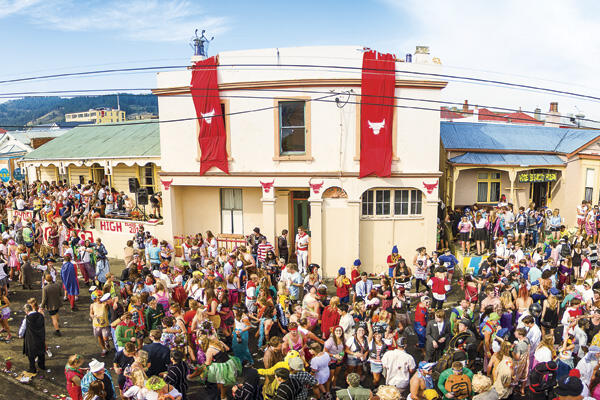
You can hide the event, but you can’t Hyde the Street
After much concern and debate, the annual Hyde Street Keg Party took place on Saturday 13 April before the watchful eyes of media, the University, and other relevant parties, who finally declared that behaviour was “OK”. 3500 students turned up to the event, which officially started at 9am despite most festivities kicking off with the age-old “6 before 6” routine. The future of the annual party was in jeopardy after the 2012 event ended on the floor for those who fell through the roof of a Hyde Street flat. Rules such as limited attendance, a ban on first years and non-students, the continuation of the no-glass policy, a one-way door policy after 2pm, and a higher security presence meant that a careful eye was kept on all attendees. OUSA President Francisco Hernandez said that the success of the event “could not be attributed to one factor.” An area of obvious improvement was the number of arrests made. Campus Cop Max Holt confirmed that there were 15 arrests made on the day, all of which were minor offences, particularly in comparison to the offences committed last year. Only one female was arrested, due to extreme intoxication, but was released once sober. Unsurprisingly, the ODT generously reported that 21 arrests were made as a result of Hyde Street, with 10 of these being “Dunedin tradesmen”. However, Holt stated that there were four non-student arrests, including two soldiers and a builder from Christchurch. The positive appraisal of the event by both media and organisers raises questions over whether or not the event will continue now that students have proven their ability to party responsibly. Otago University Vice-Chancellor Harlene Hayne stated that it was “too early” to discuss the future of the event, while Hernandez was positive, stating he was “pretty confident” about the future of Hyde Street. Although Hayne attended the party, she told the ODT, “In a perfect world, the students who attended the Hyde St party would have spent Saturday in the library.” In another interview, she also agreed that the media didn’t do their best to portray any student activity other than drinking. “I would love it if just once the news media showed up to film students going to the gym before dawn or spending a Saturday volunteering at a local school or building fences for DOC. The scarfies here at Otago deserve better than they currently get from the media,” she said. OUSA received the brunt of complaints regarding the new and improved Hyde Street keg party. Students ridiculed the requirement of emergency contact phone numbers and wristbands that were checked on entry. Kyle Walters took to Facebook, saying “wat if I plan on just jumping the fence? Wat then.” Critic speculates Kyle found out very quickly “wat” would happen, after being immediately arrested for trespass. As a result of these conflicting views, the Agnew Street keg party announced its presence on the keg party scene with a more open-armed approach. “Freshers you’re welcome – there needs to be some easy pussaayy to slay,” the invitation read. Critic assumes that the “Are You OK” team will be replaced by kind third years offering a door-to-door transport service to UniCol.
-
News
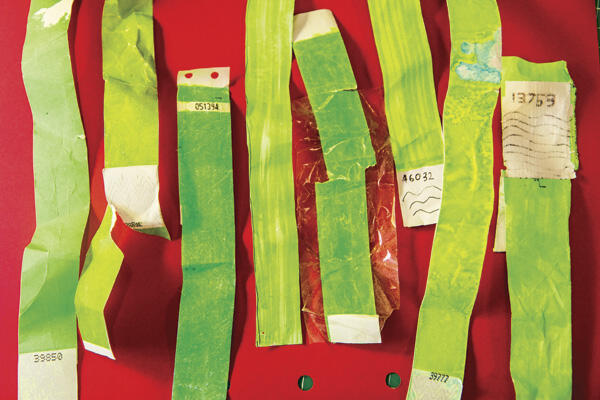
Dunedin: The China of counterfeit wristbands
The limited amount of tickets, which came in the form of a green wristband, available to this year’s Hyde Street Keg Party led to a thriving “green market” in the days preceding the event. An entrepreneurial Hyde Street keg party attendee tried to outwit authorities by ordering a large quantity of green wristbands from a supplier, intending to on-sell them to those eager Hyde Street-goers who missed out on the limited number of tickets. Things turned sour once the Police were informed and subsequently intervened. Although details of the crime are yet to be released and Campus Cop Max Holt was unable to be reached for comment, it is understood that the student has been referred to the Proctor. Critic also discovered that on the evening of Thursday 11 April, the Hydroslides at Moana Pool were issuing fluorescent green wristbands identical to those issued by OUSA. However, most counterfeit wristband wearers failed to realise that OUSA had been issued a specific set of serial numbers, making OUSA bands easy to identify. A source told Critic that another student posted on the clothing buy-and-sell Facebook group “Walk in Wardrobe” that she had 1000 Hyde Street wristbands for sale, much to the delight of those unable to get a wristie. However, when the Police turned up at the student’s flat, it turned out it was a prank. Critic also witnessed students at the event whose woeful attempts to make their own wristbands got the better of them, leaking green highlighter down their arms.
-
News

Insert Plagiarised Headline
Stashing exam notes in the toilet and posting computer science code on an online forum were among the 45 cases of dishonest practice that Otago students were reported for in 2012. The Annual Discipline Report shows that of these 45 cases, 17 stemmed from the Commerce Department, 15 from the Humanities Department, seven from the Science Department, and six from the Health Sciences Department. Most of the 45 cases in the report involved students reproducing work identical to that of another student, submitting work that was incorrectly cited, or simply copying and pasting content from the Internet. Two levels of dishonest practice are recognised within the University, one concerning unintentional plagiarism as a first offence, the other concerning intentional plagiarism as a repeat offence. Penalties range from receiving a warning and reduced marks for the work, to more severe penalties that involve receiving zero marks for the entire paper or being excluded from the University. When asked if there was any explanation for the Commerce Department stealing the highly sought-after honour of “Most Cheaters”, the Uni said it “would be expected” that the number of dishonest practice cases between the four departments would “vary from year to year.” Critic spoke with one plagiarism student known as Cheaty Petey, who submitted an internal assignment for a third-year Statistics paper that appeared to be identical to that of another student. Petey said that “getting everyone else [who cheats] done for it would involve too much paperwork,” and felt that the Department did not handle the situation well. “I was left in the dark for quite a while by the Department about what was happening, and none of my emails were replied to.” While Petey was let off with a warning, he did admit the ordeal had effectively deterred him from repeating the same mistake. In a thriftily-produced video on the University website, “Anna” teaches students the ins and outs of plagiarism. She recommends exhaustively citing all information used and not assisting anyone else to plagiarise. Critic would like to thank Anna for her sage advice. The 2012 report shows that the number of dishonesty cases was down from the previous year, when 52 cases were investigated.
-
News

Otago: Too Big To Fail?
Figures revealed at the University’s 9 April council meeting show student enrolments “running some 2.3% down on the equivalent point last year,” despite first-year domestic enrolments at Otago increasing by 2.9%. Vice-Chancellor Harlene Hayne expressed particular concern at the large drop in postgraduate student numbers, amounting to over 200 equivalent full-time students, which she attributes to the Government’s recent decision to cut postgrad allowances. A report released last year by the University shows that student expenditure supports almost a third of Dunedin’s workforce, and there is concern that the drop in student numbers will affect the city’s economy. Otago Chamber of Commerce chief executive John Christie told the ODT that “recent declines would put some pressure on landlords and give students more choice of flats.” Critic remains unsure what spin he was aiming for with this comment. Despite the figures, the University is still rolling forward with several major building projects scheduled to begin within the year, including the $50-$100 million replacement of the Dentistry School, a new aquarium, and $50 million worth of earthquake strengthening. Tabled at the same council meeting, the University’s annual financial review also revealed for the first time the amount loaned to Knox College for earthquake strengthening and extension: $3.269 million.
-
News

Don We Now Our Gay Apparel
Louisa Wall’s Marriage Amendment Bill passed its third and final reading in Parliament Wednesday night by a landslide 77-44 votes. OUSA President Francisco Hernandez told Critic, “You’re not going to get a different take from me. I’m just going to circle-jerk the liberal-left celebration.” When asked if and how the change will affect students, Hernandez said, “I think people will feel more tolerated. It was the last major barrier of legislative inequality for those who are homosexual. 87% of students were in support of this during OUSA’s last referendum, so most students are going to be happy.” Neill Ballantyne, OUSA Queer Support Coordinator, said: “Last night around 40 students got together from 4pm in Clubs and Socs in order to celebrate the third reading of the bill. There was a great atmosphere of celebration and progress. It was especially emotional when the legislation passed and we all sang the waiata together.”
-
News

Eva Lavi
“My name is Eva Lavi. I was born in Poland in Krakow, and I was two years old when the war started.” Last Wednesday evening, Eva Lavi shared her incredible story of Holocaust survival. Nearly 600 people crammed into the Colquhoun Lecture Theatre, well exceeding its usual 312-person capacity. In the words of the woman herself, Lavi is a “child of miracles.” The outbreak of World War II saw Lavi and her family compulsorily moved into Poland’s Krakow ghetto. A week after their arrival, her grandparents were killed for being too elderly. They were 50 years old. Lavi spent the next six years of her life fighting for survival, encouraged by her mother’s love and fighting spirit. “My mother said, ‘Don’t talk, don’t cry, don’t be heard, don’t be seen. Be very obedient. Do only what I say to you.’” One particularly cold winter’s night, Lavi’s mother ushered her daughter out the window as the Nazis raided ghetto houses in search of children. “I was told to hold onto the drainpipe and not cry, to do nothing.” Lavi recalls almost freezing to death in the -30°C temperatures, unable to feel her little fingers, but her mother retrieved her from the drainpipe when the officers had finally passed. “It shows how desperate she was, but how right she was,” Lavi says of her mother. The situation worsened. Lavi’s father, a “very proud man,” couldn’t stand seeing his beloved wife and little girl die suffering. He acquired a poison, and put a spoon of it to the lips of Lavi. Once a fragile woman, Lavi’s mother resisted and knocked the poison from his hands. “No. We will not die in that way,” she asserted. “There is a God in Heaven and He will decide. We will not do it.” When the ghetto was disbanded, Eva’s family was moved to the Plaszow Labour Camp. Lavi recalls that the ghetto was a good place in comparison to the camp, where Chief Officer Amon Goeth became known as “The Angel of Death”. “People were punished for everything. For going too fast. For going too slow. Everything was punishable.” Lavi would have inevitably perished in the camp if not for the sympathies of German businessman Oskar Schindler. As she lined up to go to work at one of Schindler’s factories, a Nazi Officer questioned the usefulness of an 8-year-old factory worker. Schindler showed Lavi’s little hands to the Nazi Officer and assured him he had delicate work for her slim fingers. However, in yet another unfortunate twist of fate, Lavi’s train was diverted to Auschwitz en route to the factory. She spent several months there before her family finally made it to Schindler’s factory where, in reality, Lavi would never work. “I did nothing at the factory. I was not there. I was not heard. I was not seen again.” Following the war, Eva’s parents had vowed that she would be raised like a normal girl. It wasn’t until 2006, after the death of Lavi’s mother, that Lavi began to speak of the nightmare of her formative years. “I don’t wish that anybody would pass such an experience. The good things, the bad things. There is nothing so bad [as] the war. I can’t really explain. I can’t.” Eva’s thoughtful recollection of such a horrific and testing time in her life was met with a standing ovation from the crowd. Lavi was visibly moved by the reception as she clasped her hands to her chest and wiped tears from her eyes. Lavi’s talk is part of the Holocaust Outreach Project jointly run by the Jewish Federation of NZ and the Zionist Federation of NZ. Ben Isaacs, President of the Dunedin Jewish Students Club, worked hard to have Dunedin included in Lavi’s tour, which was originally approved only if he could get 50 people along. Isaacs was “blown away by the talk,” and remarked that Lavi’s experiences are “rare to find today.” Lavi was in NZ from 5 April until 19 April. Watch a video of the lecture at critic.co.nz/HolocaustTalk
-
News

Drug dealers lose a significant portion of their clientele
In a crushing blow to the legalise cannabis movement, new legislation passed on 9 April will require beneficiaries to undergo drug testing when looking for employment from June this year. A 2008 Ministry of Health study showed that those on the benefit are three times more likely to be weed smokers, so an estimated 20% of beneficiaries will be rushing to purchase eye drops and urine cleansers, thus spending even more on the habit. Social Development Minister Paula Bennett said that the legislation would guarantee employers drug-free employees, while also giving drug users the chance to rehabilitate. Those who fail the test will receive a warning. They will then continue to receive payments until such time has passed that the drugs will have exited their system, at which point they will be tested again. A second failed test will result in payment reductions and possibly cancellation. Those who refuse testing will receive a 50% cut in payments and will be given 30 days to become drug-free. Green Party co-leader Metiria Turei was sceptical: “It’s too expensive and it won’t work.” Early analysis by the Ministry of Health supports this, showing that the legislation would cost $14 million in rehabilitation, testing, and administration, while saving only $7 million in benefit payments. Labour Party leader David Shearer was even more sceptical, claiming that the legislation was nothing more than smoke and mirrors to distract the public from a scathing Unicef report on New Zealand’s child poverty, released around the same time. Critic notes that the drug-testing legislation was introduced in September 2012, and thus the Government would need the foresight of the Jigsaw Killer in order to have perfectly timed the final reading of the bill with the Unicef report. Although student loans are currently safe from persecution, Critic speculates it won’t be long before Paula Bennett tries to stop those receiving them from blazing up.
-
News

Alcohol Implementation Group Meeting
Last year University of Otago Vice-Chancellor Harlene Hayne initiated an “Alcohol Implementation Working Group,” chaired by the staunchly anti-alcohol Professor Jennie Connor, to research and take action on ways that alcohol-related harm could be reduced among students. Critic has gained access to a report released to the ODT under an Official Information Act request. The report reveals plans to notify students of the trouble “excessive drinking and other risky behavior” might get them into, and the consequences they might face under the Code of Conduct. It also emphasised that publicity around the proposed North Dunedin liquor ban was a deliberate attempt to make students aware of the consequences of drinking. The group, which is made up of University staff and international professors, aims for “the deterrence and reduced availability of heavy drinking opportunities, strengthened by effective leadership, clear policies, and a thoughtful communication strategy.” One of the group’s advisors is Dr. Bob Saltz of America’s Prevention Research Center and UC Berkeley. His field of expertise is in college alcohol intervention programs, which Critic presumes are not exactly uncommon in US fraternity houses. A multi-faceted communication plan will work on the principle that if students are exposed to more than one type of anti-drinking campaign, they are more likely to listen. “Having multiple sources tends to reinforce the idea that there really is ‘something’ going on and not just with the University,” the report says. The plan proposes a new group of “alcohol-free street” police, and takes aim at student flats, especially regarding initiations and “hazing.” Critic speculates that this is the University’s latest ploy to eliminate initiations and red cards, leaving nothing but the library for the weekends.
-
News

Victoria Uni teaches students how to rort the system
Victoria University of Wellington appears to have rorted its way to the top of the university research rankings, which were published last week. Victoria came top in two of the four measures, including the coveted award for having the highest average quality of research per staff member submitted for the evaluation. However, evidence suggests that Victoria has been systematically manipulating its employment contracts to ensure that only their best research staff were eligible for assessment under the rules. Victoria hid some poorly-performing staff members away for ranking purposes by giving them fixed-term employment contracts that ended just before the ranking cut-off date of 14 June 2012. Meanwhile, talented staff recruited from overseas were given contracts starting well before they actually arrived in New Zealand, so they would be eligible in time for the rankings. Political commentator and blogger David Farrar, who has covered the issue extensively on Kiwiblog, told Critic: “The term ‘rorting’ is a teeny bit tough, but Victoria has a system in place to manipulate employment contracts to maximise their ranking. From what I gathered from people in other universities, other unis did it in an opportunistic fashion, but at Victoria there was a coordinated agenda to shift every employment contract they can to maximise their rating. Despite having more students, they got their number of rankings-eligible staff down by 200, because they reclassified.” Statistics published on Kiwiblog show that Victoria gamed the system to have just 780 eligible staff for the 2012 rankings, after having 988 eligible staff in 2006. This means that in six years Victoria managed to hide away over 200 staff members, or 21% of their eligible staff. Otago, by contrast, has just 12% more students than Victoria, but reported nearly twice as many staff as eligible for assessment. Last year, when Critic asked University of Otago Vice-Chancellor Harlene Hayne whether Otago engaged in these practices, she said the Uni’s employment practices were “squeaky clean.” These findings provide some support for her assertion. When contacted by Critic, Otago Deputy Vice-Chancellor Richard Blaikie did not wish to comment on whether Victoria had rorted its way to the top of the rankings. As a result of the rankings, Otago’s share of the research-based funding pool has decreased from 20.8% to 20.3%, while Victoria’s share has increased. When Critic asked Farrar for his opinion on Wellington student magazine Salient’s gleeful and hasty reporting of Victoria’s “victory” in the rankings, he said he had not yet read their coverage, but added: “There’s a fine line between patriotism and media impartiality. It’s like how you cheer for NZ to do well at the Olympics, but you also expect them to be critical if NZ used performance enhancing drugs.” The University of Otago’s summary of the research rankings report can be viewed at otago.ac.nz/research/PBRF
-
Columns

The Leek | Issue 08
With a startlingly low nine arrests made by Dunedin police at this year’s Hyde Street Keg Party compared to last year’s 15, it appears that students have really cleaned up their act under threat of discontinuance of Hyde Streets for years to come. Or have they? After talking with the gallant police officers that patrolled the area last weekend, it has become clear to Critic that the primary goal of these arrests was quality rather than quantity. While the actual reasons for the arrests printed in most reporting publications were subsumed under the headings “trespassing” and “disorderly conduct”, Critic is always on the quest for truth. A closer look at the four most outstanding arrests made last Saturday reveals the indubitably high calibre of the young men and women who roam the streets of this humble scarfie town. #1 A 19-year-old Phys Ed student was arrested in the late morning when he attempted to feed his scrotum through a hole in his neighbor’s fence, only to have it sliced partway open by a jagged edge of the corrugated iron from which the fence was crafted. He was later admitted to hospital and vaccinated against tetanus. #2 A middle-aged non-student who managed to gain entry to the party undetected blew (not only) his cover when he was caught committing unspeakable sexual acts with a toppled street sign. The man was escorted from the scene naked from the waist down, as his pants were unable to be located at that time. It was unclear to police whether the perpetrator himself had felled the street sign or if it was already like that when he found it. Either way, “stop” means stop, kids. #3 A particularly obstreperous fresher invited to the party by an unnamed Hyde St resident was placed under arrest when she allegedly “farted” on a policeman after being asked politely to climb down from her friend’s roof. The policeman was in the process of assisting the girl in dismounting said roof when she “broke wind on [his] face”, reportedly waiting until her behind was optimally positioned before releasing a flurry of putrid air on the unsuspecting law enforcement expert. #4 An arguably unnecessary arrest was made when a third-year student outfitted in a day-glo vest, stubbies, and army-issue boots took it upon himself to help out the security squad patrolling the huge event. The well-meaning vigilante spent the better part of two hours helping intoxicated students out of the way of others, preventing several fights from breaking out, and chasing off trespassing cats and beggars. Police arrested him on the charge of “doing [their] jobs better than [they] were”. Fair enough.
-
Columns

Failient | Issue 08
The title of this week’s Salient was “Offensive?” The answer was a resounding “No.” Nothing in this issue offended anyone. Attached is a list of mild, inoffensive content: 1) Crass sexual jokes about Christians, specifically: nuns. About as edgy as ripping out Rebecca Black or the Westboro Baptist Church. 2)An article discussing whether the word “cunt” is the last truly offensive word. Maybe back in 2006. 3) An article criticising the feminist movement – for being worthwhile and relevant, but too insensitive towards ethnic minorities and transgender people. As a white, cis-gendered, heterosexual male, I was going to be offended but then I stopped and checked my privilege. 4) A recipe for Fig and Pear Pie. Disturbing stuff.
-
Features

Lonesome World - Dunedin
Why Go?Most guides to New Zealand will tell you that Wellington has the culture, Auckland has the luxury, and Queenstown has the beauty. But savvy travellers have long since known that dynamic Dunedin does all three far better than the big, scene-stealing tourist traps. Home to the University of Otago, New Zealand’s oldest university, the country’s seventh-largest city bursts at the seams with a vibrant student culture that keeps the rest of city perpetually on its toes – glam George Street’s designer boutiques and slick malls are a paen to sleek sophistication, while the cheerfully carefree denizens of funky Castle Street ensure the city never takes itself too seriously. The student population has brought to Dunedin an eclectic melange of ethnic groups, from Pakeha to New Zealand European to Caucasian, and the same cosmopolitan vibe permeates the city’s eateries – from luxurious buffets (Great Taste, p99) to authentic Szechuan (China Palace, p88), Dunedin’s got the cravings of even the choosiest chow hound covered. This appetite for indulgence doesn’t end at the dinner table – Dunedinites love a sneaky tipple, and the boozers on offer range from casual-cool student dives to classy nightclubs, where the music pumps and thousands of young revellers heed the call of the dancefloor into the wee hours. If you somehow manage to tire of sampling Dunedin’s smorgasbord of cultural delights, then stunning natural beauty is never more than a short drive away. Explore the endless white sands of St Clair, dive headfirst into the intoxicating runoff from the St Kilda sewage pipe, or take a stroll through the sun-soaked enclave of North East Valley. But don’t get too relaxed! You’ll get the most out of your trip if you completely surrender yourself to the city’s 24/7 lifestyle, and fully embrace the come-what-may, fast-living attitude of its residents. Still, beneath the luxurious window-dressing of this modern metropolis, Dunedin is a city with heart – don’t be surprised if it steals yours. When To GoFebruaryThe annual influx of new and returning students paint the town red for “O Week”. Bring your party hat and dancing shoes! MayTake a seat at a graduation ceremony and soak up the satisfaction of sharply attired students finally receiving their degrees after up to six long years of hard yakka. SeptemberPlay cat-and-mouse with the single day per month in which the sun shines and local parks and beaches heave with Dunedinites cheerfully staving off rickets for another week. ActivitiesCastle St walking tourDunedin has long been a hotbed of Victorian and Edwardian turn-of-the-century architecture. Many of the best-preserved examples can be found on the tidy, tree-lined Castle Street, which stretches languorously northwards from the University to the Botanic Gardens. These days the charming houses are “flats” inhabited near-exclusively by student tenants, who don’t let their commitment to their rigorous studies stop them from having a good old-fashioned knees-up every once in a while. Set aside an hour or two to wander the tranquil boulevard, letting it soothe your fractured soul. If you get tired, stop and have a chat with the famously friendly, polite tenants – they’ll likely invite you in for a refreshing afternoon funnel, reassuring you that the future of our lonesome world is in safe hands. St Clair Beach/Dunedin Ice Stadium(Tues – Sun 11am – 4pm, Fri 7.30 – 10pm. $13) Take a drive through the adorable, humble bungalows of South Dunedin and in a mere 10 minutes you’ll be at St Clair, the most romantic of beaches. Paddle in the shimmering turquoise waters, then lounge on vast swathes of soft white sand, letting the balmy northerly breeze tenderly caress your sun-baked skin. Once the sun starts to go to your head, escape the heat with a refreshing spin round the rink at the Dunedin Ice Stadium. Friday nights turn into a wild disco on ice, complete with strobe lights and pumping music – compete with new friends for spot prizes until you’re forced to hang up your skates and head home, exhausted from too much laughter. SleepingOne-night stand’s house($$$ - your self-respect, 30-minute catatonic trudge home, up to 12 drinks) Not only is crashing in the bed of a one-night stand a cost-effective option for the budget traveller, it is the quintessential Dunedin accommodation experience. Places to spend the night don’t get much more authentic than this – if you’re really lucky, your hotelier might even leave you with a permanent STIouvenir of your stay. UniCol penthouse suite($$ - From $100/night) Popular with visiting academics and parents who want to keep an eye on their little Scarfie on his first year away from home. Complete with 14-inch TV, roof access with panoramic views of beautiful Clyde St and the post-modern architectural icon that is the Gregg’s factory, and the excitement of the dangerous but rewarding UniCol electrical control room. Carousel toiletsThe most spacious and relatively clean bathrooms in town. Ideal for a revitalising two-hour power kip before you rejoin the festivities. EatingGreat TasteA cut above even the most prestigious hotel buffets, Great Taste takes diners on a wild ride along an international gastronomic highway. An eclectic clientele of South Dunedinites in Kmart slacks and students out filling their bellies in preparation for a late-night study session are united by their passion for good food, and lots of it. So close your eyes and open wide – your tastebuds are in for one hell of a ride. On the way, make sure to sample Great Taste’s trademark Liquid Mince® and their signature crab salad – a creative riff on the classic which showcases the best in local shredded lettuce and imitation crab meat. Wash it all down with unlimited instant coffee, or get creative and squeeze your own juice from the pile of orange eighths available at the buffet. China Palace Restaurant and TakeawaySmack-bang in the middle of the salubrious fine dining precinct of South Dunedin, China Palace promises not just to sate even the heartiest appetite, but to jostle your very being and set each of your senses alight with pleasure. The opulent décor pays homage to the faded Middle Kingdom elegance of dynasties gone by, with gold trim and plush red velvet rugs. Though the restaurant is roughly the size of an aeroplane hangar, the sense of intimacy and service is never compromised, with lavishly full bowls of complimentary gruel served to all customers on entry. Wolf down sweet-and-sour pork with a few good friends and make some soon-to-be-cherished gastronomic memories. The Green AcornCome to the Green Acorn to enjoy the old-fashioned hospitality of the genial octogenarians who run the place. Stay for the perfectly-extracted strong coffee served by a team of bouncy young baristas. But if java isn’t your bag, don’t fret – you won’t find a thicker smoothieanywhere in Dunedin. Pair your beverage of choice with a vegetarian sandwich, complete with mandoline-thin slices of brie and deliciously floury tomatoes, and float home on a cloud knowing you’ve done right by your tastebuds today. Mei WahMei Wah is justly famous for its delicious chips, which are pre-cooked then re-frozen, so they are able to be cooked pronto – perfect for the jaded traveller in need of some fast, tasty tucker! The charming, cosy takeaway shop is the ideal surrounds in which to sample the classic, crispy Kiwi treat. Old video games nestle next to Street Fighter and a collection of fine local journalism, including The Envoy From Bedlam and Onit. CountdownThis large, well-stocked supermarket has everything the thrifty traveller needs to make themselves a hearty home-cooked meal – or just grab a Bouton d’Or Mini Brie, some Just Hummus, carrot sticks, and a deliciously doughy Pumpkin and Chive Loaf and enjoy a picnic lunch in the tranquil carpark. In a hurry? No worries – Countdown Dunedin Central employs a vast army of attractive staff to man the counters in order to cope with the steady flow of happy customers. DrinkingThis town ain’t no place for teetotallers. Dunedinites love a strong drink served in atmospheric surrounds, and the entire city is peppered with every imaginable kind of drinking den. This may be a student town, but don’t expect too many grungy urine-soaked student dives here – the buzzwords of Dunedin nightlife are class and innovation. The bar scene is constantly changing and evolving, so don’t just rely on this guide – what’s hot today might have completely fallen off the cool kids’ radar in a month! Try asking the staff at edgy clothing boutiques and cool cafes, like Glassons on George St or Crusty Corner in North East Valley, what’s going on tonight. If all else fails, take a stroll through the CBD and listen out for the sounds of beautiful people letting their hair down. BrimstonePacked, sweaty, but always overwhelmingly sophisticated, Brimstone is perhaps Dunedin’s most exclusive and innovative nightclub. An eclectic line-up of DJs spin perfectly mixed obscure vinyls, while shyly handsome bartenders pour the well-heeled clientele endless Manhattans as they indulge in debaucherous antics to be extensively discussed over Bloody Marys and Eggs Benedict at Sunday brunch. Brimstone is a Dunedin must-do, but be warned: the dress code and face control are strict. Men, don’t even consider trying to get in without a lady friend, a shiny pair of leather loafers, and at the very least a fitted shirt and some dark-wash jeans. MetroCarousel’s hottest competition for the most luxurious bathrooms in town (p77), the dual-levelled nightlife heavy hitter Metro does a fine line in drink teapots, and evokes a turn-of-the-century speakeasy with its moody lighting, exposed brick, low ceilings, and moodily disenfranchised clientele. The atmosphere is only enhanced by the music – downstairs, a groovy playlist of 90s pop hits gets feet moving, while upstairs too-cool-for-school youngsters in eye-poppingly skimpy attire get down to live bands while sipping on their teapot of choice. Highly recommended. AlibiStrong, cheap drinks? Check. Strapping, broad-shouldered rugby-playing lads? Check. Friendly bouncers? Check. Lots of space in which to dance the night away? Check. The epitome of the hard-partying Dunedin spirit, Alibi is the place to get up, get down, or get more than a little tipsy. Down-to-earth yet chic, just crowded enough but with lots of secluded corners replete with couches, Alibi is beloved by Dunedin’s trend-setters and taste-makers for a reason. There’s no such thing as a perfect bar, but Alibi comes damn close. Getting There And AwayBy Plane:Both Air New Zealand and Jetstar fly direct to Dunedin from several major New Zelaand cities. Air New Zealand’s charming safety videos epitomise whimsical Kiwi charm and will get you smiling for takeoff, while Jetstar runs on island time and epitomises the relaxed, “she’ll be right” attitude of the New Zealand people. By car:Dunedin is about five hours’ drive from Christchurch, three hours from Queenstown, and 2 ½ hours from Invercargill. The drive from Christchurch is particularly recommended for the traveller who has overdone it on exciting scenery and requires five hours of gazing at calmingly bare plains and the back of stock trucks to refresh their jaded eyeballs. Getting AroundTo/from the airport:Southern taxis operate an exclusive taxi rank at the airport – the fare into town is a very reasonable $100. However, if your budget can’t stretch to even that much, Super Shuttles run regular, efficient shuttles for the rock-bottom price of $30. We suggest a shuttle – the competent drivers consistently take the most logical route to their many passengers’ final destinations, and often the roughly 22km journey comes in at less than two hours! By car:Driving is the only way to reach some of Dunedin’s more obscure destinations (day trip to Mosgiel, anyone?), and a car will definitely see you right. Technically you generally have to pay for parking, but Dunedin’s parking wardens are famously laid-back – the odds of getting ticketed are slim, so make the most of it! On foot:Why not do as many students do and fire up the ol’ hammies, then explore the city under your own steam? The persistent warm northwest breeze, gaggles of happily giggling teenagers, and invigorating scent of Jaffas and burnt coffee make Dunedin a joy to explore on foot. About The AuthorMADDY PHILLIPPS first visited Dunedin at the tender age of 13. She fondly recalls staying at the luxurious Alexis Motor Lodge on a pull-out sofa bed. Upon finishing school, a lifelong penchant for masochism led Maddy to move to Dunedin to complete a law degree. She fell in love with the city all over again, and now calls it home. When she’s not hard at work tirelessly making her own lecture notes for her beloved law papers, Maddy can usually be found sipping a bourbon and coke at fave haunt Alibi.
-
Culture
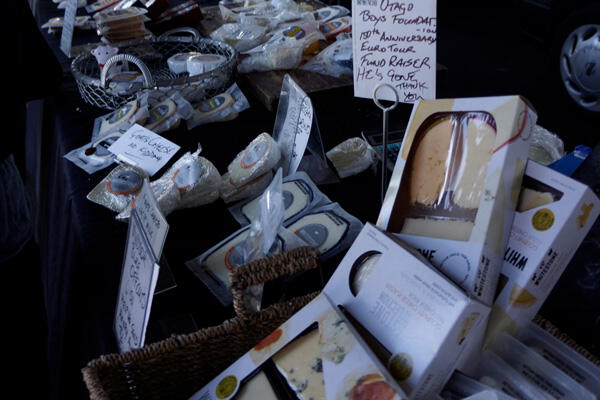
Sweet, Salty, Saturday: Indulgent Food
This week Ines Shennan spins a few stories about her Farmers Market exploits, and delivers recipes for decadent, salty, sweet, soft, crunchy, spicy, and generally delicious mouthfuls of bliss. The kind of rich, heartwarming, beaming-smile-across-your-face kind of food that you can’t wait to share with your flatmates. Or maybe just scoff by yourself, you greedy thing. Otago Farmers MarketEvery Saturday at the Railway Station, Dunedin opens itself up to an explosion of flavours. From treats made before your eyes to produce ready for some TLC, everything just begs to be consumed. The Farmers Market is host to over 60 different vendors, including resident chef Alison Lambert, who demonstrates how to create fresh, playful dishes from the seasonal produce available. The market is open from 8am until 12.30pm, making it an ideal stop for breakfast, brunch, lunch, or all three. Trot along with a big appetite and some cash in hand, and you won’t be disappointed. Best Value:The steamed pork buns from the Jia He Asian Food stall in the north end. Glossy, plump, soft buns encase a hot filling loaded with minced pork, vermicelli noodles, cabbage, and peanuts. For the pig lovers (or haters, depending on which way you see it), there are also buns that have the same filling sans the pork mince, in plain or curried tofu varieties. An intensely spicy, tangy Szechuan-style dipping sauce sits at the front of the stall, ready to be liberally spooned over your tightly-guarded takeaway. Dumplings are also available, though yours truly was too busy going back for round two of the steamed buns to give the former so much as a fleeting glance. Oh, and at $2.50 each for a glorious mound, it’s hard to contend with them for the best value prize. So. Freaking. Good. Most Fun:Check out the spreading, flipping and filling magic at La Crepe. Priced from $4 to $9.50, there’s an exciting array of sweet and savoury flavours to choose from. Banana, chocolate, and whipped cream is utterly divine: definitely the epicurean’s definition of good time at 11am on a Saturday morning. Lemon curd, honey and sliced almond, passionfruit and whipped cream, cheese and ham, “The Complete”, even a savoury special – there is something for every palate. Pack a delicate, sweet one into your belly with a strong coffee, or jump aboard the savoury crepe train and go for one of the combinations. Vegan Heaven:A fabulous vegetarian sidekick of mine raves about The Joyful Vegan, and I can understand why. Try one of their $7 burgers, officially crammed with amazingness, and you’ll immediately wonder if their beef patty-filled competitors might be knocked off their perch of popularity one day soon. Or maybe they already have been. A delightful caravan that also sells breads, slices and muffins, it’s a bustling, joyous little stall. Not-So-Vegan Heaven: Bacon butties from the Bacon Buttie Man. North End. Salty. Mustard. Fatty. Tomato sauce. Greasy. Soft white bread. $5.50. Good for a hangover. Good for everyday life. Fills-That-Ravenous-Hole Award: Grab a pie from Who Ate All The Pies if the thought of crisp pastry paired with flavours like beef, mushroom and red wine, chicken, bacon and thyme, and pork sage and caramelised onion warms your heart. Or your stomach. Or both. This is a legitimate breakfast. Not every week. But maybe once a month, treat yourself to a Farmers Market “shopping for seasonal veggies”-but-on-a-pie-for-breakfast mission.
-
Features
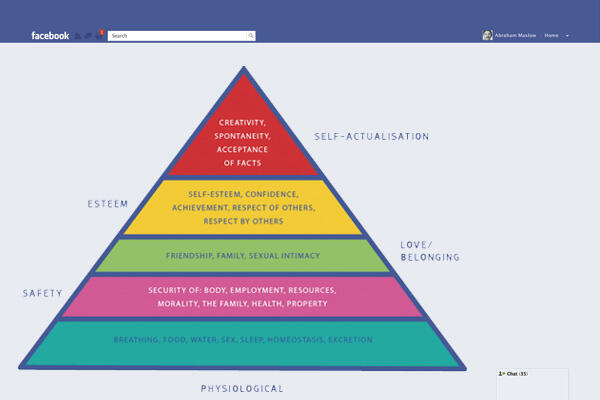
Maslow's Hierarchy of Facebook Needs
Maslow’s pyramid illustrates the stages that human motivations move through as we satisfy increasingly sophisticated psychological needs. The most basic needs are at the bottom. The less urgent but still important needs are at the top. Previously, a couple of 100-level PSYC papers would have been necessary to truly understand this illuminating psychological theory. Now we have Facebook. physiologicalThe lowest level of Maslow’s hierarchy consists of the basic physical requirements for human survival. The inhabitants of this tier are yet to develop enough cognitive function to engage in even the most basic abstract thought. Statuses chronicle their daily trials and tribulations as they grapple with adequately feeding, sheltering, resting, and hydrating themselves. safetyOnce an individual’s most basic needs are satisfied, he or she seeks security of body, employment, the family, health, resources, and property. Those stagnating in this tier utilise the status update function to show off their latest material acquisitions and air the dirtiest of dirty laundry. love/belongingAfter safety is established, the need for a sense of belonging to a social group arises. Lavish albums are devoted to the fact that this person enjoys the fleeting caress of self-confidence and self-worth only when surrounded by those who affirm their life choices by dressing and acting exactly like them. esteemAfter belonging comes the desire to be respected and valued by others – a need for recognition, importance, and attention. This results in the usage of Facebook to post statuses that are designed to win the envy and esteem of their peers, but only serve to highlight the person’s intense insecurity and craving for approval. self-actualisationOnce esteem is achieved, a person can recognise and realise his or her full potential, becoming the best they can possibly be. To reach this level, a person must master each of the previous needs. There is no recorded instance of a fully self-actualised person ever posting anything on Facebook.
-
Culture
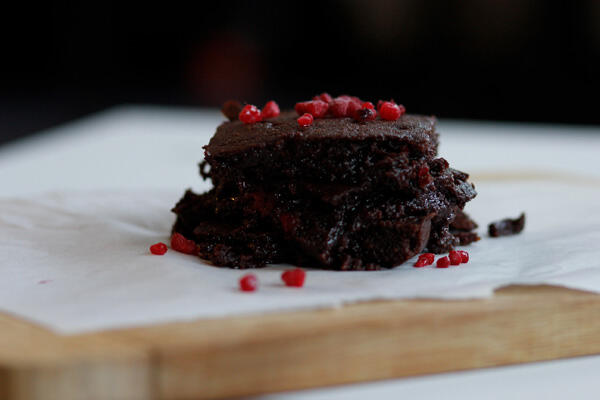
Filthy Fudge Brownies
This brownie is immoral and fiendish. Unlike the consistently firm, cake-like brownies often found sitting pretty in cafe cabinets, this is far more brutish and unforgiving. On the Chocolate Baked Goods Spectrum, it sits far closer to a decadent slice of fudge than a cake. Luckily, it has a more complex texture than pure fudge. Adapted from a Nigella recipe, it eats like a pudding, though be careful not to overheat it if you choose to have it warm, as it will probably melt into a puddle of hell. Not necessarily a bad thing, but some structure is nice. To cut through the richness, be sure to serve it with something tangy and chilled, like thick yoghurt (Piako’s lemon curd gloriousness would be my recommendation), fresh raspberries, or sorbet. Don’t eat too much at once – I have warned you. Ingredients200g block dark chocolate (70% cocoa solids or more) 225g butter 4 tsp vanilla essence 200g caster sugar 3 small eggs, beaten 140g + 3 tbs white flour Handful fresh or frozen raspberries (optional) Thick yoghurt, fresh raspberries or sorbet, to serve 1 empty stomach Method1. Preheat the oven to 165°C fan bake, or 170°C regular bake. 2. Cut the butter into about eight chunks, and break the block of chocolate into six to eight chunks. Place in a medium-sized saucepan over a low heat. Stir until melted. Remove from the heat. 3. Mix the vanilla essence and sugar into the chocolate. Set aside for 15 minutes to cool. 4. Add the eggs and flour to the mixture, stirring until smooth. Add more flour (up to 1/4 cup) if you want a firmer brownie, but too much and you’re really missing the point of this fabulous filth-fest. 5. Pour the mixture into a baking dish or tin lined with greaseproof baking paper. Scatter over the raspberries, and press them into the mixture. I used a particularly large dish, so the mixture was only two inches thick – I cooked it for 17 minutes before removing it from the oven. Thicker brownies may need up to 30 minutes. Ultimately you want the brownie to appear set around the edges, with a mostly to completely set surface, but still a bit wobbly beneath. 6. Allow to cool at room temperature for half an hour, or speed up the process in the fridge. When it appears firmer, slice it into outrageously large squares, and pile two to three squares on top of each other, depending on how thick they are. This will give you a sinfully good brownie, with several fudge-like layers, which you can cut into smaller pieces. 7. Serve on a reasonably empty stomach with a liberal dollop/handful/scoop of one of the suggested accompaniments.
-
Culture
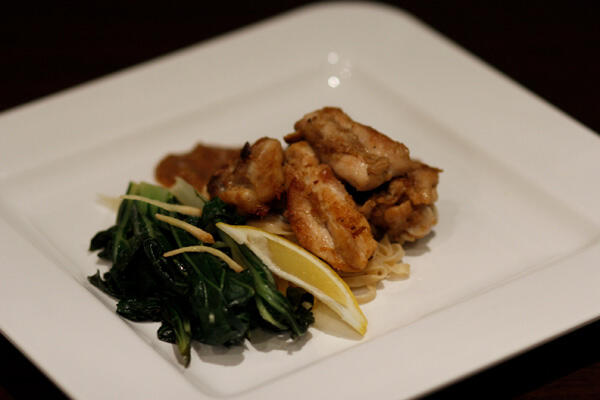
Crispy Chicken with Salty Satay and Ginger Bok Choy
This dish satiates the tastebuds on every level: it’s sweet, salty, and ginger-laden, with crispy chicken ready to soak up all the fun. Rice bran oil is a great choice to use for high-temperature cooking, and is also neutral in flavour, allowing your other ingredients to shine. Frying chicken over a high heat with ginger and garlic results in delicious not-so-small tidbits, with a crunchy garnish of sorts left over in the pan. You can sprinkle this over the chicken, or be a glutton like me and eat it straight from the stovetop. Coconut powder can be found at specialty grocers, and is a convenient alternative to coconut milk when you need only a small quantity of liquid. Simply add water, stir briskly, and you’re set. It doesn’t impart the same intense richness of canned coconut milk, making it perfect for the satay sauce, which focuses on the nutty, salty flavours from the peanut butter and soy sauce. I’d stick with the canned stuff for curries, however. Get your greens in with steamed bok choy, gently flavoured with ginger, lemon and sesame oil. Lay on the sauce and you’re good to go. IngredientsSatay1 tbs rice bran oil 1 onion, diced 2 tbs peanut butter 1-2 tsp soy sauce to taste 2-3 tsp white sugar to taste 1/2 cup coconut milkChicken1 tbs rice bran oil 2 thumb-sized pieces fresh ginger, grated 2 cloves garlic, finely chopped 4 bone-in or semi-boned chicken thighs, cut into thirds 2 tsp peanut butter 1 tbs soy sauceBok Choy4 stalks bok choy, washed and sliced diagonally Lemon juice to taste Sesame oil to taste 1 thumb-sized piece fresh ginger, grated Method1. Heat the oil in a wok or large frying pan. Add the onion and cook until soft over a medium to high heat. 2. Add the peanut butter and stir until melted. Slowly add the soy sauce until you reach the right level of saltiness. Add the sugar to taste. Add the coconut milk and simmer, stirring, until thickened. Set aside. 3. Heat the second measure of oil over a high heat. Add the ginger, garlic, and chicken. Cook for 30 seconds until brown. Add the second measures of peanut butter and soy sauce and stir to incorporate. Turn the heat down to medium and keep stirring until the chicken is cooked through. 4. Place the white of the bok choy, followed by the green, in a steamer. Steam over boiling water with the lid on until almost tender. Transfer to a hot pan with a squeeze or two of lemon juice, a splash of sesame oil, and the second measure of ginger. Cook for one minute, then remove from the pan. 5. Serve the chicken, bok choy, and satay sauce with steamed basmati rice or wide egg noodles.
-
Columns

Love Is Blind | Issue 08
Critic’s infamous blind date column brings you weekly shutdowns, hilariously mismatched pairs, and the occasional hookup. Each week, we lure two singletons to Angus Restaurant / Moon Bar and ply them with alcohol and food (in that order), then wait for their reports to arrive in our inbox. if this sounds like you, email news@critic.co.nz or FB message us. But be warned – if you dine on the free food and dash without sending us a writeup, a Critic writer will write one under your name. And that won’t end well for you. Young Master PunctualDressed to impress, I left the flat after a couple of beers to settle my nerves. Strolling into Velvet burger at 7:30 on the dot, I was feeling pretty good. Being told I was at the wrong place wasn’t the dream start, so I rushed down the block to where I was meant to be. Luckily for me, the girl was far later then I was. After sitting at the small table alone for around 30 minutes, and reading the 3 page menu about 100 times so as to not look like I’d been stood up, I decided it was no longer rude to dig into the bar tab. As I was about to text my flatmate to pretend to be my date, and to join me for a free feed, my date arrived, apologised for her lateness, and said that she had forgotten all about the date. I was a little disappointed, as she had not really put too much effort into what she was wearing. It looked as though she had just come from the library, in all her comfortable clothes. We ordered our meals, and got talking. Conversation was pretty easy between us. She was a local girl, and a first year. The look on my face must have said it all. She was studying forensics. I used to watch a lot of CSI, which it seemed, was about all we had in common. She was an animal lover, I work summers as a slaughterman. In saying that, I was so engaged in the chat that I didn’t even notice my flatmates enter the bar and make several trips past the table to check the girl out. She told me she couldn’t drink much, as she had a test on the Saturday she needed to study for. We were in such dire straits that we needed a quick shot each to even finish our bar tab before we took off. I walked her back to Cumby, we swapped numbers, and I was on my way, not even a peck on the cheek to show for it. Little Miss ForgetfulSo it was 7.50pm on Thursday night when it became apparent that I’d forgotten I had a blind date, and was now 20 minutes late. I ran out the door in the same clothes I’d been wearing all day, no makeup, and undone hair. I was walking to Moon Bar when it started raining. I eventually arrived. My date was sitting patiently, having a beer and not mad at all – which was a surprise considering I was half an hour late at this point. I sat in the seat facing the cash register, which would later prove to be a mistake because a friend was working in Moon Bar that night and proceeded to make faces at me the entire time. Anyway, conversation was flowing, and it didn’t seem to be awkward at all until he chose to tell me that he’d been talking with his flatmates earlier and when they’d talked about what he didn’t want his date to be, they’d said no freshers. Well, that was awkward considering I am a first year. And then when he told me he’d worked in a slaughterhouse I started to hear my mum’s voice in my head telling me to “be careful.” We began talking about cats and Japanese language, and I think we both surprised each other. I seemed to know everything about his cats, which freaked him (and me) out. And he seemed to be surprised when I knew a few Japanese words. We ordered our food, and when it came I struggled to eat any of it considering I’d already had dinner. When the time came to leave we decided it would be a good idea to do a cheeky wee shot. Of Patron. I’d never done Patron in my life, so didn’t know what to expect, but it proved to be the most horrible thing I’ve ever tasted and pushed me over the ledge into the land of the tipsy. We left and discovered he was walking home to his flat, past my hall, so we walked together. I purposely made it so we didn’t get to the door to say goodbye, because I had told an RA on duty that I was going on a blind date, and didn’t want to be made fun of.
-
Columns

For Fuck's Sake | Issue 08
Lectures can be pretty dicey – they force a room full of strangers to tolerate each other for hours at a time. Some of us are happy, most of us are pissed off. Some of us are actually listening to what the lecturer says, most of us are doing more important things (like sleeping). The potential for awkward shit to happen is at an all-time high, and the worst thing is that there is no escape. The only option is to ride the awkwardness out, stuck in a bum-numbing seat that oozes the ass-crack sweat of the poor fuckers who sat there before you. If possible, avoid talking to people. Luckily, awkward conversations with strangers can be pretty easily avoided via either (a) a helpful buffer of friends sitting on either side of you, or (b) an even more helpful one-seat buffer that any polite stranger will leave between you and them. But there is no buffer for protection from those in the rows in front of and behind you. So naturally some pretty awkward shit can go down. The worst of said shit is catching the eye of someone sitting in the row ahead in the reflection of their laptop screen. Eye-catching in general is bad, but this is worse, because although it’s easy to accidentally do, the indirectness of the contact gives the impression that you must have intended it to happen and thus are a creep. Eye-catching is the pits because it can very easily turn into a vicious cycle – it’s hard to do just once. I don’t know why movies portray catching someone’s eye as something cute that happens in elevators and turns into true love. It’s not cute, it’s odd – and it only ever turns into the other person thinking that you are a psychopath. Lectures are deceptive, because it’s easy to retreat into a bubble and forget that you aren’t alone. Believe me, you may think that you can send your friends a snapchat of your triple chins and that people won’t notice, but they will. Every time you play a round of Temple Run, the people sitting behind you are equally as concerned for the health and safety of Guy Dangerous (your average explorer) as you guide him on the hunt for the golden idol. You cannot have a private conversation, you cannot discreetly eat an apple. Lectures are bad, and awkward shit is worse. Together they are fucking terrible. Unfortunately, we cannot complete our university degrees from the safety of our beds (believe me, I’ve tried). So venture out with care, fuckers, and good luck.
-
Columns

Science, Bitches! | Issue 08
It’s time for a column about evolution. Don’t worry, I’m not going to preach about the problem with creationism – that debate has been going on for years, and by this point most people know evolution is real, and a few will never be convinced otherwise. Aside from the occasional “Challenge to Evolutionists” or a new fossil that could “Finally Prove Evolution”, for the most part we’ve seen all the evolution we’re going to in the content of that debate. I’m sure you sensible people know that evolution is real, but if you haven’t studied evolutionary biology, you mightn’t know too much about the details. I’ll elaborate. Natural selection is so elegant! It’s simple and intuitive once explained, but the first time it occurred to Darwin (and Wallace) it must have been mind-blowing. Basically, if organisms in a population have variation in their physical appearance and behaviour, if that variation is inherited by babies from their parents, and if not all organisms survive (because nature is cruel, like when the lion eats the antelope and David Attenborough’s soothing voice makes you want to cry), then babies with “good” variations will survive better, and they’ll have their own babies with good traits too. Ta-da! A population with traits suited to the environment – natural selection! This explanation often leads people to assume that selection results in “perfect” organisms. Because selection can only “choose” from existing traits, lots of strange structures occur when a nearby structure changes thanks to selection. The giraffe’s vagus nerve is an example. All mammals have this nerve – it starts at the brain, travels down around the arteries of the heart, and loops up to the voicebox. During embryological development, the nerve takes this path as it grows through the body. In mammals with short necks, this makes sense, but giraffes have a two-metre long neck, so their vagus nerve travels all the way down and then all the way back up their neck! Because this pattern of growth evolved before the long neck of the giraffe, the nerve will never be able to grow directly to the voicebox. A sexier example occurs in humans – the vas deferens is the tube through which sperm travels from the testes to the penis. Like the giraffe nerve, it takes a crazy route. The vas deferens loops all the way up over the bladder, then back down to the penis. This is because human testes descend during development, looping the vas deferens over the bladder as they go, whereas in other mammals the testes don’t descend. This leaves the poor sperm with a fair distance to swim to reach their goal – although perhaps that makes the fun part last longer? For that, you can thank the science, bitches.
-
Columns

Daily Grind | Issue 08
2/5 Coffee Cups
-
Columns

Lez Feminables | Issue 08
Young people struggle with identity issues. Things would be much easier if humans were hive-minded beings of singular purpose (probably galactic conquest), but we aren’t. We are billions of young and often directionless moulds, which is why our Facebook “inspirational people” are actually kind of important. This week, I want to tackle this by offering up feminist and LGBTQ role models and icons. Julie D’Aubigny: Who’s this seventeenth-century French girl? Oh, just the best damn opera-singing fencing master ever. She was a truly independent woman who lived apart from her husband because she preferred to stay in Paris doing her own thing – her “own thing” being illegal duelling. She had nightly shows at the Opéra du Quai au Foin, and once disguised herself as a nun to enter the convent her girlfriend had been sent away to. Now, I’m not saying that killing 10 men in illegal duels, body snatching, or arson are actions to be idolised, but if you’re looking for a badass bisexual woman to look up to, “La Maupin” could be her. Carmen Rupe: This one’s a little closer to home. Born in 1936, she was an LGBT activist during a time in New Zealand’s history when homosexuality was still criminalised. She was a transwoman, and lived her life as a fiery ball of attitude and activism: she was summoned before the Privileges Committee by Rob Muldoon for her comments, and ran for Mayor of Wellington in 1977. She died in 2011, and it is possible that a statue of her may be erected. Leonard Matlovich: The first member of the US Army to oppose its stance on homosexuals, and a race relations instructor in the Air Force during the ’60s, when lots of people were still really racist. Along with Harvey Milk, he was a figurehead for gay rights in the ’70s. He famously said, “When I was in the military they gave me a medal for killing two men and a discharge for loving one.” When he died due to HIV/AIDS complications in 1988, this quote was engraved on his tombstone instead of his name. Angela Davis: A member of both the Communist Party and the Black Panthers back in the ’60s, basically everyone was out to fire and/or arrest Ms Davis. She was jailed, freed, acted as her own (successful) counsel in front of all-white jury, was on the FBI’s Ten Most Wanted list, and led several political groups. After years of being at the forefront of racial, feminist, and LGBT activism, she settled down into her current position as a Distinguished Professor Emeritus at the University of California, Santa Cruz, and an out lesbian.
-
Columns

The More Things Change | Issue 08
This week, records and computers go bad, but the Internet does all right. 23 April 1564: William Shakespeare was allegedly born. The exact date of his birth isn’t known, because somebody in the eighteenth century wrote their records down wrong, but he was baptised on the 26th so people generally figure it must be close enough. This isn’t the only uncertainty that Shakespeare’s legacy has passed down – among other questions, some people doubt that he wrote any of his works at all. It has been proposed that he was a cover for another writer who couldn’t or didn’t want to publicly take credit for the works, but despite the undoubtedly lengthy and vicious arguments this has led to, there’s only a relatively small group that is trying to get more people concerned about the so-called authorship question. In the midst of all this controversy, though, one significant event remains undisputed: the date of Shakespeare’s death, which also happened to be April the 23rd. This is apparently the major reason biographers have latched onto the same date for his birthday, morbid though that may be. 26 April 1962: NASA tried to crash a spacecraft into the moon, and did it wrong. The craft, Ranger 4, was meant to crash-land on the moon and collect data to be sent back to NASA for study, and to assist the development of the Ranger programme for developing new spacecraft. It was also supposed to take pictures of the surface of the moon, which NASA hadn’t yet done from that close. But an onboard computer malfunction resulted in its solar panels and navigation systems failing, and it ended up crashing into entirely the wrong side of the Moon without sending back any data. It does get some credit for being the first US spacecraft to reach the Moon, though, even if they couldn’t crash it right. 22 April 1993: Thanks to the USA’s National Centre for Supercomputing Applications, the web browser Mosaic was launched. It wasn’t the first browser, but it was the one that popularised public use of the Internet. It was made free for general use and had an interface that was more user-friendly than those of earlier browsers, which led to a massive surge in Internet use among the public, where previously it was used mostly in academia and research institutions. It died out after a few years due to its creators developing a new browser (a code descendant of which is Firefox), but is still remembered to this day for its part in the rise of the Internet. Modern browsers still have features derived from Mosaic, which is not bad 20 years later.
-
Columns

Hi Dr. Nick | Issue 08
Hi everybody! Last week we talked about how men’s members measure up, shedding some light on what an “average” dick actually is. And while, much like a Health Sci, we tried to dress it up in a lab coat and pretend it was medically relevant, it was ultimately a column stating “It’s not the size, it’s what you do with it.” Continuing the “Sex Ed Messages From Year 9” theme, this week’s column is all about STIs. We’ve already covered the basics (wear condoms, get tested if you’re concerned, lather, rinse, repeat), so check out Column #4 for that stuff – this week’s column is cold hard facts about dicks, drips, gashes, and rashes. Chlamydia:Number of NZ cases per year in 20-24 year olds: 1,973 per 100,000 (1.97%). As common as: Red hair (1-2%). Symptoms: Asymptomatic in 25% of lads and 70% of ladies. Women: May get change in discharge, bleeding between periods, and/or post-sexy time bleeding. Men: May get pain when peeing and/or watery discharge. Untreated: Can cause infertility, pelvic inflammatory disease, testicular inflammation, and arthritis. Treatment: 1-2 pills. Genital Warts:National rate of virus: Quite high (lifetime risk of getting virus 80%, people
-
Columns

ODT Watch | Issue 08
This week, the ODT essentially calls a world-renowned vet a sheep shagger. Meanwhile, things were “heating up” (lolzz) in Cromwell when the volunteer fire brigade was pulled out of the pub to attend to a patch of grass. But the action didn’t stop there, with the Blueskin on Show day on the grass featuring an epic battle between two old people on bikes. The story contained the sport’s fearsome battle cry: ‘The handlebar’s got me in the groin!’ In financial news, the University has elected to continue its Dunedin domination, purchasing a hotel so that its students can have a more glamorous location in which to slack off and make poor life choices. That said, at least the Uni has money to burn; the DCC’s coffers must be running low given their list of injuries claimed to ACC, indicating that the staff have a lower pain threshold than Sergio Busquets.
-
Columns

Get Out Of The Ghetto | Issue 08
Tunnel Beach is Dunedin’s best worst-kept secret. It’s one of those places that makes every local nod if you ask them about it. Magically, though, Tunnel Beach never attracts the tourist hordes like St. Clair or even Sandfly Bay. The beach is located around eight kilometres from the ghetto – head south down the west coast. A nicely-manicured track at the end of Tunnel Beach road (bit of a clue there) takes you down a steep hillside out onto sea-carved sandstone cliffs. The tide and salty winds have bashed this shoreline for aeons, so there are some interesting rock shapes to be seen up and down the coast, including a natural sea arch which makes a nice spot for a picnic. Watching the waves heave and swirl around the cliffs is strangely alarming and soothing in equal measure. Just don’t jump in. As far as beaches go, Tunnel Beach has a pretty killer backstory. As well as the track that takes you out onto the top of the smallish cliffs, there is a tunnel! Who would have known? This tunnel was commissioned by the original landowner, Dunedin’s first MP John Cargill, way back in the 1870s. Some poor bugger was paid to carve the tunnel out by hand. Descend 72 slippery steps to the secluded patch of sand below. And watch out for seals. Enjoy. Get there: by bike or car, from November through July (the track is closed for lambing season from 1 August to 31 October). Do: watch the sun set. Don’t: swim, unless you’re awesome. Eat: a picnic (cute).
-
Columns

Love Online | Issue 08
Critic created a female internet dating profile expecting a low standard of suavity. But not even we could be prepared for the barrage of sheer ineptitude that followed, each new suitor representing a new nadir in the evolution of mankind. This column is a word-for-word transcript of an actual message received by Critic’s online dating profile. You can’t make this shit up. Subject: A hot proposition for you! Hey baby girl you sound delicious! This dirty daddy dom would luv to get his filthy old hands on you're fine form and teach you how to please him! So if you have any interest in a light exploration of the bdsm world at all I'm here to help! I'm also a sweet and generous daddy who will spoil you in all ways and treat you like a princess, If your interested tell daddy all your wants and desires and he will make them happen for his princess if he can!
-
Culture

Defiance (PC, PS3, Xbox360)
Massively Multiplayer Role Playing Games (or MMORPG, games that are played entirely online with people from all over the world) are a tricky business. They require significantly more money to develop than a standard video game instalment due to the large scope of content as well as the ongoing costs of maintaini ng servers and creating new content and patches. This money is all gambled on a very fickle formula for success, which is that the game must allow for characters to play through a series of areas and quests which allow them to improve their characters. Once players reach the maximum level they expect content such as Player vs Player matches (PvP) and raids, which offer a seemingly infinite play experience. The formula allows developers to create a game that players will theoretically never stop paying for. You may wonder why developers bother if it is such a gamble. They bother because Blizzard, developers of World of Warcraft, made $4 billion dollars in revenue last year – a tidy 10% of a 40 billion dollar industry. There is money to be made in MMORPGs, but only to those who offer lasting experiences. Many have tried to claim their slice of the pie, and almost all have failed. I fear that Trion Worlds’ new MMORPG, Defiance, will soon number as one of the fallen. Defiance has intrigued me since its announcement last year. It wanted to claim its stake in the MMORPG market by doing something new. That something was that, in addition to the game, a TV series would be developed by SYFY in the same universe, and air at the time of the game’s launch. The developers boasted that this would allow a really rich narrative-heavy experience in both the game and the show, where events within the show would affect the game world and vice versa. There’s no doubt that it’s an awesome idea. The trouble is that the game has almost no storyline. After spending a week with the game, I still can’t tell you a thing about it except that it is set in America after some aliens arrived. The rest is a mess of contradicting information – for example, the premise is an alien assimilation, but the only enemies I encountered in the first 20 hours of play were mutants and giant bugs. Where the fuck did they come from? No explanation, no elaboration, nothing. So my question is: what happened to the rich, narrative-heavy universe? The show doesn’t come out till next week in America, so not only are New Zealanders high and dry without resorting to illegal means, but are the developers really saying you NEED to watch the show to understand the game? Because that’s beyond retarded. The show and the game should complement each other, not be dependent on one another. Still, if you can get past this unbelievable oversight, you can enjoy some incredibly derivative but fun third player shooting action. You can play with a variety of gun types, which you collect as loot, much like Borderlands. You can choose between the four incredibly plain powers of cloak, decoy, overpower, and melee. The more you play with a particular weapon type, the better you get with it. This, combined with a rating system which calculates the combined effectiveness of your loadout choices, is the game’s answer to levelling. My advice is that if you feel like playing a third person shooter, pick up Gears of War. If you want to play an MMORPG, pick up Star Wars: The Old Republic or World of Warcraft. This game offers both experiences, but does neither well. I’ll watch the show when it airs next week with much interest. But even if it’s the best show in the world (doubt it) it won’t make this game any more enjoyable. Rating: 6/10
-
Culture
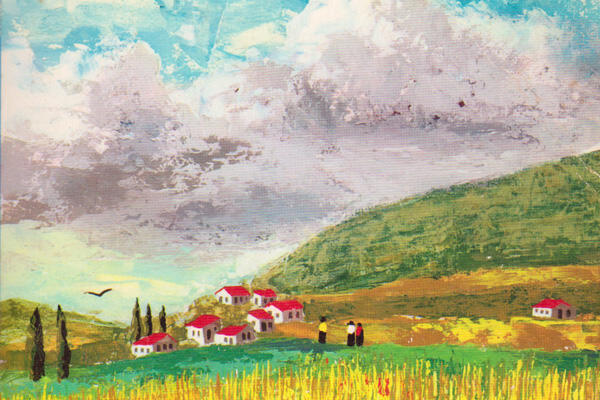
The Sun Also Rises
Not much happens in The Sun Also Rises. It’s the 1920s. Four men and one woman visit Spain to see the bulls, and then they go home again. During their stay in Spain, it becomes apparent that all four men love the woman, but she falls in love with a guy who loves bulls. One particularly brutish man insists on stalking the woman, punches a few people in the face, and then leaves. All four men are usually drunk, especially at lunchtime, and in the end we realise that relationships never last, even if you live in Paris. Jake, the narrator, is the most passive and observant of the characters. Jake’s relationship with Lady Brett (not Monsieur Brett, as I assumed up until the description of her “hull of a racing yacht” curves) is undefined. Their love for one another, however, is concrete and at the forefront of conversation. It is the only feeling in the book that comes across as remotely genuine. As he was born in the USA, Hemingway’s accounts of Paris and Madrid are composed from an outsider’s point of view. He is not bashful about it – most scenes in the novel are set in cafés or at tourist events such as the fiesta. His characters are all expatriates, and he simultaneously pokes fun at their superficial lifestyle and showcases its brittle charms. Hemingway’s descriptions of some of the activities make you feel like you are actually there. When Jake swam in the sea at San Sebastian I could feel the cold water on my shoulders, and then the hot boards of the raft on the backs of my legs. I liked the simple descriptions of mundane actions. The dining descriptions are beautifully presented to the reader: hot vegetable soup, fried trout, a stew, a bowl of wild strawberries, then smoking and reading in bed to keep warm. There is no hint of burning your tongue on the soup or your duvet stinking of tobacco. Hemingway’s ability to ignore the uncomfortable banalities of day-to-day life while still giving creating empathetic characters through believable dialogue is inspiring. He finds the perfect balance between romance and reality. Hemingway manages to slot inspirational and memorable comments on life into the dialogue without them standing out in the sea of drunken chatter. I learned that you’ve got to work for what you want, and that everyone feels worse about life at nighttime than during the day. It is an easy and enjoyable read that makes you forget you’re reading a novel with such hefty literary cred.
-
Culture

Astro Children
Astro Children are a Dunedin shoeglaze/spacepop band comprised of childhood friends Millie Lovelock and Isaac Hickey. Recently they have been enjoying huge local success, with latest single “Jamie Knows” topping Radio One’s song chart for seven weeks running. Critic caught up with the duo recently to discuss which corner of the universe they’re off to next. How long have you two known each other? Isaac: Our parents are friends, so we’ve known each other since we were seven years old. How do you share songwriting responsibilities? Millie: The songwriting feels pretty equally shared. Isaac is the only person I can “jam” with – because I have known him for so long, we sort of feed off each other when we are writing songs. Do you draw influence from other rock duos? Isaac: We’re both lifelong White Stripes fans, and I like the minimalist sound that lots of two-piece bands have. Millie: I feel like the restrictions we have as a two-piece are really helpful creatively. The White Stripes were there a lot to start with because we didn’t know how to play without bass, but now I am more comfortable with the size and sound of my band. Did you adopt the retrofuturistic space-themed aesthetic first and then try to tailor your music to it, or did your music inform it? Isaac: I think they both kinda developed together. When Millie started using lots of pedals with her guitar was when I think we started to sound “spacey,” but we were called Astro Children long before that. You just shot a music video for your song “The One We Start With.” How was that? Isaac: Really fun! We got chased around and jumped on by a bunch of children, plus we had a food fight and rolled down a hill. Basically we behaved like children for a day, it was super fun. We haven’t had a chance to watch it yet, I think they’re still adding the finishing touches to it. How much of your material has been professionally recorded? Millie: If that means in a studio with lots of flash gear, then none. Studios don’t really seem like our thing. Isaac: We have an EP called “Lick My Spaceship” that was recorded at The Attic last year by Lee Nicholson, and also our single called “Jamie Knows”. We’re planning on recording a full-length album up there really soon. Do you have plans to release your music physically? Isaac: The first EP was released on CD, I think we’ll do the same for the second one. Do you plan to approach the likes of NZ On Air in hope of sourcing recording or music video funding? Isaac: We’ve thought about approaching NZ On Air. The ways they give funding are a bit too closed off to bands who have lots of potential but aren’t particularly well known. But I suppose we might as well try. Your recent single “Jamie Knows” showcases a more polished, melodic version of Astro Children. Is this a direction you hope to pursue? Millie: That is actually quite an old song that we re-recorded. More melodic is something I would like to pursue, but “polished” isn’t something I am too into. We’re a band that is best rough. Where do you feel you fit in Dunedin’s current musical landscape? Millie: I think we fit into the “we played way too many gigs last year” category. We like playing live a lot, and we both have trouble saying no. But I think we’ve settled into the scene quite comfortably. When’s your next gig scheduled for? Isaac: We’re playing on Friday 26 April at The Crown with Toy Destruction and Not From Space. We’ll also do a screening of our music video when it’s finished. What are your hopes and plans for the future? Isaac: Hopefully we’ll have another EP or album done soon, and maybe have toured some more. In May we’re going to Auckland. Millie’s other band, Trick Mammoth, are playing up there so we thought I might as well come too so Astro Children can play. Millie: Playing with Japandroids would be really cool, if someone would like to put in a word for us! We’d love a couple of nice reviews, maybe a record deal...
-
Culture
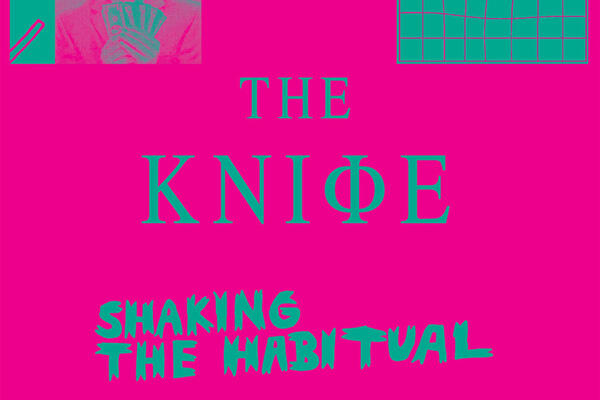
The Knife - Shaking The Habitual
For the uninitiated, The Knife are a Swedish electronic duo consisting of Karin “Fever Ray” Andersson and her younger brother Olof. The siblings splice together an eclectic array of genres including synthpop, industrial, world music, and ambient to create a technicolour sound that defies mimicry or categorisation. At 96 minutes in length, new album Shaking The Habitual sees The Knife at their most self-indulgent, but also their most creative and evocative. As far as deviation from their previous work goes, Shaking The Habitual is a more fractured and experimental affair. Though melodically captivating, this album has very little in the way of serviceable pop, often too menacingly executed or lyrically haunting to be easily digested. Those looking for another synthpop anthem à la Heartbeats will instead find caustic, skeletal blasts of psych-industrial and several ominous ambient soundscapes, one of which (“Old Dreams Waiting To Be Realised”) reaches almost 20 minutes in length. Vocally, Karin is as enticing and outlandish as ever. The obvious comparison to her naked voice is fellow Scandinavian Björk, though Karin is often extensively processed and pitch-bent down to a low, androgynous croon. This fluidity of gender in her voice is perfect for the album’s progressive lyrical themes, which subvert preconceptions of gender, sexuality, and race. What awed me most about this album was its dichotomous instrumentation, which blurs the primitive (bongos, flutes, zither) and the futuristic (synthesizer, programmed beats, distorted bass) to stunning, seamless effect. The exotic and often indeterminable sounds of which it is comprised make Shaking The Habitual more comparable to the likes of industrial innovators Einstürzende Neubaten and Coil than The Knife’s previous contemporaries, indie temptresses Lykke Li and Austra. But however esoteric and abstract Shaking The Habitual sounds on paper, in practice it awakens something very primal within your gut. This is not music to contemplatively stroke your beard to, but to physically submit to and convulse along with. Those seeking an exemplary sample of this album should look no further than the Amazonian rain dance “A Tooth For An Eye”, the industrial assault of “Full Of Fire”, or the Kashmiri crunch of “Wrap Your Arms Around Me.” Elemental, immense, and cerebrally satisfying, Shaking The Habitual is quite possibly the finest album The Knife have ever produced.Rating: 4.5/5
-
Culture
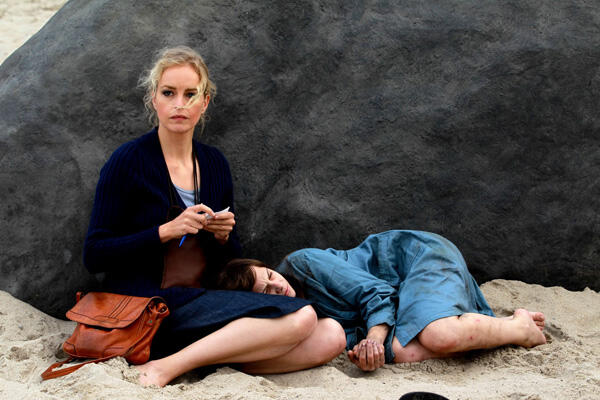
Barbara
Pre-film trailers are typically selected to appeal to the same audience as the film itself. When I arrived at the cinema to see Barbara, knowing nothing about it, the first trailer I was shown was about an old person being chosen to cook for the President of France. The trailer was very long, and gave no indication of any sort of plot. The second trailer was about old people singing. Good God, what the fuck had I gotten myself into? Fortunately, Rialto had simply assumed that those who watch glum German films about the Cold War would also enjoy mawkish pensioner films about the nearly dead. A little insulting, but there you go. The title character of Barbara is East German, and boy is she grumpy about it. A physician, Barbara is transferred to the wops from Charité hospital in East Berlin as punishment for submitting an official request to leave East Germany. (We don’t like that you don’t like your life, so we’re going to make your life worse – impeccable Soviet logic right there.) From there, the film is a sort of bucolic version of The Lives of Others. Decent people are turned into distrusting arseholes by the community’s oppressive, sleazy paranoia. Her boss might be spying on her, but she’s not sure; maybe he actually likes her, in which case her ice queen routine is a bit unfair. Barbara is quite a slow film – there are extended periods in which little happens, and for all the spying and grim commie craziness there isn’t a great amount of dramatic tension. Nonetheless, the film presents an interesting rural side to the Soviet machine – a bit like one of those Midsomer Murders episodes where all the old people in the village have secrets, except with more communists. A solid but unspectacular movie. Rating: 3.5/5
-
Culture

The Croods 3D
I’m at least 15 years older than this movie’s target audience. That’s fine though, because as innumerable sanctimonious reviewers love to point out, a good kids’ film should also appeal to adults. Maybe it’s because kids are stupid, so their opinions don’t really signify much. Maybe it’s because a good story and well-rounded characters are universally desirable traits. Either way, it’s a nicely self-serving principle and I’m more than happy to adopt it. The Croods tells the story of the eponymous family of Neanderthal cavemen who live trembling under a rock. Father Grug (Nicolas Cage) likes to scare his kids with tales of the world’s dangers (the tales invariably ending with “... and then they died!”), but daughter Eep (Emma Stone) yearns for excitement and adventure. When a ridiculous, 2012-esque apocalypse looms (Pangaea apparently broke up in the space of about a week), the family must follow Guy (Ryan Reynolds), a resourceful Homo sapiens sapiens, towards a safe new home. That’s about it, really. Raymond Chandler this is not, and whimsical slapstick replaces plot for most of the film’s 99 minutes. Most scenes involve the family running away from either volcanic explosions, lethal animals, or a combination thereof – but in true kids’ flick style, it’s not entirely clear what can actually harm the characters given that they are routinely crushed by boulders and survive falls from great heights. Reynolds is much less irritating in animated form, in which I don’t have to look at him “act.” Of course, I can’t see Emma Stone either, but then again her voice is half the fun. The real star, however, is the animation. Shockingly, the 3D actually enhances the experience rather than making my brain hurt, and The Croods features a fantastical, psychedelic environment that’s part Avatar and part Alice in Wonderland (the 1951 acid version, not the 2010 Tim Burton monstrosity). I wanted to see more of the flying tortoises, but sadly it wasn’t to be. 3/5
-
Culture

Performance
Like Lex’s pseudo-political banter or a Unicol girl’s acquisition of the fresher five, it’s a certainty that Oscar winners will undo much of their good work with subsequent awful films. While Performance (released elsewhere as A Late Quartet) never reaches the murky depths of a Halle Berry/Catwoman scenario, it is nonetheless a muddled, uninspiring, and ultimately dull effort from an exceedingly talented cast, including Christopher Walken, Philip Seymour Hoffman, and Catherine Keener. The film opens with Walken, cellist and leader of a two decade-old string quartet group, telling his three colleagues and friends (including Keener and Hoffman as a husband-and-wife duo) that his early onset Parkinson’s may signal the inevitable disbanding of the group. This acts as a catalyst for simmering tensions, romance, and competitiveness to resurface between the four, with dramatic yet sadly predictable results. The dynamics of the group are interesting enough, as are the impassioned speeches about the relevance of classicism, but they are drowned out by the tepid love affairs and multiple storylines. Not enough time is given to the separate plot strands, which become so disparate that the film resembles Crash more than an analysis of the lives of four friends. Walken, despite putting in his finest performance in some time, is especially wasted in the potentially rich role of a man whose lifestyle and livelihood are threatened by illness. The film struggles to juggle its weighty themes of mortality, infidelity, and fame, and feels like a bad cliché of an indie film. It ends up with more melodrama than an average Days of Our Lives episode, each plot contrivance signposted miles in advance and noticeable to anyone who’s seen a film before. For a film that has so much to say (i.e. so many metaphors to ram home) about the passion and romance of the quartet’s music and muses, it fails to inspire either, and even the sporadic use of the Beethoven soundtrack fails to inject much life into the proceedings. This is the sort of film festival-goers like to fawn over without any specific reason other than “awards-worthy” material and a handful of Oscar winners. Rating: 2/5
-
Culture

The Big Lebowski
The Coen Brothers (Joel and Ethan) wrote, directed and produced this cult comedy classic 15 years ago. Jeffrey “The Dude” Lebowski (Jeff Bridges) is a lazy, unemployed stoner living in LA, who hangs with his bowling buddies, drinks White Russians, and enjoys long hot baths while listening to tapes of whale sounds. Life takes an abrupt turn, however, when The Dude is mistaken for Jeffrey “The Big” Lebowski (David Huddleston), a millionaire from LA whose wife who owes some bad people some big money. Two confused thugs flush the Dude’s head and urinate on his rug to coerce him into paying a debt he knows nothing about. The Dude pays The Big Lebowski a visit hoping he will replace the rug, but ends up accepting a one-off, high paying job to play delivery-boy for the money owed. The Dude gets caught up in the schemes of Lebowski’s daughter, erotic artist Maude (Julianne Moore), encounters cops and bad guys, and drifts through an extravagant bowling fantasy entitled “Gutterballs.” Throughout these trials and tribulations, The Dude still keeps his cool, even if his bowling buddy, Walter (John Goodman) – a gun-toting Jewish-convert with anger issues – is not quite so good at staying calm. The film’s cult following has spawned a Lebowski Challenge drinking game, worldwide Lebowskifests, and Indudependence Day and The Day of The Dude (officially on 6 March, the movie’s release date in 1998), which both involve achieving nothing for the day. Some guy known as “The Dudely Llama” has also set up Dudeism – The Church of the Latter-Day Dude, the slowest-growing religion in the world. Dudeism is a priest-ordained religion which teaches that preaching or yelling out your religion at others is “implicitly undude.” You can be ordained as a Dudeist Priest online – currently there are over 160,000. The movie also has a great soundtrack which includes Bob Dylan, Elvis Costello, Creedence Clearwater Revival, Sons of the Pioneers, and Nina Simone. So go and watch it, enjoy a White Russian, then check out The Dudespaper online – a lifestyle magazine for the deeply casual and the official newsletter of Dudeism. It has some great reads, particularly the origins of the F-word, and the art of Dudeitation (meditation of the Dudes). Or if you don’t feel like reading anymore, then go Dudeitate, man.
-
Culture

Oblivion
Oblivion tells the story of the last man and woman on Earth, who are both attractive and like each other (that’s a stroke of luck, huh?). After aliens blow up the moon, our planet is ravaged by natural disasters, and war ensues between humanity and our galactic enemies. Although we won the war (yay!) our planet was wrecked by nuclear weapons (lame!), leaving Jack (Tom Cruise) and Victoria (Andrea Riseborough) to do a bit of cleaning up before they can join the rest of humanity on Titan, one of Saturn’s moons. With only two weeks to go before they leave Earth forever, it is only fitting that all the secrets of the universe are exposed to them. And gosh darn are these big secrets! Not often in our day and age do I literally have no idea what is going to happen in a film. It was refreshing to be constantly shocked, though I wasn’t overly surprised to see Morgan Freeman reprising his role as Wise Old Man Who Has All The Answers – he does seem to be the go-to-guy when a Hollywood film has to do a lot of explaining. Freeman aside, it was nice to see actors that aren’t usually in big budget blockbusters. I find Andrea Riseborough very interesting (and although her nude scene could not have been more gratuitous, she does have a nice bum), and it was great to see Kiwi Zoe Bell kicking some ass with the all-stars. As inoffensive as Tom Cruise was, unfortunately there are some really lame things that go with his territory, like extended vanity shots of him riding a motorbike to soulful soft rock, and “witty” one-liners. The film lost a chunk of realism every time Cruise quipped some cocky, indifferent bullshit instead of just being a normal person. But overall, this is really good, pure science fiction with amazing visuals, cool twists, and interesting themes that you could enjoy even if you’re not into aliens (i.e. if you don’t have a soul). Rating: 3.5/5
-
Culture

Michael Harrison - Invasion Biology
I always enjoy a visit to Michael Harrison shows. His symbolic imagery and soft watercolours are consistent, understated, intimate, and playful. Overall they're comfortable, yet it is this comfort that can very easily transform into boredom if care isn't taken. It is pleasing to see Harrison developing as an artist in this exhibition. As a whole, the series feels more elated than usual. Although the animal images are similar to past work in their reminiscence of Len Lye's camera-less photographs, Harrison’s human figures have started to go beyond the “innocent, tortured boy desiring difficult girl” routine John Hurrell criticises him for. They're less unsettling, more... intimate. The desirous boy, well, he seems to get the girl these days. One piece, entitled Taking That Final Step, features a young couple framed on either side by another girl and boy. They're all naked, of course. The central girl looks longingly down at the boy's crotch where her hands have disappeared, while the extra couple evokes Matisse's The Dance – their poses are fluid, and the palette isn't dissimilar. It's a moving and sensual piece. Kushana Bush's Omens series was exhibited alongside Harrison's Venus in the Tenth House series at Ivan Anthony Gallery in Auckland last year, and I can't help but feel that Kushana may have had some influence on Taking That Final Step, among other work from the series. The more full-on sexuality displayed by the central couple and the sense of community lent by the extra youths is very much Bush's raison d'être. Harrison's work seems more liberated, and certainly brighter, than it was in that show last year. The series’ main contrast with Bush’s work, aside from obvious stylistic differences, is its inherent heteronormativity. The title Invasion Biology, combined with his consistent animalist imagery, hints at the idea of acting on explicitly heterosexual animal instincts. Yet this is where meaning gets muddy and conclusions are questioned, for the same set of factors supply Harrison’s own critique. His tried-and-true symbols of cats and birds add an intriguing commentary on humanity, nature, and conquest – New Zealand has a rich array of native birdlife, while cats are introduced. Formation, with its burial crosses, picket fences, birds, and mountain in the background, could easily be referencing the Colonial influence, or the effect of invasion biology, on Maori. The Christian burial crosses, specifically, contrast with the spiritual status of the mountain. The soft palette and “otherness” could even invite more comparisons with Matisse’s approach to such subject matter. A strong point of Harrison's is his apparent simplicity and vagueness, leaving the viewer to do that staple of art viewing: make their own minds up. Overall, the images aren't too far from Harrison's usual serialisation – but they go somewhere interesting.


