
-
Columns

Editorial | Issue 04
Themed issues are so 2012. But retro is making a comeback, so welcome to the Fashion Issue. Know what else is in right now? Gay marriage. Parliament just voted in favour of the bill at its second reading. Good for them. I would have voted in favour too. But I can’t help feeling somewhat underwhelmed by the whole thing. The phrase “civil union” will be replaced with “marriage” on some $26 certificates. It’s a nice gesture, but it’s not exactly revolutionary. Gay people are fantastic and as much as I love receiving hate mail, I’m not writing this editorial to provoke a response. The simple truth is that the bill will make little practical difference to people’s lives. Meanwhile, legislation that will actually do something is quietly snaking its way through Parliament while the public’s attention is focused on the sideshow that is the Marriage (Definition of Marriage) Amendment Bill. To name just three of the more substantial bills currently before our talented and tragically underpaid elected representatives: 1) Alcohol Reform Bill; 2) Consumer Law Reform Bill; 3) Psychoactive Substances Bill. Have you made a submission on any of these bills? Meanwhile, the Facebook frenzy on Wednesday night when the bill passed its second reading was more cringeworthy than a staged photo of a politician clearing rubble with a spade. Hashtags and self-congratulatory statuses everywhere. People were clambering over the top of each other to preach to the converted and show how much they cared about the #issues. “So this happened yesterday. #MarriageEquality #EqualRights #Discrimination #HomophobiaGottaGo.” Thus Tweeteth Muay-Thai-fighter-with-a-heart-of-gold Richie Hardcore, whose statuses alternate between updates on his punishing personal training regimen… Buenas días! Feeling really upbeat & #positive after this morning’s 10k #run. All the best #chemicals are already inside your brain, like #endorphins and #serotonin, you just need to know how to tap into them naturally to feel great! #PMALLDAY!
-
News

Fashion Angers The Patriarchy
Dunedin’s iD Fashion Week was launched last Monday evening at a boozy invite-only function in the bowels of the Otago Daily Times. While introducing Susie Staley, who is the iD Committee Chairperson, Paul Dwyer of the ODT had a dig at the event’s lack of a major sponsor, suggesting that “maybe it’s about time we got a man on the board to quicken things up.” At the conclusion of his ramble one attendant exclaimed, “what the fuck was that?” Critic also notes that this really was the only thing even remotely interesting about the opening (save for the international guest Stephen Jones turning up from London despite health issues), and is glad to pass on the now-controversial patriarchal torch to our cousin publication. Tuesday night saw the combined launch function of local labels Moodie Tuesday and UNDONE in a cave-like underground venue on Dowling Street, with the youngest group of attendees any iD event has ever seen. Beer from Green Man Brewery, however, is never a good idea and Critic’s classiest advise against its use. Wednesday night continued the alternative iD content, ushering in “Underwater Apocalypse Adventure Vacation” at None Gallery, featuring performance art, a sound and video installation, and fashion by Auckland label Nymphets described by one attendant as “crazy, raw and fucking awesome.” It was indeed outstanding; however, a Critic reporter tripped over the main plug, turning off the entire exhibition and becoming the latest victim of conceptual fashion. The Emerging Designers Awards held last Thursday night saw the victory of Rakel Blom from the design school at Otago Polytechnic, with a collection of what looked like woolen poodles. At the introduction to the event it was kindly pointed out to the audience that David Shearer and his cronies had appeared, if only to be reminded of their position as the Opposition. Regrettably, Critic obtained no photographic evidence of each individual’s demolition of a bottle of bubbly. Critic is pleased to inform readers, however, that we did in fact see a model smile for the first time in written history, and that the token runway trip-up occurred at the end of one designer’s series.
-
News
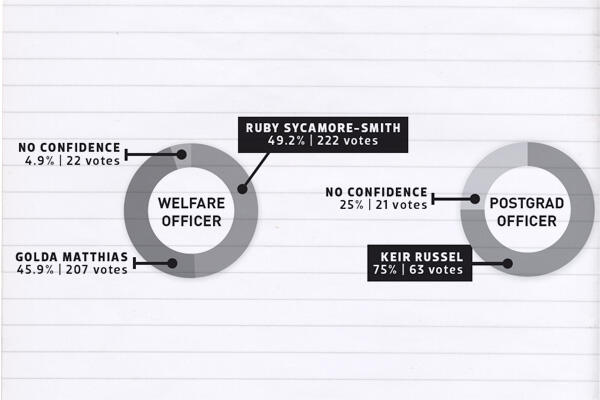
No confidence and "Glodia" defeated in OUSA by-elections
OUSA will get to indulge its by-election fetish one more time, after Ruby Sycamore-Smith emerged victorious in the Welfare Officer contest. Since Ruby has now resigned her current position as Campaigns Officer in order to take up the welfare position, there will be another by-election. Bliss. Ruby defeated Golda Matthias by a narrow margin of 222 to 207, with 22 no confidence votes. Meanwhile, Keir Russell won the Postgraduate Officer by-election with 63 votes. 21 picky postgrads voted no confidence. Ruby ran on a platform of improving student flats, while Golda ran on women’s issues and opposition to the liquor ban. Ruby was magnanimous after her win, telling Critic that the tight margin showed that she and Golda were “both capable candidates.” She hoped that Golda would consider sitting on the Welfare Committee, but somewhat undermined these sentiments by referring to her as “Glodia.” For her part, Golda was keeping positive. “I should have campaigned harder, but I spent my last ten bucks on booze instead of posters. No regrets.” Although she was “considering” running for Campaigns Officer, she said “I’m going to have to wait until more than 30 minutes have passed after losing this election before I make a decision like that.” In the meantime, she would be “getting drunk and watching Hedwig and the Angry Inch.” Keir was relieved to have beaten back the faceless menace of No Confidence, telling Critic, “I’ve got a lot of ideas I’m looking forward to working on.” Asked if there was anybody in the Executive he was particularly looking forward to working with, Keir went with the obvious choice. “I’m definitely looking forward to working with Fran,” he said. “He’s an interesting character and he’s got a lot of great ideas.” Cute. Nominations for the Campaigns Officer by-election open 9am Wednesday 20 March and close 4pm Thursday 21 March. Voting will run from 9am-4pm Thursday 28 March. Critic detects an undercurrent of pissed-offness in the brief windows OUSA has set, and intends to bring back the greatly-missed No Confidence sock puppet to torment candidates’ dreams and force yet another by-election.
-
News

No Jobs Bro
Students are struggling to find work, with recent statistics revealing that more students are looking for jobs and fewer gaining employment following the cut to the student allowance for post-graduate students. The number of students seeking part-time work during the summer period was up by 24% on the same period last year. Meanwhile, the number of students recently employed has dropped by 15%. While the employment market is tough, the figures have been exacerbated by the increased demand for part-time work among postgraduate students. The government’s cuts to postgraduate allowances came into effect on 1 January this year, and this has increased the need for extra income among those affected. Critic has received unconfirmed reports of unskilled postgraduate day-labourers swarming across the border to take undergrads’ jobs. OUSA President Francisco Hernandez agreed that the postgraduate allowance cuts had affected the employment rates. “Postgraduates are being forced to compete in an already overcrowded job market. This has adverse effects for undergraduates who have to now face competition from postgraduates who tend to have more experience and wider skill sets.” Hernandez also stated “we’re also facing tough times throughout New Zealand with a difficult economy and a tight job market.” However, he encouraged students not to be discouraged. “Keep applying. Look for volunteer jobs to boost your CV and pop into the Uni Careers office to make sure you have the best CV possible.” Hernandez believes that the government should be funding a similar amount across the board for student allowance and the living cost loans, as the loan only allocates $173 per week compared to the allowance of $204 for a postgraduate not living at home. Critic spoke to one undergraduate philosophy student who had also struggled to find work over the summer. “The summer before last I had a nice cushy job at a burrito and meta-ethics stall in the Meridian food court, but last summer I was replaced by some postgrad soy bean-eater because he had ‘more relevant experience.’ But people don’t need the really advanced theory with their burritos. Most can’t even understand this new guy when he speaks, he uses words like ‘sublation’ and ‘eudaimonia.’ It makes the customers uncomfortable. “We don’t need his type coming over and taking our jobs. He should just go back to the Gazebo lounge.”
-
News

Smoke banished from campus; fire to follow?
The demise of the durry on campus appears inevitable after the University Council affirmed that from 1 January 2014, the University will be completely smokefree. Previously smokers had been exiled from the shelter of building awnings when smoking within six metres of any building on the Dunedin campus was banned in 2010. One group who will be left smouldering by the policy change is the NORML club, organisers of the 4:20 protests. The smokefree policy may ultimately mean the club will have to set their sights on alternative premises, with the Union Lawn explicitly targeted by the Council. Critic spoke with a member of the NORML group and sometime attendee of the 4:20 protests who, when queried about the ban, surmised that the University are “gonna do what they’re gonna do.” He remarked that while he didn’t yet know what effect the smokefree policy would have on NORML, “if the group’s there, I will be there,” and he expected everyone else within the group would feel the same way. Critic sought to gauge the general sentiment to the policy change on campus. One very self-loathing smoker remarked that “personally I don’t think that people should smoke around people who don’t smoke.” However, the general view from non-smokers was that some form of segregation would result from the policy. One unsympathetic non-smoker suggested that “there should be like a little smokers’ pen. It would be like a cage, really small and with glass walls, and you’d see them all in there and you’d laugh at them. Right in the middle of uni.” University of Otago Vice-Chancellor Professor Harlene Hayne remarked that the University “will be publicising the new policy widely to staff, students and visitors to ensure it’s widely known and understood.” The implementation of the policy is not believed to be problematic, and the expectation is that everyone will comply. “Other tertiary institutions that have brought in smokefree campus policies have successfully used an educative approach to foster compliance and we will adopt the same stance.” Critic shares Prof Hayne’s optimism, and is sure that university staff and students, particularly those working at the top of Richardson or somewhere in the labyrinthine deathtrap known as Archway, would be extremely grateful to the University for forcing healthy options on them by making their lives as difficult as possible. Critic has also compiled a list for the University’s consideration, entitled “Health Nazi Policies for a Happier Campus.” Some of Critic’s suggestions include: - No carparks within one kilometre of campus. - Fat people must hula hoop for 30 seconds before they can buy a pie. - The Law Faculty is to introduce a no-alcohol policy.
-
News

New Alcohol Policy?
The fate of where and how licensed premises operate in Dunedin could lie in the wrinkled hands of bitter geriatrics due to current alcohol legislation allowing for local body policies to be influenced by communities. A draft local alcohol policy for the city is currently being worked on by Dunedin City Council staff and a period of public consultation is intended for September. Older residents may use their we-know-best-because-we’re-so-old attitude to influence when and where licensed premises can operate in the city, despite many having once stumbled down Castle Street with a big bot in hand and set fire to the odd couch themselves. The subject of their input ranges from the opening hours of premises and their locations to restricting late-night re-entry to bars. Critic predicts that if Nana has her say Monkey Bar will have a one-way policy and everyone will be ushered off to bed at 7.30pm, right in time for Coro. Critic spoke with DCC Liquor Licensing co-ordinator Kevin Mechen, who is currently working on the draft policy. Mechen remarked that while the Alcohol Law reform, by default, restricts closing times to 4am nationally, Dunedin was leaning towards a 3am closing time. When asked if student drinking culture might influence the older population’s submissions, Mechen replied that crime statistics seemed to be the most influential factor supporting a policy change. Mechen emphasised that the Council “want to do [the submission process] while students are here” and conveyed the message that “if students don’t speak up, they won’t be heard.” While students may be inclined to make one submission with multiple signatories, it appeared that individual submissions from people who “have taken more time and put more feeling” into their submission would carry more weight. While Critic imagines that the student population would be frothing if Joan Butcher were to make a submission, the likelihood of this carrying more weight than others has us in low spirits. After submissions are heard in September, a provisional policy will likely be put in place by the end of November. The policy will not be advertised prior to 18 December, and it will take effect from 17 January at the earliest. Changes to trading hours would not take effect until three months from that date.
-
News

University sticking it to the man
Copyright Licensing New Zealand (CLNZ) is taking all eight of New Zealand’s universities to the New Zealand Copyright Tribunal, after Universities New Zealand (UNZ) refused to increase the annual licensing fee that allows lecturers to copy course materials for students. The fee covers any use of copyrighted material that goes beyond that permitted by the Copyright Act 1997. The Act allows universities to copy up to three percent of any copyrighted work. Critic understands that the licensing agreement permits up to 10 percent or one chapter of a work to be copied, and also allows universities to charge for course packs. The current licensing fee is $20 per student per year, and has been in place since 2007. CLNZ wants to raise it to $26, with yearly adjustments for inflation. In a totes balanced article on Sunday 10 March, the Otago Daily Times quoted extensively from CLNZ chief executive Paula Browning. Ms Browning accused universities of taking advantage of the system, charging students up to $85 per course reader – as much as $680 a year – while passing on only a minimal amount to authors and publishers. Critic smiled beatifically at Ms Browning’s blatant grasp for students’ sympathies, and wondered whether universities would take the increased licensing fee out of their own bottom line or pass it on to students. A real puzzler, that one. An Otago lecturer with experience compiling course readers told Critic that “a lot of time, effort, and knowledge” goes into the process. She doubted that the University turns a profit from the readers: “I would never have thought of it as a profiteering thing. Our department certainly doesn’t profit from them.” Asked about the cost to students, Critic’s source said that compared to the price of textbooks, “a well-compiled course reader is extremely good value for money.” CLNZ claims it filed the case with the Tribunal after a year of fruitless negotiations, during which the universities refused to budge on the $20 figure. However, UNZ apparently denies that this was the case, claiming that CLNZ had filed the case without consultation. This juvenile little game of “he said, she said” left Critic feeling smugly superior, something we hadn’t felt since last year’s Student Press Awards. Critic contacted Student Services to get the lowdown on the pending tribunal case. However, student services palmed Critic off to some spin doctor in the University’s marketing and communications department. Stung slightly by this rejection, Critic chased down its new lead only to be directed, once again, to a higher-up, this time presumably some kind of spin neurosurgeon or spin hospital administrator. By this point Critic was wistfully reminiscing about childhood birthday games of Treasure Hunt, which, though demeaning, at least held the tantalising promise of chocolate. With a growing sense of pessimism, Critic contacted the spin neurosurgeon and was dealt a crushing blow, the one-line reply redirecting Critic to some hack spin chiropractor from Universities New Zealand. Critic quickly calculated the odds that the chiropractor would refer it to some weed-smoking Wellington spin homeopath, and gave up. Enjoy your expensive course readers I guess.
-
News

Belgian brings laptop to Union Hall
Over 1500 students turned up at a sold-out Union Hall on Thursday 14 March to witness Belgium’s top liquid funk, drum and bass, and dubstep musician Netsky. The evening started off with opening acts Fazerface and Southern Lights, before Netsky (rhymes with “get pie,” not with “let me”), named after a prolific computer virus, got the throbbing crowd entwined in his body squirming beats. Tickets to the event were included in the O-Week Superpass and limited to those who purchased them; however, tickets were being on-sold for up to $75, nearly half the cost of a Superpass. OUSA had initially planned to hold door sales if ticket holders hadn’t entered by 10.30pm but due to unusual promptness all ticketholders had arrived before the cut-off. While many freshers had been able to on-sell their tickets to older students, some turned up in long-sleeve tops or carrying a bag of chips to the front of the mosh pit, more or less outing themselves as dubstep virgins. Some revelers told Critic they were “frothing” even before Netsky had started performing, and were “fucking amped after seeing them at R&A.” Critic found that similar highs were not reached with a few paracetamol and Vitamin C. OUSA President Francisco Hernandez was happy with how the evening was going but noted that they had needed to send a few people home, which was “fairly routine.”
-
News

Critic runs fluff piece in order to show off pretty infographic
If Facebook likes were votes, the Greens would win the next election by a landslide. The Daily Blog published the results of a hypothetical social media election on Wednesday 13 March, putting the Greens as sole governing party with 63 seats. Ever the politics nerd, Critic re-crunched the numbers to take into account Parliament’s ridiculous threshold rules and emerged with an even more impressive figure of 66 seats. Labour would hold 23 seats, Mana 12 and National 10. The internet has also proved kind to ACT – despite registering 0.1% support on the latest Colmar Brunton poll, they would win five Facebook seats provided that John Banks retain his Epsom seat. No pressure, John. Critic attempted to contact Facebook Co-Prime Minister-elect Metiria Turei but received no reply. Critic speculates that Turei was busy with her new responsibilities, perhaps drafting tough new anti-troll legislation or confirming Gareth Hughes’s appointment as Minister of Lolcats.
-
News

DJ Fadez Away
The Dunedin music fraternity is shocked and saddened to hear of the retirement of popular local musician DJ Fadez, who on Wednesday announced via Facebook that he would be hanging up his mic for good. Fadez, a.k.a. Tim Patrick, made the decision after the hard drive containing his life’s work was stolen. Fortunately, nobody can steal the joy that songs like “Livin’ on the Edge” have brought to the inhabitants of Dunedin. Fadez started creating techno remixes in 1999, but his career truly took off after 2008, when he began to sing and rap over his beats. His first music video, for “Livin’ on the Edge,” was uploaded in October 2010 and quickly went viral. He followed this up with an appearance at Zinefest 2011, gaining a firm cult following within Dunedin’s music crowd. Fadez had a reputation as a savvy businessman as well as a talented artist. He founded a record company called Nu Age Entertainment, released a clothing range and an app, and maintained a steady Facebook presence. With Fadez’s retirement, Nu Age Entertainment is to close its doors. Fadez’s biggest success was also his greatest controversy. Accusations of plagiarism had dogged him since late January, when it emerged that other songs featured the same beat and hook to “Livin’ on the Edge,” with one uploaded to YouTube as early as December 2009. Fadez always denied any wrongdoing, claiming that he and associate Tim Adamack had developed the music and sold it to the other artists. However, Fadez later spoke to Critic, suggesting that his retirement would be temporary. While he confirmed that he would be on an indefinite “break,” he hinted at a return at some unspecified time. “DJ Fadez will return ‘cause so many people count on me to make great music,” he said. Dunedin waits, and hopes. Go to critic.co.nz/djfadez to watch DJ Fadez’s magnum opus, “Livin’ on the Edge.”
-
Columns

Proctology | Issue 04
Proctology kicks off this week with those perennial troublemakers, Campus Watch. After hearing on Police radio that the occupants of an abandoned vehicle were wanted, our Guardian Angels took it upon themselves to look around “just in case they could see them.” They decided to check around some bushes, and after hearing a noise that sent them deeper into the undergrowth, someone yelled, “come out or I’ll let the dog in!” This of course was directed at them, and nearly resulted in Campus Watch’s first mauling by a Police dog, not to mention yet another case of messy undies. As for students, a recent problem has arisen with second-years returning to “their” room at “their” College at 3am after having “seven jugs,” and are apparently “bewildered” at why they would possibly be told they’re “not wanted and not loved and to go away.” The Proctor has also been visiting student flats, with noise complaints registered everywhere from the central city to Maori Hill and up to Opoho. “We are spreading far and wide,” he says. He points out that although Red Cards may be fun, the organisers can be held responsible if people do dangerous, criminal or self-harming acts. “They’re made to do a bong, a keg stand and then some fandango in a kilt in front of Robbie Burns, which is okay, but there’s usually something between here and Robbie Burns they do which is stupid.” You have been warned. And finally, the Proctor recently learned that in America, one can smash bottles all over the street wherever one wants. He learned this from an American student who was doing the same deed here, but speculates, “I don’t think she was telling the truth.”
-
News

"Fins Up and Bums in the Air"
As far as extreme sports go, underwater hockey, also known as “Aqua Challenge,” will not be at the X Games anytime soon. Often ridiculed for being a hobby and not a sport, Aqua Challenge is frowned upon by most mainstream athletes. However, fourth-year student Louise Daley has managed to push past the sceptics and achieve victory for the New Zealand Under-19 Women’s Team in 2011 at the World Champs. She now hopes to continue her form with the New Zealand Women’s team this year. Tell us about how you got into underwater hockey. Was there a natural progression from underwater hockey’s half-brother field hockey? Well, no. I am really uncoordinated on land. I used to do swimming, but I wasn’t very competitive with it. Most people in New Zealand start playing at the beginning of high school, but I actually started quite late when my friend took me along in year 11 and I loved it. As a swimmer they just told me to swim in a straight line with a puck. For those oblivious to the game of underwater hockey game, how is a game played? We play with fins, snorkel, a mask and a glove. The stick looks like something you would beat someone with and you flick the puck along the bottom. A lot of people think it can be hit but it is too heavy. What position do you play? And what other positions are there? There are six people in a team. In New Zealand we usually play two forwards and a backline of three and goalie. In the back three is a centre and two wings. I play as a winger. Even the goalie scores quite a few goals and doesn’t strictly play like other goalies. How well does New Zealand perform on the international underwater hockey scene? For New Zealand Under-19 it is a lot like rugby and you are expected to win. If you don’t, then this is bad. This is usually because we start playing at high school and other countries don’t start until university. We have World Championships this year and we will be hoping for a win. Have you sustained any serious injuries playing underwater hockey? I broke my little finger before I was trialling for Under-19s and got selected wearing a hand cast. This was revolutionary for underwater hockey and I had to have my hand taped to my stick. Otherwise just a few black eyes. What do you hope to see in the future for underwater hockey? Do you think Olympic recognition could be achievable? I’d like to see a few more people give it a go because people seem to forget it still exists down here after high school. As far as the Olympics go there are a lot of loopholes you have to jump through first. Currently they are trying to get to the Commonwealth Games first and then move on from there. Is it possible for spectators to enjoy underwater hockey? At social club nights it’s mainly “fins up and bums in the air.” Sometimes at national tournaments we have cameras. At World Champs we have divers in the pool who stream it live on the Internet so my parents back home could watch. The majority of the time it’s a hard spectator sport. Most people just say, “what are they doing?”
-
News

Test Match Induces Persistent Vegetative State in Spectators
The first Test Match between New Zealand and England at the University Oval ended in a dour draw. Day one was rained out and while England’s batsmen made a valiant effort to set up a result by throwing their wickets away on day two, their sacrifices were to no avail. New Zealand fans could have been forgiven for feeling optimistic heading into day four with the match in a position where only New Zealand could win. Alas, the previous two days of New Zealand dominance had only conspired to set up the most dogged of England rear-guard actions. England are a team stacked with sensible, conservative batsmen who pride themselves on calmly repelling even the most vigorous bowling attack at their own languid pace. This was their time to shine. Alastair Cook is the stern librarian of international cricket. At any sign of unrest, stress or raised voices he simply purses his public school lips, takes a deep breath and sets about calmly taking control of the mayhem. Never hurried, always serene, on day four Cook and his right-handed facsimile Nick Compton painstakingly dragged England back to parity with an opening stand of 231, erasing most of the lead New Zealand had built in the previous two days. The pair ground the New Zealand bowlers into the dust and the crowd into a vegetative state with a look of bored disdain. Even Tommy Cooper’s incessant trumpeting took on the tone of a balloon deflating as the hours wore on. It quickly became clear that England’s first innings was an aberration. The pitch was dead flat. Geoffrey Boycott was heard to note in the commentary box that his “grandma could bat all week using a knife and fork on this pitch.” Four days was never going to be long enough to win this one. In New Zealand’s first innings, local lad Hamish Rutherford had blazed 171 on debut to put New Zealand in a commanding position with a lead of almost 300. From there it was the job of New Zealand’s seam bowlers to bowl out England in five sessions to force a win. Unfortunately, with no pressure to score quickly, Cook, Compton and co were able to set up camp in the middle and see off the remaining 170 overs. New Zealand’s most energetic bowler Neil Wagner tried to drag New Zealand to victory with pure determination. His shouting, stomping and snorting, though ultimately futile, were nonetheless a sight to behold. Match Drawn.
-
Features

Marriage 101
It may be 2013, but plenty of students are still getting engaged, married, and even divorced. Brittany Mann tracked down six married Otago students to ask them the why, when, and why? With my debut as a bridesmaid for a friend’s wedding looming menacingly on the horizon, I have found myself thinking about marriage a lot lately. In between trawling the internet like some cyber equivalent of Sig Hansen from Deadliest Catch for purple Jeffrey Campbell shoes (don’t ask) and fretting about how I am going to look in an unintentionally see-through dress that also exposes the top of my ass crack, I have begun to wonder if weddings really have much to do with marriage at all. It occurred to me that perhaps all this ridiculousness is nothing but a cunning ploy to divert attention from being young, a student, and living under the gauntlet of impending nuptials. Marriage in NZ: The Obligatory Statistics After all, it is general knowledge that in the Western world, marriage is in decline. New Zealanders are getting married at the lowest rate in over a decade. According to our national bastion of demographic intelligence, Statistics New Zealand, in 2006 the proportion of the over-15 population who were married dropped below 50 per cent for the first time. In 2011, New Zealand residents had 20,231 marriages, the lowest number since 2001. Furthermore, the median age of first-time marriage has risen from 23 years to 29 years for grooms and from 21 years to 27 years for brides since 1971. Throw in the oft-cited figure that one third of all marriages end in divorce, and it is clear that the institution of marriage has become rather unpopular. In light of these figures, I became curious about that clandestine subculture of “young marrieds” I felt sure must exist somewhere on campus, perhaps lurking furtively around the crèche or the theology department. I wanted to know why anyone would want to get married at all, let alone as a young student juggling drinking and study commitments, with a whole life stretching gloriously ahead in which to sow one’s wild oats with carefree, joyful abandon. The "Young and Married" Stereotype: Justified? Let’s face it, young marrieds today are perceived in a rather negative light. When Critic put out the call, bugle-like, for interviewees, I fully expected to endure excruciating sessions listening to boring, lust-crazed Christians, post-natally depressed almost-single mothers and, of course, those short-sighted folk who got hitched to become eligible for the student loan. You can only imagine my disappointment when the people I met turned out to be not only attractive, friendly and intelligent, but also (dare I say it?) such good chat that I now secretly want to befriend them all in real life. In saying this, it’s true that some young marrieds did say things that aligned with my preconceptions. For example, Imogen*, 21, got married in February and stated that her faith was a factor in her decision to get wed whilst still a student. “I guess we got to a place in our relationship where we wanted to take it to the next level. Yeah, I mean, it would have been another two years, which is admittedly kind of a long time to wait for sex and live together. And I feel like if you’ve decided … it’s almost just like a lot of temptation on yourself.” A person much wiser than me once said that the problem with stereotypes is not that they are untrue, it is that they are incomplete. Despite what you may be thinking, there were no dowdy hausfraus amongst the engaged or married girls I spoke to. Indeed, spotting one of them at uni the day after our interview, I pointed her out to my friend, who enthusiastically exclaimed, “God, she’s so hot I’d marry her as well!” The marrieds themselves are aware of the stereotypes. Imogen, for example, has had strangers in her lectures comment on her wedding ring. “People think you’re a little bit strange or something … I think that people assume that if you get married you want to settle down and have kids. I was little bit apprehensive when we were going to tell everyone that we were getting engaged, just because of the whole stereotypical ‘Christian’ thing.” Lucy*, 23, who has been married for 15 months, has had similar experiences. “There’s still that stigma of, oh you’re gonna get married, you’re gonna have kids and then you’re gonna be in this thing where he works and you’re at home … people think it’s kinda weird.” Despite professing no religious affiliation, Lucy – blonde, gorgeous and distinctly un-Burqa’d – has been asked, due to her youth and marital status, whether she was a Muslim. “I was like, do I look Muslim? And how does that even make any sense? I was sort of like, do you know anything about Islam?” But Why Get Married At All? I felt compelled to reassess my initial and, admittedly, rather hyperbolic scorn for the young married. But I was still interested as to why someone would prematurely ball-and-chain themselves when they could have all the convenience and none of the expense or fuss with a good old-fashioned de facto relationship. The Property (Relationships) Act 1976 effectively means that couples over the age of 18 who have been living together for three or more years have similar property rights as those who are legally married. So why fork out, at the bare minimum, the $170 for a marriage license? It would seem that the reasons for students wanting to get married are much the same as they’ve always been for anyone. Jeremy*, 21, and Beth*, 23, have been married for 16 months. For Jeremy, marriage “gives you an opportunity to officially affirm to each other and everyone else and everyone that matters to you that we feel like this, and we’re doing this with our lives.” Lucy is slightly more matter-of-fact about the subject. “We just did it as a nice way to cement our relationship … you can go and get married … I think it costs, like, $160 for the wedding certificate, so it’s pretty cheap.” All this is well and good, but it seemed to me that, apart from the Christians being keen to get sexy times underway ASAP, there was no real reason why those I interviewed couldn’t wait until after graduation to say their “I dos.” But maybe I was asking the wrong question. Mariah*, 18, and Justin*, 19, have been together for four years and got engaged in March last year. Mariah says that being a student “didn’t make a difference. We can be engaged and study at the same time, being engaged doesn’t mean you have to act any differently or do anything different to what we would usually be doing, except for the fact that we’re planning a wedding.” Jeremy and Beth felt similarly. “It seemed like the natural thing to do so in that way, it’s not a big deal,” Beth says. “It’s not this thing that I need to sit and plan out meticulously for two years and spend $50,000. We didn’t do it on the cheap, but it wasn’t expensive.” Jeremy and Beth were married in a hillside ceremony in which she wore an emerald-green dress and they recited vows written by a Tibetan monk. “It felt right,” Jeremy says. “I don’t know why you’d wait a few months. I think that’s just a societal thing, that you might be too young.” The Juggling Act However, it would appear that the “student factor” does present a unique set of challenges to young marrieds who are still studying. “We seem to be doing things at completely different times, most of the time,” says Jeremy. Beth agrees: “Being relaxed together is the biggest challenge.” Despite being new to marriage, Imogen is also finding this juggling act tough at times. “It’s tricky to find quality time. Also, because you want to devote time and invest in your marriage, I haven’t spent as much time doing student things.” For Lucy, whose husband works in the North Island, long-distance marriage actually helps her manage her work/life dynamic better. “It’s actually a really good incentive to study during the week because I’m like, I’m going to see him this weekend so I have to be free.” While marriage may affect study, contrary to what I had assumed it does not seem to necessarily affect the social lives of those involved. When I asked her, Lucy laughed. “We go out just as much as we used to, both by ourselves and together, and usually drunk-call each other, which is kinda funny.” Imogen doesn’t see marriage and maintaining a healthy social life as mutually exclusive either, saying “it’s great because you have someone to go home to when you’ve been out with your friends at night … also, it’s quite nice going out with him with his ring on, and it’s like ‘yeah, he’s taken’.” Traditional Gender Roles? Not Even. Not historically one to enjoy admitting I am wrong, no one is more despondent than me to concede that, as the interviews wore on, I began to wonder if marriage would really be all that bad. Certainly, my half-hearted, patriarchy-related criticisms of marriage have been dashed. Indeed, not only did Beth propose to Jeremy soon after she had moved to New Zealand to be with him, neither see their marriage as approximating those of their parents’ more traditionally gendered roles. “We’re a lot more equal than my parents were,” Jeremy says. “My parents were very traditional and my dad would go to work and come home and sit in the chair and my mum would look after us and cook food and do all of that, as well as going to work.” Beth agrees: “My mum was a housewife, which is the opposite of what I’m going to be, or am.” It seems that these days, practical concerns generally tend to win out over any old-fashioned notions of men as the primary breadwinner and women as the baby-maker/slave. Lucy, ever the pragmatist, says, “I fully intend to work, I don’t intend to stay at home and raise the children. He has a very flexible job so it would probably actually be him doing it more than anything.” Similarly, Imogen says that she and her husband “came to the conclusion that we’d try to do whatever worked for the relationship. If that meant that he stayed home and cooked because I was studying then that would be what we’d do.” However, historical habits can die hard. Despite her egalitarian ideals, Imogen adds that “dad works and mum works, too, but she still does the cooking and that kind of stuff. It’s really hard not to get into that because I find myself wanting to have the dinner on the table.” Selina*, 21, has been engaged for 8 months and is getting married at the end of November. Regardless of my very unprofessional disdain, she admitted that “I personally still kind of like the idea of having the male or the husband be … definitely not superior or anything, but taking a leadership role in the marriage. I want to, I guess, in a way, serve him … but then I don’t want to feel like that’s something I have to do; it’s more something I want to do. And I kind of hope, I guess, that he would want to do the same for me. Which he does.” The Missing 33% In 2004, Fox News announced that after 43 years together, the plastic dolls responsible for an entire generation’s low self-esteem had decided to “call it quits.” If Barbie and Ken, the most attractive couple in history, couldn’t make it last despite entirely lacking the powers of speech or movement, what hope do the rest of us have? I mean, where are all those tragic, divorced young souls who statistically must exist out there somewhere? Well, like houses in a Christchurch earthquake, the three divorced interviewees I had lined up all fell through. Given the levels of commitment they had hitherto exhibited, this probably should not have surprised me. A Final Word Writing this feature, my growing feeling has been one of deflated, grudging goodwill to all the participants who are, unexcitingly, normal, nice people. Like Kevin McLeod in the final moments of an episode of Grand Designs, I walked away from them having heard of their reasons and their trials, thinking they’ll probably be just fine and wishing them all the very best. But if it’s true that one third of marriages must end in divorce, two of the couples I interviewed are not going to make it. Don’t worry about that too much, though. Divorceme.co.nz makes it easy with a “DivorceMe Pack” that will set you back only $399.
-
Features

In The Company Of Style
With iD Fashion week recently catwalking by, Critic took the chance to get a further insight into the fashion world. Loulou Callister-Baker ventured out into the city to interview four Dunedin designers who are each at different stages of their careers, from studying at Otago Polytech’s Fashion and Design School to mingling with the world’s most successful designers. I had just washed up after enduring that messy business of evacuating the womb. While I waited around for my twin brother to join me I noticed I was lacking something everyone else had – clothes. Without understanding why, a deep embarrassment filled me. My kind of nude wasn’t “in.” It was only after a long wait that I was dressed – fashion was first imposed on me in the form of a pink outfit with a matching pink beanie. While my nondescript outfit would have only induced a sigh of disinterest by the likes of Anna Wintour, its meaning as a gender-defining, nudity-reducing accessory was significant. However, the simultaneous need to scream, consume and eventually shit quickly took over my post-birth pondering. Now, after 20 years, my post-birth clothing anxiety has led me on a quest to further my insight into the fashion world. The Student Ross Heath, the son of a past competitor for Miss New Zealand, started off studying physics. Soon he realised he didn’t want to do that. “I was reading a Vogue magazine and I realised, I love fashion! I don’t want to be pumping equations out for the rest of my life. I want to be doing something I love.” In pursuit of fulfilling that dream, Ross recently did a fashion diploma course in Christchurch but, due to the earthquakes, he made the move to Dunedin. Now Ross is in his first year at Otago Polytechnic’s Fashion and Design school. The Fashion School has a cluster of rooms with an array of creative facilities including laser cutters and a new, huge 3D printer that students can use to print off jewellery for their collections. In students’ second year, they get the opportunity to apply for exchange to Milan to study at one of the best fashion schools in the world. In their final year they must design an entire collection from material they have sourced and paid for themselves. It may be long hours, but as Ross tells me, “you’ve got to get it done.” The Beginners After graduating from Otago Polytechnic’s Fashion and Design school, Rachel Webb and Elise Barnes took a huge risk – they decided to form a fashion label. Two years later, UNDONE already has both a seasonal range and a high-end range of handworked, one-off pieces called BESPOKE. This year was their second time showing at the iD Fashion Show. How do you find material? Rachel: We just stalk the internet and email everybody then get samples sent to us. Once you find a good company you can usually stick with them for ages and they send you catalogues. Some high-end brands like Karen Walker have ranges of clothing made in China – what is your view on that? Rachel: If I’m buying clothes I like to buy something with a limited amount because I don’t like mass-produced stuff. So with our label we’re trying to keep it NZ-made with a boutique market. Karen Walker does have her high-end clothing which is still NZ-made but she also has her range which is made offshore, which is a lot more commercial. What is your attachment to Dunedin? Rachel: It’s cheap to live with no commuting. Dunedin’s really cool if you think about it. It’s got an underground culture that can only exist because of the people coming and going. Is the fashion world around you competitive? Elise: It’s funny how much help we’ve had from the fashion industry – a lot of well-known designers have been helping us out and I don’t think we could have done it without them. Charmaine Reveley always lets us use her buttonholer – I think she enjoys seeing us around and what we’re up to because it’s a reminder of where she started. Tanya Carlyson also has a bit to do with us. Have you been to New Zealand Fashion Week (NZFW)? Rachel: We went last year just to sell clothes. Elise: Eventually we’ll show there but we’re probably a few years away still. It’s quite an expensive experience and we probably don’t have big enough collections yet. For winter we have around seven main items we’ve produced and we wholesale, but other labels will have 20 items. Rachel: But that’s what Dunedin Fashion Week is really good for. It gives us huge exposure here. Do you have any celebrity endorsement plans for UNDONE? Elise: Rachel is obsessed with A$AP Rocky. He’s coming to NZ and Rachel wants to make him a one-off jacket. I read that your debut collection channelled androgyny, is that correct? Elise: Yeah – I guess the idea for UNDONE is that we’re completely different in absolutely everything that we do. I’m more of a romantic type in design and Rachel is a bit of a badass. Rachel: UNDONE is the idea of opposites being played off each other – like when a girlfriend borrows her boyfriend’s shirt or blazer. Do you think fashion is becoming more gender neutral? Would you want your brand to become that way? Rachel: Yes, fashion is going that way. It would be great for UNDONE. I follow the blogger Bryan Boy and he often wears women’s collections. I would be so honoured if he wore UNDONE! Is it possible for you to be attracted to someone hideously dressed? Elise: [Laughs] Maybe. If they had a really awesome personality. You can always mould a man. [More laughter] Don’t put that in there! Rachel: But fashion is really important. I’m attracted to the way someone portrays themselves through their clothing rather than the clothing itself as a material thing. There’s always a time and a place for fashion. Elise: Like today, we’re hideously dressed because we’re exhausted and we just run to our studio and hide then run home. Where are the rest of your cohort from fashion school now? Rachel: A few of the girls are working for companies over in Australia. One of our friends, Steph, has started a cool jewellery label called Creeps and Violets which we’re featuring with UNDONE on the catwalk at iD. Steph works for Company of Strangers and Underground Sundae doing some of their jewellery. Her jewellery has a cool vibe – we’re obsessed! Are any of your cohort working in cafés? Elise: I’m not sure! I just think it’s easier to do something like a label straight away. If you get too used to working at other places and earning money then starting up a label is almost a shock. We could have worked for someone else but the way we’re doing it – we’re still learning as we go. The Born Again After working for six years as a design assistant at NOM*d, Sara Aspinall (now Munro) created her own label called Company of Strangers. Company of Strangers has exhibited four or five times at iD (Sara can’t remember); however, Sara has been involved with iD since its second year. Can you explain the brands that make up Company of Strangers? The company started with bags and jewellery. Then, in its second season, I did a small range of clothing which is now our main line. We started up a second line called Strange Life because we felt there was a lack of high fashion brands that were price point orientated. There’s heaps of fast fashion like Glassons but there’s nothing made in New Zealand that’s under the price point of $300. It’s hard to keep things in New Zealand and keep the price point down. Why is it hard to keep the price point down? We pay people more than 20 cents an hour in New Zealand. Let’s say we make a dress. You have to pay your manufacturer between $50 and $80 per piece and then you’ve got to take into account your silk and imported fabric costs. By the time you’ve finished you might be paying $150 for pure costs without marking up the price. But you could get the same product made in China for $20 or $30. So have you made an ethical choice? I think so. I’m not saying that I’ll never make anything overseas because some countries make things better and our economy is causing factories to close. Also, we don’t have the skills anymore – nobody wants to be a machinist, although I’d rather be a machinist than a cleaner. There are some agents who are actually New Zealanders who own factories in China. So a designer can go there and see if all the working conditions are okay. But I’d rather keep manufacturing clothes in New Zealand because it creates an industry. I also like visiting our manufacturers if they have problems. Okay, so I’m wearing this grey t-shirt and it cost $100. What’s your argument for simple clothing being pricy? We do have t-shirts that cost $160 and if a customer doesn’t like it – don’t buy it. Someone could buy a really cheap t-shirt that’s made in China, but you know what? After three washes, that t-shirt is going to fall apart. It’ll get holes everywhere and it will twist and shrink. Your current A/W collection is inspired by Keith Haring’s paintings and murals. Is it possible to be a good artist but also be badly dressed? It is possible but it depends on what you class as “badly dressed.” There’s no right and wrong to what looks good. I see a lot of badly dressed people but they’re awesome! I’m really inspired by people on the street, particularly people who sleep rough. They have awesome coats and leather jackets. Sometimes I want to steal them. So you like homeless fashion? Yeah! They usually have some nice old tweeds and worn denim. I’ve heard about people buying big at a designer store, then not wearing any of the clothes and in the proceeding weeks giving all their purchases to a second hand clothing store. What is that about? Yeah, there are people like that. With fashion, especially designer clothing, there are some people who buy clothes to make a statement of status. There’s one person who is an out-of-town shopper who will buy every size 8 we have of a particular garment. Then she’ll go to every store in the country to get that size 8 piece so nobody else can get it. Sometimes she’ll buy out the size 10s as well so she has them all. Talking about fashion status – what is your most luxurious fashion moment? A stylist was shooting The Kills for NO magazine and she was using one of my first jewellery ranges. The Kills really liked the pieces and wanted to keep them and I was like “Give it to them! GIVE IT TO THEM!” That kept me going for two years. Actually, I’m still going off that. Also, when I was working for NOM*d we made these vintage bloomers shorts which were gifted to Madonna (my childhood idol, but she’s a bit naff now). I later saw a picture of Madonna wearing those shorts – I actually sewed those pants because they were samples and I kept thinking “THOSE ARE MY PANTS!” The funny thing was, she must have liked them so much that she had someone make other ones with the exact same cut in different colours. We were thinking, “we didn’t make those shorts in that colour!” And we realised, “OMG Madonna ripped us off! Aaaawesome.” Have you noticed much of an effect on the fashion industry due to bloggers? Definitely. At NZFW last year I was talking with my PR about guest lists and they were saying, “okay, well, we’ve got to have this many seats for the bloggers …” Even doing the model castings I was like, “who are all these people floating around in the background?” And it turns out that they were bloggers. There are just so many. Blogging is becoming the magazine industry but I still like buying magazines … there’s just so much content out there my head actually hurts. I wonder if it’s possible to do anything new anymore. The Victorious As a young girl in a family of four sisters, Margi Robertson developed a devout dislike for Butterick sewing patterns. This individualism paired with a creative eye developed into one of New Zealand’s top fashion labels, NOM*d (her sister Liz Findlay shared the same motivations which led to the creation of Zambesi). With a label that has retained its inspiring noir, punk aesthetic and a store that reverberates with the world’s best styles, Margi Robertson could be New Zealand’s own Vivienne Westwood. You have said that your store’s name “PLUME” comes from the term “nom de plume” – what does the idea of having a pseudonym mean in your business and personally? I like the idea that the brand is not directly associated with a person. Nom de plume is an alias, a touch of the unknown, no face as such. The collection is designed as a team effort with myself at the helm, so I feel good that the credit is not just for me! PLUME existed before NOM*d, the name was referencing plumage or adornment. With modern, instantaneous methods of communication, is it possible to create a defined movement in fashion? Instantaneous communication has changed the feeling of fashion entirely. Fast fashion stores are able to instantly pick up on new creativity; nobody seems to own an idea for more than a moment. It’s crazy! You have to create an identity for your brand and stay with that style, just developing it further each season but maintaining its integrity. What influence have bloggers had on fashion and NOM*d? Where do you think blogging will lead? Bloggers are just another opinion. These days it’s easier to be a blogger than a fashion journalist who has to spend time in education to reach the revered fashion publications. Bloggers are communicating via the cyber world, but there is nothing more satisfying than reading an article on good paper stock in a glossy magazine! What has been your most luxurious fashion moment? In the mid 90s when we went to the Martin Margiela showroom, Martin introduced himself to me. He was intrigued that we could sell his style of clothes in a city the size of Dunedin! The other thing was he never made himself public; the staff later told me it was really unusual for Martin to connect with his clients. He remained quite faceless for the whole time he was with the house – so it was quite special, really! Another crazy moment was in the late 90s. I walked by Anna Wintour at a show in Milan. She did a double take and inspected me seriously – I was wearing Margiela. What has been your weirdest Dunedin fashion moment? I can remember doing some after-hours work in the store, the lights were off and we could hear the comments of the window shoppers. Some people thought we were a second-hand clothing store and others talked about the “black” clothes. Many of the public have a weird conception of what we are about. But I kind of like that! When did you first actively hate a style? I’ve never hated a style. I’m careful not to criticise too early because I could end up loving something I didn’t initially understand. Marc Jacobs looks great wearing a skirt/kilt – when will men have skirts as a fashion staple? Men’s skirts have been around for ages. Jean Paul Gaultier, Comme des Garçons, etc have always had a presence of men in skirts. After all, Scotsmen in kilts date back to medieval times. It’s historical, really. There are men who are into it and those who are not. It’s a matter of choice. NOM*d often achieves a non-gendered look – What is your viewpoint on gender constructs in fashion? Gender constraints are created and exist in the mainstream. We like to think we are outside of that genre. NOM*d sits alongside Martin Margiela and Comme des Garçons at the Liberty of London – is that the ultimate form of success for you? It’s pretty amazing to have achieved that status! But remember NOM*d sits alongside those brands at PLUME as well. It’s great that you don’t have to be in London to have access to them. I’m currently in Paris buying Winter 13/14! It’s wonderful to have long-standing relationships with these brands.
-
Features

What/Wear/Why???
In honour of iD Fashion week, Critic hit the pavements in search of Dunedin’s answer to Alexa Chung. Instead, we found these guys. Honestly, I do not know why someone would want to wear something that makes them look puffier than they already are. But on cold days in Dunedin it seems like most of the student body turns into an army of walking black marshmallows. I understand why puffer jackets are great – it’s like wearing a hug. But they make you all look like daft fluffballs and unfortunately I must insist that goose down, like butt-plugs, is one of many things that should never leave the bedroom. Kids who come to class in fitness gear, like Sporty Spice here, are terrible people. Do they not realise the effect their garb has on the rest of us? I hate sitting beside people like this in class because either (1) they make me feel guilty that I, too, am not factoring exercise into my daily regime, or (2) they have come to class post-workout and smell like armpits. Please understand, people, that while you are living your healthy lifestyle being sporty and shit, the rest of us are battling just to get out of bed in the morning. Have a little consideration. Leggings are not pants. Nickelback is not a good band. Tourism is not a real degree. Otago University internet is not fast. Meals at Lonestar are not reasonably priced. Reading Fifty Shades of Grey “ironically” is not a thing. Chris Brown is not a changed man. Rihanna is not a smart woman. Leggings are not pants. I am a huge believer in earning one’s rips – they are a badge of honour for those people whose jeans are their number one sidekick in the quest for awesomeness. Like battle-wounds on a pirate, all rips should have a badass story about how they were earned. But the vibes I am getting from this chick are more Dora the Explorer than Captain Jack Sparrow. I can tell from her spotless sneakers and all round fresh-facedness alone that she probably listens to Owl City, and she most definitely did not earn that rip. This top is silly because it is only pretending to be sporty. It is not a real sport top, it’s just faking. The point of wearing tops like this is so that your comrades can recognise you in a crowd and high-five you. But this is a fake team! It is an emblem and a random number! There are no comrades! You are wearing a lie. Backpacks are having a bit of a moment right now. Students everywhere are ditching their vintage leather satchels and can now be seen strolling around campus with one of these puppies on their shoulders. Unfortunately this here backpack might just be too practical. It’s like she actually wants to be comfortable or something? It may as well have a chest strap to avoid stress to the lower back. This throwback to our primary school days should be enjoyed, but anything from Kathmandu or with Furbies hanging off it should probably be avoided. These two are vomit-inducingly cute. It’s like watching a ray of sunshine wearing a leather jacket walk down the street. They are yin and yang. They are a Venn diagram. One has a big head and little pants. One has big pants and a little head. They should never go to class – they should just walk around campus and make people smile. Apart, they are just two regular guys. Together they are a fucking concerto. Jeans are like potions – you have to put all the right ingredients in and not fuck anything up, or else it will blow up in your face. I like that these two have been experimenting, but they got a bit lost along the way and accidentally transfigured themselves into a less hood MC Hammer, and a nerdier Michael Jackson. I mean, the guy on the right basically has a box-gap, which would be great, if only he had the box to go along with it. Once I got over their adorableness, I realised what these two reminded me of: Destiny’s Child, when Tina Knowles was still making their clothes. These guys match so hard it makes my eyes water. I can’t tell if they planned this, or whether it was simply a nauseatingly cheesy coincidence. It doesn’t really matter – if you see two people and immediately imagine them holding hands and skipping through a meadow together, something is wrong. This is what One Direction would look like if they came from Invercargill. I can tell that these guys are freshers. I worked it out because their leavers’ hoodies say 2012, so I did some simple calculations and discovered that they must be freshers (you’re welcome). I don’t have a problem with hoodies. I only have a problem with these hoodies. Listen to me: high school is over and most of us don’t want to be reminded of the fact by all you walking bastions of year 13 optimism. The glory days are over, and people the-opposite-of-care about you. Take them off. It was only a matter of time before men discovered the greatness of short shorts. It must feel nice to finally have a little bit of breeze around your balls. Unfortunately these plain coloured shorts have become the uniform of those who want to look cool whilst shopping solely at Factorie. It’s time to branch out, boys. It doesn’t make sense that this guy’s sandals are thicker than his ankles. This girl is a walking Disneyland. She is the happiest place on Earth, on legs. Her face reminds me of some sort of sea mammal – potentially a manatee. Yes. Her spirit animal is definitely a manatee. Her spirit movie is Mamma Mia. I fucking love that this chick just does not give a shit. She has rolled out of bed, grabbed her 1B5 and walked to class. Where are her pens? Lol, who cares?! I had a flatmate who locked himself out of his room after a night on the piss and went to class the next day wearing a blanket, and wrote his notes on a meal planner. He should marry this girl and she should bear his carefree baby. It would play the tambourine in utero. I see people everywhere who are deliberately trying to appear like they do not give a shit (read: there are far too many hipsters trying to look homeless) and to these people I say, take note! This is a girl who is doing it right. Usually when I see girls wearing these pants, my first thought is that Jasmine from Aladdin has really let herself go. But I have been shown a whole new world; genie-chic is now a thing. I wholeheartedly agree with any marriage between elephants and clothing. I couldn’t agree with anything more wholeheartedly even if I tried. I’ve seen these flower thingies around quite a lot recently, and I quite like them. They make her look like a fairy princess who has gone punk, but whose mum still forces her wear the crown. I do have a slight worry though, in relation to bees. It must be really stressful walking around with God’s creatures trying to pollinate your head. Sometimes when I encounter flocks of fashion students on campus, I think I’ve stumbled across a funeral procession. What are you guys in mourning for? The return of the jelly sandal? You look like the super trendy spawn of Professor Snape, and no matter how much NOM*D you’re wearing, it’s kind of intimidating for the rest of us. This is why people cross the street when you’re walking towards them at night. Because they think you might be an axe murderer. This is the kind of girl who floats as she walks. She breezes through the crowds in the Link while the rest of us trundle along and try not to fall over our own two feet. She looks like she lives on a diet of dandelions and honeydew. Her hair is full of secrets. I’m so glad she is wearing these big heavy boots because I am almost certain that without them she would probably just drift away. Now, this is a guy who knows how to fix-up and look sharp. Just kidding, he looks like shit. Just kidding, he looks average. My gripe here is that it is so easy for guys to look good and still put the absolute minimum of effort in. But instead they walk around like this and try to mask the fact that they haven’t taken a shower in four days with an overload of Lynx. All the cool dudes around campus seem to be super sun-smart this year. Caps are fucking everywhere. Judging by his pallid skin-tone it looks like this guy has spent his whole summer slip-slop-slap-and-wrapping. Or maybe he just doesn’t get out much. Everyone seems to be wearing these pants, but I hate them because unless you are wearing very supportive underwear, everyone can see your junk wobbling around as you walk. It’s a good thing that this dude is sun-smart, because he doesn’t look very smart in many other ways. He probably wears these because he never learned how to tie his laces.
-
Columns

Love Is Blind | Issue 04
Critic’s infamous blind date column is back for another year of shutdowns, hilariously mismatched pairs, and the occasional hookup. Each week, we lure two singletons to a bar and ply them with alcohol and food (in that order), then wait for their reports to arrive in our inbox. If this sounds like you, email news@critic.co.nz or FB message us. This week, Angus Restaurant/Moon Bar played host to two lovebirds. GirlAfter making the poor boy wait two hours for the date I finally showed up, feeling flustered. Scanning the room for a table, there were no puppy-eyed boys to be seen, just some random kid taking photos with a bunch of foreigners by Moon Bar. The waitress told me she’d grab my date; I awkwardly rushed to the bathroom and glared at myself in the mirror, praying Ryan Gosling would appear alone at a table. Not quite. Dinner rolled smoothly, nothing bad nothing good. The meat was amazing, and a good drop of red managed to run down my throat. I seemed to impress him with my love for red wine, whisky and steak as he then bragged to me about his passion for wedding photography, the ultimate dream. My heart started to beat and Beyoncé ran through my head. If he likes then he better put a ring on it. Next came the most serious question of the entire date – pretty much the make or break point, and I’m not even kidding. A poster caught my eye, but no ordinary poster; it contained all the zodiac star signs. Now was my chance. I subtly said, “oh cute, star signs. Hey, this I’ll be funny, what are you?” There were only three that this mysterious man could be: Scorpio, Cancer or Pisces. This would reflect the rest of the night, and potentially, how far my legs would spread. “Uh, my birthday’s August the third.” Leo. Is this a fucking joke? The bottle of red didn’t last and it seemed like neither would anything else. He suggested Ratbags, and it seemed that it was only full of rats. After sneakily snap chatting my friend in the bathroom as I snuck away for a breather, she told me to “bitch out and leave.” So I texted my “girls” and promised him a dance in Monkey on Saturday … haha, yeah, we shall see what happens on Saturday, you little Leo. BoyTwas only four hours before the date when I found out my flatmate had put my name into the dark and desperate abyss that is the news@critic email address, and it had spat my name back out. After this news I thought why not, any port in a storm. A couple of hours before the date the flatties and I went down the road to Starters, and I decided fuck it, let’s do some shots. No good story starts with a salad. A few drinks down, and feeling rather tipsy, my flatmates dropped me off. The girl was a stunner, though at that stage I didn’t know if the alcohol was acting as real life Photoshop, or I was in luck. After average yarns, a nice bottle of red and a perfectly seasoned steak we headed off to Ratbags, where my flatmate had promised to give us a round of free drinks if I brought her in. As we sat at a table with a couple of my friends who maintained banter, my flatmate come-hither’d me to tell a story. Last year this date of mine was being fought over by two guys named Josh. After catching her having sex in the bathroom with one of the Joshes, my flatmate had to kick her out. Straight after this she went to the other Josh, who was waiting patiently outside the bathroom for seconds, and went home with him. I headed back to the table giving her the benefit of the doubt, sometimes people just have a bad day. Anyway, she was texting her “friend” to come along. He joined us and introduced himself as Josh (the sloppy seconds one). After a bit more banter it became obvious to me that my date was avoir la moule qui baille (French: to have a yawning mussel) for this guy. After a couple of drinks she decided to ditch; I wasn’t too fazed by this as she was like the first slice of bread in the bag – everyone touches it, but nobody really wants it. Many thanks to Critic, Cows and Alcohol.
-
Columns

For Fuck's Sake | Issue 04
The first few weeks in a new flat are the absolute best: there’s nothing like a month of endless pillow fort-making, Game of Thrones marathons and flat trips to the Satay Noodle House to give you that warm fuzzy feeling of general happiness and optimism (“Yeah! We are going to do the dishes after dinner! Cleaning rosters! Fuck yeah!”). But it’s about this time of year that many of you, with a sinking heart, will finally realise: your flatmates are all disgusting specimens of retarded fuckheadedness. I could write endless examples of flatmate shittiness: bad hygiene, absurdly loud and disturbing sexual dalliances, those annoying shits who never share their food. I had a flatmate who invented “Poo-Steaming,” which basically meant that he would take a massive dump right before any of us got in the shower, so we all had the pleasure of bathing in his poo-particles. But for once (just once), I think I will restrain my inner bitch, and tell all of you the inconvenient truth that everyone all must face: nobody is perfect. Amongst their blind frustration and possible flatmate-related homicidal tendencies, most people have very likely failed to acknowledge that they, too, are retarded fucks. Basically, what I am saying is – everyone probably hates you just as much as you hate them. The reason that I am telling you this, is that the absolute worst thing in this whole wide world is a hypocritical dick who always hits up their flatmates about the annoying shit they do, but is constantly doing annoying shit themselves. There’s no anger quite like the pure rage you feel when your flatmate sends you a passive-aggressive text about the dirty pot you left in the sink, when just that morning you scrubbed their skiddies off the toilet bowl and didn’t say a single thing. There’s no point in being pissed at your flatmates for the shit they do in the flat, because more than likely, the shit you are doing is even worse. When you pull that long, matted chunk of hair out of the clogged shower drainhole, it’s not just one person’s hair. It’s the whole flat’s hair. This is a very deep and well-thought-out metaphor. Fucking think about it. The only way you will get through this year without murdering each other in your sleep is if you begin to appreciate the fact that all of your flatties are putting up with you being the annoying, ignorant shit that you are. So please show some fucking courtesy and do the same for them.
-
Columns

Science, Bitches! | Issue 04
So, we’re a few weeks into the year now, and all of a sudden reality is knocking at the door. How about those assignments? Don’t tell me lies, I know you’ve left it to the last minute to prepare that presentation, and you’ve been up until 3am finishing that essay. So when the going gets tough, what better way to deal with those write ups in the early hours of the morning than to grab an energy drink? I don’t know about you, but I feel pretty ripped off when I pick up a can of Red Bull and don’t find myself with a sweet pair of wings. It’d be some pretty awesome science in a can if that were really the case. But seriously, are energy drinks actually giving you the boost they claim? Here’s the thing about energy drinks: they want you to buy them. They’ll do whatever they can to convince you that their drink is going to turn your laziness into productivity (I wish!). EXTRA this! A DOUBLE HIT of that! But what happens if we take a closer look at the “magic ingredients” they add? Let’s start with taurine – you’ll find this in Red Bull. Taurine is actually like an amino acid, but it’s used in bile, which helps digest fats in the intestine. This isn’t going to give you an energy boost for two reasons: 1) the amount in the drink is at far too low a level to do anything significant; and 2) your body is actually quite capable of making taurine itself. How about guarana – that ingredient you find in V? Guarana berries are full of sugar and caffeine, and have a history of being chewed to give energy. But this isn’t because there is some special compound in them – it’s because they’re full of caffeine and sugar. You can get the same hit from a coffee, with a truckload of sugar stirred through. The sugar and caffeine in energy drinks will definitely give you a boost, but there’s nothing else really going on here. There aren’t any magic ingredients that will give you an extra boost. You’re just as good getting an energy hit from a coffee – which is far more delicious anyway, so why are you wasting your time? Sorry guys, looks like that can of V isn’t your golden ticket to the land of productivity. It’s just a bunch of marketing that is trying to use science to make some sugar and caffeine in a can sound legit. This isn’t marketing, this is science, bitches. Science, bitches! is written by members of the Science Community of Otago (SciCo).
-
Columns

ODT Watch | Issue 04
Rest in peace, bitch. And now, the worst pun of the year to date: Perhaps aware that they'd taken things too far, the ODT published a montage of readers reacting to the pun: BNZ is smashing the glass ceiling, and the ODT's photographer got all the female staff to stand in a V formation to prove it. The patriarchy is more of a TSB Bank thing. Newsflash, ODT – it’s not a “loophole” just because your elderly, conservative readership thinks there should be a law against it. Likewise, the legislative ban on corporal punishment in schools is not an “unfortunate typo” as stated in Thursday’s news section.
-
Columns

Get Out Of The Ghetto | Issue 04
Come young fresher, I’ll let you in on a little secret. The best thing about living in Dunedin actually has nothing to do with Dunedin at all. The real treat lies a bit to the West and a touch to the North of our fine city: the magically hot-in-summer, ski-perfect-in-winter, Lord-of-the-Rings fantasy land of Central Otago. The majority of you will probably never live closer to this seasonal paradise than while you’re a Scarfie. So if you’re lucky enough to have your own car, or you have a kind amigo that does, there is no better place to escape to. Flee over the hills and far away, to the gorgeous climes of Alexandra, Wanaka and Queenstown. Getting out of the ghetto to Central need not be a repeat of that weird family camping holiday to Lake Hayes you had back in 2001. Going to Central Otago with friends is like spring break in Florida, even when it’s mid-winter. Wanaka and Queenstown are constantly abuzz, interchangeably with sunburnt European tourists (Dec-Mar) and seasoned ski bums who haven’t seen a summer since age 15 (May-Aug). The high sunshine hours and multitude of adventurous activities on offer mean people are generally ramped up on a super-fun cocktail of endorphins, adrenalin and Vitamin D, which makes for a great nightlife. The beauty of Central Otago lies not only in its bigger towns though. Stop to smell the roses en route, in rural gems such as Roxburgh (Jimmy’s Pies, real fruit icecream – need I say more?), Clyde (there’s a big dam) and St Bathans (lakes as blue as the unblemished Central Otago sky above). Take photos, wear sunscreen, forget about university for the weekend. Until the University of Otago listens to my advice and opens a Wanaka campus, the occasional excursion will have to do us for now. Enjoy. Get there: in a car – nothing like a road trip to Central. Do: appreciate the scenery and the sunshine. Don’t: only visit Queenstown. Eat: Fergburger, obviously.
-
Columns

Daily Grind | Issue 04
Doc has been a campus favourite for a few years now. He first popped onto the scene in 2011 in the garage space underneath Clubs and Socs, after increasing popularity he shifted up Albany next to Rob Roy Dairy, and recently he moved further down George St opposite Knox Church. Doc is known for both his coffee and his hipster chic décor, which in his new location is better than ever. Doc started out with Flight coffee beans (G’s fave), but has now made his own mark with the equally smooth “Doc’s Elixir.” A self-proclaimed coffee nerd, Doc is always down for banter about single-shot flat whites at the uni cafes and underground espresso beverages like the “Long Brown,” “Moccholo,” or “Cortado.” He has a good coffee card system and the option to pre-pay for a coffee concession card. He also offers barista courses. For a while in 2012 the coffee house had an extensive food cabinet. In his smaller George St location, he is back to serving great coffees with the option of a friand or biscotti on the side. G’s first experience with Doc was in 2011. G went in on a rainy day with low expectations. G and Doc soon had the banter flowing about how hard it can be to get a triple-shot these days, which landed G with a few extra stars punched in her coffee card and the best coffee of her life. To this day G is a big fan of Doc’s coffee, although if you are served by one of the other baristas your cup of joe can be a bit hit-or-miss. Doc is getting a name for himself with his “single origin cold brew” coffee, which is espresso filtered and served in glass bottles. M wanted to like it, but didn’t really take to it. M has had a shaky relationship with Doc, which climaxed one day when Doc made a FB status about putting Wu Tang Clan symbols on his cappuccinos all day. M rocked up proudly wearing his Moodie Tuesday tee that sported the Wu Tang Symbol. As he thrust out his chest at Doc and ordered his cappuccino with great valour, M received a lukewarm mocha with a dash of chocolate coughed on top. Doc’s hipster chic is concentrated well in his new location. He is a big-time coffee nerd that puts a lot of time and effort into his craft and for that, we thank him. Location: Across the road from Knox Church 4/5 Coffee Cups
-
Columns

Lez Feminables | Issue 04
I’ve had a couple of people this past week mention feminism and the International Women’s Day to me in angry tones. I couldn’t figure out exactly what was enraging them so – maybe a Jezebel.com moderator replied snarkily to one of their comments – but there’s something in the water, for sure. I’m repeating a few of the questions I’ve heard recently here, in the hope that people will be able to get a little more insight into the activist hot topic of the month. Do you like Women’s Appreciation Day, or do you see it as a further distinction of the sexes? International Women’s Day has a yearly theme: this year, it’s “A promise is a promise: time for action to end violence against women.” I like that. Ideally, we would live in a society that didn’t need annual reminders of how we should be working to lessen world suck, but the fact remains that for another few decades, at least, total equality and abhorrence of violence are not likely to be on the list of Earth’s greatest achievements. It’s better to bring gender issues to light, and take a day to appreciate what we’ve done so far, so that the future will be as bright as possible. That, and as far as I know it’s a trans-inclusive event, so shut up with your separation of the sexes. Gender is not sex. Why isn’t there an International Men’s Day? There is one! It’s 19 November. This year’s theme will be “Keeping men and boys safe,” and everyone should get behind it! I believe that the sexes are equal, but I’m not a feminist! What else can I call myself? Well, you are a feminist if you believe that, but the right to self-identification, yada yada. You could go with humanist, instead. It’s probably more important to behave in a way that promotes equality than wear labels about it, anyway! If a name tag really is important to you, and you’re scared of the f-word, go with humanist – it covers much of the same stuff, and is also a cool thing to be. Look, I don’t like that gender equality is at such a stage that those who strive for it require labeling. I hate that. I wish I didn’t feel the need to call myself a feminist because women’s rights weren’t an issue. Unfortunately, they are, and I’m struggling to inject levity into this subject! Colour me a humourless hag. Just … just keep being not-sexist, and I promise next week will be back to rainbows.
-
Columns

The More Things Change | Issue 04
This week, some extensive travel is involved, and we get a city out of it. 23 March, 1848: After an apparently uneventful three-month journey, the first Scottish settlers arrived in Port Chalmers and founded a city they called Dunedin. The name was derived from the fairly unpronounceable Scottish Gaelic name for Edinburgh, and the city was designed to reflect the characteristics of its namesake, which was a bold move given the challenging landscape. Nonetheless the city flourished, and has actually been home to many of New Zealand’s milestones: it had our first university, medical school, and daily newspaper (which still, allegedly, survives to this day). Dunedin was founded largely on the back of a gold rush, which is the reason for all the fancy-looking buildings like Knox Church and Quad, the latter of which is rumoured to have been nice once. In honour of the city’s foundation, Dunedin Anniversary Day is on 25 March this year, but isn’t important enough for a long weekend. 18 March, 1968: Russian cosmonaut Alexey Leonov performed the first spacewalk. A spacewalk is technically known as extra-vehicular activity, which is probably also something you can be charged with somewhere. The first one wasn’t free from issues: in the 12 minutes Leonov was outside the spacecraft, his spacesuit inflated so much that he couldn’t get back through the airlock. It took another ten minutes for him to release some of the pressure, risking decompression sickness, and after that the Soviets didn’t attempt another spacewalk for several years. They also hid these difficulties from the press, the reasons for which remain uncertain. But despite these problems Leonov became a national hero and has been on at least thirty different stamps, which might also be good for bragging rights. 21 March, 1999: In a truly historic moment for human aeronautics, Bertrand Piccard and Brian Jones completed the first non-stop circumnavigation of Earth in a hot air balloon. The balloon is the oldest flight technology that can successfully carry humans, so the 46,000-kilometre, 19-day journey was a great triumph, especially because a hot air balloon has no reliable steering mechanism. There are more challenges than trying to fly in any specific direction: the temperature in the cabin of a hot air balloon is roughly that of Dunedin 80% of the time, so Piccard and Jones’ drinking water froze and they had to chip ice away from the balloon’s circuitry. Piccard is known to talk about “those who believe in the power of dreams” and the great “exploration of life”, so maybe it was dreams that contributed to the success of the venture, but no one is sure.
-
Columns

Hi Dr. Nick | Issue 04
Hi everybody! In a recent poll of the two guys with me at lunch, less than 50% of them had had a recent STI check despite being sexually active outside of a long-term relationship. I know epidemiology isn’t my strong suit, but I’m fairly sure the results of this incredibly scientific study apply to most uni students. Now if you were absolutely rigorous about using condoms and knew every partner’s full sexual history then not testing might be ok. Let’s be honest though: this is Dunedin, home of Monkey Bar, so that’s not always the case. I could go on and on about wearing a condom anytime you even look at somebody else, but we’re all aware that there are times where that just doesn’t happen. Whether by choice or accident, drunken excitement or improper technique, sometimes you’re simply not protected and are therefore at risk of catching stuff. Now I know you’re not like that. You underwent a six-week training course on condom technique and always carry a bulletproof, refrigerated case loaded with condoms. You’re more prepared than an OCD boyscout so you’ll always be safe. Nevertheless I want to tell you a story. It’s one of those stories that happens “to a friend,” but bear with it anyway. See I have a “friend” who caught gonorrhoea last year after a night out. He’s a reasonably intelligent bloke (training to be a doctor in fact) so it’s not something my “friend” was expecting would ever happen to him. Mistakes do happen though and before you know it he was getting a shot of ceftriaxone to clear up his clap. I’m sure if my “friend” had an opportunity to write a column about STIs, the moral would be this: if you’re at all concerned (or have a new partner) then go get tested because, no matter what you think, nobody is immune to STIs. My “friend” didn’t have any symptoms (rashes, pain, pussy (that which pertains to pus) discharge etc), yet still was at just as much at risk of long term effects as somebody frothing away. Luckily he was smart enough to realise he dun goof’d and fronted up to pee in a cup and have a swab – no pain, no hassle, minimal awkwardness. End of the day: to look after yourself, you need to front up. Don’t feel you’re going to be judged or lectured because, again, it’s nothing special for the doctor: they’re probably more concerned about what cheeses are available in the tea room than what cheese is coming from inside you. If in doubt, just get checked out.
-
Columns

Kant Stop Husserling | Issue 04
Hegel was one of the most grandiose, self-important philosophers of all time. He believed that he had literally unlocked the secrets of the universe and devised a system for understanding history, politics, morality and human psychology. He inspired thinkers from Marx to Sartre and enraged others from Nietzsche to Russell. He would be spinning in his grave if he knew I was using his overblown theories to analyse football. But that’s what I’m doing, bitches. Football is a beautifully simple game. However, upon its basic template of three main rules – foul, offside, and handball – arises a myriad of different philosophies. The lumpen long-ball cavemen of Stoke, the crowd-pleasing teamwork of Swansea, the flash-bang artistry of Real Madrid – football is one of the few sports in which it’s legitimate, meaningful and accurate to speak of genuinely different approaches to the game. There doesn’t appear to be any “best” style – read Jonathan Wilson’s articles and you’ll start seeing football tactics and formations as an elaborate game of paper-scissors-rock. But is there ever a genuine “clash” of styles? Hegel thought that all reality could be understood by examining the clash between opposites (for instance, opposing views of politics or humanity). He believed that if you did so, you would come to realise that there are no such things as true opposites: each opposing idea is simply an incomplete understanding of some larger truth, a truth that would encompass both opposing ideas and resolve the tension between them. The notion that there is one ultimate, grand truth was of great comfort to numerous twentieth-century dictators. If there is one grand truth to football, it lies in the ability of teams to dictate games by creating and controlling space, an ability that largely transcends formations and mentalities. Hungary in the 1950s, Ajax in the 1970s, and Barcelona and Spain today all exemplify this approach despite widely different methods. Hungary would pummel opponents with pure skill; Ajax relied on tactical awareness and athleticism; and while Barcelona and Spain are both obsessed with retaining possession of the ball, Barcelona look to move the ball around as quickly as possible while Spain are methodical and conservative (and boring). What unites them is that on their day they are, or were, more or less impossible to beat. Barcelona in particular presents a dizzying whir of highly-skilled midgets, playing piggy-in-the-middle against their ruddy, clomping foes, and no sooner does a cursing Neanderthal lumber out of position than the Catalans scythe through the gap and score. Try to get the ball back and you’ll run around in circles for hours; succeed and you’ll be exhausted, isolated, and mobbed by scurrying five-foot ball thieves. Channelling Hegel, Barcelona are the image of football as totalitarianism.
-
Columns

The Leek | Issue 04
A visit to King’s High School to discover more about their new King’s Men’s Society class for developing better men has inspired OUSA to begin providing a program that focuses on developing better party girls. The class, dubbed “Tips for Tricks,” aims to prepare first-year girls for the next three to five years of questionable behavior, poor judgement calls and frequent inebriation. A spokesperson for OUSA informed Critic that, unlike a charm school, the desired outcome of this program is efficiency rather than good etiquette. “We want girls to come out of this with the skills required to party long and party hard, and to sustain that lifestyle for the rest of their time here in Dunedin.” The program runs two hours per week for seven weeks, with a practical application workshop in the eighth and final week. Below is a brief outline of the seven-week syllabus: Week 1 – Party Lingo: Girls will learn current party slang and speech mannerisms that will help them get by and be recognised as insiders, including up-to-date terms for a wide range of sex acts and recreational drugs. Week 2 – Improper Dress: Girls will be educated in how to show way too much skin, skank up their makeup and avoid accidentally wearing undies. Week 3 – Consumption: Girls will receive instruction on the correct methods of consuming food, alcohol and drugs while partying, including topics such as knowing your limit (and exceeding it), how to combine substances for the best buzz, and which foods won’t slow down intoxication or taste awful coming back up. Week 4 – Unconditional Hotness: Girls will learn how to still look sexy in awkward situations such as exiting or entering a vehicle, walking/tripping on stairs, vomiting in public, and waking up in a stranger’s bed. Week 5 – Bagging a Boy: Girls discover how to get free drinks through merciless teasing, flirt outrageously, copulate while wasted, and make a hasty exit the next morning. Week 6 – Club/Party Conduct: Girls will be taught social skills such as slutty dancing and queue cutting as well as how to “woooo!”, do a keg stand, keep their shoes on all night, and give fake compliments to other girls in the bathroom. Week 7 – When Things Go Wrong: Girls are prepared for the worst as they learn how to conceal embarrassing vomit, cope with unplanned pregnancy, pee outside on all types of terrain, and defend against being bottled. Spaces are limited, so sign up for this fulfilling course as soon as possible!
-
Columns

Love Online | Issue 04
Critic created a female internet dating profile expecting a low standard of suavity. But not even we could be prepared for the barrage of sheer ineptitude that followed, each new suitor representing a new nadir in the evolution of mankind. This column is a word-for-word transcript of an actual message received by Critic’s online dating profile. You can’t make this shit up. Lovebird 1 Hi J , maybe you are a bit different , and i think that is really so nice . You appear very honest and open too. And im too old for a relationship, damnit . But i can be really good company , as im sure you are too. I live in Balclutha and im just home from Dunedin now , i saw the movie "I will give it a year" and it didnt start until 820 , its does only take me 1 hour to drive home . I am divorced and have lived alone for more than 10 years , i like my independence , but i also love the company of bright , smart women. I would love to hear from you , but i understand if you would sooner wait for that special younger guy . I wish you success and happiness. cheers G Lovebird 2 what if arts and crafts meant making merkins together in front of the fire to use as props in some exotic 60s sexy role plays? and what if instead of masterchef we watched the live video playback of us as we get down and dirty, hot and heavy? or just fuck hard and dirty until you are quivering and spent and begging to given a rest
-
Culture
Lives We Leave Behind
Lives We Leave Behind, the newest release from Dunedin author Maxine Alterio, begins with a quote from Catherine Black, a nurse who served during World War I. “You could not go through the things we went through,” Black writes, “see the things we saw, and remain the same. You went into it young and light-hearted. You came out older than any span of years would make you.” The quote from Black hints at the trauma and upheaval Alterio plumbs in Lives We Leave Behind, her fictional exploration of the lives of New Zealand nurses in WWI. We’ve all heard about the loss of soldiers’ lives in the World Wars and the horrific injuries sustained by them, but it’s the nurses who had to care for those maimed and dying young men, day in and day out, often in Egyptian deserts or snowy French fields, all while being shelled and dealing with rampant dysentery outbreaks and the Spanish influenza. And yet, how often have we heard about these nurses and what they went through? Alterio goes a long way towards righting this historical imbalance. Mostly told through the eyes of Alterio’s two main characters, young nurses Meg and Addie, Lives We Leave Behind takes us on a kind of macabre wartime OE, whisking us from grey Wellington on to Egypt, France, and eventually London, England. But unlike the OE of today, Meg and Addie travel round the world on steamships, and most of their time is spent in hospital tents, being hit on by arsehole patients, belittled by their (male) superior officers, and trying desperately to save as many soldiers as they can. The world of the WWI hospital is vividly drawn; in fact, the book’s real strength (and Alterio’s most impressive achievement) is the novel’s historical detail. Three pages of bibliographic notes show the vast amount of research Alterio did, and it more than pays off. All these minutiae – the material the hospital tent floors are made of, the food the nurses ate, the precise descriptions of WWI-era surgical procedures, the contraception used – make the historical world of Lives feel real. But the novel wears all this research lightly, never swamping the main characters or slowing down the action. It feels strange, though, to be more interested in a novel’s historical setting and background than in its characters. Although Meg and Addie are sharply characterised, the plethora of supporting characters are often given little more than a name. Maybe this is understandable, given the novel’s wide canvas, but it’s hard to shed a tear over a supporting character’s death when you can’t remember if she’s the religious one or the one with the red hair. Meg’s romantic storyline was also somehow difficult to get invested in. This might have been because of the “interstitial monologues” – short, deftly-written segments each written in the voice of a different male character and placed between each chapter. Although I generally thought these monologues were brilliant, some of them were in the voice of Meg’s lover, which meant we learnt very early on that he was married, and troubled. This early disclosure might have marred any suspense apparent in Meg’s romance. It also didn’t help that the characterisation of vivacious Meg sometimes skates very close to caricature. But these are small blemishes on a novel that shows all too well the truth in Catherine Black’s quote. By the end of the novel, both Meg and Addie are changed women, reforged in the heat of war. In Lives We Leave Behind, Alterio makes that long-forgotten heat flicker against our own skin.
-
Culture

Sim City 5 (2013)
Last year publishing company Electronic Arts (EA) was named the “Worst Company in the World” by Consumer magazine. I am not a huge fan of EA, but I couldn’t help wondering how, in a collapsing global economy, with BP spilling oils into our seas, a video game publisher got voted the worst company? However, EA’s latest clusterfuck with the release of SimCity has finally pushed me over the edge, and now I finally understand how EA could indeed be considered the worst company in the world. You may have noticed that this review begins with two different scores, one that represents the worth of the game when it works and one for when it doesn’t. The score for when it works is for the publisher Maxis, famous for the SimCity and Sims titles; they have actually made a great game, which I will rave about soon. But first I must warn you about EA’s disastrous hand in this title. EA are a lightning rod for criticism, whether it’s for day-one DLC or the acquisition and destruction of talented developers. They are generally considered money-hungry bastards who will screw over gamers at the drop of a hat for dolla dolla billz. SimCity exemplifies this mentality. EA decided that SimCity should only be playable online through server-based gameplay, arguing that this would best support the multiplayer functions of which Maxis had been boasting. However, it became quickly apparent that its only true function was as a piracy deterrent. This was already enough to annoy gamers, but the killing blow came on launch day last week when hundreds of thousands of gamers tried to get online to play their brand-new game and the servers crashed. EA has since said they simply weren’t prepared for the influx of players and their systems couldn’t handle it. So the game is still almost unplayable due to the terrible technical support from EA. Though the situation is quickly improving, it is common not only to be unable to access the servers, but to be kicked randomly from the servers or, worst of all, to play for hours only to find later that the server has failed to save any of your progress. Despite the technical nightmare I was one of the lucky few that did manage to play the game – and despite the drama the game is awesome. For those not familiar with the SimCity series, you act as a mayor whose responsibility it is to plan and develop a plot of empty land into a city. This challenge will see you balancing residential, commercial and industrial zones as well as utilities and city specialisations. The city specialisations allow you to choose how your town rakes in the big bucks through avenues from gambling to drilling for oil. The game retains all of the things fans love about the games while also adding tons of new features to keep you interested. The multiplayer functions, which may well be the death of this game, are also some of the most interesting developments. Multiplayer allows players to develop cities with their friends in the same regions, so you can make neighboring cities with your friends and trade utilities, services and money with them. This game is currently unplayable, but it is worth playing! So give EA a couple of weeks to get their shit together and then grab a copy. When It Works: 8.5/10
-
Culture
Silver Linings Playbook
Silver Linings Playbook is a dark romantic comedy/drama that follows the blossoming relationship between two damaged individuals. Pat (Bradley Cooper) is a bipolar man recently released from a psychiatric hospital who bargains with his neighbour – the depressed and promiscuous widow Tiffany (Jennifer Lawrence) – that if he dances with her at a national competition, she will reunite him with his estranged wife. I was confused how a film that pitched itself as a “quirky rom-com” would deal with mental illness; I certainly can’t remember any schizophrenia in You’ve Got Mail. But it was tackled bravely and sensitively without losing much rom, or com. It was truthful – showing what people with mental illness really do, which is just getting on with it, as opposed to being goth girls who perform séances and self-harm or stalkers who know what you ate for breakfast six years ago. I’m quite wary of films whose leads are more attractive than anyone I’ve ever seen in my own life. But I am happy to inform that Cooper and Lawrence are the real deal, and their performances are stellar. It’s so exciting to watch actors ripping it up in a dialogue-driven film – after a year of such epics as Les Miserables, Django Unchained and Life of Pi, it was nice to see a feature relying on script for its punches. And boy, has J-Law got sass! In one scene she even out-sasses King Robert De Niro (Pat’s father), who we all know, has sass leaking out of his pores. Having said that, I believe that the competition for Best Actress at this year’s Oscars was not as stiff as usual, and although her performance was superb, I ponder whether J-Law would have been a winner if she was up against, say, last year’s nominees. But feel free to reject the opinion of a cynical film student (we’ve seen too many movies, nothing is real anymore) and make up your own mind. This is a smart film with a great cast and killer script that is definitely worth a watch! 4/5
-
Culture

The Master
I don’t know what possessed Joaquin Phoenix to take his weird break from acting/artistic endeavour but it’s great to have him back. His tortured performance as Freddie Quell, a sex-obsessed, alcoholic army vet returning to the real world in Paul Thomas Anderson’s The Master is the best of an extremely strong year for male performances. Phoenix has made his name playing characters laced with darkness, from Gladiator to Walk the Line (for which he should have won an Oscar). Once again, dare I say it, he should have beaten Daniel Day Lewis to the Best Actor gong. The movie has received some flak for attacking Scientology, and it certainly explores the effects a new religion can have on those who have lost their way. However, The Master is much more than that. It is an outstanding study of the human condition, and the first scenes are so expertly constructed that you immediately understand who Freddie Quell is. Anderson invites you on a journey with Freddie as we unravel the darkness of humanity in the most eccentric manner. Phillip Seymour Hoffman is outstanding as “master,” the leader of a new-age religion, and Amy Adams as his wife gives another one of her gold standard performances. I don’t know where Adams rose from a few years ago but I have yet to see her in a poor role. The three leads are supplemented by a talented supporting cast, who give the nuanced performances that Anderson’s script sets up for them. The movie is not for a casual night out, it can only be described as pure art. Nor is it something you would see with grandma, as Anderson is liberal with the use of nudity. There is no discernible plot but somehow it just doesn’t matter. Anderson has delivered again and if we allow ourselves to get caught up in the journey with that great cast we could all learn something about ourselves and about the power of personality. 4/5
-
Culture

Great Expectations
A classic romance has graced the big screen this autumn. I would take caution when watching this film – it is sobby and may cause severe sweet tooth, but you will become emotionally invested in the character Pip. Just a heads up boys, if you take your girlfriend to this she may expect more romantic gestures. The film follows a young working-class orphan by the name of Pip as he goes on a bizarre journey to become a gentleman and win the heart of Estella. Unfortunately, Estella confesses that she does not have a heart and that she will only hurt him. Though the film feels slow at the start, the character development and chemistry makes the somewhat dull pace acceptable. In particular, Helena Bonham Carter is in her element as the crazed and creepy Miss Havisham. Her costume and presence exude a corpse bride feel and turn everyone cold. Holliday Grainger’s performance as Estella is also excellent: the perfect embodiment of the cold wife, brought up in money and expecting it. Though she repeats that she is heartless, and though in all honestly Pip really should just drop it and find another girl, Pip’s sincerity makes you really want him to win her over. Overall, Great Expectations is a pretty film with some deep and beautiful moments – and, well, who doesn’t love watching Helena Bonham Carter play a loony? 3/5
-
Culture

Eraserhead
The Worst Film Ever Made I physically attacked my flatmate after he made me watch this film. Eraserhead is a cult film. But not cult in the good sense like Pulp Fiction or The Big Lebowski. Cult in the bad sense, like Destiny Church. As with Bishop Brian Tamaki, director David Lynch has managed to scam gullible people out of hard-earned money while making them believe they’ve had a profound, worthwhile experience. Lynch has a cult following of his own, but regardless of whether you love his other films, Eraserhead is pretentious, directionless and, most unforgivably, mind-numbingly boring. The film’s incessant use of white noise, hailed by fans as “suspenseful”, is in fact closer to White Torture. It’s a thing, look it up. Very little happens in the film’s 89 tortuous minutes. A guy with big hair walks through a dull, industrial area of town while white noise hisses non-stop. Is he going somewhere dangerous? Must be, there’s white noise. He arrives at his mother-in-law’s house and they have dinner without speaking. At least there’s white noise to break up the awkward silences. The rest of the film largely revolves around blood pouring out of various alien creatures while white noise plays merrily in the background. First a chicken, then a deformed plant-child hybrid, then the main character himself start gushing blood for no discernible reason. It probably represents something profound, like the essentially vulnerable nature of all living things. It can’t just be a series of low budget props being sliced open to a soundtrack less inspiring than that of a silent film. David Lynch wouldn’t do that to his fans. Films that rely on sudden shocks and loud noises to generate suspense, such as I Know What You Did Last Summer, are rightly derided as cheap and tacky. Eraserhead drills even deeper into the abyss of crude tack-oil by relying entirely upon an infinitely looped three-second soundbite to create “atmosphere.” There is no plot. There is no character development. At no stage did I care whether any of the entities in the film lived, died, or – as was almost invariably the case – spontaneously ruptured and became a lacklustre fountain of haemoglobin and pointlessness. I just wanted the white noise to stop. All the erasers in the world couldn’t purge my memories of sitting through this monstrosity. Learn from my mistakes. Don’t watch it.
-
Culture

How To Destroy Angels - Welcome Oblivion
For me, Trent Reznor’s music has never really surpassed guilty pleasure status. As much as I love and get a kick out of Nine Inch Nails classics like The Downward Spiral and The Fragile, the pubescent angst that permeates those records takes away from how thrilling they are musically; I always walk away feeling strangely disgusted with myself. The perfect example is the NIN song “Ruiner,” which simultaneously contains some of the most cringeworthy lyrics I’ve ever heard and one of my all-time favourite moments in music (0:48, wear headphones). Welcome oblivion, the debut record from Reznor’s latest project How To Destroy Angels, is as flawed and as cheesy as any album in Reznor’s discography. It also happens to be the most straight-up entertaining thing he’s ever done. How To Destroy Angels consists of Reznor, his wife Mariqueen Maandig, and Atticus Ross, with whom he collaborated on the acclaimed soundtracks to The Social Network and Girl With The Dragon Tattoo. Together they forge a glossy, often radio-friendly breed of post-industrial, overflowing with infectious trip-hop beats and tectonic bass tremors. If you’re curious as to what Welcome oblivion sounds like and are yet to discover this incredible thing called The Internet, just think of Nine Inch Nails, Mezzanine-era Massive Attack and SBTRKT having a really awesome baby. Unlike most Reznor-related albums, Welcome oblivion starts off experimental and grows gradually poppier instead of vice versa. The first few tracks, such as the spluttering “Keep It Together” and the nightmarish “And the Sky Began to Scream,” are the kind of moody soundscapes you might hear Reznor brewing to tense scenes of Lisbeth “Dragon Tattoo” Salander hacking a computer. Fifth track “Ice Age” features some perfectly lovely vocals from Maandig, but they are juxtaposed with madness-inducing banjo plucks that make the song more ominous than seductive. It isn’t until “Too Late, All Gone” pulses to life that Welcome oblivion suddenly gets really, really alarmingly poppy for a while. Reznor and Maandig’s vocals go from chewed-up and chilling to soaring and harmonised, culminating in epic choruses you’d sooner expect from Phil Collins or Shania Twain. But by the time this aural cheese pours from the speakers you should already be invested enough in the album to forgive it, maybe even enough to enjoy it a little. Heck, if it’s really your thing (or you’ve had a bit to drink) you may just find yourself screaming along with them, head tilted skywards, pretending the lyrics actually mean anything (sample: “THE MORE WE CHAAAANGE, EVERYTHING STAYS THE SAAAAAAAME!”). As you may be able to extrapolate, Welcome oblivion only really satisfies on a surface level. But as a relatively accessible specimen of a genre based entirely on sonics and textures, all it really needs to do is sound good. And it sounds, for the record, fucking gorgeous. Just listen to “The Wake-up,” “On The Wing,” or the orgasmic, dubstep-tinged title track to hear how succulent the beats and programming here are. Considering how sonically and rhythmically ravishing it is, Welcome oblivion’s somewhat unfocused nature and intermittent tastelessness feel like trivial qualms. It is shameful listening, no doubt, but Welcome oblivion exists alongside Oasis and Britney Spears in the uppermost echelons of guilty pleasure. Get your hands on some decent headgear or speakers, crank the bass, and blast this bad boy. 4/5
-
Culture

Frontier Ruckus - Eternity Dimming
Over this now-fading summer I’ve discovered and fallen for a few bands, but the one that caught my heartstrings and plucked them the strongest was alt-folk-Americana-country-something quartet Frontier Ruckus. After listening to their 2008 effort Orion Town Songbook on repeat for days and sinking into its haze of beauty, I discovered that Frontier Ruckus were imminently releasing a brand new album, Eternity of Dimming. Well, joy. My first experience of this album was the audiotree sessions version of “Dealerships,” a reasonable primer in both frontman Matthew Milia’s astounding lyrical craftsmanship and the band’s tight musical sensibilities. Despite this technical prowess, the song manages to maintain an incredible simplicity. Over the course of Eternity of Dimming, Milia regales the listener with blankets of oh-so-typically-American minutiae (strip-malls, parking lots, relentless highway lines, late-night diners), along with a veritable plethora of sentiment as he seeks to claim agency over the unwieldy domain of his native southern Michigan. The listener is alternately jolted from molten melancholia (such as that wrapped up in the aptly-named “Junk-Drawer Sorrow”), awed by tempo-confused eclectic pieces (“Surgery”), and charmed by lo-fi paeans that sound as though they’ve fallen straight out of a cellphone conversation onto cassette (closer “Funeral Family Flowers”). Throughout, the band bombards you with fuzzy synthesiser washes, plucky banjo lines, and those sweet, sweet organ melodies that one can’t help but fade into. I have many things I could further say about this album, but I’ll leave it at this: I cannot stress enough how strongly I recommend Eternity of Dimming as a solid, moving and enchanting aural experience. 4.5/5


