
-
Columns

Editorial | Issue 10
Ol’ Uncle John and his bestie Steven Joyce have been making some changes to the student loan and student allowance system. The stupidest change they’ve come up with is to limit the student allowance to four years of study. Sure, some students who are onto their fifth year are fucking around, failing papers, and unwilling to move on with their lives. But the majority are undertaking serious study: Getting double degrees, or undertaking post-graduate research. Why oh why, Uncle John, would you want to take money away from these students right when they are reaching the end of their studies? Why would you want to undercut their ability to become highly-skilled professionals? I don’t think you have thought through the consequences of your actions John. This is becoming the overwhelming theme for the second term of the Key government: Policy based on numbers on a page; decisions made on the savings possible without consideration of their real world impacts. They have made other changes too, designed to save a whopping $60 million per year for the government. This when they are already $1 billion further away from getting back into surplus than they thought they were. Tinkering around the edges of programs is not going to change the government’s financial position. Do not believe for a second that they are making these changes to balance the budget, or to save the student loan system. These changes are based on the ideology of the free market; on a flawed sense of morality that says “we got a free education, but you guys better pay for yours, because we don’t want higher taxes now that we’ve made our money.” It seems that students are under assault from all sides this week. The government has fast-tracked plans to change the drinking age. The most likely result is a split-age system, whereby 18-year-olds will be able to drink in a bar, but will not be able to purchase alcohol from an off-license. I don’t know how I feel about this. The consumption huge amounts of alcohol by young people is worrying: I regret how much I drank when I was 18, and I wish that it had been both harder to get and better supervised – which is a pretty good case for the split age. But at the same time, if you can vote, marry, have children, and go to war, what right does the government have to prevent you from having a drink at the time and place of your choosing? Regardless of any of this, there may be a fascinating cultural change at Otago next year, with freshers unable to drink in halls, and second-years on Castle having to bribe older mates to buy their beers for them. And while I am here: If you’re bothering to read the editorial, and to the very end no less, you’re obviously quite an avid reader of Critic. Or you’re bored and sitting in a takeaway. Regardless, I want you to get more involved with Critic. If something ticks you off, write a letter. If something really gets you going, write a diatribe. We are your student mag, and we do actually want to hear what you think. – Joe Stockman
-
News

National: Putting the “n” in “cuts”
Tertiary Education Minister Steven Joyce revealed major changes to the student loan and allowance schemes in a pre-budget announcement on May 3. The changes will come as part of the national Budget, to be released on May 24. From next year graduates will have to pay off their loans at 12%, rather than the current 10%, on any earnings over $19,084. National will also likely cancel its loan repayment incentive scheme, which offered a 10% discount on voluntary repayments. The threshold for student allowance will be frozen at the current rate for the next four years and students will no longer be able to access the student allowance after four years of study. Joyce justified the changes to the scheme, saying the government planned to rebalance spending away from supporting students and towards “the actual tertiary space.” The National government claims that these changes will reduce the current $11 billion owed by students by $250 million and save the government $60-$70 million per year. The amendments have been universally panned by opposition parties and student groups. Labour Party tertiary education spokesman Grant Robertson claims the increase in the repayment rate will lead to an increase in the dreaded “brain drain” of New Zealand graduates. “Student loan repayment starts as soon as someone earns just over $19,000 a year. This is far lower than Australia where it does not begin until someone is earning around $48,000, and even then only at 4 per cent.” Robertson also commented that the four-year limit to claiming the student allowance would limit post-graduate study (or a double degree) to the realm of the wealthy alone. “The government’s choice of graduates and students and their families as the target to cut costs is strange and wrong. We must view tertiary education as an investment. This government can choose different priorities – like not selling assets or taking on millions of dollars of consultants to restructure the public service. They don’t need to scapegoat people who are just trying to get ahead.” Green Party student spokesperson Holly Walker expressed similar sentiments. “Graduates repaying student loans were set for a cut in income this budget that could wipe out large parts of the tax cuts they received last budget. John Key has blithely waved away concern about the impact of increased loan repayments saying the effect will be ‘fairly mild’ while, in the same breath, he’d rake in tens of millions of dollars from them.” Joyce has rejected the opposition’s claims, arguing that the fact that loans remain interest free for graduates living in New Zealand will act as an incentive to stay in the country. New Zealand Union of Students’ Associations Pete Hodkinson labelled the student loan cuts “short-sighted” with NZUSA particularly worried that less access to allowances will simply mean more debt. “If a student doesn’t have access to allowances, and their parents can’t support them, then they’ll have to borrow. That costs too. We can’t reduce debt and force students to borrow to live at the same time. It’s completely illogical.” Otago University Students’ Association President Logan Edgar chimed in on the lambasting of National’s changes to the student loan scheme, shaking his head and saying sadly, “I really used to like those National party guys, but Jesus, they’re just starting to take the piss now aren’t they?”
-
News

Sign of the coming apocalypse: Drinking age to twenty
The National Government has expedited the third reading of the Alcohol Reform Bill, which will introduce a raft of changes to the way that alcohol is sold in New Zealand. One of the more noteworthy changes is a split age for the purchasing of alcohol, which would allow 18-year-olds onto licenced premises, but prevent them from purchasing alcohol at an off-licence. Other changes will prevent dairies from selling alcohol and will place a 6% alcohol content cap on RTDs. Justice Minister Judith Collins says that the Bill aims to target binge drinking without punishing those that drink responsibly. “The changes support a shift [in] drinking culture, away from drinking to excess, towards responsible, moderate alcohol consumption.” However, not everyone is happy with the changes. Professor Doug Sellman, the Director of the National Addiction Centre, compared the Bill to a “disappointing damp squib” (a squib is a is a non-magical person who is born to at least one magical parent). He claimed proposed changes were “timid and worse than weak.” Parliament will not vote along party lines when the Bill comes up next month. Instead, each MP will be allowed to cast a so-called conscience vote. Third readings are usually little more than ceremony, so next year’s freshers had better start learning how to brew their own SoGos.
-
News

Sneaky students slyly subvert system
The University caught fewer cheaters than usual in 2011, with figures released by under the Official Information Act showing that cheating and plagiarism incidents have dropped at six of New Zealand’s eight universities over the past year. Of the 19,500 full-time students at the University of Otago only 61 were caught cheating in 2011, with domestic cheaters outnumbering international cheaters by 47 to 14. A University spokesperson noted that despite the decrease in cheating bewteen 2010 and 2011, these two years represented an overall increase in the rate of cheating on the three years prior to 2010. “This might be because the use of the originality-checking software, SafeAssign, introduced in 2010, increased the rate of detection.” Although higher than Auckland and Canterbury, Otago’s cheating rates are meager compared to Waikato University, which reported 215 cases and Lincoln University, which reported 106 cases, in 2011. The methods of those caught cheating included hiding notes in toilets during exams and inappropriate use of iPhones. One particular student even tried to buy a pass mark from their lecturer. However the University spokesperson noted that bribery was not a common form of cheating. “Attempts at bribery would be exceedingly rare. Dishonest practice in general is a concern and teaching and supervisory staff are always mindful of its existence, both in internal assessment and final examinations, and use a variety of methods to detect it.” Cheating, or “dishonest practice”, is dealt with seriously by the University in accordance with the Discipline Regulations. Suspension can occur for high-level offending. Other offenders can be fined, forced to resit exams, or have marks for a paper cancelled. The University acknolwedged that the changing nature of cheating provides a continual challenge. “There has not been any obvious change in the way students try to cheat over the years apart from perhaps the influence of changing technologies. There have always been, and continue to be, unusual and inventive practices.” A number of practices falling into this category have been relayed to Critic, including notes being written on upper legs or concealed under hats during exams and calculators being programmed to store helpful hints. One particularly “inventive” incidence of cheating went undetected when a first-year Cumberland student wrote a report for a management exam and concealed it on a sanitary pad. No details were provided on what mark these efforts gained.
-
News
Power-hungry scarfies briefly thwarted
The University was struck by a power cut at around 11am on Monday April 30, disrupting lectures and severing the campus’s internet connection. The cut was the result of a contractor outside of the campus interfering with a power cable with an excavator, which stopped the supply to the main campus. Power was restored to the Uni approximately 25 minutes later with Delta Utility Services responding quickly to re-establish the power supply. According to Property Services Director Barry Mackay, the “disruption was minimal” to University operations. However, lectures were interrupted both during and after the power outage, with some classes being cancelled hours later. Castle Lecture Theatres’ electronic systems remained out of service until 1pm, meaning any Powerpoint slides accompanying lectures were unavailable. In the Central Library, students were forced to study in cold and dark conditions, with the Library’s windows automatically opening to let in outside air on one of Dunedin’s coldest days so far this year. Internet was suspended during the power cut, and certain connections remained affected for the following few hours. The internet shortage hit Radio One and Critic particularly hard, with both media outlets losing internet access for two hours. As a result of the cut, Radio One was off the air for nearly 45 minutes and the quality of this week’s issue of Critic is approximately 2% lower than usual due to its two hours of suspended production. When Critic surveyed students on their reaction to the loss of power, most seemed unfazed. “There was no internet for like, a whole ten minutes,” said one, but when queried, he denied any adverse effect on his academic performance. “No. It meant I got more work done.” Some students expressed concern about the impression the power cut would leave on the high school students visiting Otago from around the country for the Dunedin Tertiary Information Day. “It was like we were saying: ‘come to Dunedin, freeze your arses off, and sorry, there’ll be no power to warm you up.’” Another student described her ordeal stuck inside a lift for ten minutes in the Richardson Building. “It was kind of frightening at first. We pressed that emergency button and it just beeped at us for a while. But luckily the other people in the lift were good company and we schemed ways to ration two sandwiches and one banana between five people in case we were stuck there for the day.” University staff members were seemingly equally unperturbed, with Critic receiving reports that the Law Faculty’s reaction to the lack of power was to put aside its work en masse and gather in the staff room for a cup of tea. “They’re ready for the apocalypse,” a nearby law student observed.
-
News

Students unrealistic, possibly Oedipal
New Zealand tertiary students expect to be receiving high salaries and view their mums as the coolest people in their lives, according to a recent Colmar Brunton poll. Colmar Brunton is New Zealand’s most notable market research company, and was established in 1981. The poll of 220 New Zealand tertiary students surveyed opinions on a wide range of matters, from expected salaries after university to sources of news. It appeared that more than a fifth (22%) of those surveyed expect to be earning over $100,000 by the age of 30 while three-quarters anticipate earning at least $60,000. This is out of step with Statistics New Zealand’s recording of the average yearly income for those with a bachelor’s degree or higher at just over $57,000 per year. Colmar Brunton youth specialist and qualitative research director Spencer Wills said the findings came as no surprise given annual fee increases. “Today’s students are ambitious and now expect a high return on their studies.” However this ambition proved unrealistic to some, including politics student Josh who predicted, “some students have high expectations. The others will be getting BAs.” Lottie, a communications student, personally hoped to be “earning nothing” by the time she was 30 and would rather be utilising her degree as a full-time mum. The poll suggested students retain their family ties, with 15% of respondents viewing their mum as the “coolest person in their lives”, ahead of their favourite musicians and actors. Dads, however, trailed behind in sixth place with only 6% of the votes...
-
News

Not Enough Youth in Asia?
Over 300 people filled the Colquhoun lecture theatre at Dunedin Hospital on April 26 to hear a panel discuss whether euthanasia and assisted suicide should be legalised. The panel discussion, entitled, “Euthanasia and Assisted Suicide: A discussion we need to have”, was prompted by Labour MP Maryan Street’s “End of Life Choices” private member’s bill which would allow people to assist those who have a terminal illness or an incurable condition to commit suicide. The discussion was also timed to coincide with Professor Sean Davison’s release from home detention. Professor Davison was convicted in October 2011 for helping his terminally ill mother to commit suicide in 2006 by giving her a glass of water containing crushed morphine pills. While originally charged with assisted murder, Davison plead guilty to the downgraded charge of “counselling and procuring” his mother’s suicide. This case raised re-ignited the public debate about euthanasia and was one of the reasons behind Street’s proposed bill. During the panel discussion, Street argued that her Bill would avoid the “meaningless prosecution” of people like Davison who had simply done what was “compassionate”. Professor Davison, himself a member of the panel, argued that while the law might have said what he did was wrong, under the circumstances he believed “any humane person would have done exactly the same” and that it was morally right. However, Professor Grant Gillett, from the Bioethics Centre, cautioned against allowing doctors to be involved in assisted suicide as Street’s proposed bill would allow. Gillett argued that this would fundamentally and detrimentally alter the role of a doctor. Other concerns about the effect on the vulnerable and lonely, as well as society as a whole, were raised by the head of the Nathaniel Centre, John Kliensman. Kliensman argued that debate over euthanasia had to take place within a broader social discussion about the meaning of life and suffering. The panel discussion was organised by the Centre for Theology and Public Issues. Director of the Centre, Professor Andrew Bradstock, said that talking about euthanasia was necessary, because New Zealand society needs “as a country, to explore the issues deeply and carefully from all angles and not rush into considering changing the law on the basis of our response to a few high-profile cases like Sean’s.”
-
News

Drunk Wayfarers Get Their Just Desserts
Twelve students and their substantial quantaties of alcohol required rescue from Pudding Island on April 26, when they became trapped by the rising tide. After hearing the stranded students’ cries for help, Portobello residents alerted the Dunedin Coastguard. A rescue mission was sent out at 8:30pm, and delivered the students safely back to the mainland. Senior Constable Lox Kellas told the Otago Daily Times that “common sense prevailed” when it came to the decision to go ahead with the rescue mission, given that the students would have been stuck on the island until the next low tide at 1am the following morning. The Proctor was informed of the incident but the ODT reported that none of the students would be charged, though they did not elaborate on what charge could possibly be laid. Critic is unaware of any offence of “being on an island” and speculates that the entire population of New Zealand would be subject to criminal prosecution if this were the case. Pudding Island, also known as Titeremoana, is a small mound of greenery off the peninsula. At low tide it is possible to reach the island on foot. However, Critic prefers to imagine that the twelve students were endowed, temporarily, with Moses-like powers of sea division.
-
News

A Tale of Two Semi-Finals
Good news, sports fans. Gus and I have swapped roles for the week. While this has dire ramifications for the quality of Issue 10’s political analysis, the sports pages will temporarily boast a vocabulary consisting of more than the words “bro” and “fuck”. So enjoy this preview of the 2011-12 UEFA Champions League final while you can, because next week it’s back to “The Meat axe Guide to Dunedin’s Social Tee-Ball League”. It’ll be like going from watching football in full HD to watching on a single-pixel stream with Arabic commentary. Real Madrid had enjoyed a fairly easy run before the semi-final, easily smacking down CSKA Moscow and sending APOEL FC crawling back to Cyprus. But Bayern Munich proved tougher competition, and after the two legs ended 3-3 on aggregate, it all came down to a penalty shootout. Cristiano Ronaldo dropped from “man-crush” to mere “idol” in my estimation by choosing the worst time to ruin his 25-in-a-row penalty record, and Kaka’s decision to aim for the exact same spot proved not to be a psychological masterstroke. But the highlight of the game came from Sergio Ramos’s penalty. In years to come, rugby coaches and biomechanics lecturers will use Ramos’s penalty as a perfect illustration of the motion required to kick a 50-metre penalty: Taking a huge run-up, leaning back, and striking the ball as hard as possible with the laces. Combined with the look of sheer determination on his face as he blasted the ball into the top tier of the stands, Ramos’s penalty was perhaps the most comically incompetent of all time. The loss wouldn’t have felt right without some excuses from Real Madrid manager Jose Mourinho, and he duly laid the blame on a combination of bad luck and player fatigue from the Clásico against Barcelona four days before the semi-final. One man who can’t be faulted for the loss is Iker Casillas, who capped off an amazing season with two penalty saves. He and Real Madrid will have to console themselves with the La Liga title. To seize the opportunity to use a sporting cliché, full credit to Bayern Munich; they have a great squad and deserve their place in the final. Arjen Robben and Franck Ribéry have been brilliant throughout the competition, Bastian Schweinsteiger provides a touch of class, and Mario Gómez is the Kaiser of tap-in goals. When you combine their man-to-man superiority over Chelsea with the home advantage factor, Bayern Munich are the big favourites to win the final. Now for Chelsea. Let’s be honest, they don’t really deserve to be in the final. And half their team won’t be able to play anyway due to being suspended for a series of increasingly amusing fouls in the second leg. Ramires showed skills no one knew he had with a beautiful chipped goal, following on from his assist in the first leg; but we won’t get to see whether this trend towards passable ball control continues, as he picked up a yellow card and a suspension for backchat. Raul Meireles also won’t get the chance to contribute his own brand of mediocrity to the final after selflessly scything down Javier Mascherano, who was on a breakaway. And John Terry was sent off in the 37th minute for kneeing Alexis Sanchez in the back. He was going for stealth rather than power, and will rue not getting his full money’s worth from the red card. Chelsea were outclassed by Barcelona in both legs, but Ramires’s crucial away goal allowed Chelsea to hunker down for the entire second half of the second leg, to the point where they used Didier Drogba as a left back and finished the game having had just 20% possession. And just as it was for several draw-hungry minnows in La Liga this year, the tactic of having the entire team defending in the goalbox was successful in thwarting Barça’s beautiful-but-one-dimensional attack patterns. They didn’t attempt to score goals from corners, or long-range shots. And it cost them. To be fair, Barça can also count themselves unlucky that Lionel Messi hit the post four times across the two legs. The frustration from the loss was the final straw for Barcelona manager Pep Guardiola, who announced his resignation shortly after the game. Chelsea’s squad just hasn’t impressed this year – Meireles and Ramires are weak links in the midfield, and while Drogba and Frank Lampard have performed respectably they are both past their prime. Terry’s season might end in court, as he faces criminal charges over an alleged on-field racist comment. Fernando Torres has provided plenty of assists but very few goals. At the time of writing, Chelsea are sixth in the Premier League, so unless they pull off a miracle in the final they might not even qualify for the next Champions League. But now for the most important issue of all. Tommy Smyth, the Irish commentator, provides the polar opposite to value-added commentary. Each and every comment he makes detracts from the overall experience, whether it’s a baffling reference to a third-division English game during a Champions League semi-final, a shameless attempt to get people to follow him on Twitter, or his trademark definitively-stated “That’s offside. No question about it”, followed upon viewing the replay by an equally decisive refutation of the offside ruling, coupled with severe criticism of the referee. He’d better not be commentating the final. 6:45am, Sunday May 20. Watch it. And put your flat’s food budget on Bayern Munich. If your flat goes hungry, pull a Mourinho and blame society for encouraging gambling.
-
News

NZ Cricket Sucks
If you hear anyone talking about the Black Caps’s test team being in a “rebuilding phase”, this constitutes binding verbal consent to bowl beamers at them next time you hit the nets. When are the Black Caps not in a rebuilding phase? How many times have you heard the tired excuse, “well we may have been thrashed 3-0 by Sri Lanka, but our players have gained valuable experience that will serve them well against Pakistan later in the year.” From July 2012 to March 2013, the Black Caps have an epic schedule of extremely challenging test cricket on foreign soil. New Zealand will play two-test series in the West Indies, India, Sri Lanka, and South Africa, before returning home in February 2013 to play three tests against England, whose team includes NZ’s nemesis James Anderson, whose near-perfect seam positioning seemingly rends the air itself and extracts massive swing. We need results now, not excuses. And here’s three ways NZ Cricket could start getting better results: 01 | Look beyond the statisticsHow many times have we seen a player like Brent Arnel selected based on domestic stats, only to flounder against international opposition? Yes, we know he’s carving up in the domestic competition. So did Matthew Sinclair. Players like Andy Ellis and Jeetan Patel are never going to be test match quality. Everyone knows it, yet these players keep getting picked. Unfortunately, the problem is likely to get worse before it gets better – the resignation of NZ coach John Wright has resulted in even more power going to NZ’s Director of Cricket John Buchanan, who prefers to select players based almost entirely on statistical analysis of their domestic performances. This is designed to create a more consistent and fair selection process – but what about players like Doug Bracewell, who might not have been discovered under such a rigid system? Dougie’s stats weren’t amazing when he was picked for the test team, but Wright correctly banked on the Bracewell family name instilling him with the confidence to succeed at the highest level. And he duly delivered with a match-winning six-wicket haul in Hobart. NZ needs to start selecting players based on cricketing intuition. We need to track down players who have the potential to be genuine international cricketers. One player who could be worth selecting at a young age is Tom Latham. Given a chance in the Zimbabwe series at age 19, he impressed with his skilful and inventive strokeplay. I’d take the unproven Latham over the proven mediocrity of Daniel Flynn any day. 02 | Don’t drop players for bullshit reasonsJesse Ryder averages over 40 after 18 tests, yet he is constantly facing the axe for a combination of discipline issues (fair enough) and being too fat (ridiculous). Much like Shane Warne, even if Ryder’s weight did make him a liability in the field, his other skills would more than make up for it. And as it turns out Ryder, as did Warne, fields in the slips and does a perfectly good job. Bowlers should never be dropped for being too aggressive. Example: Mark Gillespie was given a decent run in ODI cricket back in 2007. His aggressive bowling tactics, aimed at taking wickets rather than preventing runs, caused him to be expensive at times. But anyone who watched Gillespie during this time will remember that he looked like a genuine international bowler. He was the second-quickest after Shane Bond, bowled a good bouncer, and was constantly looking to attack. After about a year, the NZ selectors decided to opt for more conservative bowlers, and when Shane Bond was injured, the Black Caps were left with a bowling lineup that simply could not take 10 wickets. It took the selectors three years and dozens of economical-but-wicketless performances from Arnel & Co. before they realised their mistake in dropping Gillespie. Recalled for the second and third South Africa tests, Gillespie ripped out two five-wicket hauls, and is now a certainty for the tests later this season, injuries permitting. Since he strives to take a wicket every ball by mixing things up with swing, bouncers and yorkers, Gillespie faces a greater risk of missing his length and conceding a few boundaries. But that’s the price you pay for wickets. You don’t win test matches with conservative bowling. So for the love of God, don’t drop him if he goes for four an over once in a while. Finally, sports teams should never drop older players if they’re still performing. Brett Lee is still terrorising batsmen at age 35, but his fellow Australians Simon Katich and Brad Hodge were dropped at the height of their powers because of a misguided obsession with “building for the future” rather than focusing on the here and now. Thankfully, New Zealand is not as prone to this fallacy, and we’ve reaped the benefits in the form of the tireless 37-year-old Chris Martin. 03 | More tests, fewer international T20sA cliché, but so true. The insistence upon two or three international T20s per series leaves NZ with time for only two tests. T20 is like rugby sevens – an enjoyable sideshow, but best confined to separate carnival-like tournaments such as the IPL. Does anyone even remember who won the T20 series that acted as a curtain-raiser for the real action against South Africa? Which was more memorable, Richard Levi’s T20 hundred or Kane Williamson’s epic five-hour century to save the third test?
-
News
What Is A Whale Oil?
As a change of pace from Callum’s usual dogged endorsement of rightwing doctrine, this week’s political pages will have an “everyman” flavour. No longer will you be subjected to the ranting of a man whose self-awareness and balance is as poor as your Alzheimer’s-riddled Aunty Dot that time she escaped the home and stumbled onto the Mornington bowling green. This week we answer a simple question: What, or rather who, is Whale Oil? This is a question that has been nagging away at the back of my brain ever since I heard it/him mentioned in passing last Tuesday. Whale Oil (or Whale Oil Beef Hooked to use its full title) is the personal blog of Cameron Slater. Slater is a staunchly rightwing political commentator who blogs mostly about politics but also about whatever he chooses. His favourite trick is outing offenders or people facing trial who have name suppression. He does this to either a) protest against name suppression and censorship laws in New Zealand (as he claims), or b) attract more readers to his blog. Slater has been convicted and fined multiple times for breaching suppression orders. His own facts report that his blog receives 600,000 page views a month and he claims to update content around 20 times a day. Oh yeah, he also likes to do that thing like Perez Hilton and draw crudely on pictures of people for lols. A quick Facebook stalk reveals that Slater is a fan of the E! entertainment channel and also likes “yelling at inanimate objects”. So if he hadn’t lost his family home to insurance problems a solid Khloé & Lamar marathon could keep the man happy for hours on end. Despite all the blog views and media screen time, happiness has been hard to come by for Slater. He talks openly about his battles with mental illness and self-loathing to anyone who will ask or listen. The basic purpose of Cameron Slater aka Whale Oil is to be inflammatory and push his (usually National) agenda. While being almost universally loathed can be a tough way to live your life, the attention Slater gets from his own followers, the mainstream media and the politicians he takes pot-shots at is a fair indication he’s doing a pretty good job of … whatever it is he does.
-
Columns
Execrable
This is the first time I’ve been to an Executive meeting. I had no idea what was going to happen. They gave me an agenda. Stockman told me they tend to drag on a bit … First item was a report on Unigames. Turns out there wasn’t enough funding. Some athletes withdrew at the last minute and it rained. Word on the street is, Unigames might be held in Dunedin next year. Watch this space. Another report, this time on student financing. The government is trying to increase the amount of money they recover from student loans. They want to leave the interest-free bit alone but change all the other things to get back some of their investment. An opportunity came up for the Exec to take a stance on this issue but nobody had the balls or inclination to propose anything, so the meeting awkwardly moved on. Really nice report by Matt Tucker, ably assisted by Edgar II (Ryan), very thorough. Edgar III (Blake Luff) then admitted to “pissing off every business in town” trying to cut a deal on a “mystery machine to the value of $50,000”. It became too hard so he “gave up”. (OUSA want a new van.) For the next item Edgar I (Logan) made Critic rip out a part of our agenda because we had accidentally been given confidential information. Shit then got awkward because they decided they shouldn’t talk about what they wanted to talk about because of little old me. Sad face. Some other stuff happened, including Edgar IV (Angus McDonald) being appointed to the Performing Arts Fund Committee. This is hilarious for some reason. Art isn’t funny guys; in fact, it is often quite sad. Loans to Radio 1 and Critic were forgiven, phew. The University Rowing Club was not so lucky. They have to pay back at least half the money they owe. Edgar I summarized: “We like money”. All this loan-settling is apparently because the auditors want OUSA’s books to be in better order than they currently are. Other items discussed included: Summer school exams clashing with O-Week, a MASSIVE event coming in September, a motion to replace Donna’s Scrumpy and “an anonymous means of distributing excess condoms” (Edgar II). Critic got kicked out at this point because the Exec wanted “Exec-only time” to bitch about Radio 1. I was gutted because this promised to be the most interesting part of the meeting. Also there was a fruit platter. Never again. Callum will be back next week.
-
Columns
Red and Starry Eyed | Issue 10
Have you noticed John Key looking more tired by the minute? How about the recent National scandals: From ACC to paid parental leave? About time, though his party hasn’t dropped in recent polls. It is about time to brush the dust off the covers of one of the first scandals in this government’s second term: Asset Sales. Last week a hikoi against asset sales started in Auckland, filling the streets of the CBD filled with placards, before they march their way down to parliament. By the time you read this, it should have arrived in Wellington. The majority of parties in parliament are against the sales and, according to recent polls, so are 70% of Kiwis. The National government disregard your opinion though, it does not matter if 100% of public submissions were against the sale. The National Party wrongly believe they have a mandate to sell our assets. They say they want Kiwi mum and dad investors – whatever that means – to buy the shares they are selling, so the assets will stay in New Zealand hands. Mum and dad investor don’t have money to put in shares. In fact mum and dad don’t even want to buy them; they don’t even want them sold in the first place. The government cannot sell stakes in our energy companies and Air New Zealand if it has any idea of what this has meant in the past (look up Kiwirail), and if they care for democracy at all. Democracy isn’t a vote every four years, it takes place every day. Those who have submitted or are marching down the street deserve to be heard. Key says the sale will slash billions of government debt. He’s wrong. First off, the government doesn’t know how much they will reap. It’s like a badly-organised garage sale, where nobody knows the prices. At the beginning of the year Key said we’d earn $10b, then Bill English said $7b, or possibly $5b, and then admitted it was all guesswork. The government is trying to deceive us again, in our interest of course. For National thinks we are too stupid to know what is good for the country, in fact they probably think we vote too often already. They would rather we kept our heads in the sand. Well, New Zealand wants to keep those assets, Mr Key. We also want to keep our democracy. We vote, you listen. You lie and we’ll kick you out. Maybe we should sell the ninth floor of the Beehive. –Red and Starry Eyed
-
Columns
The Tory Templar | Issue 10
The left has been crying foul over asset sales virtually from the moment the first syllable left John Key’s lips. Let’s clarify a few points from the beginning; a lot of people seem to not know much about this issue, yet are still up in arms. The government is looking to sell off up to, and no more than, 49% of some state assets to raise funds to curb our debt. At the most fundamental level partial-privatisation occurs because governments very rarely make good owners of commercial business. Look at KiwiRail, which made a loss for the tax payer for pretty much every year for 20 years before it was sold. Governments will inevitably only be interested in improved function or performance when it directly affects its ability to get re-elected. Where there’s no political gain to be had there’s no effort to make things run smoother. That’s what private companies bring to the fold, efficiency. The Templar loves that word! It’s the bedrock of a well-drilled, steam engine economy. Private companies and firms have a greater incentive to produce more goods and services for the sake of reaching a customer base and hence increasing profits. A more efficient economy also means job gains. As the economy becomes more efficient, more profits are obtained whilst no government subsidies and fewer taxes are needed. There will be more private money available for investments and consumption and more profitable and better-paid jobs will be created than in the case of a more regulated economy. Plus government investments will increase in value and put their books more into the black than the ghastly shade of red they are currently full of. Besides, all this scaremongering over selling our assets is utter nonsense. Kiwis will still have ownership of over 50%. We will still have control. Even Iwi are likely to get preferential bidding. We can all invest in these companies and all prosper from them being better run and more profit-focused. The fear of overseas control of our assets is small-minded, economically suspect and just plain bigoted. If we want to grow, prosper and close that gap with Australia partial-privatisation is a must. If not we can be the next debt-ridden economy to drown under the weight of its own mismanagement. Want to know what that’s like? Just ask Greece, Ireland, Portugal and Spain. The Templar suggests it won’t be a pleasant conversation. –The Tory Templar
-
Features

The Adorable Mr Hughes
Last week Critic caught up with Green MP Gareth Hughes, who was travelling the country holding huis with fellow MP Catherine Delahunty to discuss the impact of drilling, mining, fracking and coal extraction in the hopes of rallying an urban Greenie force. Drilling, mining and coal are probably familiar to you, but fracking is a new beast, risen to public attention over the past year. “Fracking”, or hydraulic fracturing, is the use of pressurised fluid to break open rocks, releasing gas for extraction. So what the frack’s up with all the hate on fracking?Critic: Fracking seems to be getting the most public attention. Why do you think that is? Gareth: Well, it’s a new technology. It’s on the cusp of a massive expansion in New Zealand, so Greens are concerned. Nelson’s council’s declared themselves frack-free, two investigations have been launched, and the government’s said themselves that there are many unanswered questions. Yeah, it’s gone from no-one knowing what it was a year ago to a public scene. Critic: What are the big environmental concerns about it? Gareth: There are heaps! Where you get the massive quantities of water to do a frack job, what happens to the water once you’ve finished with it, what the chemicals being pumped are (some have been shown to be carcinogenic). You’ve got increased earthquakes and greenhouse gas emissions, so there are a huge number of environmental concerns. Critic: Has it been used much in NZ already? Gareth: We’ve done fracking mostly in Taranaki, with one frack job in the Waikato. In Taranaki there have been around thirty to forty fracking wells, only using the new horizontal technique in the past ten years. Even then, we’ve seen wells blowing out, consents being breached, water contamination … We’ve seen some really dodgy practices. Critic: Would you say these are due to companies involved ignoring regulations, or negligent/careless workers? Gareth: I think it’s probably too early to say, although now we’ve got a Parliamentary environmental investigation on it. I think it highlights that there’s hardly any regulation in NZ. In Taranaki, until last year, they didn’t actually have to apply for a permit from the Council, so it’s gone unpermitted for decades. It’s probably a mix of not high enough standards and poor jobs in trying to construct the wells. We’ve got practices we use in Taranaki that a First Nations representative was amazed by: We still flare the excess gases in an unlined frack pit, just a hole. The waste fluids are often stored in unlined pits, just chucked on the ground. In Taranaki, they’re literally spraying the waste frack fluids on paddocks, for irrigation. It’s very dodgy. Critic: Moving onto drilling, we know that there are plans for Anadarko to start drilling off the coast here, and there have been a few petitions circulating about that. Why is that such a public issue as well? Gareth: I think there was massive concern, but it turned it from an academic issue into something people could touch, that they could see and smell on the beaches of Mt Maunganui [after the Rena], so it totally raised the public consciousness of the risks. What we’re seeing in the Great South Basin off the coast of Otago is very deep wells being planned by Anadarko. The Deepwater Horizon spill was a well that only went down to 1500 metres, and we’re talking about maybe twice that depth. This is the absolute frontier of oil-drilling technology, and New Zealanders – and our environment – are going to face 100% of the risk, yet we know we only get 5% of the money from the oil. The economics just don’t stack up. We’ve got the fourth-lowest government take of any producing nation in the world. Last year the oil industry successfully lobbied to get about a dozen oil worker roles put on the skilled shortages list, so they could easily import foreign workers. So my message to the country is ‘look, we’re going to see hardly any royalties, hardly any taxes, hardly any jobs … yet we’re facing 100% of the environmental risk.’ There’s no way the government, or anyone, can guarantee that we won’t see a catastrophic oil spill. Critic: Do you think it would be worth continuing the drilling if we got more of a profit from it? Is it worth the risk? Gareth: Ah, no. I mean, this is absolutely risky. We differentiate at drilling above 200 metres – off the coast of Taranaki you’re talking maybe 120, 160 metres – a person can still safely dive down and fix a problem. When you’re drilling at 1500 metres, or three kilometres down, you need advanced technology and submersibles. What we saw in the Gulf of Mexico was a need for a relief well to be brought in, and it took months to clean up the mess. In NZ, at the bottom of the world, it’s going to take six weeks to get a well to NZ, and months more to do it. What we did see out of the Rena was that Maritime NZ just doesn’t have the capability to deal with this spill. That was a few hundred tons, and we could be talking thousands. Critic: Do you think the odds are high that something will go wrong here? Are we safer than the Gulf? Gareth: It’s a totally different context. In the Gulf of Mexico they were right in the centre of the world of drilling, and all that expertise, all those resources, all the might of the American government were behind it. I think they had about a thousand vessels and forty thousand people volunteering. Maritime NZ’s got three dinghies. The government’s now passing through Parliament something called the Exclusive Economic Zone Environmental Effects Bill, which is to regulate what happens to NZ … but I think it’s an easy-drilling bill, and it’s basically going to make it very hard to ever stop the projects. Critic: Is the government putting profit ahead of the safety of people and the environment? Gareth: Absolutely. Obviously, we’ve got an oil problem in NZ. We’re importing 160,000 barrels of oil a day, it’s getting more expensive … but there’s no oil reduction plan, only an oil production plan. They’re gambling it all on trying to become the Texas of the South Pacific, but this is a totally new ball game. We can’t guarantee its safety; it shouldn’t go ahead. You’re going to wreck that clean, green brand. The public doesn’t want a bar of it, because they can see the risks in the Gulf of Mexico and the Rena, and I don’t think NZ has the capability to deal with it and manage the risks. Critic: Public awareness is really high about these issues. Do you think this is because people are increasingly aware of approaching peak oil and the fact that it causes so much damage? Gareth: Yeah, I think people really realise. There was a poll, I think a couple of years ago, that showed that I think around 87% of people wanted the government to invest in things like public transport and alternative fuels, but instead they went with the “drill it, mine it, frack it” approach, the benefits of which just don’t stack up economically. The Gulf of Mexico and the Rena really pushed that into a high profile. Critic: We export the oil produced here, don’t we? Gareth: We don’t use any of it. We export about a third of what we import. Even if we did strike it big we wouldn’t pay any less for petrol in NZ, because we still have to send it all offshore for refining. Critic: What do you think we can invest in instead of this? Gareth: Well, the renewable electricity market is predicted to be $800 billion over the next few years. With Meridian and Genesis exporting a little of their technology and taking one percent of that global market, that’s $8 billion added to our economy and up to 70,000 jobs. Last year, the amount globally invested in renewable electricity outpaced fossil fuels, which is a real tipping point. [In NZ] that really enhances the tourism and cultural sectors, because people want to buy things from a safe, pure country. If we’ve got fracking all over the country and an oil spill off the coast, that’s going to damage our economy.
-
Features
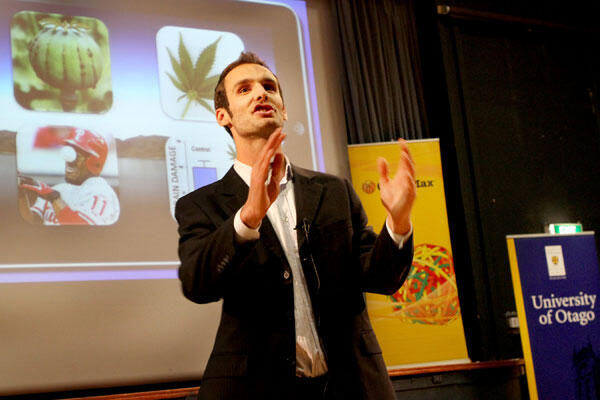
Jack Rivers
When you hear the phrase “giving marijuana to disabled babies” something along the lines of “child abuse” probably springs to mind. Not for Jack Rivers though. For three years Rivers has been working on his PhD here at the University of Otago, researching how marijuana-like substances could be used to treat brain-damaged infants. Somewhat fittingly, I spent my 4:20 on the phone to Rivers to chat about his research, I in the Nev, he from back home in Christchurch. Rivers has just taken up a full-time post-doctorate position at the Otago University Pathology Department while he wraps up the final stages of his thesis. Last August, Rivers won the Otago Uni Three Minute Thesis Competition (3MT) where contestants compact years of doctorate research into a three-minute presentation with the help of just one static slide. He went on to be a crowd favourite in the Australasian competition, securing the People’s Choice Award. Rivers believes that competitions that simplify science like the 3MT are crucial for bringing scientific research into public discourse. “I think that one of the biggest things slowing down humanity’s advancements is ignorance of what the research is,” says Rivers. “The research is not available at all and it’s because this knowledge is being owned rather than shared, and so it’s creating ignorance and separation between those who know and who don’t know, and it means that charlatans like homeopathists and chiropractors can still operate.” Rivers completed his BSc in Anatomy at Otago and followed up with a post-graduate diploma in Botany, saying that, “my basic logic behind it was that I didn’t like the smell of dead bodies, and in anatomy we had to cut up dead bodies every week. And I was like ‘plants smell delicious when you chop them up’, so I switched.” Backed by a scholarship, Rivers decided on Pharmacology as his PhD department and began searching for a thesis topic. With the aim of treating disease in mind he found an appealing combo in botany and neuroscience, eventually leading him down the avenue of medical marijuana and kickstarting the three-year slog of “slave-labour” thesis research. Historically, using marijuana to medicate is nothing new. Back around 1500BC the Ancient Egyptians used it to treat eye sores, and even shelved it to relieve pain from hemorrhoids. Fast forward more than a thousand years to 200BC and the Greeks would soak the seeds in water or wine and after removing them use the warm liquid extract to remedy inflammation and earaches. And in 200AD, Chinese surgeons could be found mixing cannabis resin with wine and administering it to patients as an anaesthetic before going under the knife. Those of you who spend the odd Sunday “self-medicating” to ensure last night’s undigested Tequila Sunrise/2am Boss burger doesn’t make a surprise guest appearance out your mouth are probably familiar with marijuana’s nausea- and pain-suppressant effects. But Rivers’s focus is on its ability to suppress the immune system. Rivers’s research looks to treat the 1 in 400 foetuses whose umbilical cord becomes wrapped around its neck during birth, causing the cord to kink and prevent blood-flow from reaching the foetus. As the umbilical chord is the lifeline, the baby’s brain then begins to die quickly in a way very similar to a stroke. The problem is further complicated by the next stage of brain damage, occurring over the course of days or even weeks as the immune system rushes a response into the brain, causing swelling and inflammation, and producing a bunch of other toxic compounds. Using this correlation of stroke victims and brain-damaged infants, Rivers would induce strokes in baby rats then administer marijuana-like substances to some in order to suppress their immune system, reducing subsequent damage to the brain – kind of like how you put ice on a twisted ankle to stop it swelling up more. Over the last three years of research his findings have been phenomenal, showing a 39% decrease in brain damage to the rats that were given these marijuana-like substances. According to Rivers, “this could be the difference between being able to speak and not, move your right arm and not, the difference between life and death.” Despite images that may have already formed in your brain of Rivers hitting bowls in the lab, his scientific research does not involve smoking nug. In fact, these marijuana-like substances that he has been trialling on rats are specifically designed not to get you high – pretty crucial really when you consider the fact that his subjects are babies. “We’re talking about developing brains here, so we took the molecule and changed it in a way that would prevent it from activating the receptors in the brain.” Being lumped in with recreational users and the legalisation movement is one of the frustrations Rivers has to deal with in researching a plant with such a stigma around it. Of these misconceptions, he says, “it’s mostly the general public that do it. It’s not other scientists, other scientists fully understand it … I mean I did an interview with Radio1 and my introduction song was ‘Hits From the Bong’ by Cypress Hill. And so that’s not good for your professional career I guess.” Actually, Rivers doesn’t support the legalisation of marijuana at all. “It’s more of a personal belief than a professional belief but I just think that introducing more substances that can alter your brain to the free-market is not a good thing, and drugs have shown time and time again not to work on the free-market … If drugs can alter your choice mechanism then it’s not increasing your freedom of choice, it’s suppressing your freedom of choice.” “I don’t think we want to end up in a place like California that has legalised it medicinally, and for things it really shouldn’t be legalised for like depression and migraines … they’ve opened the door an inch and it’s just exploded to the point where marijuana is fully legal.” Rivers draws parallels between opium and marijuana, saying that both have been used for thousands of years medicinally but have been made illegal because they get you high. Yet by extracting the active ingredients from opium and synthesising them doctors have produced crucial pain relief medicines such as Codeine and Morphine, as well as chemicals that slow down the intestines. “The doctor is never going to go and say ‘go smoke some opium’ – that’s a ridiculous concept. He’s going to prescribe certain amounts that will maximise the positive effects and minimise the negative effects. So that’s the future of medicinal marijuana.” At the moment medical marijuana is available in the form of Sativex, a spray made out of active ingredients of marijuana that goes under the tongue. However it is currently only being prescribed to patients with Multiple Sclerosis. And any pharmaceutical product from Rivers’ research is a long way off. “It could be between ten years, twenty years, it could be never that this stroke gets tested in humans. And one of the things that’s really tough about being a PhD student is that when you start you think ‘I’m gonna cure something, it’s gonna be amazing,’ and then by the time you’ve finished you’re like ‘I’m just a drop in a bucket, and you need 10 litres of research before it might get tested in humans.’” So will Rivers be joining the exodus of post-grads in search for bigger dollars? Luckily, post-doctorate research in New Zealand is some of the highest paying in the world. “They say if you go to America or Europe, you’re going to be poor … Aussies do pay slightly better, but only slightly, so it’s almost not worth it to be with scummy old Australians.” So for now Rivers is staying with researching at Otago’s Pathology Department. “I see myself getting into a media role as well, coz I do like spreading the science.” Like a Mormom, I suggest to Rivers – but with facts. “Yeah, just going door to door.” You can find out more info on Jack Rivers and watch his Three Minute Thesis at www.jackrrivers.com
-
Features

The Birth of Student Loans
Happy birthday to you Born in 1992 Happy birthday Student Lo-OANS. Happy birthday to you. Alright, that’s my attempt at turning this topic into an “engaging” feature. When delegated a brief on the 20th anniversary of New Zealand’s student loan system, I was less than excited. I suggested that the piece be reallocated to someone who is more interested in “this sort of stuff.” In fact, no one is interested in this sort of stuff. Why should we be? StudyLink is designed with apathetic youth in mind. With minimal effort, almost any kiwi student can borrow tens (even hundreds) of thousands of dollars to pay for tertiary education. As a result of this, the nominal value of loan balances is now more than $12 billion. Nearly 900,000 people have loaned money since the scheme started, and the average bachelor degree graduate has a leaving debt of about $26,000 (2,000 people owe in excess of $100,000 – yikes!). More than two-thirds of borrowers haven’t fully repaid their loans and, judging from public comments on Stuff, the entire country is bitching about our generation’s tertiary funding situation. I can feign indifference no longer. As students, we’re at the centre of the fiasco; we’re obliged to care. Currently, the student loan comprises three components: Compulsory fees: These are paid directly to the tertiary institution. Course-related costs: The borrower is allowed up to $1000 per year in course-related fees, which can be claimed throughout the year, and are paid into the borrower’s bank account. Living costs: The exact figure of living costs is adjusted yearly, but it’s designed to cover the cost of rent, food, and services. While the borrower is resident in New Zealand, loans are repaid at a rate of 10 cents per dollar of taxable income earned over the repayment threshold ($19,084). As my song suggested, this year is the twentieth anniversairy of New Zealand’s student loan system. Even though it’s older than 2012’s First-year students, it’s still a relatively young scheme amongst New Zealand’s tertiary education history. Back in 1966 – before the New Zealand dollar even existed – the University of Otago had 300 full-time staff members, and 4,000 students. Tuition fees ranged from £60 per annum for an Arts course, and £80 per annum for a Science course, to £140 for each professional year in Medicine and Dentistry. Those who reached the University Entrance standard were eligible for state bursaries, which covered basic living expenses and academic costs. In 1989, the Labour Government introduced university tuition fees for all students. At this stage, the average annual fee was only $129. In 1990, students suffered a steep (mountain-goat steep) 969% increase in their fees, which were bumped up to $1250 per year. The next year, National abolished the “flat rate fee” and allowed universities to set their own fees. The following year saw the birth of the student loan scheme. Unlike our current scheme, however, the initial loans weren’t interest-free. With the new millennia, a new Labour Government abolished the 7% interest on student loans, and capped tuition fee increase at 5% per year. By 2008, the collective student loan debt exceeded $10 billion, and the public began to stress. In 2010, National limited student loans to a maximum of seven years of study in one student’s lifetime. Last year, access to living allowances and course related costs was limited for part-time students, and for students over 55 years of age. This year, the Government has introduced a whole bunch of changes to the loan scheme which it hopes will curb students’ seemingly unsustainable borrowing. In stereotypical political fashion, they haven’t been widely communicated, and aren’t super straightforward. Nevertheless, they’re important, and they may even save you a significant amount of money. For full details on recent changes to the student loan scheme, check out the list online at (www.ird.govt.nz/studentloans/guide/changes). The following changes are a selection of the Government’s most recent:Adding “SL” to your tax code: If you’re in New Zealand and earn salary or wages, you need to add “SL” to your tax code as of this month, regardless of how much you earn, unless you have an exemption. This will ensure that the right amount for student loan repayment will be deducted from your pay. If you have a student loan and have more than one job, you can apply for a student loan “special deduction rate” to ensure that your repayment deductions aren’t too steep.View all your loan information on one site: All borrowers currently studying are now able to see a complete and up-to-date view of their loan balance, including their StudyLink transactions through Inland Revenue’s online service. So go on, have a look, I dare you to.Recalling the entire loan amount: For borrowers who have consistently been “non-compliant” (IRD’s wording) with their repayment obligation, the IRD now has the power to demand full and fairly immediate repayment of a student loan.Shorter repayment holiday: The Government has shortened the repayment holiday for overseas-based borrowers from three years to one year. Additionally, debt collectors in Australia and Britain will now seek out those who are behind on their payments. Overseas debtors make up 15% of all student loan debtors, but are responsible for 60% of total overdue payments. The campaign began at the end of last year in Australia, and has so far resulted in $1.2 million being repaid. Alternative contact person for new student loan applications: There is also a proposed change for borrowers to provide an alternative contact person for all new student loan applications for study, starting from 1 January 2013. Although these may seem like little changes, hopefully such tweaks will promote a more secure, sustainable, and user-friendly system. I caught up with Vice Regional Chair of the Southern Region Young Nats, Todd Dickens, to chat about the current scheme, and about the future of New Zealand tertiary funding. Dickens admits that he’s “...quite proud” of New Zeland’s interest-free loan system: “I know that if we didn’t have a student loan scheme, if we had to pay for university on our own, then I probably wouldn’t be here. In fact, many New Zealanders wouldn’t be studying at tertiary level. As fantastic as it is, however, it had become a burden on the tax payer. It’s a great system, but it’s a system that needs to be carefully moderated.” “If we had a system of free tertiary education, then every tax payer in the country would be paying for something that not everybody uses. On the other hand, if the system was privatised, then student loans would be treated like mortgages. Banks wouldn’t lend to students that they judged as being unviable. This would prevent thousands of people from even getting the chance of tertiary education... Which wouldn’t be great.” You’d assume that having as many university-educated kiwis as possible would be a good thing. But could such normalisation of tertiary education devalue graduates’ certificates? Dickens disagrees, as he says, “The more people that we can encourage into tertiary education, the better. Having less people at university would lead to more harm than, say, having a few people who get a philosophy degree and never use it.” Ouch. Will I become one of those people, except with an English degree? I saved soul-searching for another day (and another feature), and moved on to my next question. Another way of encouraging students to study at tertiary institutions is to keep the loans interest-free, despite the cost this imposes on the Government. Dickens acknowledges that, “It would be ideal to go back to charging interest, in that it would get the Government more money. However, it wouldn’t be ideal in that it might deter lots of students from studying. Many students don’t even want to get a loan in the first place. If there was interest on top of that, I’d be afraid that too many people would be put off the idea of tertiary education. At the same time, there’s got to be that level of accountability, to stop students from just going crazy and spending all sorts. With this system that essentially allows everyone to go to university, if it gets abused too much, parties like Act will just say, ‘No, that’s disgusting, scrap it right now!’. That’s why there are restrictions whereby if you fail a certain number of points, you’re out [of the student loan eligibility criteria]. There’s also an incentive in place at the moment which rewards early repayments with a 10% discount, which is almost the opposite of being charged interest!” Even though the system is currently running at a (significant) loss, Dickens still believes that it will succeed, eventually: “I think it’s certainly worthwhile. I wouldn’t scrap it because it’s running at a loss. By bringing down the loss as much as we can, we will help prevent it getting out of control. By making little moderations, we can save an incredible amount of money. We will be able to retain the system.” Dickens points out that even though the student loan system has been around for two decades now, it’s hardly had the opportunity to speak for itself: “It’s had so many changes from government to government, that it hasn’t really had a chance to prove its worth. Hopefully these recent solid changes will be built upon, and it will continue to level.” Really? Dickens, at least, is hopeful: “Once that $12 billion debt comes down – and I think that will happen over the next few years, as people who have recently graduated will repay their loans, and as people overseas are confronted – we’ll see more regular payments, and more students being on task. When that comes into play, fingers crossed, the public will realise that not all students are useless. If every student just pulled their fair share, then we wouldn’t have the begrudging public.” Part of “pulling our fair share” is ensuring that, as students, we’re able to make informed decisions about our tertiary funding, by keeping in touch with the policies and procedures of the student loan scheme. We’re very fortunate to live in a country which places such value on education; let’s make the most of it, so that by the time the next tertiary funding milestone rolls around, we’ve got a system worth celebrating.
-
Features
TRANS
Imagine you are five again. Sitting on Santa’s lap, you ask in a whisper for the one thing in the world you truly desire: A Barbie. Christmas morning rolls around; you run to the tree, sliding around the corner like a scampering dog in your excitement. And under that tree you find, with baited breath, a present in the shape of a rugby ball. You reason with yourself that maybe it’s just a really fat Barbie. Sorry, kiddo. You complain to your parents: They say it’s just not normal, that you’ll grow out of it. And for a few years you believe them. Although at recess you want to sit and play inside with the other girls and their dolls, you force yourself out to play with trucks in the sand pit. You know deep down, that it isn’t right: You’re not a boy damn it; you’re a girl. Despite the difficulties that the queer community continues to face, society overall has come along way in its treatment of homosexuals. However, there is a final burden to overcome, a final group still pushed to the margins and ignored, still treated with a level of disrespect that we would consider unconscionable; this is the world of the transgendered. Transphobia seems to be one of the last acceptable taboos in western culture. Children that do not conform to their biological gender are over 40% more likely to experience childhood abuse; their lives are likely to be are plagued by discrimination, barriers to health services, and limited legal and public recognition of who they really are. They are blocked from enjoying the same rights and responsibilities as everyone else. Zane Pocock looks into the lives of the transgendered, and the struggles that they face. Trans-NZTransgendered people are those who innately identify with a different gender to their biological sex. Most “cis” individuals (those who align with the gender they were assigned at birth) are ignorant of what it is like to live as a transgendered person, or of the immense challenges they face every day: Transitioning or living as a trans person can be immensely difficult. Jamie Burford, queer/trans activist and former OUSA Queer Support coordinator at the University of Otago, says that, “of all the students I worked with, the trans-identifying or gender-questioning students often had the roughest time.” This takes the form of challenges around access to healthcare, being able to have their gender identity recorded by the University, or simply being able to find a bathroom to use safely on campus. Because some trans people may not “pass” easily as the gender they identify with, they can “bear the brunt of the worst violence and verbal abuse,” Jamie says: “There have been times when we’ve had to take complaints to the Proctor because trans people have been walking around the campus area and have had abuse hurled at them: ‘What is it? Is it a boy? Is it an it? Is it a girl?’ – that kind of stuff. I remember one student who didn’t even feel safe enough to go back and collect his car at the end of the day.” The University seems to be trying to make changes for trans students at Otago: Recently, there was a successful request to get preferred gender listed on University documentation. “But it’s a difficult, exposing process,” says Jamie. “It’s not just an opt-in. Students are having to do this work on top of their school work, on top of the work of possibly getting hormones, possibly contemplating surgeries and probably talking to their family, friends, partners, and employers about it. It’s a lot of work.” As a result of transphobia, trans people experience a higher number of negative indicators for health and wellbeing, including higher rates of rape and sexual assault than cis-people, drug and alcohol dependencies, and poor educational outcomes. “Many trans people struggle to get the care, services and support they are entitled to,” Jamie concludes, but “most trans people are strong, amazing and awesome in spite of it.” Transgendered people are those who innately identify with a different gender to their biological sex. Most “cis” individuals (those who align with the gender they were assigned at birth) are ignorant of what it is like to live as a transgendered person, or of the immense challenges they face every day: Transitioning or living as a trans person can be immensely difficult. Jamie Burford, queer/trans activist and former OUSA Queer Support coordinator at the University of Otago, says that, “of all the students I worked with, the trans-identifying or gender-questioning students often had the roughest time.” This takes the form of challenges around access to healthcare, being able to have their gender identity recorded by the University, or simply being able to find a bathroom to use safely on campus. Because some trans people may not “pass” easily as the gender they identify with, they can “bear the brunt of the worst violence and verbal abuse,” Jamie says: “There have been times when we’ve had to take complaints to the Proctor because trans people have been walking around the campus area and have had abuse hurled at them: ‘What is it? Is it a boy? Is it an it? Is it a girl?’ – that kind of stuff. I remember one student who didn’t even feel safe enough to go back and collect his car at the end of the day.” The University seems to be trying to make changes for trans students at Otago: Recently, there was a successful request to get preferred gender listed on University documentation. “But it’s a difficult, exposing process,” says Jamie. “It’s not just an opt-in. Students are having to do this work on top of their school work, on top of the work of possibly getting hormones, possibly contemplating surgeries and probably talking to their family, friends, partners, and employers about it. It’s a lot of work.” As a result of transphobia, trans people experience a higher number of negative indicators for health and wellbeing, including higher rates of rape and sexual assault than cis-people, drug and alcohol dependencies, and poor educational outcomes. “Many trans people struggle to get the care, services and support they are entitled to,” Jamie concludes, but “most trans people are strong, amazing and awesome in spite of it.” Trans what? Being trans-gendered basically means moving from one gendered space to another. There are lots of terms and it can be difficult to get your head around them all. As Jamie puts it, “we have the word trans*, which is often used as an umbrella term for lots of identities such as gender queer, trans-gender, trans-sexual, fa’afafine, and other kinds of culturally specific ways of being ‘trans’. Some people may just identify as trans, but we can also use trans* as the gender-diverse composite term.” The two main terms to know are “trans-man” – a man who was assigned female at birth – and “trans-woman” – a woman who was assigned male at birth. Jamie himself identifies as gender queer: “Obviously I haven’t transitioned from male to female, but I exist in a realm somewhere between those two genders.” It is important not to make assumptions about trans people: They may or may not decide to take hormones, or have surgeries performed. They may be gay, straight, bi or any other sexual orientation. They might be out, or they might not be. The complexity of each individual’s situation means that the easiest way to know for sure is simply to ask. Interestingly, Jamie wants us to “think about cis-sexism, as opposed to transphobia. While cis-sexism might be a new word for some people, it is perhaps a more accurate reflection of the systematic de-valuing of trans* folks (in the same way sexism devalues women – we don’t call sexists woman-phobic) – whereas transphobia minimises the structural element of this kind of bigotry, instead focusing on the so-called ‘phobia’ of the individual.” Whether you call it cis-sexism or transphobia, Neill Ballantyne, the current OUSA Queer Support coordinator, thinks he can understand the reasoning behind it. “Initially, being trans is obviously quite hard to understand for cis individuals because they don’t feel that way – so they think, well, ‘why would you go down that track?’ But I think it’s also quite challenging to our society’s stereotypes and norms around gender in general. So as you’re aware, with media, societies traditionally perpetuate stereotypes around the butch manly man and the fairly docile, submissive woman. “So media and advertising have got this very polarised idea of gender. And trans-gender completely leaps all of that, because you’re born a man but you want to become a woman, or you feel that you identify as a woman, and then that whole gender thing starts becoming less like boxes and more of a fluid spectrum that can sort of flip as well. So I think people find it challenging, hard to understand, and it can be quite confronting for people as well, as they sort of go ‘well, what’s my gender?’” Recently, it seems trans issues have struggled to receive the limelight, especially compared to the experience of gays/lesbians. “Trans people haven’t emerged on our TV screens in the same way. It’s not as visible. Lots of people don’t realise that there are trans people walking around this campus,” Jamie remarks. It should be easierI caught up with Andrew (not his real name), a third year Otago medical student who identifies as transgendered. Andrew was assigned male at birth, but wants to transition to life as a woman. At the moment, he is fine using male pronouns. “For me, being transgendered is weird, because I’ve been taught to be a guy for 20 years. I went to an all-guys boarding school, for example. But basically from when I was 12, I’ve felt like I wished I was a girl.” Since his early teenage years, Andrew would lay in bed at night, wishing he’d wake up female. “But it was a fantasy. That’s what I thought: I’m a guy. I’m not allowed to be a girl. It doesn’t work that way. In my mind I just told myself ‘be realistic and be a guy’.” Interestingly, it wasn’t until university that he got the courage to experiment, but that experience quickly turned sour. “When I first started it was pretty positive. I was like ‘Oh my goodness, I may be able to look like a girl!’ and I had hope that this may just work. But when you’re coming out in public, people close to you are the hardest. I had friends at UniCol who I thought were quite open-minded. But the first time I was cross-dressing in front of them, one girl just cracked up laughing and couldn’t stop. Another guy was like ‘I’m totally fine with it, but just don’t do it in front of me.’ But that’s not tolerance, you know?” This makes it difficult to choose whom you tell about it. Andrew has told a lot of people – even his parents – but as for showing them pictures, or dressing as a girl in front of them, “I haven’t had the courage. People can say they’re really supportive of what you’re doing, then just shut off once they see you as a girl.” Andrew thinks it’s difficult for friends who know him as a guy to suddenly be confronted by “BAM! I’m wearing a dress! They don’t know what to say or even think.” He does, however, find girls in general to be a lot more accepting. As for coming out of the closet completely, well, that’s yet another challenge. He’s trying, but “it’s not as easy: I’m not a naturally extroverted person. Some trans people just don’t give a shit, and I’m jealous of that. For me, it’s about taking small steps – three steps forward and two steps back. I hope to be completely out and be able to live as a girl every day at some stage, but it’s hard to see exactly when that’ll happen or the best way to go about doing it.” It can be very difficult for trans people to realise their goal of physical transition. Andrew would love to have genital reconstruction surgery, “because I don’t see myself getting intimate with anyone else as a guy.” Having this surgery in New Zealand is difficult due to long waiting lists in the public health system, and it’s a huge sum of money to undertake surgery privately. Still, this is a route taken by many. There are a few resources for trans people, but not many in Dunedin. Although OUSA’s Queer Support do a really good job running SPACE on Tuesdays – which is basically just a safe place for people to talk – there are no specific trans groups in Dunedin. UniQ is a great place to go, but the purpose of it is to socialise and mainly meet gay guys/girls, which isn’t necessarily what a trans person wants. Rather than physical violence, Andrew identifies social awareness and acceptance as the biggest challenge. “It’s just the general attitude that is really crap,” he says. “Being gay, when you come out people don’t really need to know, but when you come out as trans, especially those who don’t pass as the opposite gender well, you feel like you’re wearing a giant badge asking to be abused.” In 2008, the NZ Human Rights Commission published a report entitled “To Be Who I Am”. The report recommended four areas for immediate attention: Increasing participation of trans people in decisions that affect them, strengthening the legal protections making discrimination against trans people unlawful, improving access to health services, including gender reassignment services, and simplifying requirements for change of sex on a birth certificate, passport and other documents. This report is a stepping-stone in ending discrimination against trans people. One of the most striking things Andrew says is that “even some gay guys get a little freaked out, which is really disheartening.” This mistreatment within the wider LGBT community is, in fact, well recognised. As Jamie says, “I think that the wider queer community needs to take some responsibility for that. Often GLB people aren’t good at standing alongside trans people. There’s an unfortunate history of that too, of trannies being the weirdos on the fringe. And middle-class white gays and lesbians going like, ‘ooh that’s a bit intense for us; we just want to be seen as normal.’ “So I think there’s some wider responsibility there from the wider queer community to step up and advocate for trans folks. Because there’s lots of queer people who are ‘yup, as soon as we get marriage and adoptions, we’re sorted’ – forgetting the experience of trans people altogether. So I think not only are trans people marginalised within wider society, they’re also marginalised within GLB(t) communities. The T is often a silent T, a very small T. I think that makes it doubly hard.” It’s so bad that there was even a report published by the American National Center for Transgender Equality in 2008 on “nine keys to making lesbian, gay, bisexual and transgender organisations fully transgender-inclusive”, entitled Opening the Door to the Inclusion of Transgender People. CIS-ADVICE Jamie says that cis-gendered people should treat transsexual people exactly as you do with any other. Take cues from their presentation: How people present themselves is generally a pretty good indication of the pronoun (“he” or “she”) they want you to use. “If you’re in doubt, ask the person in the most private, discrete and sensitive way possible,” says Jamie. “But in most cases that won’t be necessary. What it’s not okay to do is purposefully mis-gender a trans person – referring to their biological sex, name, pronoun, any of that stuff. That’s just not okay. Many trans people are really generous, and will be okay with people making mistakes. So don’t be afraid, but be sensitive and try to get it right.” Being transgendered is a small part of who these people are, it’s not an exhaustive definition. What they want is no different to what we all want: Respect and dignity. As a middle-class, straight, cis, white guy, I was accepted with open arms by the queer/trans community while researching this article. It’s high time that cis-heteros repaid the favour. With recent reports on the experiences of transgendered people, the framework for positive change is definitely there. Transgendered people are already working hard to realise their rights, often without the support of others. To cure transphobia/cis-sexism, the challenge is for the rest of us to step up to the plate and challenge our own assumptions about gender – the problem is not with the trans people, it is with society’s inability to accommodate, accept and celebrate them.
-
Columns

Me Love You Long Time | Issue 10
Dunedin is renowned for many things, but its dating scene is not one of them. Getting boozed and pashing people on the dance floor is hardly anyone’s idea of romance, so Critic wants to sort you out. Every week we’re sending two loveless loners on a blind date to Tokyo Gardens (with a bottle of wine to ease things along of course) to see if we can make some sparks fly. If you want in on the action, email critic@critic.co.nz. Ryan After one too many angry hand jobs, and some chick at Unipol giving me a boner, I decided that it was time for me to try my luck on a blind date. I mean, if it could lead to two randy lesbos scissoring in the link toilets, then surely it would mean I could at least get a gobbie, willing or not. As a gay guy in Dunedin, you come across a lot of uglies and batshit crazies. So in prep for my date, I had a bit too much tequila (expecting him to look a whole lot less attractive than he was) and I hope I wasn’t slurring my words too much … can’t quite remember. (If you are reading this Mr Blind Date, for that I am sorry.) I slyly walked into Tokyo Garden, half expecting to see a turd rolled in glitter, wondering why the hell I had agreed to do this, and, BAM, he was late. I had assumed he’d be running on gay time, so I had another beer. Eventually I turned around to see two hotties standing at the counter: One was my much-better-dressed-than-myself date, and the other was a certain babin’ Critic editor (Mr Stockman, how you doin’?). Sadly Stockman was just dropping off the wine, and quickly left. After some witty banter with Mr Well Dressed, and a few rounds of “God Save the Queen” I was impressed. As the night went on, flirting became less and less subtle until neither of us could stand up without obvious tent action. We conversed about everything ranging from “what we study” to what a Donkey Punch was (he had no idea). Eventually we went back to his – with a cheeky pash on the uni campus on the way – met his flatties, who of course were all totally aware of what was going to happen, and off to the bedroom we went. All I’m going to say is that everything after that was very Sean Cody. Thank you Critic – I did the walk of shame at 7am this morning, I had forgotten that bittersweet sense of victory. Thanks! RickyI will admit, I was a bit nervous about meeting a complete stranger in a restaurant; normally I would at least like to see a pic of them. In my nervousness I somehow convinced myself that multiple shots would start the night off nicely as I desperately hoped he wasn’t one of those effeminate types, with loose wrists and a lisp. I walked into the restaurant and spotted him straight away, sitting alone at a table without a bottle of wine – Joe the GC personally brought that for us (although red wine is vile). I’m not gonna lie, my heart skipped a beat, he was cute! So I sat down introduced myself and the wine and conversation started to flow. After the food which I wasn’t that interested in we decided to head out for some more drinks. Had a couple of rounds at the Bog then after some glances and less-than-subtle eye-fucking we both decided it was time to head somewhere. I lived the closest so we walked to mine, through uni campus. Had a romantic kiss under one of the trees near St Daves and some less than romantic groping and fumbling; this is when I discovered he was pretty hung! I thought of the lube and condoms I had laid out at home (of course, I was prepared). We arrived at mine and I had an awkward moment fumbling to get the key in the lock, then entered the lounge to find my flatmates watching TV. After some awkward hellos I hurried him up to my room. We were both a bit drunk at this point but decided another shot wouldn’t hurt; we decided to go for the vodka, next thing I know he’s out of his shirt, now I had a raging hard-on and quickly pulled off my own t-shirt. Somehow the shots were forgotten as we started hooking up. Next thing I knew we were on the bed and his hands were at my crotch, he was a bit clumsy now and I think the alcohol made us both unco, but we still managed and, well, I don’t think I need to say what happened next. Thanks heaps Critic – found me a hotty and even if he doesn’t call I’ll still have that memory.
-
Columns

Diatribe | Issue 10
I don’t think everyone who opposes Crafar Farms is a racist. I do think they are wrong. I will be making a case for why we should allow sales of land to foreign owners and why that benefits us as a country. Turning first to an important principle, the right to own land itself. In NZ we think it is a great thing for our citizens to own land. It is productive, helps our economy and it has intuitive personal benefits to the owner. Attached to the right to own land should be the right to profit from land you own. You should have exclusive possession and rights of transferability on it, that is the nature of ownership. Through blocking people from selling to the highest bidder we infringe upon the rights of ownership. It is undeniable that in at least a few cases the highest bidder will be from overseas, that is where the money is after all. What is the reason that people believe we should restrict this right? I am going to dismiss the idea that the reason comes from the thought that this is an invasion of our sovereignty, which is stupid, the land remains under NZ jurisdiction. The fundamental point I have heard over and over is that the problem people have is that profits will leave NZ. There are three flaws to this idea: Firstly, this idea raises an inherent tension with the right to own property, we wouldn’t care if someone in NZ simply owned land and didn’t use it profitably, but we do care if that person wants to make an individual profit and sell it to someone who does want to make use of the land. Secondly, it is simply not true that NZ does not benefit. Again I would assert that most of the time the people who want to pay the most for the land also have the best ability to make it productive. In the case of farmland a foreign buyer will be treating it as an investment. They want it to make money, how does it make money, you need to up production of goods from it. How do you do that, employ people to work the land. Because the foreign buyer will want to make money off this land they are incentivised to hire local hands to work it for them. Employing NZ workers with foreign money does help our economy. Finally, I want to talk about the benefit of the large individual cash injection. Through the selling of their land the previous owner has made a large profit. Given that they are presumably NZers that money goes into the economy, either through spending or local investments. It also raises the probability that savvy investors will invest offshore with this large chunk of cash. If we are to believe the rhetoric from Labour, this will mean that when a NZ buyer invests overseas, we will receive their profits. Sounds good to me.
-
Columns

Straight Up | Issue 10
This week’s column is about Intersexions, a documentary that premiered in Auckland last week. The film is a collaboration between my dear friend Mani Mitchell and Mark Lahood. It shares the stories of a number of intersex folks across the world, interwoven with Mani’s story. Mani is a part of a generation of people who were non-consensually surgically and hormonally assigned after birth. Intersex is a composite term for over thirty conditions that originate pre-natally. In brief, an intersex person may have atypical chromosomes, genitals that are not typically assignable (inside or external), or sex development differences. Often intersex folks are left right at the end of the LGBTQQI… acronym – which is why I wanted to put them first today. It is estimated that there are over 2000 intersex New Zealanders. Many of them will have had surgeries as babies to ‘correct’ what are perceived by medical experts to be ‘abnormalities’. What this really amounts to is doctors deciding to make people who have different kinds of bodies/genitals ‘normal’. In most cases these procedures are performed at birth, but some have gone on throughout childhood. In some cases what we are talking about is simply a baby having a large clit, or a small penis (people with clit’s might agree, that having a bigger one could be rather excellent. Now imagine what it would be like if someone removed it from you without your consent.) It doesn’t take a genius to figure out that doctors taking it upon themselves to hack off parts of babies genitals is a bad idea. Many intersex people lost sensation in those parts altogether as a result of these surgeries. Others live with pain or incontinence. These procedures are now largely discredited. Intersex activists have argued these surgeries are more about assuaging the discomfort of society (is it a boy or a girl?) than that of intersex folks. Yet up to five nonconsensual surgeries still occur each day in the USA. If I am ever blessed to have a gorgeous intersex child, I will tell the doctors to leave it up to them to decide what they want to do with their body. Mani said it best, “whatever body I was born with can’t be shameful.” I know one thing for sure - you wont create a happy ‘normal’ child by mutilating their genitals. Finally, I want to shout out to Mani and all of the amazing intersex activists of the world, who are using their own often-painful herm-stories to make change. Xox (Herm is a personal pronoun some intersex people have adopted in order to make living as intersex visible). – Dame LaDida
-
Columns

No Fringe, No Indie | Issue 10
This week’s style commentary will feature the satire created by political commentator Chris Trotter but with an Otago University twist. Without further ado, introducing the “Waitakere Jock”: The Waitakere jock tends to enjoy the odd pint while watching a good game of rugby with the lads. Nostalgia is reserved for Gardies of course, but the Cook will suffice. New Zealand patriotism runs deep with these lovelies and affiliations to the likes of Fred Dagg and the Muldoon years is mandatory. Think Jemaine Clement’s velvet voice, think pies, think full fat milk. As for appropriate attire, Waitakere jocks sport stubbies, “wife beater” singlets and jandals/flip-flops. Not thongs. Dabbling in woman’s clothing for the purpose of costuming is a no-no. We wouldn’t want to associate ourselves with the product of a repressed, Anglo-Saxon, macho society now would we? Rather, the “chick” is thought to be a foreign and yet easily acquired treat for this UniCol/Cumberland/Hayward/Studholm/Castle Street-residing breed. Fancy yourself as a Waitakere jock? Why not try your hand at some DIY activities? For example, the standard beer “crate” offers a plethora of possibilities. –The crate can be used as any sort of furniture substitute. For example, a coffee table, a bookshelf or a vase (however, the vase could be problematic). For those of the highbrow variety, the crate can also be used as a lovely foot stool, or “pouffe” to some “politically correct” folk. –The crate may also serve as an excellent laundry basket. It has been over two weeks since your last stint at mum’s house. Why not do your own filthy washing? For those who hope to complete the pinnacle of all DIY jobs, why not try and make your very own desk? Steal or borrow an old door that you probably kicked in last weekend during one of your benders, thinking it was a) open b) the Cook or c) your girlfriend. Stack two sets of three crates (six in total) to make the legs, and voila! This way, you can further your career or at least complete your commerce degree. With your new desk, you may aspire to be global head of foreign exchange, make hundreds of people redundant at Merrill Lynch in Australia or who knows, become Prime Minister of New Zealand, and one day dine with the Queen? –Sasha Borissenko
-
Columns

Proctology | Issue 10
It was belting down with rain when Critic went along to the Proctor’s office last Tuesday; we must have been the only people to ever want to stay in his office longer than absolutely necessary. Campus Watch have been on the lookout for a persistent peeping tom (what is it about guys named Tom?) in the Ethel Benjamin/Hyde Street area for the last couple of weeks. The cops are on it too, but as you can imagine, it’s hard to catch someone in the act of peering through a window. The Proctor highly recommends closing your windows and pulling your curtains before you get your gear off. Humanities students were greeted with an unusual parking job a week back when one young lad’s scooter made it onto the landing above the entrance to the Burns building. Several burly Campus Watch types and numerous ropes and pullies were required to return the scooter to a very thankful scarfie. Despite offering their help in finding the culprit, he was fairly sure that he could find the guilty party and provide his own unique form of justice. The Proctor has also had some issues recently with water balloons thrown from the sixth story of a residential college. Apparently they can pick up enough speed to do some real damage when they hit, and complaints have been made. While he refused to confirm which college it was, the Proctor suggested to Critic that there aren’t that many around that are taller than six stories. Hint taken. Asked if he was expecting an uptick in incendiary-type trouble with the influx of graduates over the coming weekends, the Proctor suggested that there have been occasions where graduates have tried to relive their glory days on Castle Street, especially to try and impress younger siblings. As they are no longer students, they have had the pleasure of dealing directly with the police. And from the Proctology archives, two intrepid groups of students had a “pumpkin off”, in which they painted two pumpkins unique colours, and then positioned them in strange and quirky spots around the campus. They made appearances on the girders in the library, and under the ITS building that spans the Leith, before one team really upped the ante. The Uni bigwigs arrived to find a large coloured pumpkin strategically balanced on the lightning rod above the Clocktower of the Registry building. Game, set, match. – Walter Plinge
-
Columns

Swillable | Issue 10
Müller-Thurgau Alcohol Content: 8% Price: $10 As any decent wine critic knows, the difference between a good wine and a bad wine is the quality of the grape. This week’s review covers a vino about as appealing as a lamb shank from the 2-4. It tastes like a yucky chardonnay. Müller-Thurgau is a Swiss creation (like velcro and LSD) dating back to 1882. Things initially look promising. From what I’ve seen on the internet, most things from Switzerland are sexy. Müller-Thurgau is Germany’s most planted grape, prevailing after crops were devastated by Nazi soldiers. It is renowned for being a refreshing, medium wine with rich stone fruit flavours. Corban himself has taken this flavour and made a mess of it, fitting in well with the rest of the range. Drinking Corbans makes me uncomfortable. I imagine it’s similar to how young mothers feel breastfeeding in public. Part-embarrassment, part-self disgust. This bottle is recommended with a range of seafood or chicken dishes featuring fruit or fruit-based sauces. I only had Kronic and shaved ham. I’m more disappointed than the father who sends his daughter to university to become a doctor but instead comes back with a BA and a belly full of babies. I’ve been stung with a bottle of something that belongs in a cask. Initially, it’s refreshing and fruity. It could easily be mistaken for expired Fresh Up. It’s all downhill from here though, becoming bitter (almost salty?) before peaking at an all new level of shit. It’s a sad day for mankind when the Swiss come up with an inferior product. The brewers at Corbans seem to be all emotion and no skill, similar to women’s sports. The white label promises prestige but delivers pain. It would appear that sometimes paying more pays off. Not financially, though. By all means, if $7 is all you have, get a bottle of Corbans. But if the wallet is a little more full, my recommendation is to save up for a Tupac hologram. – Mr. Squid
-
Columns

Classic Film | Issue 10
Director: Richard Linklater Richard Linklater’s Slacker is considered one of the defining points of 20th century American independent cinema. It signalled the dawn of a new era for independent directors, proving that one does not need expensive equipment or “stars” to successfully create a filmic statement. Slacker may ultimately be remembered more for its effect than for its actual content. Dozens of directors credit Slacker as their inspiration to pursue a career in filmmaking. As Kevin Smith, the cult director of Clerks, Jay and Silent Bob and Cop Out fame, said, “Slacker was the movie that got me off my ass, it was the movie that lit a fire under me, the movie that made me think, ‘Hey, I could be a filmmaker.’ And I had never seen a movie like that before ever in my life.” Slacker’s impact comes from its complete transparency. Presenting 24 hours in the life of an eccentric collection of Generation X “slackers” (read: Overeducated, underemployed, pretentious as hell), Linklater does not direct as much as he observes. With no apparent subjectivity, the film seems to follow its characters around in a disconcertingly Orwellian fashion. In this way we become less of an audience, and more like voyeurs; peeking in on life’s most intimate situations with no context or knowledge. With no discernible plot structure, no narrative continuity and little focus, Slacker is less of a film and more of a societal experience. We are not confined to a particular character or perspective. Instead we watch from above: from coffee shops, to concerts, to back alleys, to suburban homes. Linklater gives us over 100 characters and a selection of unconnected yet nonetheless interesting (and often hilarious) events. Slacker documents a day in the life of a Generation X-er, and has become one of the most valid cultural sources of the 90s. Slacker is an unrestrained look at one of the least-represented generations in history, and for that alone Linklater deserves his acclaim. – Lukas Clark-Memler
-
Columns

Objection Overruled | Issue 10
Drink driving. As with drugs and casual sex, many students have dabbled. Whether it is a morning-after stint or a blatant act of driving obliterated, drink driving is rife in New Zealand. This is particularly so in the Southern Region, where 16-24 year olds are over-represented compared with the rest of the country. Legislation introduced in November 2009 targets drug-impaired drivers too, as the growing subculture poses an increasing risk for road users. If you are apprehended on the suspicion of driving under the influence of drugs or alcohol, you can expect the following: Any person driving or attempting to drive a motor vehicle is required to undergo a passive breath test if requested by police. This detects any level of alcohol on your breath. If it detects alcohol, a breath screening test measures whether you are over the legal limit of 400mcg for micrograms (for those aged over 20). If you fail this, you must accompany the police officer to the station for an evidential breath test. At this point you may contact a lawyer, with whom you may speak for a reasonable amount of time. The evidential breath test measures the precise level of alcohol in your breath, with the lower of two readings being counted. You are then given the opportunity to give a blood specimen. If apprehended on the suspicion that you are affected by drugs, you will be required to perform a compulsory drug impairment test. This measures the ability to follow instructions and motor skills – walking in a straight line and turning, plus balancing on one foot – and also measures pupil activity with a torch light. Certain indicators of drug taking include the inability to follow instruction, difficulty with tracking the light and enlarged pupils. If you do not complete the test to a satisfactory level, you must give a blood specimen. The Land Transport Act provides that “motor vehicle” means a vehicle drawn or propelled by mechanical power. Interestingly, it explicitly excludes pedestrian-controlled machines such as bicycles and skateboards. These are classed as “vehicles” for the purpose of careless driving, but you may escapade drunk at your leisure without fear of a drink driving conviction. – Alice O’Connell Disclaimer: Critic does not endorse or incite you to ride a bicycle or skateboard whilst intoxicated.
-
Columns

Uncle Howie | Issue 10
Dear Uncle Howie, I can’t believe I’m writing in, but I need your advice/knowledge/wisdom and after reading your column I think you’re the go-to person on such a topic. I recent acquired a Fuck Buddy who is dynamite in the sack but my complete opposite and he enjoys talking for at least an hour afterwards about stuff I really couldn’t care less about. How do I broach the subject with him that after a bit of rumpy-pumpy it’s time to leave so I can go to sleep or vice versa? I don’t want to seem inconsiderate but we only get together for one thing, to meet one mutual need, and we have already agreed it’s going to be nothing more then sexy-fun time: No strings and no potential relationship, which I’m more than happy with. Thanks, I await your advice. Hi there, Great to hear from you. I fucking hate post-coital chat, it’s far too often like the sex itself: Mundane, awkward and often cuming to an expected stop. Congratulations on the penis, it’s tough out there so let’s see if we can work this out. Having a fuck buddy is like having business partner; you’ve got to set out your roles clearly and make sure all involved stipulate expectations from the beginning. It sounds like you’ve done this, which is good, but you have to continue to be upfront about things. At the end of the day, literally, this man is simply there to get your juices flowing. With winter fast approaching you’re going to want to have a nice fella to pop round, sling it up ya, give you a peck on the cheek then get out of your grill. Many girls use the classic line “I have a lecture in the morning …” or “ahh I’ve got soooo much on tomorrow …” – but I hate to break it to you, us fellas all see straight through it. Just be honest. Next time, before sex, let him know that you really enjoy what you’ve got going on but you need your sleep, staying up to the wee hours having small talk just isn’t going to cut it. Reassure him that it’s no reflection on him; it’s just that you like to have your own space in bed. Alternatively a simple solution is to do your dirty work at his house. Once the deed is done, let him know “you’ve got to get home” and leave. To be honest, when a man hears a girl utter these words after sex it’s a real treat. He will be secretly over the moon, and you get your sleep. – Howie.
-
Culture
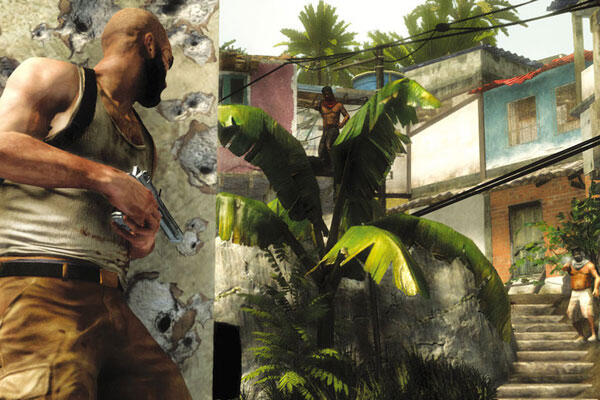
Max Payne 3
Platforms: Xbox 360, PS3, PC Developer: Rockstar Vancouver Genre: Action 3rd Person Shooter You expect an unobtainable beauty to be the protagonist in a modern videogame: A Nathan Drake type with sculpted muscles, a full head of hair that’s wavy but not-too-wavy, and a perfect coating of uniform stubble. Max Payne 3 is pretty progressive in the sense that its eponymous lead character is the complete opposite. For big parts of the game he appears to sport a greasy wife-beater around his potbelly and a greasy full beard around most of the rest of him (Except his bald head). Rockstar Vancouver brings the series to the current generation in a few ways. It remains (at least in terms of box-ticking) a noir tale, with Payne narrating his thoughts and motivations to the audience, but the setting has migrated from the chilling air and cinema-appropriate-rain of New York City to the sun and sweat of South America. It looks to be a jarring, if refreshing, shift from the cool-clean aesthetics of the earlier games. Max still tends to dive and lunge more than he walks and runs however; the shooter combat aims to feel as much like older titles as it possibly can. By launching himself through the air in a fluid, slow-motion swan-dive the player can avoid gunfire, no matter how diffuse, and take out opponents by swivelling the upper body in deliberate directions. It’s here that new additions are most obvious and most impressive. The direction of fire is in no way limited by the game’s library of animations. No matter Payne’s equipped firearm, his dive trajectory or his body position, he can contort his body to aim at foes in any corner of the arena. It’s the same euphoria engine from GTA IV and other Rockstar titles that’s responsible for this, and for a general visual sparkle. Max’s bulky frame looks as though it should take real effort to move around, and even more effort to lift off the ground. The graphical engine reflects this; the player heaves and strains with every movement (differently, too, with every gun) and crashes and tumbles into vertical walls after a dive. Max Payne looks in a state of constant physical and emotional fatigue and bruising, which is exactly how a stressed videogame character should feel. Enemies, hopefully, will be equally dynamic, blending animations and the physics system together seamlessly. Rockstar hopes to produce a visceral, violent reward with a close-up shot each time an enemy is dispatched – with no two looking quite the same. Max Payne 3 has a simple cover system, as well as the ability to depress the left trigger for an over-the-shoulder camera for more precise aiming. Both are quintessential conventions in today’s third person shooters, and seem to be present for comfort more than anything else. The developers make sure to point out that they are ancillary, and the real meat of the combat remains the Hong Kong-action style acrobatic gun-combat. It makes sense too – the parts of trailers that show Max Payne walking look odd – perhaps it’s because he is constantly surrounded by enemies in the open and soaks up magazines full of bullets in his stained cotton singlet.
-
Culture

The Most Fun You Can Have Dying
Michael (Matt Whelan) is around about your age. Like you, probably, he’d been reasonably assuming that he was at the start of his life. Now he’s got terminal cancer. Michael’s only option is an expensive treatment that raises his chance of survival to a dismal 10%, and his town manages to raise the money. But before attending the celebratory ceremony, Michael is told he must get in a wheelchair. “You don’t look … sick enough.” This bleak-but-ridiculous humour continues in Michael’s frequent check-ups. “Jellybeans?” the doctor offers after a particularly gritty prediction. The rare occasions you laugh in this film, you’ll laugh a lot. Eventually Michael, reeling from an ongoing bender that began after his diagnosis, casts his weakening morality to the wind. He steals his treatment money and secretly hightails it to Europe, leaving his loved ones in the dark. Abroad, he adopts an increasingly wild lifestyle. One night, he is beaten unconscious in an alleyway and awakes to the sight of the appealingly accented Sylvie (Roxane Mesquida), whose madcap behaviour attracts him. They grow closer, but as they do, they uncover several angsty wounds, and not just Michael’s. Whelan’s edgy ennui is an about-turn from the ungainly dork he played in his last major film. I’d almost simperingly call him a star in the making. As events worsen onscreen, you’ll be unable to turn away. However, you might feel you’re sadistically watching a spectacular car-crash of a life, rather than going along with Michael for the ride. Dying is a very difficult topic to convey with sincerity and depth, and sometimes the film just seems to be ticking boxes: Despair, angst, more despair, check, check, check. But Marcon hits all her targets very gracefully, and this is a local film you can proudly take your American and British friends to see. 4 / 5
-
Culture
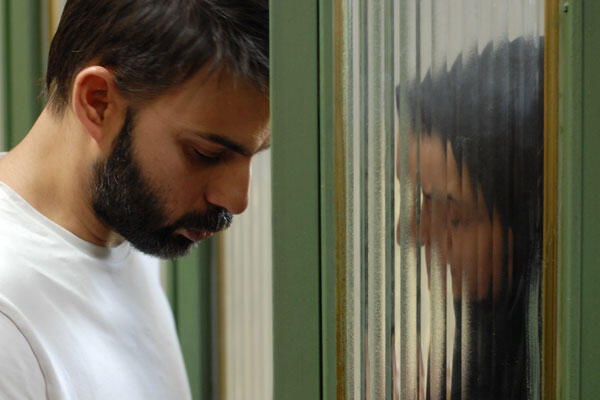
A Separation
When I think about the topic of divorce in film, I conjure up scenes of slightly comedic melodrama which only goes so far as the Jennifer Aniston and Vince Vaughn types can take it. I had thought that divorce in film was a topic left to the cardboard world of cliché until the Oscar-winning film A Separation came along. Although A Separation is set in contemporary Iran, a country that would be unfamiliar to many in New Zealand, the conflicts it presents within a family on the verge of breaking apart are universal. In this story, Simin (Leila Hatami) provides her husband, Nader (Peyman Moadi) with an ultimatum: Leave Iran with her and their daughter, Termeh, or she will file for the divorce of their 14-year-long marriage. Nader refuses to do so due to his Alzheimer-suffering father and he does not consent to the divorce. When Simin leaves her husband and daughter, Nader hires Razieh, who has her own persistent personal troubles, to assist with his father. The story spirals into complexities after Nader comes home one afternoon to find his father close to death, tied to the bed with no sign of Razieh. A Separation is enthralling in many ways. It provides a commentary on the tensions of theocracy, domestic rule, sex and politics between two classes in Iran. It feels like a story that was not created by a director but instead is compelling in the honesty of its depiction. It does not and cannot explain all the trivialities of every day life in Iran and the story ends as it started, with troubling and saddening uncertainty. A Separation is the best type of film. – Loulou Callister-Baker
-
Culture

5 People to Watch Out for in 2012
New Zealand Music Month is upon us and Isaac and I thought it was about time we made some predictions. We’ve compiled a wee list of some New Zealand artists/bands we think are going to make it big in 2012 (whether nationally or internationally), and if you haven’t heard of them already, you will soon. KIMBRAKimbra’s first single “Settle Down” made a few waves in New Zealand, and even Perez Hilton was a fan, but it was her collab with Gotye on “Somebody That I Used to Know” that really got her onto people’s radars. The song shot to number one in nine countries, certifying 9x platinum in Australia alone and prompting them to quickly claim her for their own. Surprised much? It’s been blasting from most radio stations all summer and was even covered on Glee. Her most recent collaboration with Mark Foster (from Foster the People) and A-Trak is well worth a YouTube, and has left fans quivering with excitement over what she’s going to come up with next. Listen: “Warrior” (with A-Trak & Gotye) THE NAKED AND FAMOUSEveryone knows The Naked and Famous are pretty cool. Their songs “Young Blood”, “All of This” and “Punching in a Dream” were an alty kid’s wet dream until they went a wee bit mainstream. And who can blame them? They cleared up at last year’s New Zealand Music Awards and their album Passive Me Aggressive You was certified Gold in NZ. That’s not to mention the massive North American tour that they are in the final stages of, and apparently they’re pretty awesome live. So keep your ears peeled for these guys, because they are on their way to making it big. Like, international big. Listen: “Girls Like You” UNKNOWN MORTAL ORCHESTRATrue musical freedom without stereotypes and expectations usually only occurs at the start of careers. “Usually”, because this is not exactly what happened to Ruban Neilson, once a member of now-defunct alternative music royalty The Mint Chicks who found himself in virtual anonymity living and working on the other side of the world in Portland, Oregon. With no record labels or band mates, Neilson had a clean slate, and in his basement Unknown Mortal Orchestra was born. A jaunty, heavily psychedelic project floated on top of sampled drumbeats and freak-out vocals, his music pricked curiosity, then praise from the blogosphere, indie music labels, audiences worldwide, and acclaim from us here at home. The recent winner of this year’s Taite Music Prize, UMO is turning heads overseas, grabbing attention not just for Neilson but for our country, blazing a trail for our homegrown talent with musical integrity and flair in equal amounts. Listen: “Ffunny Ffrends” DAVID DALLASHe’s not just that other guy from Scribe’s “Not Many, If Any” anymore. He’s the only musician to be nominated for the Taite Prize twice, with an album released for free which garnered over 50,000 downloads, and huge blog attention worldwide including a plug by a certain big-mouthed, mic-stealing K. West. Not only pushing the boundaries for New Zealand hip-hop’s international attention, he also has creative opinions when it comes to the consumption and release of music. He released an entire album for free as a digital download, and produced an interesting composition of the eventual physical release which included four more songs and an entire instrumental disc for people to interact and rap over themselves, or just enjoy the beats. He pushes the boundaries of what it means to “consume” music while producing some high class, locally-grown, internationally-heard hip hop. Listen: “Take A Picture” JANINE & THE MIXTAPEEqual parts R&B soulstress, social media princess, and beat-making-song-churning machine, Janine & The Mixtape is a force to behold. Involved in every part of her music from making the beats, to singing the songs, to recording and even booking her own live gigs, New Zealand’s own take on the highly popular R&B resurgence (effectively described in a YouTube comment as “Adele with swag”) is part of the “cyber musician” movement. Her website/blog is a computerised scrapbook, with all of her activities including cut-off parts of songs, her own videos or just disjointed thoughts straight from her to her fans, creating a sort of cyber community where it’s less artist-and-fans and more musical village. A village which may become more of an overpopulated, crowded, super-hip city of its own, floating in cyber world and weighed down by a ton of swag. Listen: “Bullets”
-
Culture

Dub FX
“Fat beats, dirty bass lines, rap vocals and melodic vocal lines too. And I put it all together with loops. I’m multi genre.” Ben Stanford’s description of his sound sums it up in a few short adjectives; he has something for everyone. The DJ better known as Dub FX’s unique style started off as a street performance with a guitar and backing track. After he saw someone else using a loop station, he took it into his own hands and incorporated it – along with some epiiic beat-boxing skills – into his current sound. “It’s like a combination of lots of different things … I’d beat-box, and then I’d loop a beat, play guitar and sing over top. But as I kept busking people were interested in this loop – they were saying ‘do something with that!’ and it changed very quickly. I took the guitar away and started just using the loop station. So that’s how I play with the loop station; all the effects are my voice, I make all the bass lines, and I change the pitch of my voice to sound deeper or higher, or [to make] delays. That’s something I was already doing in bands for a long time so by the time I got the beat station I was already quite savvy with all the effects and what I could put into it.” With our dub, rootsy and heavy bass line music culture, Dub FX has a massive following in New Zealand and he loves coming here. Even though he lives in Australia, Ben said he resents the music culture there, but “[came] over to New Zealand and saw what was going on over there and I felt so much more at home ... musically I feel like my home is England, but as soon as I got to New Zealand, I was like ‘wow’, it’s pretty much on par with what I’ve been seeing.” His trademark collaborations incorporate all kinds of different sounds into one track, and have included the likes of Chali 2na (Jurassic 5), Pete Philly, and a whole load of other artists and producers. He explained his dream collaboration without missing a beat: Bob Marley. “But there are a lot of producers that I’m interested in like Nu Tone, High Contrast, Noisia, that kind of crew. Just because I’m a bit of a geek … my real passion is in the studio crafting songs even though that’s not what I’m really known for, but that’s what my passion is driven from – trying to emulate all these different genres and producers. When I listen to a song by Noisia I think ‘how can I possibly make that song? How can I make that with my pedals?’” He travels around performing with his fiancée, better known as Flower Fairy (can you see where I’m going with this? I’m sure you’ve seen the posters up around town). They’re playing at Sammy’s on Wednesday night, and you should go because they cater to everyone’s musical tastes – this is one gig that is not worth missing. But it’s hard work being one of the most promising drum & bass DJs in the world at the moment, evident when I asked Ben for his chosen superpower. After much discussion about the different merits and a moral debate about being able to get people to do whatever you wanted them to, he decided that “the obvious one is flying, but I can’t say that because it’s so obvious. To remain as calm as the Dalai Lama – to be in control of my stress. That would be the best superpower on the planet. And to have amazing amounts of energy. Unlimited amounts of energy.”
-
Culture
2012: Capocalypse
A week-and-a-half out from Opening Night, I sat down with the co-directors of this year’s Capping Show to discuss how this year is panning out for them so far. A show this size, and which gathers such huge crowds, is always a highlight of the Uni year. But it’s also a daunting task, albeit one which Aaron Mayes and Caitlin McNaughton are thriving on. This year’s show tells the story of John Everyman in a post-apocalyptic world, after the Mayans’ predictions came to fruition. Filled with satire and exciting dance numbers, McNaughton says, “people are pegging this as the best one yet, so we’re hoping to live up to that.” Both Mayes and McNaughton have been involved with the show for years. Both coming from a theatre studies background, they acted in numerous performances, while Mayes also acted as assistant director last year. They both agree it’s not that difficult working together. “We have really similar artistic preferences,” McNaughton explains, “so it’s quite easy to work side-by-side.” Mayes agrees: “We don’t disagree on much.” This is a relief when you consider how much time these two have spent working together. The process began last August when the theme was decided and the production roles applied for in October, leaving a long summer break to enjoy before the mayhem began in January. Once auditions were held in March it was non-stop until May, with rehearsals taking place five evenings a week. With this in mind, it’s no surprise the cast end up one tight-knit family. “This year’s cast are fantastic; they are really good,” Mayes enthuses. “There hasn’t been any real drama or anything, which is a bit out of the ordinary for Capping Show, because normally with a cast this sort of size there’s bound to be some sort of drama. But this year everyone’s just been great to work with.” McNaughton adds that, “this year was quite a fresh intake, because a lot of the older generation of Capping Show who have been around forever, it was their final year last year. [This year’s cast is] the new generation and you’ll be seeing them for a few years.” With a large mix of people taking part, from med to philosophy students, the script reflects the diversity of the cast; there’s a little bit of something for everyone. When asked what first-time audience members should expect, McNaughton says you should “expect to be shocked, and maybe offended, but also expect to laugh … a lot, and be really impressed – because there’s amazing things in terms of tech, and the videos are brilliant, and we’ve got amazing costume people and props and lighting, the whole shebang!” Mayes agrees: “The show’s been getting better and better over the years and more people are getting involved, like OUSA … there’s been more money getting involved and more time working on it, so it’s just like every aspect of the show is improving.” With this kind of enthusiasm about the show, it’s hard not to get excited with them. After so much time and hard work has gone in to the project it’s great to see it almost at its opening night. Performances run from May 9-19 with tickets going for $15 a pop, which is pretty great value for a homegrown show. Tickets are available at OUSA – get in fast because without a doubt, it will sell out.
-
Culture

Bossypants
Oh, Miss Tina, will you marry me? Who’s this Tina, you ask? That’d be Tina Fey, former Saturday Night Live writer, 30 Rock creator, all-round comedienne and now, thanks to her debut book Bossypants, pants-splittingly funny author. Part sardonic memoir, part behind-the-scenes tour, and part half-serious discussion of women in the entertainment industry, Tina Fey has written a book that’s witty as all hell, endlessly quotable and just generally awesome. Bossypants covers the years of Fey’s adolescence, college years, her time in the legendary comedy theatre group Second City, and finally her years at SNL and 30 Rock. Naturally there’s the bits you expect; for example, there’s a chapter about 30 Rock, the quintessential little-TV-show-that-could (and it’s this chapter that had me say out loud, “Oh, that’s who wrote the line ‘Never go with a hippie to a second location’!”). But the earlier parts that recount her childhood are just as interesting and funny, especially since Fey takes absolutely every opportunity to lampoon herself and her supposed “celebrity” status (how else to explain her inclusion of a class photo of herself proudly sporting one of the most heinous shag haircuts known to man?). You also sense that Fey wrote Bossypants with a mind to answering all the questions she is asked most often, like “How’d you get that scar on your face?”, “How do you juggle being a working mother?” and “What’s it like being boss?” In that way, Bossypants addresses all the things that you’re interested in about her and which probably made you pick up the book in the first place. On the other hand, Bossypants is also a well-disguised platform for Fey to talk about some of the things she’s interested in, and it’s these more political themes that, along with her authorial voice, help Fey hold this book together. The strongest thread binding together Bossypants is her feminist ethics and, in particular, the ridiculousness surrounding women in film, television and theatre. As she says, in one of her only half-kidding moments, “only in comedy ... does an obedient white girl from the suburbs count as diversity”. With her trademark weird and cutting humour, Fey talks about body image in the media (“The person closest to actually achieving [the ideal body] is Kim Kardashian, who, as we know, was made by Russian scientists to sabotage our athletes”), and the expectations placed on actresses by other people. (There’s a great story about Jimmy Fallon jokingly complaining that Amy Poehler’s latest gag wasn’t “cute” – that is, sweet and ladylike. Poehler’s response? “Amy dropped what she was doing, went black in the eyes for a second, and wheeled around on him. ‘I don’t fucking care if you like it.’” Yeah, can that be our next feminist catchphrase? Please?) In a lot of ways, Bossypants reflects the kind of ethos that pervaded Fey’s first Sarah Palin sketch – namely, “You all watched a sketch about feminism and you didn’t even realize it because of all the jokes ... Suckers!” In other words, Fey talks pretty explicitly about political issues but uses comedy to make it go down more smoothly for the average punter. For people like me, though, who are already fans, Fey not only talks about things you agree with, she expresses those sentiments in ways both funnier and pithier than you ever could. Seriously, the woman is a one-liner machine. (“Gay people don’t actually try to convert people. That’s Jehovah’s Witnesses you’re thinking of.”) Bossypants is whip-smart, completely readable and possibly the most hilarious feminist text you’ll ever read. Really, once you read it, you’ll understand my marriage proposal. (Tina – call me. I’ll have your second baby.) – Feby Idrus
-
Culture

A Good Wee Cause
Walk into the Dunedin Community Gallery this week and you will be confronted by a large and odd assortment of some quite frankly wacky and eccentric items. Miniature glass pieces soldered together to create a curving spiral-like form constitutes one original sculpture by the window; a portrait of a ferocious wolf faces; a pop art-esque comic book rendering of a young woman with billows of yellow hair; several more realistic still-lifes decorate the very back wall of the gallery; and all the while a basket that contains several mysteriously leafy and long-stemmed plants holds court in the centre of the room. To the casual passersby (and the friend that actually informed me about this exhibition), the first impression to pop into your head would probably be a mix of surprise and confusion, followed perhaps by a quick dismissal. Hopefully this article will persuade you otherwise, because art, like so much else, is something you really can’t afford to judge by its “cover” (there you go, your eye just swerved upward involuntarily, didn’t it?). Arranged by the Artsenta organisation, the exhibition is a group one, which at least accounts for the large variety of styles and pieces. But what explains the curious diversity of the artworks even better is the fact that each one was created by an artist who is mentally impaired, with the help of resources and guidance offered by Artsenta. The organization describes itself as “a shared art studio for people within the mental health community”, where anyone who uses mental health services and is over the age of 17 can book a time to drop by the studio and discuss what kind of creative venture they may be interested in. Not only are they flexible, catering for both group activities and individual efforts, but going to Artsenta is completely free of charge. The Dunedin Community Gallery exhibition, following on from the previous Artsenta one at the Dunedin Railway Station, displays the aforementioned larger artworks and sculptures, which are all for sale at ridiculously reasonable prices. But what makes the exhibition particularly unique is its interactive aspect, perfect for those just dropping in to those who want to get more involved and find out more about how Artsenta works. Each of the Artsenta artists have been invited to create a CD cover-sized piece specifically for the exhibition, and anyone who would like to own one simply needs to create their own artwork on the spot to exchange for the one they take. There’s no pressure to make some fantastic masterpiece but it’s a pretty sweet way of getting involved in the art scene without too much commitment, and giving back to Artsenta for the clearly incredible work they’re doing. Personally I’m a fan of anything that follows the old school barter and trade system that, oh my God, doesn’t actually involve me debilitating my already-financially-crippled bank account any further! Yay! Pop along and see if there’s anything that takes your fancy; chances are there will be, thanks to the large range of artworks and styles on display, with anything from hanging mobiles to miniature sculptures to surrealist paintings and drawings. Not gonna lie, there’s a gorgeous faded pastel fabric hanging I’m probably going to snap up once my bank account recovers in a couple of days … why thank you, Studylink! Artsenta Group Exhibition Dunedin Community Gallery, Princes Street April 24-May 4, weekdays
-
Culture

Sophie’s Granola
Critic Food this year has been centred around hearty dinners, savoury dishes and a whole lot of olive oil. So now it’s time for something a little sweeter, something to rouse the tastebuds of the sugar-lovers among you. Delving into the land of breakfast, my dream of daily poached eggs on toast with bacon and a never-ending mug of Earl Grey is usually crushed by the bleak reality of cheap instant coffee and 9am lectures. Glorious granola can be prepared in advance, keeps for a few weeks in an airtight container (provided you don’t nibble away at it all before then) and its flavour range can be easily mixed up with the addition of whatever dried nuts, seeds or fruit appeal to you. You’ll notice I haven’t provided measurements for the cranberries, apricots and almonds. Just follow your instincts and throw in however much you like. This granola recipe is borrowed to a large degree from a recipe in Sophie Dahl’s Voluptuous Delights – a pick-me-up, always inspiring book of recipes, anecdotes, and mouth-watering food photography. Ingredients1/2 cup honey (whatever’s cheap) 4 TBS old fashioned/cloudy apple juice 1 tsp ground cinnamon (optional) 2 cups rolled oats 1/2 cup thread coconut Dried cranberries Dried apricots, sliced Sliced almonds Method01. Melt the honey in a large bowl in the microwave in 10-second bursts until runny. Stir through the apple juice, and cinnamon if using it. 02. Add the oats to the liquid and stir to coat. Don’t fret if it’s not mixed through entirely evenly – if you get a few clumps this will result in delicious granola clusters. 03. Spread the intoxicatingly sweet oats in an even layer on a baking dish or oven tray. Make sure the layer is fairly thin. Bake at 180°C for 15-20 minutes until golden, then turn the mixture with an egg flip and bake for a further 10-20 minutes or until golden brown. Any clusters may feel a little soft but they will harden up when the mixture cools. 04. Stir the thread coconut, cranberries, apricots and almonds through the granola once it has cooled. Experiment with flavours and textures – try pumpkin seeds, hazelnuts, sliced dried figs or whatever else tickles your fancy. Store the granola in an airtight container. 05. Keep it simple, and serve with milk. Alternatively, if you feel like being a little bit indulgent, soak some granola in apple juice in the fridge overnight (which will make the apricots incredibly plump), then serve with a generous dollop of thick Greek-style yoghurt and fresh berries. I opt for unsweetened yoghurt because of the sweetness from the apple juice and honey.
-
Columns
Te Roopu Māori | Issue 10
Kia Ora whānau, It’s that time of the year already … Graduations, for a few of us older tauira it is the chance to catch up with old friends who are in the workforce and to reminisce about the good times and memories we all shared. For others, this will be your first time to experience how Dunedin and the University of Otago celebrate the achievements of our students as seen in the George Street parades. Fortunately, Māori students have the opportunity to celebrate their successes at a more intimate ceremony with the pre-grads the Friday beforehand. From personal experience, this is most humbling to openly share, not only with your whānau but also with other tauira whānau, the Māori Centre staff and respective departmental and divisional staff members. Congratulations to all who are graduating in the ensuing weeks; I cannot wait to celebrate this occasion with you all. As this is the time to acknowledge and celebrate the achievements of all, there have been many wānanga and Hui that have been happening both on and off campus, which a cohort of Māori students have been a part of. Therefore, here is the low-down on two of them. Te Roopu Māori sponsored seven students to attend Kura Reo up at Arai Te Uru. This Hui served many purposes, which include the ability for those at different levels to be in a fully immersed reo-speaking environment and learn from some of the best Te Reo speakers. This was also a chance to increase the profile of Te Reo Maori, which coincides with the theme for Te Wiki O Te Reo, July 23-27: Arohatia to Reo. Secondly, The University Of Otago School Of Physical Education hosted the Māori Games Wānanga run by Rangatahi Tu Rangatira, where there was action to raise the profile of Māori traditional. You may have seen a bunch of on the museum reserve playing some of those traditional games. A big mihi goes out to Anne-Marie Jackson for facilitating this Hui and word is through the kumara vine that there maybe some more opportunities for the community to become engaged and learn about this awesome kaupapa. Finally, for all those that have been living under a rock, or in your books, a committed group have been working hard to prepare for Te Huinga, the National Maori students conference. As we are hosting this event all those that are still keen to get amongst this and help out, email Huinga Leader Rimutere Wharakura on whari341@student.otago.ac.nz or the Te Roopu Maori email at teroopu.maori@otago.ac.nz. Hope the studying is going well – not too long till exams, watch this space for some kai times at the whare. – Lisa