

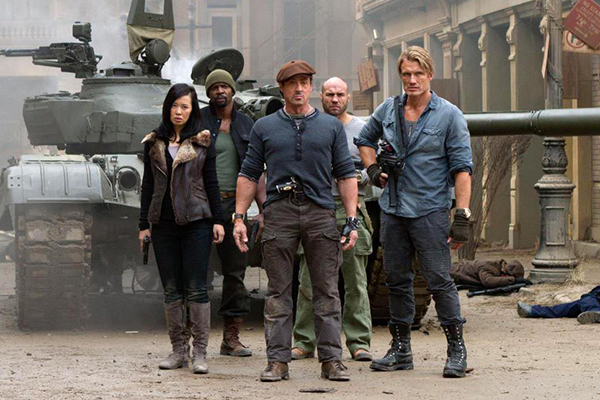
The Expendables 2 revolves around a group of mercenaries, the Expendables, who are enlisted by a Mr Church to retrieve a lost package from a downed plane. What seems like an easy job takes a wrong turn when one of their crew is murdered during the operation. Determined to seek revenge, the Expendables wreak havoc among their enemies even though the odds are stacked against them. To add to the chaos, the crew is also attempting to keep five tons of weapons-grade plutonium out of the wrong hands whilst undertaking their mission: "Find em, track em, kill em".
Starring Sylvester Stallone, Arnold Schwarzenegger, Chuck Norris, Jean-Claude Van Damme, and Bruce Willis, The Expendables 2 is an 80s action fan’s wet dream. This amazing cast offers a testosterone-fuelled and action-packed film that doesn’t disappoint, with non-stop gratuitous violence from the get-go. The Expendables 2 is one of those rare sequels that is much better than its predecessor. Its most entertaining element is the relentless stream of one-liners, which pay homage to 80s action films. A special mention goes out to JCVD (the villain) and his signature kick.
I highly recommend this movie, but keep in mind that it’s not meant to be serious; it’s a throwback to the good old action movies of the 80s and 90s. The Expendables 2 is an action movie that will plunge a blade into your heart, twist it, shoot it, and then blow it up with an airplane.
Culture
More Culture from Issue 24
-

The Driver’s Seat
The Driver’s Seat follows Lise, a nondescript woman of little importance, and her own way of reasoning inside a mind which seems to have got the whole world the wrong way round. The book opens with Lise freaking out at a shop assistant for suggesting she buy a stain-resistant dress – “Do you think I spill things on my clothes? Do you think I don’t eat properly?” Lise needs a dress for her holiday to an unnamed country to find a boyfriend she hasn’t met yet, but is sure she will recognise when she sees him. She is paranoid that she will look like a prostitute if her hem is too long. Her jacket clashes horribly with her dress. Everybody remembers her. The narrator does not know Lise’s thoughts. Glimpses of a future of Identikit pictures, witness interviews, and newspaper clippings magnify the peculiarities of Lise’s actions, which she carries out with blank stare and parted lips. She takes out a pen and a map, unfolds it, re-folds it, puts it away. Forgets about the pen. She stuffs her passport down the back of the seat in a taxi, to keep it safe. When she checks in her luggage you hold your breath. She smiles at the contents of her handbag and you grit your teeth. Lise is terrifying. Every character in the book has a different type of unnerving weirdness. A grotesque woman holds her breasts and laughs openly for a long time at Lise’s clothes. A woman buys books in pastel shades to match her spare bedrooms. Lise meets Bill, a greasy sex-crazed entrepreneur with very particular eating habits. He carries around a sack of rice which leaves a dribbling trail wherever he goes. Bill’s world is split into Yin things and Yang things. Coffee and salami are bad Yin. Rice and sex are good Yang. Lise likes coffee and doesn’t like sex. Bill thinks he is Lise’s type. Lise meets Mrs Fiedke, an elderly Jehovah’s Witness who suffers from narcolepsy and confusion. She is worried about the men’s rights movement; that men are demanding to be able to wear jewellery and look after the children. They won’t be content with equal rights only. They’ll want the upper hand next. Mrs Fiedke buys presents for the nephew she is sure is arriving on a flight sometime soon. She stays up late in case he knocks on the door. A nice man in a dark suit changes seats on the plane so he doesn’t have to sit next to Lise and Bill. He doesn’t know why exactly. He tells the police he was scared. I love this book. The Driver’s Seat is a mind-fuck of a crime story in which the narrator and characters seem to be conspiring against each other for no reason other than paranoia and spite. Neither author nor heroine attempt to explain what is going on. Trying to keep up with details only makes the plot more nonsensical, but it kind of makes sense, provided you accept the book’s absurdity. Everything seems to come back around to the start, but with none of the coherence expected of a crime novel. The Driver’s Seat is a slim book – just over 100 pages – so you pay close attention to long descriptions of uncannily normal details. The crime-reader’s eye picks these up as clues, and they sort of are. The book was written in 1970, when politics surrounding gender, race, oppression, and human rights were very much in the spotlight. Murial Spark turns everything the 70s stood for upside down, blurring the definitions of emancipation, freewill, motive, and especially victim and perpetrator – not to mention everything else in the world. Spark says, “I aim to startle as well as please.” If by “startle” she meant “scare the shit out of and confuse horribly”, then she was successful. You should read this book. Good luck.
-

Defender’s Quest - REVIEW
"Grinding” doesn’t sound like a great way to spend one’s time, does it? A mule in a medieval mill did a lot of grinding – of grain – to turn it into the coarse, unrefined flour that was the serfs’ staple food supply. That gameplay mechanic, as popular as it has historically been in classic Japanese RPGs, is cheap. To me, arbitrarily forcing a player to replay the same battles over and over again in order to beef up their characters so that progress becomes possible is a repetitive way to pad out a game’s length. In some ways it is also diametrically opposed to the idea of a tower defence game, and is the reason that the otherwise brilliant Defender’s Quest is undeniably imperfect. Defender’s Quest takes place in a pixellated path through a kingdom of vast grassy fields bordering choked deserts. The story is extremely self-aware, and cheekily makes fun of all the generic fantasy conventions that it employs. Strangers join your party at the drop of a helm, and all are skilled in conveniently contrasting disciplines. The story isn’t important, but the dialogue bubbles that make it up can easily be skipped, and it’s good for the occasional mild chuckle when the mood strikes you. It is a typical tower defense game, albeit one with a staggering attention to detail, except that the towers are all human members of your party – with pseudonyms, military equipment, and abilities that you allocate to them with the experience and currency that you gain in the battles. It’s a terrific idea. Having a large, ever-growing posse of heroes to assist you is a nice feeling. Games like Mount and Blade and the indie game Queens are as fun as they are partly for that reason. You set up your buddies on the edge of a course, and zombie and worm foes rush down the roads to your wizard character. Setting up all your warriors in the correct location and equipping them correctly is imperative to succeeding. The trouble is that tower defence games are fundamentally about fine-tuning your strategy. They are satisfying when defences are set up in an inspired, reasoned way, and the player gets to watch the dominoes fall in exactly the way he or she hoped they would – with minimal interaction. You can cast spells, but they tend to be used whenever possible to boost your characters, or as a last resort to directly damage enemies. Grinding unfortunately makes this fine-tuning impossible, because you never know if you are supposed to be able to beat a level. Am I failing this section because I’m not thinking about it or strategising correctly, or am I failing because I haven’t done quite enough arbitrary work beforehand? Defender’s Quest is still terrific, addictive, and satisfying, but two of the components that contribute to its greatness cancel each other out somewhat. 4/5 stars
-

Hero
The latest Stage South reading to grace the Fortune Theatre Studio stage is Hero, directed by Erica Newlands. A haunting and beautiful play by Arun Subrmaniam, a New Zealand playwright, Hero takes us on a journey to Malaysia, where the first political assassination took place. Patrick Davies plays the father of the family and successful politican. The character is beautifully written – a different man according to each character, who never shows his true self to anyone, not even his family. He is described as both a monster and a hero, unable to control how he is perceived. His son, played by Luke Agnew, is a 13-year-old genius sheltered from his father’s work life and infidelities by his mother, played by Nadya Shaw Bennett. The mother is the most intriguing and complex character, and I found her consistently engaging. She portrays complex feelings through her jumbled English, and makes observations that strongly echoed the themes of the text. With the father already dead at the beginning of the play, our viewpoint shifts from his after-life self, observing the present, to memories of his life, when the family unit was still complete. A lot of characters tell stories or relive past moments involving the father without him being there, so we only see him portrayed through others’ eyes, most poignantly when his most violent moments are told through the eyes of his wife. The contrasting characters were really enjoyable to watch, with the narrative building interesting, complete characters who were still able to surprise us. The variety of monologues and conversations was also a highlight, with conversations taking many different forms at the same time, such as acting out memories in the middle of someone’s story to demonstrate a point. Hero was enjoyable to watch as a reading, and I left feeling satisfied. However, I can’t help but think about what it would be like as a full production. With a cast of four it is an achievable goal, and would bring diversity to any theatre’s season. Perhaps we could see it put on in Dunedin some time soon? With the American elections a hot topic of conversation, the parallels between the world of the play and our own are hauntingly similar, and made me reflect on politics in general. Oh, I know, how boring. But this play truly made me question how we take things at face value – we’re taught to trust those in power without really knowing them as people. Hero shows us that the person on the podium can be a very different person to their wife, their children, and their friends. Obviously we all have different masks we put on for different people, and Hero simply portrays a more elaborate version of that, but it gets you thinking nonetheless. Though this play is specific in terms of setting and era, its core is crafted from basic human instincts and emotions. Very satisfied with this pick, Stage South. Until next time!
-

Here is some Music
‘Over and Out’ – MalesMales have just released their debut EP for free, because, you know, YOLO right? Not sure if this is the single, but it should be. Not that the other songs aren’t just as good, but “Over and Out” is one of those rare songs that sounds completely full, finished, and realised. It’s a pop song that follows the perfect avenues of sound and melody as it rollicks along, fulfilling each idea’s complete potential without overdoing it or boring me. Essentially, it’s the perfect pop song filtered through a garage rock band, a fantastically interesting singer, and a whole heap of clean-cut, stoner-behind-closed-doors vibes. Richard Ley Hamilton is one of the more prolific musicians in a city filled with prolific musicians, although unfortunately, and mostly due to reasons beyond his control, I and the rest of the public have been consistently starved of recorded material from any of his numerous bands. However, I hope this dearth disappears with the release of MalesMalesMales. With the reclusive super wordsmith networking burger king Sam Valentine and the rosy cheeked, ever smiling choir boy drummer Ben Madden, Males might just become a band that all of New Zealand can lose their shit to, just like all of ReFuel did at the dunedinmusic.com birthday party. They should swap instruments, though. That would make them way cooler. Males debut EP available for free at malesmalesmales.bandcamp.com ‘Give You All My Lovin’ – Tom LarkTom Lark, New Zealand’s best new earthquake-surviving, one-name, five-person band of merry men, is basically just awesome from start to finish. His debut EP, available for free online, features a mix of great songwriting, quirky themes, catchy hooks, weird noises, and a whole lot of cheek, adding up to a tight and endearing release. “All Night Long” has a chorus dripping with honey and a hook that just won’t get out of my head even six months later. It includes one of my favourite ever lyrics, “my Midas touch might as well be doubt”, which is both terribly defeatist and completely relatable. “Give You All My Lovin” has a gunshot of a chorus, bursting out through the chest of the verse in a mix of blood, bone, and 90s nostalgia that slaps you in the face before reloading again. A jack of all trades media-wise, the band comprises Daniel Fowler of FowlerFace productions, who handles the video making for the band, creating an appropriately bright video for “All Night Long” and a strangely beautiful fast-paced clip for “Lovin” involving a horse mask, and singer/songwriter Shannon Fowler doing his best I’m-shy-but-I’m-a-rock-star pose. He writes fantastic songs, with a wit and sharp tongue belying his quiet demeanour outside of music. Tom Lark is wacky and weird, but in such a perfectly accessible way that shows that outsiders are in (shit that sounds hipster). All in all, this album would get a perfect score if Lark hadn’t changed the perfect name of their song “Christians Who Don’t Do Shit” to “Hipsteranity”. And more points off for playing at Parachute and not playing “Christians Who Don’t Do Shit”. That gives them a total of 7/5. Oh, and they are even better live – it’s ridiculous but true. ‘Pulled You In’ – Artisan GunsThis song sounds how I assume it must feel to float within a steady stream of clouds, basking in the light warmth of the sun as memories of a lost love fade into resigned nostalgia. There is something hypnotic about the rhythm, which chugs along underneath the perfectly understated vocals of Matthew Someone as he sings, “I cry myself, I cry myself to sleep”. It’s not a dark winter night of a song, though – instead of cold concrete floors and loneliness, there’s a winter warmth, like that core-warming yet bleak and hazy early sun on a spring morning. This song romanced me, carrying me along with its flow, enchanting me into only being able to write overly flowery and romantic things about its gorgeous form, and transforming me into a swaying field of summer daffodils, with my eyes closed, getting pulled under. I’d turn gay for it, basically.
-

Yvonne Todd: Wall of Seahorsel
Curated by Melbourne arts writer Serena Bentley, “Wall of Seahorsel” is a showcase of the most recent works of one of New Zealand’s most respected contemporary photographers. Yvonne Todd is an award-winning artist based in Auckland. She has become well known for her photographs, which utilise the clichés of commercial portraiture to both expose and celebrate the artificial nature of such photography. “Wall of Seahorsel” examines awkwardness and uneasiness by contemplating a series of illogical actions immortalised in Todd’s large-scale photographs. Todd’s background in photography and fine arts degree have allowed her to successfully incorporate her photography into her art in an eclectic way. This exhibition occupies two opposite walls, enveloping the spacious room it currently inhabits in the Dunedin Public Art Gallery. The left-hand wall features Todd’s 2009 photographic series of large portraits entitled “Wall of Man”, and the other is her newest collection of large-scale photographs called “Wall of Seahorsel”, from which the exhibition takes its name. “Wall of Man” is a collection of photographs featuring 12 businessmen, who on closer inspection are not as ordinary as first assumed. Todd uses subtle techniques such as missing fingers and excessively bright eyes to add eccentricity and peculiarity to the photographs. The indirect awkwardness of the photographs forces the viewer to attempt to decipher what elements arouse such feelings of strangeness. This peculiarity is amplified in “Wall of Seahorsel” on the opposite side of the gallery, in which the new series of photographs features costumed occupants of an imagined community. Connections between the subjects are insinuated via a series of senseless bodily positions. The men and women in the photographs explore movement and posture in combination with strategically placed props and costumes, which add to the strange feel of the photos. These absurd stances prompt uneasiness in the viewer and work in conjunction with “Wall of Man”, making that collection feel less unsettling than it did before approaching “Seahorsel”. In “Wall of Man”, the connection between each man is made clear by the uniform way in which they are dressed and positioned. The photographic techniques are varied but consistent, giving a coherent feel to the collection as a whole. These connections are harder to find in “Wall of Seahorsel”, and thus the consistency is found in the illogical actions of its subjects. The beachy elements of each picture – pieces of seaweed, driftwood, light fabrics and other beach materials – also aid in tying the collections together. “Wall of Seahorsel” is thought-provoking and confusing, frustrating and perplexing. It triggers a sense of restlessness and anxiety, while also allowing space for quiet reflection.
-

Prawn, Spinach and Lemon Spaghetti
This simple pasta dish marries prawns with smoked paprika and tart lemon, wrapping the lot up in a rich cream sauce. If you’re a seafood fan but can’t get down to your nearest waterway armed with fishing artillery or face the price that blue cod and salmon fetch at the supermarket, then stock up your freezer with prawns. You can pick up half a kilo for well under $15. Simply thaw them as you need them, whether in the fridge overnight or in the microwave for a few minutes. Spinach and tomato set you on the way to 5+ a day, and balance the heaviness of the cream. I prefer coarsely grated lemon rind, but superfine zest works equally well. For extra tang, try adding a few splashes of white wine along with the tomato. Allow it to cook off before adding the cream. My spaghetti of choice at the moment is the “angel hair” variety – super thin, as the name suggests, and the perfect vehicle for a creamy sauce such as this one. As with most meals, don’t forget the essential final touch of lashings of freshly cracked black pepper. Ingredients250g dried spaghetti 3 tbs extra virgin olive oil 1 tsp smoked paprika 1 red onion, finely diced 1 tbs soft brown sugar 20 frozen raw prawn cutlets, defrosted 3 tomatoes, deseeded and roughly chopped 300ml cream 300g frozen spinach bundles, defrosted, squeezed of any excess water and roughly chopped Zest and juice of one lemon Serves 4 Method01 | Fill a large pot with water, add a pinch of salt and bring to the boil. Add the spaghetti. Cook for 8 – 10 minutes, or until firm to the bite. 02 | Meanwhile, heat the olive oil over a medium heat in a deep frypan. Add the smoked paprika, red onion and soft brown sugar. Cook until the onion is soft, stirring frequently. 03 | Add the prawns and cook for three to four minutes or until cooked through – they will become pink very quickly. 04 | Add the tomatoes and cook for a further minute, stirring to break them down a little. 05 | Add the cream and spinach, stirring to evenly incorporate. Turn the heat up until the cream just starts to boil, then reduce the heat and simmer for ten minutes until the sauce is heated through and thickened. Stir through the lemon zest. 06 | Drain the spaghetti and toss it through the sauce. Pile into bowls and squeeze lemon juice over each portion. Eat immediately.
-

Wunderkinder
Wunderkinder, set in the Ukraine in 1941, follows three young musical Wunderkinder, or child prodigies, who are bound by their love of music. Violinist Hanna Reich (Bridgette Grothum) is German, while pianist Larissa Brodsky (Imogen Burrell) and violinist Abrascha Kaplan (Elin Kolev) are Jewish. They live in a small town only miles from the frontline of WWII. As Germany advances on Russia, it is Hanna’s family that is initially forced into hiding, but as the Germans fend off Russian forces the tables are turned and it is the Jewish children who must hide. A “return the favour” scenario occurs in which each family assists the others. The brutality of wartime results in a heart-wrenching twist that tests the Reich family’s loyalty to their beloved Germany. Although the film shies away from explicit depictions of brutality, the harshness of the Nazi treatment of the Jews is still difficult to comprehend. A child-like understanding of the Nazi-Jewish relationship is represented by Abrascha’s claims that he and Larissa cannot be friends with Hanna anymore, “because adults are stupid”. The film is beautifully shot, and Ukraine is utterly picturesque. The film is subtitled, and although it took me a couple of scenes to acclimatise to the flow of German speech, it would have been a very different film had it been in English. However, Wunderkinder does lack the beautifully rendered childhood sincerity and naïveté that Boy in the Striped Pajamas so delicately mastered. The musical abilities of the children add a texture to the film which at times can be chilling. While the story is told in a measured way, the suspense is at times uncomfortable, particularly as the viewer knows enough of the Holocaust story to appreciate that the film isn’t going to end well. 4 / 5 stars
-

Moonrise Kingdom
Set in the 1960s, Moonrise Kingdom is about a couple of New England kids who cross paths at a summer camp and fall head-over-heels in love. Suzy comes from an upper-class family of lawyers, while Sam is an orphan who is constantly in and out of foster homes. Before leaving the camp, they make a pact to reunite the following summer and run away together. With camping aides in tow, as well as books and a cat, they set off for a week of hiking and spending time together, hoping to settle in a cove on the island which they entitle “Moonrise Kingdom”. Their “love” blossoms as they dance on the beach and generally live it up (well, as much as you can as a tween), until they are eventually found by their families and camp leaders. Moonrise Kingdom has been getting rave reviews, and I cannot for the life of me understand why. The film is odd and quirky in a very awkward way, almost like a Dr Seuss novel. Its vintage tint, which I assume was added in an attempt to date the film, is distracting, and the plot is completely nonsensical. The foundation of the “love story” is a particularly naïve presentation of what young love is, and the fact that it involves two 12-year-olds is frankly uncomfortable. What started out as an eclectic, light watch ceased to be entertaining after the first half-hour. The film’s scope was so narrow it was almost condescending, and to call the ending a let-down is an understatement. I can’t say it’s something I would ever watch again.


