
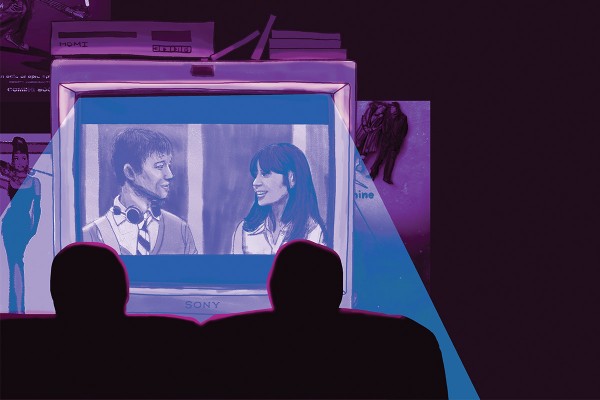
The manic pixie dream girl doesn’t do small talk, only enigmatic discussions about the universe and its infinite possibilities. She stargazes from abandoned rooftops, sings out loud in the supermarket, and writes poetry on bathroom stalls. Her love language is dancing barefoot in the rain. She also likely has attention deficit hyperactivity disorder (ADHD) – so do I, so trust me on this.
I grew up watching these whimsical undiagnosed women on screen. I’m talking Zoey Deschanel’s character from 500 Days of Summer, groupie Penny from Almost Famous or the mysterious Ramona in Scott Pilgrim vs the World. Not to mention the romantic interest of every John Green book ever written. It’s always the same story: a beautiful, wildly eccentric woman stumbles into the life of the shy male protagonist and teaches him to embrace emotion and adventure. Then, when her work is done – that is, he’s found his confidence – she disappears, bundled into the back of a Kombi van that drives into the sunset, or aboard a one-way flight to Morocco. All the forever-changed protagonist can do is reminisce. It was only recently, however, that I realised just how much this trope has inextricably weaved its way into my own love life.
Now in my mid-twenties, after years of catastrophizing and crippling procrastination, I have a loving relationship with my ADHD. I’ve found a life worth focusing for. I may be married to my medication, I’ll confess, but it’s a very happy marriage. The kind where, even after 35 years, you still hold hands in the supermarket, picnic in the Botans, and take turns controlling the TV remote. My friends will tell you I still juggle an irrational assortment of hobbies, but I’ve learnt to cherish that kind of chaos. We’re in it for the long haul. It’s only in my dating life, when it comes time to let someone else in on that relationship, that I’m confronted with its twists and turns. The manic pixie dream girl, it turns out, has written the script for many of my romantic relationships.
Never has neurodivergence looked so captivating, so passionate or so pretty, as when written by a depressed (dare I say lonely) straight man. The manic pixie dream girl cherry-picks the traits of ADHD to build a woman that’s supernaturally seductive and free-spirited, without all the uncomfortable realities of having a learning disorder. Disorganisation becomes spontaneity, inability to stay on topic becomes playfulness. Any sign she might be an actual human being floats away on a glittery breeze. God forbid grocery stores overwhelm her or she struggles with low self-esteem. She definitely isn’t medicated. That would be far too messy. Too utterly… human to be sexy. It’s giving “Nooo don’t medicate yourself, you’re so sexy aha”. And so the manic pixie dream girl becomes one-dimensional, her less-palatable traits masked by male fantasy.
A boy once affectionately told me “I love the way you think” after listening to me talk for twenty minutes about how I imagined clouds would taste. It was 1am and I’m sure he would have much rather been sleeping, but he meant it genuinely. I had always been insecure about how much I talked and the compliment totally swept me off my feet. But a little down the line, those same things he adored at the beginning bothered him. The alluring rom-com facade had slipped and he’d caught a glimpse of the not-so-sexy stuff. He’d fallen for emotional vulnerability and spontaneity but was startled when that sometimes meant rejection sensitivity and poor time-management. As much as the manic pixie dream girl will make it seem otherwise, one does not exist without the other.
Except the manic pixie dream girl was never designed to be a permanent partner. She lives to teach the male protagonist something transformative about himself, to advance his plot. It’s never been about her. If I had a dollar for every time a man lost interest after he’d learnt something ‘life-changing’ about himself (like how to feel empathy), I’d have at least two dollars. Which isn’t a lot but it’s weird that it happened twice, right? For a true manic pixie dream girl is best served in memory, fondly thought of, but never a wife. She might be fun and flirty but most importantly, she magically vanishes from the film when she no longer serves the male lead. This is okay for the most part in fiction but problems arise when offscreen, young neurodivergent women are treated as romantic plot points, the ultimate ‘good time, not a long time’. As if we, too, cease to exist outside a man's personal growth arc. Believe it or not, women, even the ones who apparently sing out loud in public spaces (I’ve literally never done that), have their very own narratives and should be treated as such. It’s the least we deserve.
I’ll admit there was a time when I embraced the trope; when I was a deeply insecure teen and the idea of someone finding me attractive, even if as a stereotype, felt positive. I leaned into it and found myself accentuating my neurodivergent traits just to entertain the fantasies of seventeen-year-old boys. As cringe as it was (especially during the peak of Tumblr), I don’t blame my younger self. At an impressionable age, when the world is telling you the most important thing you can be is desired, it seems only practical to surrender to the male gaze. And so, I became the manic pixie dream girl. A self-fulfilling prophecy, if you will.
On that note, the manic pixie dream girl isn’t dissimilar to how women have always been represented in cinema. That is, rooted in misogyny. Need I bring up the Bechdel test? It’s the classic case of ‘always a love interest, never her own complex character’. Even as the trope declines in pop culture, she lives on in the fantasies of men to be rescued from their troubles by an electric but temporary woman. I don’t hold the boys I’ve dated responsible. They’ve consumed the same media and are probably following the same outdated script that I am. But ADHD women are tired of being manic pixie dream girls, where neurodivergence is only viewed through the warped kaleidoscope of the male gaze. Where the only understood traits of ADHD are those considered sexy. What the trope doesn’t tell you is that it’s a package deal. An all-inclusive, minus the awkward group Zumba classes and tacky Hawaiian shirts.
These days the trope doesn’t affect me as much. I know I’m lovable, even when I’m not frolicking in a field or gazing up at the moon, searching for something I can’t describe. Some of it is owed to simply growing up, but a lot of it took significant time and effort to work through, as do many aspects of living with ADHD. Either way, I’ve found my very own storyline. One that (thankfully) doesn’t centre around teaching brooding young men to embrace life’s adventures or to understand empathy (they’ve got acid for that). Perhaps, If I’m feeling extra playful and spontaneous, it’ll even centre around myself.