NY Excuse For A Good Time
from Issue 27 ()
from Issue 27 ()
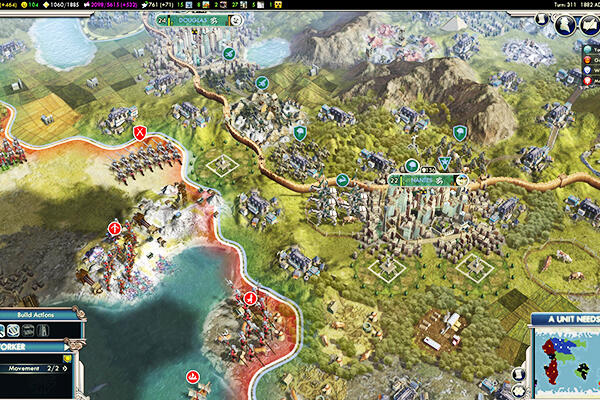
2005’s Civilization IV was a wholesome game to give to your offspring. Combat, though it was very possible, was rarely an optimal method to achieve a successful, wide reaching collection of cities. IV was a game that promoted agriculture, enlightenment and diplomacy, a game that, after its patch cycle and all of its expansions were released, was an immaculate spider’s web of game mechanics that always felt like it was smarter than you. In 2010 Civilization V was released. It was recently updated through the Gods and Kings expansion, and although it’s still smart, it lacks that same feeling of utter perfection. Combat has received a serious revamping, and becomes extremely appealing. If you want to play as Ghandi and engage in a post-modern version of the Cold War with Montezuma of the Aztecs, then Civ V is for you. The basic idea remains the same. Start off with a single city, and build more. Civilization V reins in your dreams of a sprawling empire somewhat, discouraging the building of too many cities by pumping up the “unhappiness” of your populace more quickly – and unhappy people, as the French revolution has taught us, are a bitch to rule. Cities can be fortified with buildings which provide passive bonuses, units that contribute your ever-massing forces, and wonders, providing better, more interesting bonuses but that can only be built once in the entire game-world. It’s a tangible change from Civ IV. It used to be that Joan of Arc’s vast network of interlinked settlements was as powerful as it was impressive looking. In Civ V, Ghandi’s singular juggernaut Mumbai can be just as effective. It might be less viscerally satisfying, and it’s hard to think of a terribly good justification for it. However, Civ V’s upgrades to combat and hexagonal tiles (seriously, continents actually resemble landmasses rather than weird square blocks) make it impossible to return to Civ IV. The exercise of stacking as many units as you could onto a single tile in some sort of bizarre human pyramid has been replaced with the tactical placement of units on a tile each. This change, in addition to adding ranged units, takes what was the worst element of Civ IV and transforms it into the strength of Civ V – engaging in the wanton destruction of other civilisations’ cities is now possibly the most entertaining way of playing. Archers finally function like actual archers; they have range, and need not be placed immediately adjacent to a pack of vicious elephant warriors. The Gods and Kings expansion adds two discrete elements into the game: one is richly integrated into the mechanics of core Civilization, while the other is merely an exercise in ticking a couple of boxes. Espionage, while fun in theory, boils down to gaining a new spy in every age, secretly shipping them off to a city, and “stealing” a technology dozens of turns later. Religion adds a whole heap of new elements to play. Not only could you found a brand new religion, “Criticism” perhaps, and win the game through sheer piety, it’s also possible for a religion to enhance other methods of victory. A blood-soaked bible that is the foundation of your civilization’s culture adds, as you would expect, military bonuses to your forces. Gods and Kings adds to what was already a great game, and although the total package is not quite as mechanically perfect as Civ IV, it’s still engrossing and addictive as ever. The improvements along with the stunning graphics and UI make it a pleasure to play, and you’ll find yourself up at three in the morning in a radioactively fueled diplomatic standoff between Ghandi and Catherine the Great. Just one more turn…
Let me tell you about a dessert-related revelation I had some years ago. You take an overflowing handful of fresh strawberries, hull them, halve them, and place them into a bowl. Next, grab your nearby spice grinder, conveniently filled with black peppercorns. Crack the pepper over the strawberries. Then avidly consume these pepper-laden strawberries. Though it sounds strange, it tastes phenomenal, all sweet and hot and tart. Jumping on the idea of unusual pairings, this week’s recipe plays on the seemingly unusual combination of chocolate and beef. Tender rump steak soaks up the rich, sweet flavours of the mouthwatering cooking liquid, and a small quantity of cocoa powder offers extra warmth, along with the exotic smokiness of chipotle sauce and smoked paprika. With this, Critic wraps up for 2012. So next time you’re considering what to do in the kitchen, play around with your flavourings. Never assume that an ingredient only belongs in a certain category of cooking. Get inventive. Throw your spices around. Trust your instincts. Add a pinch of sugar to tomato-based sauces. Don’t be afraid to pair citrus fruits with otherwise savoury couscous, finely sliced pears with a tangy cheese, or chocolate with red meat. Speaking of chocolate, do try the varieties with chilli, lime, and sea salt. If just one Critic recipe this year has sparked your curiosity, then I consider our job done. A huge thank you goes out to the wonderful Maeve Jones for her steady stream of contributions. Survive the exam season like a champion and enjoy your summer –wherever you may be, and whatever delicacies may be eating. Bon appetit! Ingredients4 tbs canola or rice bran oil 600g rump steak, cut into large chunks 1 red onion, cut into 8 wedges 4 tsp ground cumin 2 tsp smoked paprika 3 tsp cocoa powder 4 tbs tomato puree 4 tbs chipotle sauce (find it in the international aisle alongside the taco kits) 300ml liquid chicken stock (made up from powder) 250g sour cream 2 spring onions, finely sliced Handful of fresh coriander, roughly chopped Method01 | Heat 1 tablespoon of the oil in a deep pan over a medium heat. Add the meat and cook for one minute to brown it. Remove the meat from the pan and set aside. 02 | Add the remaining oil to the pan, then add the onion and cook for five minutes, stirring frequently, until soft. 03 | Add the cumin, smoked paprika and cocoa powder to the pan. Cook for one minute, stirring. Add the tomato puree, chipotle sauce and chicken stock. Stir well to combine. Give it a taste and add more chipotle sauce or spices if you wish. 04 | Return the meat to the pan and simmer, uncovered, for 30 minutes. 05 | Serve the Tex Mex as is, on top of steamed rice, or with corn chips. Top with spring onions, coriander and a generous blob of sour cream.
It was on a fine day in New York City that the tall and lanky young man entered the chambers of an elderly Wall Street lawyer and undertook the job as a legal scrivener (legal copyist). The lawyer’s chambers were on the second story of a building that sat in the shade of its neighboring buildings. The windows of the legal office faced dark brick walls. The only natural light that could be said to enter the old lawyer’s chamber came from a skylight outside the office’s front door. Bartleby was a quiet worker — painfully so. However, his work was good and legible. He worked at a small desk in the corner of the office and kept pace with his work better than either of the other scriveners in the office, who were both eccentric and could only put in a half day of work before losing their tempers or staining their work with blotches of ink. One day, without looking up from his desk, the old lawyer held out a piece of work that he wished Bartleby to copy. When he demanded that Bartleby do the work, the young man politely replied, “I’d prefer not to.” The old lawyer was taken aback; it had possibly been years since anyone had even mumbled the word “no” to him. This refusal threw the lawyer into a fit and he asked why, but Bartleby said that he preferred not to give him an answer. The next day, the lawyer asked Bartleby to do something else for him, but again the strange young man replied, “I’d prefer not to” before walking back to his desk. As time wore on, Bartleby did less and less. The old lawyer used sympathy, anger, anything to make the young man work, but soon Bartleby did not do any work at all. He would stare out the window, at the black brick, as if he were looking out onto an ocean, or some other captivating vista. He was asked to leave, but he preferred not to, and stayed. The lawyer came in one weekend and found Bartleby in the office. He said that this would just not do. Bartleby was kicked out, but he lay on the doorstep to the office, below the skylight, and waited there, as if to die, like there was nowhere else to go. Out of pity the old man let him back in, but shortly afterwards he moved offices and left poor Bartleby alone in the empty chamber - he could be someone else’s problem now, the old man thought. But soon he heard that the new tenant of the chamber was to have Bartleby arrested. The old man pleaded with Bartleby to leave, to come with him, to go anywhere to avoid arrest for trespassing. “I’d prefer not to.” Bartleby responded. In prison he refused to eat. He did not exercise. The old man paid the grub-master to make sure that Bartleby was fed - he paid handsomely for this, but to no avail; Bartleby looked awful. And the last time the old lawyer saw the scrivener, he was a wasted body, crouched and on his side beside a giant brick wall used to keep the city safe from its criminals - a wall not too dissimilar from that which stood outside the window of the lawyer’s old legal chambers. Bartleby died. At the end of the story, it is made known by the narrator that Bartleby used to be a subordinate clerk in the Department of Dead Letters in Washington DC, where he was suddenly moved by a change in administration. “For by the cart-load they are annually burned. Sometimes from out the folded paper the pale clerk takes a ring: — the finger it was meant for, perhaps, moulders in the grave; a bank-note sent in swiftest charity: — he whom it would relieve, nor eats nor hungers any more; pardon for those who died despairing; hope for those who died unhoping; good tidings for those who died stifled by unrelieved calamities. On errands of life, these letters speed to death. Ah Bartleby! Ah Humanity!” Smile and nod and the job market will accept you with open arms, class of 2012.
When you enter the new exhibition at the Dunedin Public Art Gallery, the enormous pool table that monopolises a large floor area in the centre of the room grabs your attention. The exhibition is “Sir Frank Brangwyn: Captain Winterbottom and the Billiard Room of Horton House”, and it is this billiard room that the exhibition endeavours to recreate. Sir Frank William Brangwyn (1867 –1956) was an Anglo-Welsh artist – a painter, water colourist, engraver, and illustrator extraordinaire. The exhibition strives to display Brangwyn’s many artistic talents, and depicts a range of his styles and textures in an attempt to showcase the breadth of his work. The exhibition also emphasises to the viewers Brangwyn’s attention to detail and the specificity of his artworks. The exhibition has been curated by the Gallery as part of the 2012 Otago Festival of the Arts, and contains many of the artist’s works, with the addition of his magnificent large-scale murals and a range of period furniture in order to reconstruct the memory of the famous billiard room at Horton House. The house was based in Northhamptonshire, England but has since been demolished. The village in which the house once stood is now called “Horton” (not to be confused with the one that “hears a who”). The exhibition flows well, with the billiards table in the centre of the enormous murals which frame the back half of the room. The pieces are grouped together, exhibiting several different mediums, including watercolours, oil on canvas, etchings, and lithographs. Among the artworks are antique furniture pieces that not only complement the era of the exhibition, but also add great visual interest to the arrangement of the exhibition as a whole. What lets the exhibition down is the lighting, which comes across as too harsh, reflecting off the large murals and giving them a glossy quality which makes them hard to view. Paintings of such a high calibre should not be reminiscent of a bald man’s head under bright stage lights. However, despite this, the wall murals are beautiful. Their soft colour and striking detail give them an arresting quality that grabs attention and is aesthetically attractive. The murals are stunning, and they can’t help but pull focus and demand attention. Whether deliberate or coincidental, they are the stars of the exhibition and their companion artworks merely supporting actors. The whole exhibition is worth going to for these pieces alone. What is appealing about the exhibition as a whole is the broad range of elements included in it. Brangwyn’s subjects are varied – people, landscapes, buildings, as well as the assortment of mediums that come together in this collection. Brangwyn’s pieces have the kind of inconsistency that you don’t always find with artists, and each piece brings with it a unique sense of character that is exclusive to that particular piece. The variety that the display showcases is remarkable, and this certainly adds to the appeal. The exhibition includes a snooker demonstration by Adam Marlow (the number one ranked poll champion in New Zealand) and Sam Chin (New Zealand Master’s Champion) on Sunday 21 October, and there will be tours for those who are blind, partially sighted, deaf or hearing impaired.
Get a bunch of 30 overly dramatic, scheming theatre students together and tell them to create a show that uses a stage in new and innovative way. Ready, set, go – you’ve got Voyager. Tell them they can take any idea, any theme, any over-the-top, ridiculously outlandish, and extravagantly impossible show and they simply come up with a Baby Forest Animal Emporium. Now, you’ve got Voyager X. Voyager is a project that found its roots in the Theatre Studies department five years ago, as a new and innovative way for students to showcase their newly acquired skills in THEA152 – Theatre Technology. Using lights, sounds, costumes, and set, the class works together to find a way to keep tradition standing. This year’s class knew they were on to a winner when they sat down and brainstormed ideas for their performance. After approximately two seconds of thought, someone blurted out those four words: Baby Forest Animal Emporium. It was fate. Everyone was instantly on board, there was no Plan B, this shit was happening. Thus, they set about creating the best damn Voyager the world has ever known – or so they say. Suffice to say, you can expect a lot more from Voyager X than the name suggests. While everyone loves a good fuzzy duckling exhibition, the class had other ideas. More ideas were added and things got more and more out of hand, so ridiculous that before you could say squirrel, they had themselves a shocking twist. What is that twist, you ask? Come see for yourself… That’s right, folks. Give the slightly psycho kids of THEA152 a chance and they’re going to do something utterly outrageous. Classic Theatre students. The tenth in the Voyager series promises to be a mind-blowing, unreal assault on the senses; a lavish and ridiculously over-the-top yet incredibly shocking example of what a bit of enthusiasm and a hideous scheme to lure innocent victims in by the promise of an Animal Emporium can do. Prepare to be amazed, shocked, and terrified. Expect the completely unexpected. Do not trust anyone. The evil geniuses behind the whole operation have done a marvellous job of keeping the true agenda of the Emporium under close wraps, but that doesn’t mean there haven’t been rats among them. The corseted freaks lurking around campus might have something to do with it, maybe have a word next time you spot one. Then decide if you’re brave enough to come along. By chance, if you do decide to put on your big boy boots and rock up to Allen Hall sporting your best “come at me bro” attitude, shit goes down on Thursday 11 of October at 1pm. For the ultra brave, it happens all over again on Friday 12 of October. Something wicked this way comes…
With the starring role played by the director herself, this movie was bound to be a little odd. Where Do We Go Now is set in a fictional village in Lebanon, where Christians and Muslims are living in harmony, oblivious to the war-torn nature of their relationship outside of their own community. This little bubble has been preserved by the women of the village, who have worked together to keep out radios, televisions, internet, or any other media, in an attempt to keep the men unaware of the fact that Christians and Muslims are not living as content neighbours in all parts of Lebanon. The story is told from the point of view of the women, who go to great lengths to keep their husbands in the dark about their country’s true political situation. Some of their antics are very reminiscent of Desperate Housewives, as they fake religious miracles, utilise drugs in their cooking, and even employ exotic dancers to try to distract their husbands. What is really nice about the film is its ability to make light of something that is always taken so seriously. Although the film is a bit chaotic and messy at times, its quirkiness is very amusing, and the themes within it, though often serious ones, are all in good fun. Though its premise is based on war, it has a “rom-com” type quality to it, and even incorporates musical numbers at times. I’m a bit lost as to why Where Do We Go Now did so well at the Toronto International Film Festival (taking out the “People’s Choice” award), but if you are looking for light weekend entertainment, and you can live with subtitles, then you could do worse than this film. 3 / 5 stars
In the year 2044, there are no flying cars. Admittedly, there are motorbikes that hover, but they’re totes unreliable. Most people drive the same cars as in 2012. And realistically, that’s what the future is going to be like. How much have cars actually changed since the 1950s? Likewise, antihero Joe dresses like a guy from the 1950s, with slicked back hair and a leather jacket with a tie, because 2044’s trendy movies are bringing back the retro. Another thing they don’t have in 2044 is time travel. That was invented 30 years later, but immediately banned by meddlesome government bureaucrats. The only people who use time travel are criminal gangs looking to dump corpses where they will never be found – the past. Joe is a “looper” – his job is to wait at designated drop-zones for unfortunate peeps to arrive from the future, and execute them. Eventually, every looper will receive the unwelcome gift of his future self, who must be shot. The downside is that this looper will now know he only has 30 years to live. The upside is that his future self will have died with dozens of gold bars strapped to his back. As Joe says: “Enjoy the next 30 years!” The cardinal sin for a looper is to “let your loop run”, which causes a giant clusterfuck and is generally a bad idea. Since I come from the future, I know what happens at the end of the movie, but I’m not going to spoil it for you. Should you go watch it? If you’re even remotely interested in sci-fi, yes. There’s action, graphic violence, constant twists, and complicated time travel plots that make you scratch your head but still understand what’s going on. There were only two things that grated with me. Firstly, the movie was a little slow-paced at times. Secondly, and more jarringly, the way Joe went from ruthless self-interested killer-for-hire to selfless hero in the period of roughly three days was totally unrealistic. That said, the movie was very entertaining, and I was absorbed and fascinated throughout. Definitely worth watching. Gotta put on my shades, cos the future’s so bright. 4 / 5 stars
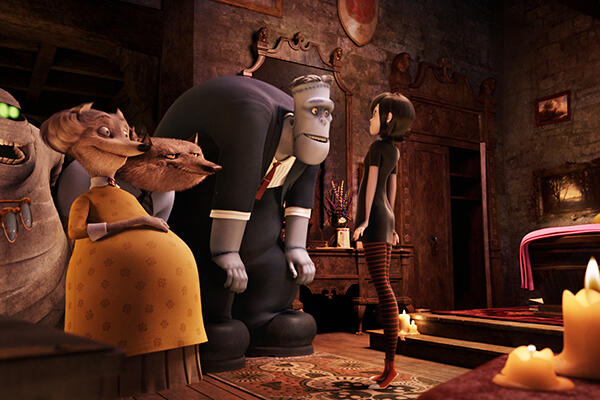
Hotel Transylvania is based on the concept that humans are the perpetrators of scariness and monsters are the victims. The Hotel, built by Dracula (Adam Sandler), is a sanctuary for monsters, a place where they don’t have to hide in the shadows and can indulge all their eccentricities. For Dracula’s daughter Mavis’ (Selena Gomez) 118th birthday, all the monsters are convening at the hotel to celebrate the occasion. The classics are present: Frankenstein, the Mummy, the Werewolf, the Invisible Man, and some less-classic characters like Zombie Beethoven. Unfortunately a human manages to slip through the doors, and has the potential to totally ruin the party by stealing Mavis’ heart. The film is carried by the dry humour typical of chief writer Sacha Baron Cohen, and although the film is G-rated there is a scattering of “adult jokes”. The animation itself is sort of hipster-retro, with muted colours and not-so-life-like cartoons. We even splashed out and went to the 3D version. Which was cool if you like that kind of thing, but admittedly I don’t really get 3D, it’s a bit of a rip off and doesn’t really add anything. Although a monster did fly at us in the opening credits and I squealed a little. The highlights were Dracula screaming in agony when listening to Party Rock Anthem and lamenting the representation of his kind in the Twilight series. All round, it is a bit of a giggle. Well, at least my flatmate and I and the guy sitting behind us (his girlfriend was not so impressed) had a giggle. It is no Lion King, but it is a good-quality, wholesome children’s movie. Maybe take a child with you, or at least an immature date.
There is no way I can do this great film justice in a 300-word review. The opening sequence of Men Like Us illustrates the abundance of heterosexual images found in Western culture and sets the scene for nine men’s stories to be told, most of which begin with the way in which they were raised to believe that homosexuality was a choice, and a negative one at that. The men range in age from early 20s to late 70s and come from all walks of life and areas of the country, all united in their struggle to come to terms with what it means to be gay in 21st century New Zealand. The diversity of the interviewees is what makes for such a great watch. The group of men includes a Maori, a Catholic priest, a Chinese immigrant, and a speed-skating Olympian, who come together to discuss issues such as body image and masculinity, school bullying, suicide and bereavement, HIV, drugs, and religion. What makes the documentary so great is how unassuming it is. There are no stereotypes, expectations, or labels. It is just an honest look at what it is like to live in New Zealand schools, sports, churches, and towns as a gay man. The film doesn’t “do anything” to showcase the men’s homosexuality, but just invites you into their lives to reveal the struggles they have had and the issues that gay men face every day. Hopefully Men like Us will be seen by a wider audience than just the gay community. Given the recent same-sex marriage legislation in Parliament, perhaps more people will choose to watch this candid film. 5 / 5 stars