
Rating: A
I was 17 when I played Limbo for the first time. I remember sitting on the floor in front of the TV at my friend’s house, eagerly playing this beautiful and creepy puzzle game. Since then, I have replayed the game multiple times. I was told that I would like INSIDE, but had not looked up or read anything about it. I went into it without knowing that it was essentially the spiritual successor to Limbo. When I was playing, there was a total “oh!” moment, as I realised that it must be from the same developers.
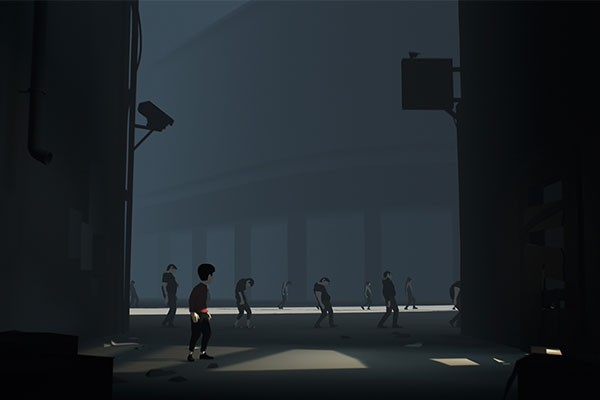
As INSIDE begins, you are a young boy running through the forest. There are car loads of people chasing you. Men with torches and aggressive Dobermans will run you down given the chance. You end up on a farm, and spot some dead animals around. The animals have strange worms sticking out of them, then they come to life and chase after you. You progress further, and begin to see loitering zombies. They don’t attack you, but they’re definitely reanimated corpses. There’s no dialogue, no text or anything. You’re launched right into the game with no explanation as to why they are chasing you, but you should probably run.
At its core, INSIDE is a sidescrolling platforming game. You can only move to the left or the right: right is forward, left is back, and the only logical step to make is to keep progressing forward. Everything about the gameplay is natural and intuitive. It’s easy to work out how to control the boy on the screen, and – much like Limbo – the game flows steadily and becomes more difficult as you continue. It introduces new gameplay mechanics, it teaches how they work in an easy setting, and then ups the ante each time you use them. It makes the gameplay harder, but it isn’t burdensome, and it fits with the schematic of the game. INSIDE is mostly a puzzle game, with each area introducing a different form of puzzle based on what you’ve already been taught in the game. The only part I didn’t like was when you had already figured out how to progress through a puzzle, but had to keep redoing to it due to not getting the timing perfect. You are supposed to feel helpless – just like the main character – but if you know how to progress but can’t because you mess up a little, it’s all the more frustrating.
The world building in INSIDE is excellent. The tension is real. You’re just a child, running, unsure about where you’re coming from or why. You’re very weak and fragile, and will usually die in a single hit. When something is chasing you, it’s awful and tense. If you have to time running through a series of obstacles perfectly, it churns your stomach. Towards the end of INSIDE the gameplay and narrative escalates very suddenly, and things get very weird very quickly. It’s intense, and I felt myself sitting forward, getting more agitated and urgent as I progressed.
The animation is fluid, and there are no loading times anywhere. When you’re completing a puzzle, the game must be loading the next sequence, as the transitions are completely seamless. The game is only around four hours long, but to have the level of detail that it does as well as no loading times is impressive. The length of the game is good; it’s not padded out or artificially extended just for the sake of having a longer game. Nothing is superfluous or unnecessary, and you are given just enough information to keep you interested without making things too heavy.
Without any spoilers, this game did make me feel quite sad by the time I got to the end. I’m not sure that I actually liked how it finished up – but that’s probably a personal preference more than anything else. INSIDE is a creepy, eerie, tension-filled game. It’s definitely one of the best games that I’ve played this year – and it definitely lives up to its predecessor, Limbo.