
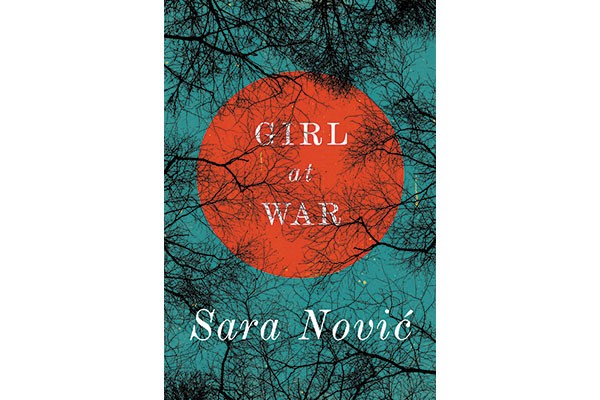
When you grow up surrounded by war, how do you continue through life once the war is over? This question hangs over Ana in her adult years. She grew up in Zagreb and spent her youth, the development years, calling the war-torn country of Croatia her home. Now in America, Ana struggles with her past and feels the need to face her demons back in Croatia.
The novel is split into different parts, swinging between memories of Ana as a child in the war and Ana now, re-visiting her home and facing the trauma she left behind. It is a powerful novel, one where the brutality of war is not dulled down and you are thrown into the conflict and forced to deal with it alongside Ana.
The author of Girl at War, Sara Novic, writes with an unashamed purity that leaves no feeling untouched. We, on the outside, would believe that growing up in a city at war would be horrifying for the children - and we would be right. However, Novic delves into that innocence that only children possess and we get snippets of excitement with air raids and frustration and stubbornness when the children fight over who can ride the bike that generates power for the shelter. We feel sad for the children who understand far too much about the war, playing the role of adults when the power goes out or when the water needs to be collected. Then Novic really gets into the cruelness and absolute disregard for human life, ending part one with a haunting, violent and abrupt event that sets an undertone for the rest of the novel. Fast-forward ten years to when Ana arrives back in Croatia and we have a twenty-year old woman who doesn’t feel a connection to the America she was sent to as a child, nor the Croatia post-war which feels alien. She manages to find her old friend Luka, and together they help her to move forward and find some peace with her life and somewhere to call home.
I really enjoyed this novel, although I did find some of the war scenes quite confronting and difficult to read. However, this should not be taken as a negative. It is these confronting scenes that make the novel far more incredible and raw than anything I’ve ever read. While these scenes took me out of my comfort zone, I don’t see any harm in being shown a life that is real and incredibly foreign to my own childhood. It is one of those novels that should be read in a book club; there is so much to talk about and remember that it is impossible not to want to share it with anyone who will listen. I highly recommend you add this to your to-be-read pile for summer.