
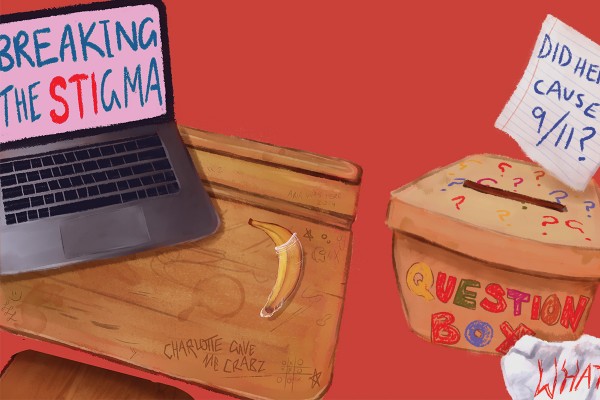
“Welcome to a dog shit dimension, where everyone is infected with something that they got from fucking.” Back in May, we attended Otago’s annual Capping Show, and much like every other year, Sexually Transmitted Infections (STIs) were the punchlines of a handful of sketches and musical numbers. This particularly catchy verse rang throughout the auditorium in a rendition of ‘Hamilton Chlamydiot’. While neither living in Hamilton nor contracting Chlamydia is all that fun, the latter isn’t something to be ashamed of. STI-related stigma is rife in our student community, and it’s spreading. So why are our conversations about STIs so rooted in shame? Two hard-to-embarrass, sex-positive post-grads are here to start the conversation, and hopefully clear up some misconceptions.
How did we get here?
Cast your mind back to Year 9 sex education. Perhaps you were tasked with rolling a condom onto a banana. Maybe you were shown some gruesome pictures of lesion-covered vulvas and penises on a PowerPoint presentation that had been recycled since the early ‘90s. Or worse, you were just told to not have sex at all. Until marriage, that is, because STIs famously can’t be contracted if you are lawfully wed (for legal reasons, this is a joke). Knowledge, crucial to sexual wellbeing, was hurried through by embarrassed teachers to a class of equally embarrassed teens.
Take discharge for example (not a sentence we thought we’d ever say). No one told fourteen-year-old Jodie that it was a natural bodily function. So when puberty hit, and with only those awkward health classes to go by, she came to the only logical conclusion she could find. In biblical Virgin Mary-esque fashion, without having had any kind of sexual encounter, she worried she had contracted chlamydia. With a little Googling and the no-show of any three wise men, she realised this couldn’t be the case. This isn’t a unique tale. Gaps in knowledge have meant misconceptions about sexual health run rife in the student community. One of Charlotte’s friends went to the GP about a lump on her vulva she was worried about, which turned out to be her clitoris. Another student shared with Critic that they’d once thought chlamydia was a type of crustacean (anyone fancy a Bog basket?).
With such a limited foundation in sexual health education, many of us were left filling in the gaps with whatever we could find on SkyTV, or in an incognito tab on the family computer. Unfortunately, these sources don’t always give us the naked truth. Media often equates having an STI to being ‘dirty’ and irresponsible. As if contracting one is a damning reflection of your character, rather than a potential reality of being a sexually active adult. In 2017, John Oliver – the same person who fucked with the 2023 Bird of the Year competition – compared herpes to terrorism. On top of this, film and TV have fueled the fire of misconceptions about STIs. A particularly unlikable character in the teen classic Easy A gets his ‘karma’ in the form of a chlamydia infection, and is seen writhing in pain in hospital. But in reality, chlamydia can often have no visible symptoms. Also, we’re pretty sure karma-ydia doesn’t exist.
Closer to home, a 2018 Critic Te Ārohi Booze Review read, “Corona is like herpes, because every third person in the room has it, and it’s usually a fuckboi,” suggesting that the only people who get herpes are those who have a lot of sex (not true) and that having lots of sex is a bad thing (also not true). Then there’s the Facebook page UoO Meaningful Confessions. Every time there’s an honest admission from someone discovering they’ve contracted an STI, the comment section becomes nothing more than a stream of breathas tagging their mates: “Not again buddy.” Can’t be very comforting to the brave soul who sent in the submission.
Don’t get us wrong, a joke or two can be an excellent social lubricant. Critic knows better than anyone, humour can bring people together and strengthen a community. In North D we are a uniquely close-knit community. But that, our sexually active friends, is also exactly why we need to discern facts from fiction.
The Cold, Hard (!) Facts
Cutting through the myths and misconceptions to get to the facts, Critic Te Ārohi spoke to (s)expert Katie McCullough from Just the Facts, a sexual well-being resource focused on delivering easy-to-understand sexual health information to rangatahi. Katie is a clinical lead and nurse practitioner for the Sexually Transmitted Infections Education Foundation (STIEF), so she knows all the ins and outs of the in and out.
First and foremost, Katie stressed that contracting an STI is not a moral failing. She reminded us that, despite what we have heard growing up, “STIs are medical conditions, and are part of being human.” Having an STI does not make you ‘less than’ your peers. In fact, most of us will have at least one STI during our lifetime. A whopping 80% of New Zealanders have herpes in one form or another – that’s eight out of the ten people in your group project – and there are thousands of new chlamydia and gonorrhoea cases every year.
Once again, contrary to Easy A’s depiction of a regretful teen clutching his crotch and screaming in agony, many of these cases will be asymptomatic. It’s because of this, Katie told us, that getting regular sexual health checks is important, even if you don’t have any visible symptoms. The good news is most STIs are curable, and all are treatable. It’s when stigma and fear lead to avoidance, and STIs are left untreated, that things can take a turn for the worse. Katie warned that a culture of STI shaming “can deter people from sexual health services, resulting in complications such as chronic pain or infertility, [and] risk transmitting infections to others.”
Getting tested is easier than contracting the fresher flu during Flo-Week. However, much like Otago students trying to get by in winter, STIs hibernate. All STIs have ‘window periods’ where the virus may not show up on a test. So if it’s recent unprotected sex you are worried about, check with the receptionist about when is best to book a cheeky check-up. Critic would never tell you to do anything we haven’t done ourselves. So for research purposes, we sent Jodie to get an STI WoF at Dunedin Hospital Sexual Health Clinic (Charlotte hasn’t had sex in two years so she stayed at home*).
Booking the appointment was a breeze. A quick phone call with a cheery receptionist that would put anyone at ease had Jodie booked in for two days’ time. Located just inside the Frederick Street entrance of the hospital, the waiting room was an eclectic mix of people, complete with your classic candy bowls of free condoms. The clinician welcomed Jodie into her office and asked her some chill questions about her sexploits and then equipped her with a self-swab kit (which brought back eye-watering pandemic flashbacks). Alas, a quick trip to the loo proved this self-swab was easy peasy and painless. If you have a penis, the test for you usually consists of simply pissing in a cup. Jodie also received a blood test for HIV and syphilis (the latter of which is making a global comeback bigger than low-rise jeans). All this for $12.99 less than a Nitro! (it’s free). A few days later, whilst Jodie was deep in a thesis-induced spiral, she received a text message with the results. All clear, and she could go right back to catastrophizing her degree.
But for those who might receive a positive result, we have some (just the) tips for the next steps. Katie shared some words of comfort: “You're not alone, and millions of people live with STIs.” In terms of treatment, you are in safe hands with your local sexual health clinician. When telling sexual partners, Katie emphasised that “honesty and compassion is key.” If you’re having an in-person chat, it might help to “choose a private setting, be clear and factual, and explain what steps you're taking to manage your health.”
Although difficult, these kinds of conversations are part of responsible, mature relationships (even your messy situationship) and are about protecting each other. If someone is a dick about it, it only reflects their lack of sexual education in the face of so much stigma. When Charlotte once told a partner she had a UTI, he came to the conclusion she must have cheated and threatened to break things off. When, in fact, the only third person involved was Mr E.Coli taking a trip somewhere he shouldn’t, after she neglected to piss after sex. Education matters.
The Climax
Sure, humour can break the ice and diffuse tension when it comes to tricky topics (take a shot for every sex pun that has penetrated this very article). However, jokes that incite fear and spread misinformation can have huge consequences for the mental and physical health of our Otago community. If you’re sexually active, try to have open communication with your partners, keep learning about your sexual health, and use protection. Don’t be shy; dig into that OUSA-provided condom bowl. As we learnt today, “STIs are a common part of human interaction and contact. It’s essential to reframe these conversations to normalise sexual health as a routine aspect of overall well-being.” The less taboo, stigma, and choruses of ‘Hamilton Chlamydiot’ we hear, chances are the healthier we’ll all be.
*Revised: Charlotte ended her dry spell so she’s booked in for a test in two weeks time xo
Resources
Sexual Wellbeing Aotearoa (formally Family Planning) 07 810 6610
Dunedin Sexual Health Clinic: 0800 742 546
Herpes and HPV Helpline: 09 433 6526 info@stief.org.nz
Just The Facts: www.justthefacts.co.nz or @justthefactsnz
Student Health Otago: 03 479 8212