[REDACTED] those people because I don’t think they understand how [REDACTED] it is when [REDACTED] don’t participate, you know?
More Culture from Issue 25
-
Antisocial Media
by Pippa Richards, Dom Piceno, Maddi Butler, and Ruby Chadd This article was written by students from MANT252, a paper designed to develop future leaders. As a part of this, they’re tasked with leading a social action project with relevant stakeholders, and this group requested Critic Te Ārohi. The following article is one of those projects. We have set out to address mental health and crack down on why there's such a stigma around finding help when you are feeling shit. Despite listening to your fav motivational podcasts or sad Spotify playlist, drowning your sorrows or even having a cheeky cone as a relatively cheap coping mechanism, mental health chats need to be had. After all, nearly one in four young people aged from 15 - 24 years experience high levels of mental distress. We spoke to Ollie Mills and Kind of a Big Deal, social media creators who are trying to further this conversation online, as well as a representative of Silverline, an Otago-based initiative that recently shut down. Ollie Mills This conversation is happening everywhere on social media - perhaps ironic given that social media is itself a driver of anxiety. Oliver Mills has over 627.8K followers on TikTok and a podcast called ‘An Attempt at Existence’. His journey into discussing his mental health on social media wasn’t a calculated decision; he just started out online sharing videos of himself singing and occasionally crying in his car while listening to sad songs. For Ollie, it was merely a reflection of the human experience, something he believed everyone went through which, if we’re honest, we all do. But when Ollie’s mum expressed concern about his videos, he realised the impact he was having. Thousands of comments from viewers flooded in worrying about his wellbeing, which prompted him to make a video addressing his mental health. He revealed to his followers in another video that he had been battling depression since the age of 16 and had been taking medication for eight years. To him, discussing his depression was a natural extension of his identity, something he couldn't hide if he wanted to be authentic online. He compares his depression to a chronic illness, similar to diabetes, that he must manage daily. This desensitisation allows him to discuss his struggles openly, but he is aware of his responsibility to not exploit his mental health for views or engagement, emphasising that his goal is to be honest about his experiences rather than desensitise them. Ollie believes that normalising mental health conversations is the first step in making a meaningful change. He says that comments like “seeing you singing and expressing emotion helps me express my own” reflects the influence he’s had. This type of influencer reminds us that it's okay not to be okay, and that seeking help and sharing our experiences can make a world of difference in the lives of others. Kind of a Big Deal We also reached out to Bryn Fredheim and Ryan Forlong, known as ‘Kind of a Big Deal’. Their journey into the world of mental health advocacy began in Dunedin with their involvement in the ‘It's Not Awkward, Bro’ initiative, run by a student-led programme called Silverline. This campaign was aimed at breaking down the barriers in discussing mental health among friends. The initiative provided conversation starter cards and created safe spaces for open dialogue. As Bryn recalls, "We talk heaps of nonsense all the time but never really about how we feel with each other. During one of these sessions, we discovered that some of our mates were struggling with mental health. It was an eye-opener." With their humorous videos and laid-back style, Bryn and Ryan have garnered a substantial online following. However, like all influencers, they've encountered their fair share of negativity and trolls. When asked how they deal with online criticism, Ryan emphasises, "We don't take it too seriously. There are plenty of good comments out there, and the mean ones often make us laugh." Bryn adds, "Our style is all about humour and taking things lightly. If we find it funny and we're happy with it, that's what matters." Balancing work and wellness in maintaining mental health while juggling the demands of social media can be challenging. For Bryn and Ryan, exercise plays a pivotal role. They've also learned the importance of setting boundaries between work and personal life. Ryan explains, "We've become more aware of the need to have time for ourselves, away from video content creation. Sometimes, it feels like making funny videos is all-consuming." When asked about their role in addressing mental health, Bryn and Ryan believe that influencers can significantly encourage conversations. While they don't feel obligated to do so, they recognise the potential impact of their platform. Bryn says, "If we can make a funny video that also brings home a message, like encouraging people to talk to their mates, then that's a bonus." Silverline Silverline is a student-led initiative in Dunedin dedicated to building a community around mental health and wellbeing, tracing back to 2016 when the University of Otago commissioned a review of its mental health services to students. Recognizing the need for more student-led initiatives, the University's Student Health Service approached Sze-En and her team at the Social Impact Studio to explore innovative ways to support students' mental health. Sze-En believes that every student here wants to have a positive impact in the community, especially socially. Silverline takes a student-centred approach, leveraging the creativity, energy, and passion of students to create spaces for open conversations about mental health and wellbeing. The kaupapa behind Silverline was acknowledging that the mental health struggle is real, and then to “challenge the struggle”. It’s about challenging students and the University about how we engage in conversations about mental health and wellbeing. Over the years students repeatedly showed up for Silverline events, big and small, proving their willingness to engage in conversations about mental health: “A testament to how much students give a shit.” Sze-En believes that what underpinned Silverline’s approach was taking a creative spin on how they were engaging with students: “Who wants to go to an academic conference about mental health and wellbeing unless you're studying psych?” This approach sparked events and initiatives such as the annual Silverline Festival, Fluro Fridays (inspired by the OneWave community in Aussie), and Silverline Flat Chats. Despite the substantial interest Silverline received from students, it was not unusual for Silverline to apply for external funding to offer their initiatives, as continuous funding remained challenging. Silverline challenged the struggle for a good six years. Silverline’s passion and devotion to student mental health was recognised by the Minister of Health as recipients of the Youth Volunteer Award in recent years, and they also hold a position in the Otago Hall of Fame. Although Silverline has been discontinued, Sze-En pointed out that there are still many other communities and initiatives that support student mental health and overall wellbeing, including the new student team behind Hold On To Your Friends and long established organisations like Youthline. Sze-En encourages students to challenge themselves to get out of their bubble and meet new people, and gain some new experiences and perspectives. “A bit of life padding,” says Sze-En. Inspired by some recent guest speakers, Sze-En also says not to underestimate the power of drinking water and choosing rest, two small but impactful steps you can take for yourself. We suggest that the University could also give us a hand in this - perhaps through longer mid-semester breaks and not having assignments due the week after? The pandemic response proved that the University is able to pivot rapidly, so surely they can pivot in the mental health landscape to achieve the start of some better balance for students. Overall, it doesn’t matter whether you have a TikTok following or not. If you’re feeling shit, talking openly to your mates like Ollie, Bryn and Ryan do can have powerful effects on your own mindset and your mates’ perspectives. Simultaneously, reaching out to local support networks or “challenging the struggle” yourself by meeting new people to gain new experiences and perspectives are small steps you can take for your mental health.
-
Planning Your Course to Make the Best Apology Video
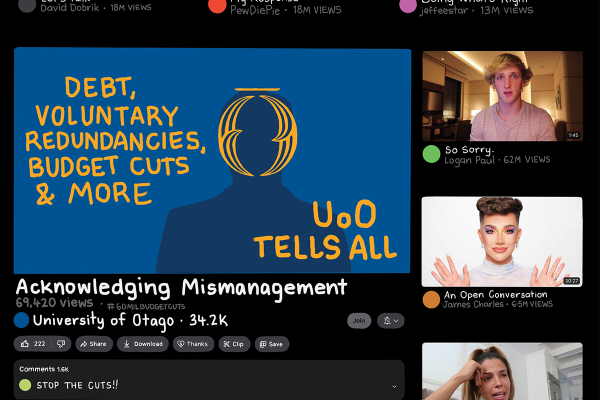
Are you having trouble with your online image? Finding that your comment section is more shame than fame? If you’ve done something to get yourself cancelled it can be hard to navigate the digital experience. That’s why a tried-and-true method to cleanse yourself of all wrongdoing is the classic apology video. Think Logan Paul apologising for filming the suicide forest. David Dobrik posting “let’s talk” while turning off the comments. Colleen Ballinger’s ukulele-filled apology from hell. That sort of thing. It literally can’t go wrong because deep down, you’re perfect. You just made a little oopsie and now people are thinking about it a little too much. Nothing that some crocodile tears won’t fix. Luckily for you, you’re a student at Otago, so you have everything you need right at your fingertips. Be sure to take the following papers if you ever want to succeed online. Essential Classes: English131 Controversial Classics You will obviously need to take an English paper. Writing a convincing script is important in order to convey your message, whether that be rage or regret. Sometimes both! This paper is perfect for you. It tackles classics: controversial classics. Paradise Lost, Lolita, and The Picture of Dorian Gray, just to name a few. You’ll need to learn how the greats did it before you. Heck, in a way, these books are the original apology videos. They tackle heavy themes that society typically doesn’t like to talk about. They present their ideas effectively and dare to be so bold in sharing their otherwise diabolical perspectives… sound familiar? This class is essential and must be paid attention to at all costs. If you really seek to write the most baller of YouTube apology videos, then your only hope is Oscar Wilde. Theatre151 Improvisation Improv! Obviously, improv is a must. The power to cry on command is possibly the greatest gift one could have. It's not enough in this day and age to just look down sadly. No: you need tears. Delicious, salty tears. Will anyone really be mad at you if you sob like a child? Exactly. In fact, theatre really should be your major. Media102 Media, Power, Society In order to succeed in your message, one needs to know how to structure and design your video from top to bottom. From thumbnails to music to editing, you need to know how to make your message carry. Your crocodile tears can only go so far. This class teaches you about the power the media carries through our society. Specifically, though, social media. Jackpot! This course acts as a how-to on making a certain audience feel the way you need them to feel. Like for example… a baller title? Think back to any of the great apology videos. So many memorable titles like, “Hi”, “Let’s talk”, “I’m sorry” and my personal favourite, “I think I’ve messed up”. Only true masters of media could possibly arrange such a collection of words. With a working knowledge of media and all her mysteries, you could get away with murder. Maybe some already have. Psychology204 Justice, Race and Class Last but not least: Psychology, of course. Think of any great figure in history. Patrick Bateman, Annie Wilkes, Billy Loomis: these people got it. They understood how to prey on people's emotions, and to convince people of their overwhelming innocence. Of course, you didn’t do anything wrong to begin with. But just in case, the mind is a powerful thing. It is your job, as a respectable YouTuber, to know how to control them in mass numbers. Just look at that Markiplier, do you think anyone would actually watch that stuff on their own accord? Get real. It’s simple, really. If you follow these few steps you are well and truly on your way to the best YouTube apology video this world has ever seen. Side note, though, you may want to try taking some singing lessons, maybe a bit of guitar on the side. It’s not essential, but studies have shown that people are very easily swayed by song and dance.
-
TOP Leader Raf Manji: On Despondency, Political Potential, and Progressivism
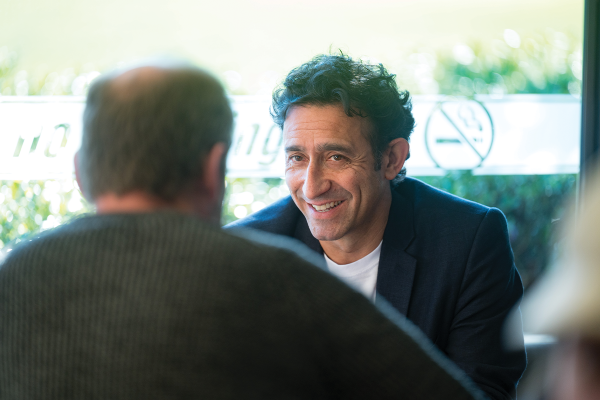
The Opportunities Party Leader Raf Maji is sort of like that international student who showed up in your Geology class one afternoon: you aren’t too sure who he is or where he came from, but he seems pretty cool and is giving all the other popular kids a run for their money. While TOP has yet to enter Parliament, this election season, Raf Manji has the potential to stage Aotearoa’s newest political upset. Originally working for non-profits and volunteering with the Student Volunteer Army, Raf’s main motivation for getting into politics was due to the Christchurch earthquakes and the devastation that had shaken the place he called home. Raf was elected to the Christchurch City Council in 2013 as an independent councillor, and continued his political journey by standing as an independent candidate for Ilam in the 2017 general election. Raf decided to leave politics in 2019 to focus on working for the March 15th Response after the Christchurch Mosque Attack, but was approached by The Opportunities Party in late 2021. “I did have conversations with people about other parties, but what I liked about TOP was that it had a more independent and partisan approach to politics which is where my space is,” he explains. “With some of the other parties you feel like you have to give up a bit of your soul to join them, but with TOP, there’s a focus on outcomes and policy that works and a more collaborative approach to politics. The world is complex and not binary, and we need parties that can look at things like that.” In terms of election atmosphere, Raf thinks that the current state of political affairs have left people in a state of “despondency,” and that major parties are lacking the vision required to improve things in Aotearoa. Relatable, Raf. “If you go back to 2017, it was potentially going to be a National Government, but Winston upset the apple cart and decided to pick Labour and go into confidence with the Greens,” he says. “When it came to Covid in 2020, things had shifted. New Zealand First had fallen out of love with Labour, they weren’t really talking, then the Jacinda wave came through and everyone thought she did really well. I think now we’re at the other side of that conversation and everyone is pretty hacked off with the government, so the pendulum is swinging,” says Raf. “I don’t think there is any great vision from the future… I don’t remember an election where people have been less politically engaged, but also more worried about the future.” With election campaigning in full swing, Raf says that while people are feeling uninspired by what the major parties are offering, getting people to see the power of minority parties has still been a challenge. “I am having conversations everyday with people saying ‘Oh, we did the vote compass and came up with TOP, but we didn’t know much about you’. It shows people are open to other perspectives and ideas,” he says. “People are saying ‘I’d vote for TOP if you were in Parliament,’ and polling indicates we have the 8 to 10 percent party vote out there, but we can’t get there without those votes.” Raf also mentions that TOP’s commitment to bi-partisanship makes them a compelling party as they’re willing to be a progressive option that could work with National or Labour depending on the results that filter in. So, with all this talk of despondency and dismissal, what exactly is TOP offering young people that other major parties aren’t? “We need to start to invest in our young people, and get an understanding of what it means to be a citizen when we’re going to face big complex challenges,” he says. One of TOP’s core policies is the Teal Card: similar to the Gold Card for retirees, but for young people. The card would assist with getting access and discounts towards health care, mental health support and public transport. Raf also mentions that TOP wants to create more financial equity for young people, as we’re often shut out when it comes to talk around home ownership and renting. “I want to push financial literacy, and make sure that every child gets an IRD number, a national health number, a bank account, a Kiwisaver account set up. I think if you get the first five years right, you’re on the road to success, and investing upfront saves money downstream,” he explains. In terms of his advice for young voters or those undecided this election, Raf kept it simple: “This election, don’t worry how it’s going to work out. It’s going to be pretty messy, look at the parties, and just vote.”
-
Local Candidates Debate: A Summary
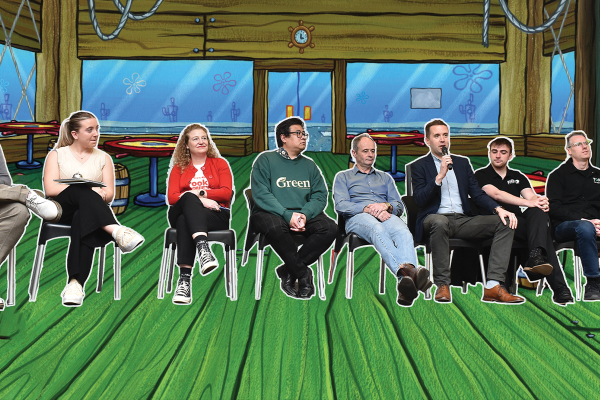
With all major parties (bar ACT, surprisingly enough) wanting a slice of the student voting pie, OUSA in conjunction with POLSA hosted a high-octane debate in the union hall at 1pm last Wednesday. The result was largely underwhelming, as candidates showed the utmost respect for one another in attempts to save face for their parties. Boo, get the claws out next time. Still, there were a few golden moments in the one-and-a-half hours of unceasing yarns, moments which Critic Te Ārohi will feed back to you in a cryptic fashion leaving you more confused than you were before the article started. The dogs in the fight were Labour’s Rachel Brooking, Green’s Francisco Hernandez, the independent Jim O’Malley, National’s James Christmas, NZ First’s Keegan Langeveld, and TOP’s Ben Peters. One curious omission from the debate was National’s Dunedin candidate Michael Woodhouse, who has been a bit AWOL since he removed himself from the party list earlier this year. Also sorely missed was New Conservative’s Paul Deacon, who at a OUDSA (debating club) debate the Friday prior got the whole squad laughing when he bluntly announced climate change was an ideological ploy designed by the government. Good chat bro. Keeping the candidates honest was OUSA President Quintin Jane alongside POLSA’s (politics club) Lily Stock, who were tasked with the all-important job of heartily tapping the bell when the candidates spent too much time speaking. Quintin also intervened when a member of the crowd asked candidates, “What is a woman?” stopping Peters from speaking in efforts to preserve the sanctity of all members of the crowd. Slay Quintin. Aside from this question, the crowd mostly sought to ascertain policies on wealth and climate, bluntly voicing the rage of an indentured student community. James Christmas also blushed when asked to fess up about the whereabouts of his Dunedin paramore. In general questioning, each party was given plenty of breathing room to speak about policy on tax, climate, and housing. The person with the most breathing room was independent Jim O’Malley, who was free to wax lyrically about the evils of neoliberalism without having to stick to party policy. Ben Peters also shared a similar advantage, taking the time to inform the audience that “Dunedin is a flat city, other than the hills themselves.” The people who got the least speaking room were representatives of the Electoral Commission and Generation Vote who sat idly beside the main stage, pleading silently to audiences that they should probably enrol at some point. As such, the audience generally took to the minor parties, though the Greens got the greatest hoots of support. It’s hard to say who won. Was the real winner at the end of the day then perhaps debating itself? Probably not. See below to have your take on the matter. On the matter of housing, Labour’s Rachel Brooking said “we plan to build 27,000 for 2027.” Ah, isn’t it great that dreams are free? Greens’ Fran Hernandez said that “we side with renters” and that the party “supports a landlord register.” Independent O’Malley said that “housing is a right” and that us nomadic students are “living a transient life.” James Christmas, whose name would suggest ample knowledge about the intricacies of indoor heating, took a page out of the National Party handbook and said that “it’s a supply issue.” We did not ask him anything about chimneys, or if it would be possible to stave off the winter cold by supplying students with their annual coal allowances in July, rather than the Northern Hemisphere-centric December, when coal is pretty useless. To finish the housing part off, Peters touted the benefits of a land value tax. Then, the topic on everybody’s mind: taxes. Labour has ruled out a capital gains and wealth tax, so everyone is wondering how the fuck we’re meant to be funding public services. Brooking contended that there is “bipartisan support in our tax system,” while Hernandez fired back by saying that we need to “redistribute wealth so we can properly fund the services we need to.” O’Malley echoed a similar sentiment, saying that “wealth is accumulating at the top of our society, and we need to bring it back.” Christmas didn’t offer up much apart from “Muldoon was basically a socialist,” which is… certainly a take. Langeveld mentioned “the books are in bad shape”, and Peters refined his earlier statement, saying that he’s all about “a tax on land, specifically.” Now, for the most highly anticipated and existential question of our generation: climate change. Brooking started off by saying that “the ocean is a wonderful place,” and she’s so real for that. She also mentioned the importance of “fishing controls and marine reserves.” Hernandez wasted no time to spark anxiety, saying “we’re living in a climate emergency” and that we “needed to save 30 percent of our ocean for reserves by 2030.” O’Malley kept it simple, saying “get us some help,” with Christmas saying we needed to “rapidly increase the production of renewable energy” which is ironic coming from a party who wants to repeal the ban on offshore oil and gas exploration. Langeveld mentioned something about “farm-level reporting emissions.” Peters said we needed to “increase public transport and city density” and that it was important to “cap total emissions.” And that was about that.