

Abraham Lincoln: Vampire Hunter unsurprisingly revolves around Abraham Lincoln, the 16th president of the United States. During his childhood Lincoln witnesses the death of his mother at the hands of a vampire. Nine years later, he makes the acquaintance of a man named Henry Sturgess. Henry makes a deal with Abe: he will teach him all he needs to know about vampire extermination if Abe promises not to seek vengeance for his mother’s death.
Armed with a silver plated axe (surprisingly useful) and the knowledge he gains from his mentor, Lincoln relocates to Springfield, where he works as a store clerk by day and hunts vampires by night. Many years later he becomes the president of the US, leaving his vampire-hunting days behind until he finds out that the Confederate forces have enlisted the help of vampires to help them defeat the Union. To stop Civil War-era America from being taken over by the walking dead, he embarks on a secret mission to defeat them.
I went into this movie with mixed emotions. Abraham Lincoln, arguably the greatest American president, leading a secret life as a vampire hunter? Really? However, this movie delivers exactly what you would expect from its title. It’s a ridiculous and over-the-top action/horror flick. The action scenes were very well done, and the CGI was entertaining to say the least. I highly recommend watching the film in 3D — the last action scene alone is worth paying the extra cash. If you do end up seeing the film, don’t expect any historical accuracy. Just watch in amazement as Abraham Lincoln decapitates vampires for the good of the nation.
3.5 / 5 stars

Culture
More Culture from Issue 21
-
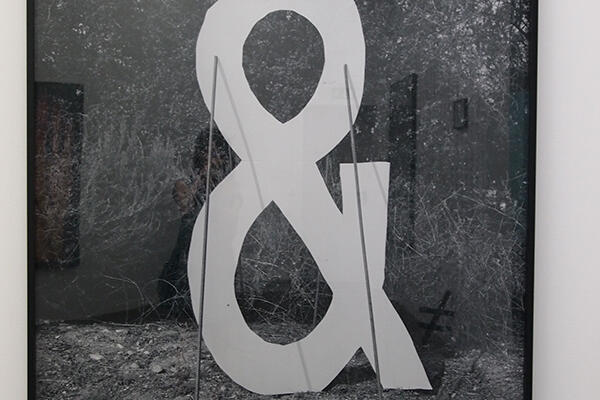
EX, WAI & ZEE
www.bit.ly/IOJCZj It was pretty much inevitable that this exhibition would interest me, considering that it deals with two of my favourite topics: language (hello, English major) and art (hello, editor of what section again?). On a very basic level, it might appear that words and images are rather dissimilar modes of communication. While we use both to convey information in our everyday lives, they function quite differently: words paint a picture figuratively, images literally. Ecstatic Alphabets/Heaps of Language is a collection of artworks that seeks to disrupt this very convention, forcing us to cast aside our deeply ingrained presumptions of how these two mediums co-exist and interact. Words and images accompany each other in anything from advertisements to storybooks to newspapers and magazines, but it isn’t often they combine with a whole new dialectical significance. And yet this is exactly what Ecstatic Alphabets does. The exhibition brings together artworks from a wide range of international artists, divided into historical and contemporary groups. The historical pieces explore the fascination with language that developed in Europe in the twentieth century, examining how artists and poets began to experiment with using language in an increasingly visual manner. Random words, abrupt sentences and oddly fragmented phrases intersect in space, arranged and ordered in seemingly bizarre ways. This prompts us to question exactly how we make sense through language: how literary history has dictated our modes of understanding and interpreting words and their meanings. Filippo Tommaso Marinetti’s Vive la France features his signature phrase “zang tumb tuuuuuuuuuuuum” repeated in varying sizes and styles across the canvas, layered across and over one another in complex formations. The dizzying pattern the viewer’s eye follows across the artwork invokes the onomatopoeic nature of the peculiar phrase, emphasising its verbal and visual qualities. The contemporary collection of pieces for the exhibition continues to discover new horizons in word and picture play — “language is boldly cut off from literature, received meanings, and, in some cases, the duties of communication altogether.” Contemporary artists experimenting with language and art increasingly utilise sculpture, collage, and print to create new expressions of dual meaning. The fascinating artwork Found Fount: Wild Asters by Paul Elliman is an ongoing project that aims to create a system for explaining the world (much in the way words do) using objects already present in the world. At first glance, Elliman’s artwork does not so much resemble art or language as it does an arbitrary assortment of pieces of jewelry. However, the collection of rhinestones, lucite, silver and other materials actually constitute a kind of font, where no “letter” or character is used more than once. The work urges us to reconsider our use of language by offering a font is that doesn’t invoke our own familiar alphabet but is nevertheless a system of visual communication. Apart from the whole deep-thinking, reconfiguration-of-all-our-notions side of it, the exhibition itself is highly visually stimulating, with a lot of works that are simply fun to look at and encourage us to ponder the playful interplay of words and pictures. One of my favourites from the entire collection is Tauba Auerbach’s How to Spell the Alphabet, which simply spells the alphabet phonetically from A — Z. Wonder if my lecturers would object to me sneaking in a cheeky “dubblyew” instead of “W” in an essay? I’ll keep you posted.
-
The Art of Fielding
The Art of Fielding reads like a wicked change-up. The pages flip fast as the narrative creeps closer to the plate, but as the crux of the novel draws near it’s difficult to judge the arch the themes arrive on. Is Chad Harbach’s debut novel about baseball or a University campus? Has he revamped Jonathan Franzen’s brand of psychological realism found in The Corrections, or does his accessible page-turner border on young adult fiction? Is the title a metaphor? Is it another application of Buddhist pedagogy to western pastimes in an attempt at an enlightening read? Is it a gay novel? All valid questions. The power of the change-up is deception; a good pitcher knows what the batter wants. A great novelist is a master of invoking empathy. Harbach achieves this connection with the reader through carefully developing emotional complexity in his characters. Their vulnerability is genuine. They feel the gravity of modern day predicaments, and struggle to make sense of their individual validity when unclipped from their crutch, be it a university, a team, or a husband. They keep going despite the staggering weight of failure. Much like Samuel Beckett’s ending line to Unnamable — “you must go on, I can't go on, I'll go on” — the characters scrape through the story, just as we drag ourselves through our daily lives. Henry Skrimshander steps to the plate. The “scrawny novelty of a shortstop” didn’t have a hope of playing college ball until Mike Schwartz, a heavy-drinking jock with a bad knee, scouts him after a baseball game during summer break. Schwartz witnesses perfection in motion: “The kid glided in front of the first grounder, accepted the ball into his glove with a lazy grace, pivoted, and threw to first… his motion was languid, the ball seemed to explode off his fingertips...” By fall Skrimshander is enrolled at Westish, a fictional University located “in the crook of the baseball glove that is Wisconsin”. Henry’s perfection jostles with the cast of heroes who live on campus with him. His roommate Owen Dunne introduces himself to Henry with an ironic “I’ll be your gay mulatto roommate.” The lonely and aging president of the college, Guert Affenlight, straight before he lays eyes on “the beautiful Owen”, begins a secretive love affair with the young student. The affair drastically reduces the amount of attention Affenlight allots to his daughter, Pella, who has just moved back home after leaving her husband. The sturdy support that Mike Schwartz offers Henry is crushed when he fails to gain admission to law school. With his future compromised, Schwartz turns his attention to Pella rather than support Henry, who is assured a bright future. However, when Henry makes a mistake on the field, Harbach finds his opening and brilliantly weaves the personal relationships of his characters around Henry’s struggle to perform under pressure. Perfection as an attainable goal to strive for is severely questioned in the novel. Performing in the competitive “real world” exposes the fears of Henry’s supporting cast, but also shows their advantages over him. The exchange of the perfectionist’s quest to find worth outside of statistical brilliance, and the struggle of the flawed, injured or marginalised to stay on their feet in a time of transition and/or crisis, unite the heroes to metaphorically express the duality of a baseball team: a group under one banner that must possess the particular skill sets required to perform the tasks that define their individual positions for the good of the team. We empathise with the characters because they symbolise the juxtaposition between the individual self and the self as a social being. When the crux arrives and the themes finally begin to solidify amongst the jubilation of a Westish Harpooner’s tournament victory, the narrator laments: “If Henry were here, Henry’s joy would be total, his holy-fool dancing would put the Buddha’s to shame, but Henry wasn’t here. He hadn’t pushed through that one last barrier, his fear of succeeding, beyond which the world lay totally open to him.” Harbach’s captivating, charming and deeply sensitive novel avoids the myriad clichés of the typical baseball story to create something much deeper and more timeless.
-

Passages
In the past few years, Allen Hall Theatre has made a name for itself in the verbatim theatre world. Hilary Halba and Stuart Young have championed this contemporary theatre form in Otago, recently showcasing a trilogy of incredibly touching works: Gathered in Confidence, Hush, and Be | Longing. This year’s 400-level Documentary Theatre class, one that is only offered every four or five years, brings their latest creation to the stage. Passages tells the story of a variety of people, from children to parents, reflecting on moments of transition in their lives: “We just said, ‘Tell us about a right of passage in your life,’ and people have just come up with so many different things.” I met with some of the actors in the piece, Alayne Dick, Jakub Green, and Olivia Kelsey, to discuss the ins and outs of this refreshing new genre, and the challenges they faced in performing something so original. “It is a very new form [of theatre]. I think the earliest official documentary theatre only came out in the sixties, and that’s not what we’re doing now. We’re using iPods and you have to memorise everything they say and how they say it. Every mannerism, you have to do it perfectly,” Green says. On those people who don’t understand why one would choose theatre over film, Kelsey explains: “I personally love [film] documentaries, and I didn’t really know much about documentary theatre. I think when you get to 300-level theatre you’ve studied a lot of Stanislavski, you’ve studied a lot of Chekhov, and they kind of morph in to one type of acting, whereas this is almost completely contradictory. It’s completely technical, which is something we haven’t really explored before with theatre.” Green agrees: “Collecting information and thinking of a topic is similar to doing a film, but when it comes to acting documentary theatre, it’s very different to acting out any other type of theatre, because things that you are previously taught about getting in touch with the emotion of your characters, spontaneity, improvisation, are not things that apply at all, or certainly not to our type of documentary theatre.” This style of acting is vastly different to “normal” acting. Kelsey comments, “You press play. That’s how you get in to the character. It’s an incredibly draining rehearsal process. Everything is incredibly specific, like where is this finger in relation to the other one? Personally, I can’t do it for more than 20 minutes because I get too drained.” Preparation for the production has been lengthy, starting in February, so it’s no wonder it’s exhausting. “Sometimes it’s easy to get pedantic, but then other times it’s like Chinese water torture, and it’s really hard to put up with it for too long.” However, Kelsey assures us there’s a rewarding side to it as well. “I’ve seen it a million times, but every time we watch it it’s still interesting to me and I still laugh at the bits that are funny. Even though it’s very technical it still has the power to affect us. You’re playing with peoples’ lives. It’s not a character that’s been written by a playwright, that’s an actual person. And you’ve got to be careful.” It’s an understandable concern, but I’m certain this talented group of actors will put on a tasteful and entertaining piece of theatre for us to enjoy. How will verbatim theatre progress at Otago? Watch this space!
-

Baldur’s Gate I and II: Enhanced Editions
Developer: Overhaul Games (Bioware) Genre: Role-playing Platforms: PC, iPad, OSX, Android (tablets) Baldur’s Gate: Enhanced Edition is a satisfactorily vague title for a massive overhaul. It’s an obvious attempt to smooth out all the lumpy bumps between the two games and two expansions that are the project’s constituent parts. Re-jigging developers Overhaul Games are marrying the free-roaming wilderness areas from the original game with the vibrant creativity and dramatic interactions of incredibly likable characters from its sequel. Even on the game’s official website, very few mentions are made of where the vast number of alterations and enhancements will be found in the context of the saga. This is an edition of the 12-year-old saga of games that aims to be as smooth as the iPad screens that will be running it in September. A Nineties audience more used to The Fresh Prince of Bel-Air must have appreciated the first Baldur’s Gate, which made the rigmarole of Advanced Dungeons and Dragons die-rolls and character development accessible to a contemporary audience. The game world is a mosaic of wilderness areas, which must be traversed to reach a civilised area. There is a sense of discovery, the kind that games like Skyrim are entirely made up of, that comes from striding off the beaten path and finding a happy fisherman or an angry giant bug. The second game is remarkable for artistic reasons. Playing modern blockbuster RPGs, think Skyrim, tends to be associated with a wealth of recycled assets. For instance, a quest might begin: “Oh my, I’m being embezzled by thieves, you’d better go retrieve my anti-embezzlement goat-horn from a barrow full of draugr.” Or: “ My word, I’m deeply in love with the goat herder’s daughter. Could you go retrieve my goat-horn-of-love from a rickety barrow full of draugr?” It’s understandable – in these fully realised 3D worlds, a single unique room is incredibly resource intensive. In Baldur’s Gate II, creating a new room was an afternoon’s work. The 2D levels are all hand-painted. The entirety of all four games is effectively one gigantic, richly detailed canvas. Every stroke of every brush is evocative. It’s an economical way to design a game, because your imagination does all of the work — rendering each speck of dust on a tavern’s bench top and every shadow cast by an iridescent crystal — so the game’s engine doesn’t need to. Each of Baldur’s Gate II’s enormous dungeons is unique and fully realised. The prison that opens the game is, superficially, very typical – it’s an actual dungeon after all, fully decked out with rusty shackles and icy cobble. But after exploring it further, melancholy subtleties start to emerge. Beautiful rooms reveal an element of the antagonist’s character. The whole game is integrated – it’s not just combat sections partitioned away from storytelling bits by a shadowy entrance to a cave. Puzzles are there for a narrative or character-building reason. At least three new characters are being added with their accompanying quest lines (12 hours of content at least), as well as original quest lines and over 400 small modifications to tighten up the interface and the combat.
-

Tone Deaf
I don’t play any musical instruments. I’m uncoordinated, have short arms, and despise sucking at something I don’t have an inherent knack for. Basically, I can’t get over my fear of failing at something I love so much. This is one aspect of me, and one aspect of my relationship with music. Another aspect of it is that I am going deaf. It’s a cruel irony for sure, but it’s my own fault. Music sounds better loud. While I’m very self-conscious about these two things, thinking about them makes me wonder what qualifies me to soap-box my passion of music to others. The fact is, I don’t necessarily have a qualification any more than your average person on the street listening to their iPod does, other than the fact that I’ve been listening to music for a very, very long time. But haven’t we all? I don’t want to be all preachy and pretentious because there’s enough of that going around, so I endeavour to earnestly portray what music means to me. Before writing this piece, I was given a rough guideline of what to say. Write about your love of music, they said. It’ll be fun, they said. Therein lies the rub. I’ve been humming and hawing about what needs to be said, but it’s my fear of not doing it justice, my fear of failing, that cripples me with anxiety that it won’t be as good as I think it needs to be. 750 words isn’t nearly enough space to write about why the 22,000-odd songs that fill my laptop mean so much to me. I like to think that my vast music collection shows I’m a person who is aurally versatile; that my taste and preferences are in a perpetual state of learning and revision. I’m wise enough to know that there are different strokes for different folks, and you should never bag on someone because they love a genre of music you hate. No one is too cool; there’s always a right time and place. When I purchased Justice’s † in 2007, I was repulsed by 90% of the tracks on the album. Interestingly enough, it’s now my favorite record of all time. I was 17 then, now I’m 22. We’ve all been emotionally charged, angst-ridden teenagers, and no doubt we’ve all had moments of pious derision when we see someone bobbing along with their headphones, thinking what an asshat they look like. I’ve teared up in poignant moments in a Wes Anderson film when Sigur Rós is playing in the background, but I’ve also waited angrily at train stations listening to Queens of the Stone Age, glaring at old people while truly believing that they didn’t “get it”. I’m also certain we’ve all been frenzied and wild-eyed at gigs at 5am, when The Chemical Brothers are blaring with an intensity that makes you feel like your brain is leaking out of your ears and your heart will explode. It’s hard to capture the essence of these moments, to elaborate upon them to express how they made you feel in the right context so that others will nod enthusiastically, telling you with a huge grin, “Fucking aye man, that’s it!” Music is emotionally charged, dammit! It’s often said that those who can, do; those who can’t, teach. This is especially pertinent to me. Since I can’t express my passion with a kick and snare, I cheerily head to Radio One twice a week to host shows and spin music that makes me feel happy and that I think listeners will enjoy. This is my way of expressing myself in the manner most befitting to me. Additionally, every Tuesday I drag a fat sack of vinyl down to Refuel for the open deck night, which is hosted by the Fat Controller’s Club. I can’t mix — I’m no Tiesto, and I don’t have the stage presence of Skrillex — but this is irrelevant. These nights are always fantastic, and provide me with the opportunity to get over my performance anxiety and play music for music’s sake, to do what I love to do alongside the super-friendly crowd of music enthusiasts that I’ve connected with over the shared love of musical expression and the smiles that brings. The best part is that there’s not a shred of pretense to be found. Coming from someone as self-conscious as I am, that means a whole lot.
-

Braised Leeks with Sweet Lentils and Gravy
Leeks are phenomenally cheap at the moment, and are a great flavour base for meals. Typically I would slice the whites into rounds and add them to risotto or pasta. This recipe, from spectacular food blog Sprouted Kitchen, honours the otherwise humble vegetable and makes them the protagonist of the dish. Buttery leeks are paired with sweet, tangy lentils, crunchy breadcrumbs, and a gravy whisked up from the cooking liquid. Ingredients25g butter 4 tbs extra virgin olive oil ½ tsp salt 3 leeks 1 ½ cups liquid beef stock ½ cup water 2 cups brown lentils ½ tsp salt 3 tbs extra virgin olive oil 1 — 3 tbs rice wine vinegar Small handful soft brown sugar Freshly ground black pepper 1 tbs butter, melted 1 tbs white flour 1/3 cup panko crumbs, or regular breadcrumbs, lightly toasted Small handful of roughly chopped fresh coriander, basil or parsley (optional) Method01 | Remove the green parts from the leeks, and slice the tough part of the bottoms off. Slice the leeks in half lengthwise and rinse with cold water to remove any dirt. 02 | Melt the first measure of butter, olive oil, and salt together in a large, deep frypan. Add the leeks, cut side down, and cook until golden brown. Turn over and cook until the other side is golden brown. Pour over the beef stock and water. Adjust the heat if necessary to allow the liquid to come to a gentle boil, then partially cover and reduce to a gentle simmer. Cook the leeks for 20 — 30 minutes, or until soft. 03 | Meanwhile, place the lentils in a large saucepan and cover with 3 cups of water and the second measure of salt. Bring to the boil and cook until just soft. If the water evaporates while the lentils are still hard, add a little more water. If there is any water left in the pot when the lentils reach the desired texture, simply turn the heat up and cook the excess water off. I like my lentils with some bite to them. Do whatever works for you. 04 | Heat the second measure of olive oil in a large, deep frypan. Add the lentils and cook over a high heat for one minute, stirring occasionally. Add a small measure of the rice wine vinegar – say, one tablespoon – and the soft brown sugar. Stir for a further minute or two over the heat, adding more rice vinegar until its tanginess is balanced with the sweetness from the sugar. 05 | Mix the flour into the second measure of melted butter. Remove the leeks from the pan and transfer them to serving plates. Whisk the flour mixture into the cooking liquid from the leeks. Turn the heat up and stir constantly until you have a delicious, thick gravy. Add salt and pepper to taste. 06 | Place the lentils on top of the leeks. Pour the gravy over, followed by the breadcrumbs and fresh herbs. Serves five people for around $12. Photo courtesy James Stringer
-
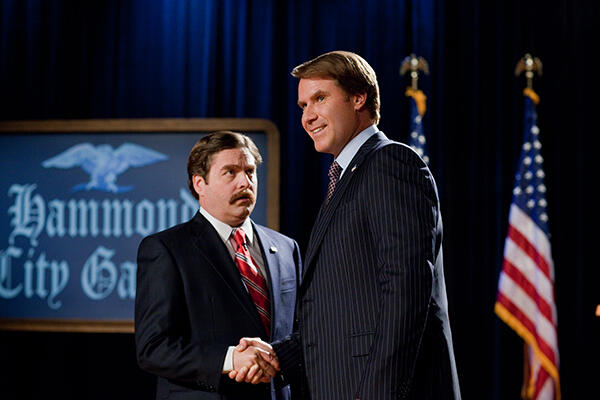
The Campaign
The Campaign pits Will Farrell against Zach Galifianakis in a vulgar, violent, and ferocious political satire that will leave Will Farrell fans laughing out loud for an one-and-a-half hours straight, and everyone else disgusted and disturbed. Will Farrell is Cam Brady, the slimy, long-unopposed congressman of the 14th District of North Carolina. Leading into the upcoming election an obscene phone call to the wrong person sees his approval ratings drop drastically, and high-powered business owners the Mitch Brothers (John Lithgow and Dan Akroyd) rush in with a puppet candidate of their own, Marty Higgins (Galifianakis), to challenge him. Higgins is the naïve and effeminate director of the local tourism center, and is putty in the hands of the devious Mitch brothers and their brilliant campaign manager Tom Wattley (Dylan McDermott). The stage is set for two over-the-top smear campaigns, which are both hilarious and scarily realistic at the same time. The Campaign brazenly humiliates real-life politicians through thinly veiled analogies. Though it never really makes a point or sends any relevant messages, it does, in its own warped way, put a spotlight on the current corporate interest-driven nature of politics. The film is far funnier than Ferrell’s Talladega Nights but never reaches Old School or Anchorman levels. Ferrell is the same as always, and Galifianakis is actually very funny and does a great job developing the character of eccentric Marty Higgins. If you’ve seen either of these guys in a movie before, you’ll know what to expect from The Campaign. Keep your expectations around the level of The Hangover or Blades of Glory and you won’t be disappointed. 3 / 5 stars
-
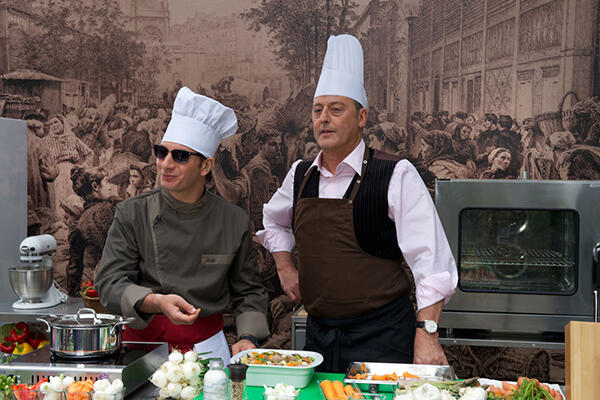
Le Chef
French comedy Le Chef follows the struggles of veteran chef Alexandre (Jean Reno) and his second in command Jacky (Michael Youn) as they try to juggle home life with their love of cooking. This tricky situation is further exacerbated by the interfering son of Alexandre’s retired business partner trying to shut down their restaurant. I have to admit that I didn’t expect much when I went to see this film, and to be honest, I wasn’t blown away. Le Chef’s storyline was average at best, and reminded me quite a bit of Ratatouille and The Mighty Ducks. The film’s strengths lay in its in its portrayal of the characters and the subtle build-up of humour throughout. Halfway through the film things started to get extremely weird, as though the director had spontaneously dropped a couple of tabs of acid. The chefs got really into a new style of food, “molecular gastronomy”, involving mixing liquid nitrogen into food and breaking down duck into cubes which tasted like raspberry. It was all a bit too Willy Wonka’s Chocolate Factory for me. I enjoyed this film, but it’s not something I’ll be watching again anytime soon — once was enough. Definitely check out Le Chef if you are a fan of cooking, or you just want to watch an enjoyable movie. 4 / 5 stars
-

Step Up 4: Miami Heat
In the fourth installment of the Step Up franchise, we find ourselves in Miami (which means lots of bikinis and bleached hair). We meet Emily, the daughter of a wealthy property shark (Hollywood veteran Peter Gallagher), who falls for Ryan, a guy from the wrong side of the tracks. Shockingly, Ryan has also got a bit of thing for Emily, whose father is soon to bowl down a whole community to put up a strip mall. Budding romance aside, this is primarily a dance film with a backdrop of protest and demonstration against corporate greed and consumerism. Emily joins a somewhat anarchical dance group called “The Mob” who stage large-scale stunts in public places. The Mob soon takes on a political agenda and their dances become political statements, voicing concerns similar to those of the Occupy movement. The romantic undertones leave a lot to be desired, and are a far cry from the starry-eyed chemistry of Channing Tatum and Jenna Dewan in the first film. However, the dancing is not lacking in sauciness, and at times borders on R-rated. The movie isn’t heavy or emotionally draining, and what it lacks in dialogue and plot it certainly makes up for in dance numbers. It is rather obvious that the actors involved were picked for their dancing rather than their dramatic abilities. However, if you’re looking for a couple of hours of light entertainment with maximal dancing and minimal storyline, you will definitely enjoy this film. If you don’t like dance movies, it goes without saying that you should sit this one out. 4 / 5 stars


