A message for the 2024 Otago Student Cohort
Last week, we reported on a flat initiation involving a live eel. Since then, the ODT and NZ Herald have picked up the story, police have been informed, and an investigation by the Uni (who knew about the incident prior to publication) is underway. A minority of students defend the initiation in the name of “good fun”, while the majority have never, and will never, engage in one. There is mounting concern among many, chiefly the Proctor, over the escalating severity of initiations. Critic spoke to the Proctor, who explained that over his seven years in the role, initiations have evolved. But they’re not actually tradition: “Students say it's been around for 50, maybe 100 years. It’s not, it’s maybe 15 years old.” Despite this, students involved ardently defend the activities - though they’re not quick to put their names, faces or addresses on record. Wonder why. One of them commented to Critic that they think “the Proctor’s been really harsh about it all.” In response, the Proctor said, “I’d rather be seen by students as trying to ruin their fun than sit back and wait for someone to die.” The Proctor said initiations had subsided a bit with Covid, but this year they’ve been “back with a vengeance… What seems to happen is that year on year the events are added to, so if one year the host flat did A, B and C, year two it’s A, B, C, D and E and then we get to a point where it’s really dangerous and really feral and we’re harming people.” Or, in some cases, animals. But, even considering the chugging of vomit, the beatings, the hospital trips and stomach pumps, “At the end of the day everyone is enjoying themselves,” said one student. The Proctor also gave us a copy of a letter penned to flats who plan on hosting initiations. In it, he points out the section of the Student Code of Conduct relating to initiations that reads: “Organising or participating in any initiation event or ceremony that jeopardises your fellow students’ wellbeing, personal, physical or emotional safety, or encourages breaking the law” are among behaviours that “put you in serious risk of facing exclusion from the University for a semester or more”. This is part of a “proactive approach” initiative that was sparked after 2017 when a vomit-filled Debacle initiation made national headlines and saw the nine hosts expelled from the Uni. It resulted in what Critic reported on at the time as a “crackdown” on initiations by the Uni. The Proctor told us that this was opposed to “sitting at the bottom of the cliff and waiting for them to crash - let’s get to the top of the cliff and put some barriers up.” “So we go and have a conversation about the expectations, we provide them with a copy of the Student Code of Conduct, and then this year we followed up with an email to the flat.” The email contains the foreboding statement that “there is genuine concern that one of these events will result in serious harm or death.” “If we have a really bad event and a student dies - has an anaphylactic shock to something that they’re forced to eat, or dies of alcohol poisoning or whatever - who's gonna be investigated? The host flat [will be], and that'll be for a manslaughter charge,” said the Proctor. “And I don't want that. I don't want the death, and I don't want the flat investigated.” He has heard more rumours than evidence, and he said that this year especially, the stories are starting to take a toll. But “I will sleep quite well at night knowing that I'm doing this work. And I'll make no apologies for it. It's not a tradition. I don't think it reflects our students at all.” And as media coverage creates scrutiny, many initiations have moved indoors or into backyards, away from public view. There is still a group of onlookers present, who are generally encouraged to bring shit to throw at the first-years. Last year, an egg cost one student the better part of his eye. “It worries me that that’s how we can treat our own,” said the Proctor. “Our first-year students are less than a year’s difference in age, and yet it gives the second-year students permission to bully, intimidate, humiliate, degrade.” Another major concern is the power imbalance between the second and first-years meaning that even if they wanted to, they couldn’t say no to being subjected to these events that entail “humiliation, nudity, bodily fluids, bullying, intimidation or harassment” because of the immense pressure coming from the second-years and their fellow initiates. “And then you add a hundred people in the crowd who are encouraging and love the debauchery and the salacious nature of it. And sometimes that can be a catalyst for the hosts losing control of it and things spiral quickly out of control.” It’s like our very own fucked up version of Lord of the Flies. Besides the initiation we know involved cruelty to a live eel (that carries a maximum sentence of five years prison and hefty fine, mind you) there have also been rumours going around that some initiates may have been or will be asked to bring live ducks. And considering recent events, it’s not outside the realm of possibility. “Absolutely no good could ever come of this,” said the Proctor. “I don’t think it reflects who we are.”
The University is advertising for a new Vice Chancellor. Again. Someone has to take up the mantle and lead this struggling institution through tough times, so we at Critic Te Ārohi figured we’d throw our name in the hat. After all, nobody knows Dunedin like we do. Here’s what we sent in.....
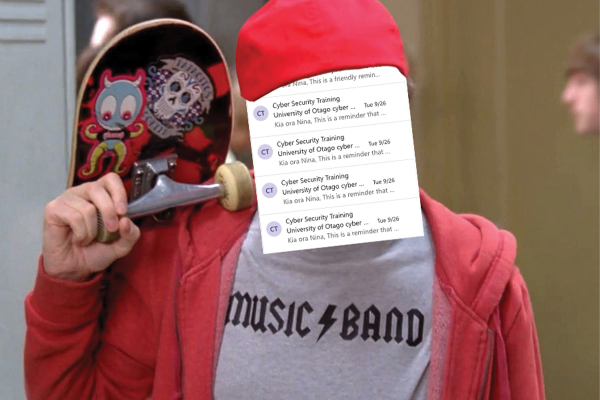
If you've looked at your inbox at all this year, you will have noticed a torrent of emails from the Uni giving you a “friendly reminder that you have not yet completed the University of Otago cyber security training module(s)” and that these are “mandatory to complete”. The onslaught of these ironically spammy emails has left students a little peeved, with one news tip sent to Critic complaining that cyber security can “get fucked! Every day there’s a new training email,” with another student reporting they received four identical emails within the space of two hours one afternoon. One student aptly pointed out that the very same emails saying that “if an email you receive if threatening, pressures you for time, and looks like a scam email then the email is most likely a scam” are, in fact, “THREATENING that they will snitch me to my supervisor, TELL ME I HAVE LIMITED TIME to complete the training, and looks like a scam email.” Make it make sense, doll. Clearly one of the biggest frustrations from students was the sheer quantity of emails sent. One student said, “They spam me too much… It’s my prerogative if I want to get phished or something like that.” Aware that at least some students may give a fuck about the modules, and wondering if they are actually mandatory or whether the Uni is cosplaying as a playground kid making threats to tell on you to your parents, Critic made the effort to have a look into students' concerns (or lack thereof). When asked if they were concerned about there being consequences for not completing the modules, one student said, “Fuck it , I don’t care.” Another said that at this stage they’re not going to do it “out of spite.” This lack of interest seems to add up. Otago Uni IT Services Acting Director Wallace Chase told us that about 30 percent of students have completed the training, with average scores of about 83-95 per cent in assessments.” Hey, at least it’s a decent grade right? Go students? The biggest question on everyone’s minds centred around the use of the word “mandatory”. What are you gonna do if I don’t do it? Tell on me? The Uni’s response would leave any politician salivating: “Training is mandatory for staff – including students in staff roles – and is highly recommended for all students.” So no it’s… not mandatory for students? Chase elaborated: “While the training is mandatory for staff and students in staff roles, it is not mandatory for other students and including the word ‘mandatory’ in their emails was an oversight which we are correcting.” Asked about the point of the training, Chase told us: “We strongly believe the training is a valuable skill we provide for students’ study, work, and play… Students will be better equipped to identify constantly evolving cyber threats, including phishing, smishing, whaling, and social engineering attacks.” On whether or not that’s actually working, he replied, “Last year, 20 percent of students clicked on a malicious link sent as a test, and this year it was 15 per cent, indicating training has been effective,” because as any Health Sci kid will tell you, 5% makes a big difference. He did, however, offer a sincere apology for the number of emails sent to students, and “any inconvenience those email notifications caused.” Ah, vindication.